

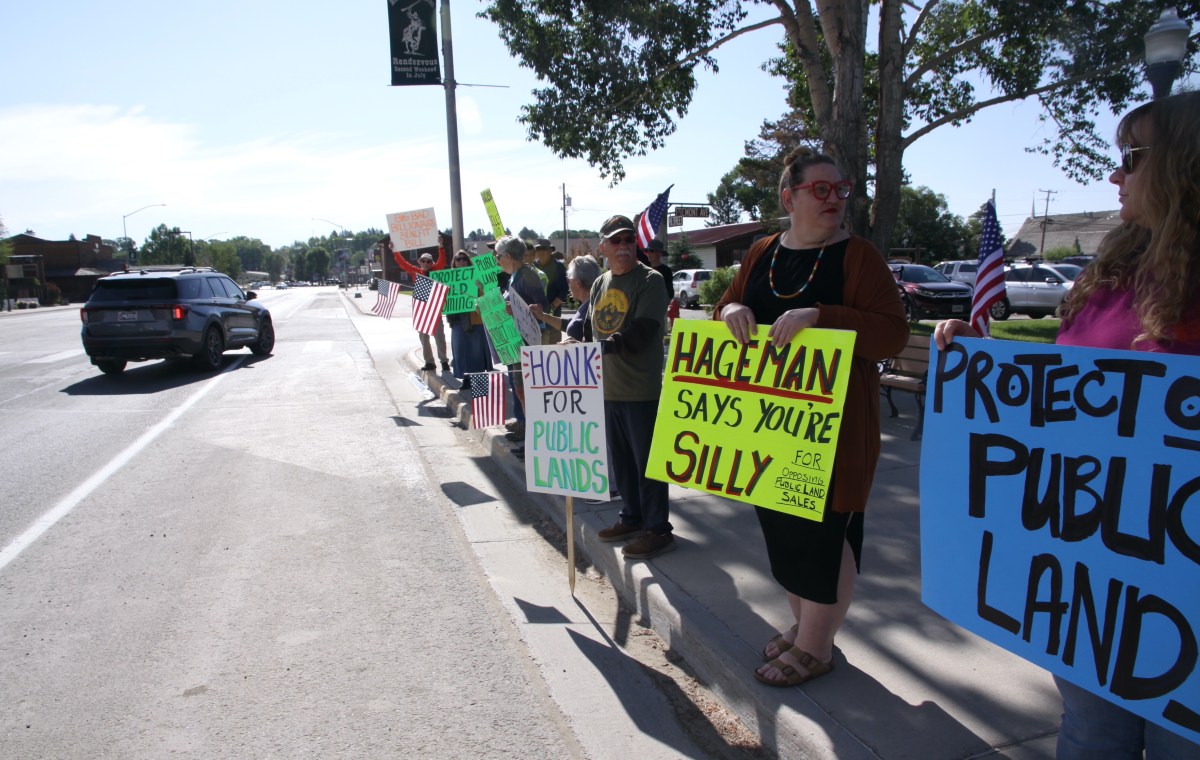
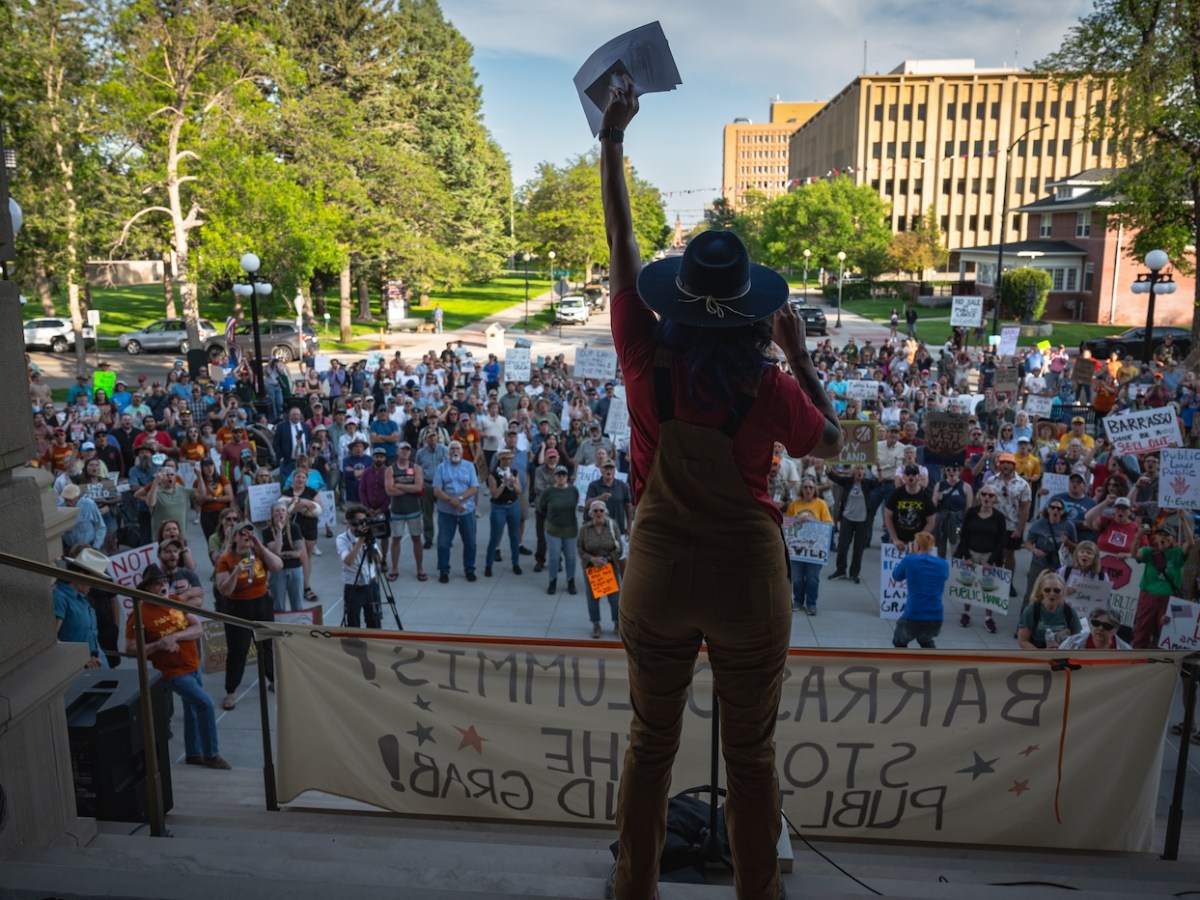
PINEDALE—A dozen “Honk for Public Lands” signs brought almost 300 enthusiastic responses from drivers (and bikers) traveling through and around Pinedale, including a number of license plates with the 23 prefix for Sublette County. Signs also telegraphed fears that Wyoming’s Congressional Delegation — Rep. Harriet Hageman and U.S. Sens. John Barrasso and Cynthia Lummis — would “sell out” their constituents.
Opinion
After my unexpected retirement from Wyoming Newspapers 16 months ago, I was eventually invited to participate in local rallies to advocate for constitutional rights — freedom of speech and freedom of the press — and veterans, seniors and families. My journalistic ethics required me to remain on the sidelines, uninvolved (yet free to ask questions). So when I made the decision to participate in speaking out as a private citizen, I did not make it lightly.
After decades as a Sublette County and Wyoming journalist, I still report occasionally for the Pinedale Roundup. I absorbed and melded journalistic ethics with my personal morals, a tendency to question authority and the Golden Rule.
So being a journalist will likely always shape my eye, heart and mind as a private citizen. I want to ask questions to better understand how my community, friends, neighbors and family (and I) will be affected by policy decisions, at any level of government. I also want to chronicle events with photographs.
On June 28, I didn’t pick up a sign to carry at the rally. Instead, I put on my Wyoming Press Association pass, carried my camera, notebook and pen and identified myself as a reporter. Reporters are scarce in small-town Wyoming. I wanted to capture people’s thoughts at my grass-roots level amid the national uproar over Utah Sen. Mike Lee’s plan to sell off public lands to offset the costs of tax cuts. Here’s what I learned during that June 28 rally from the 50-plus rally goers crowding Pinedale’s main street — Pine Street — waving flags and signs with slogans demanding public lands stay public.
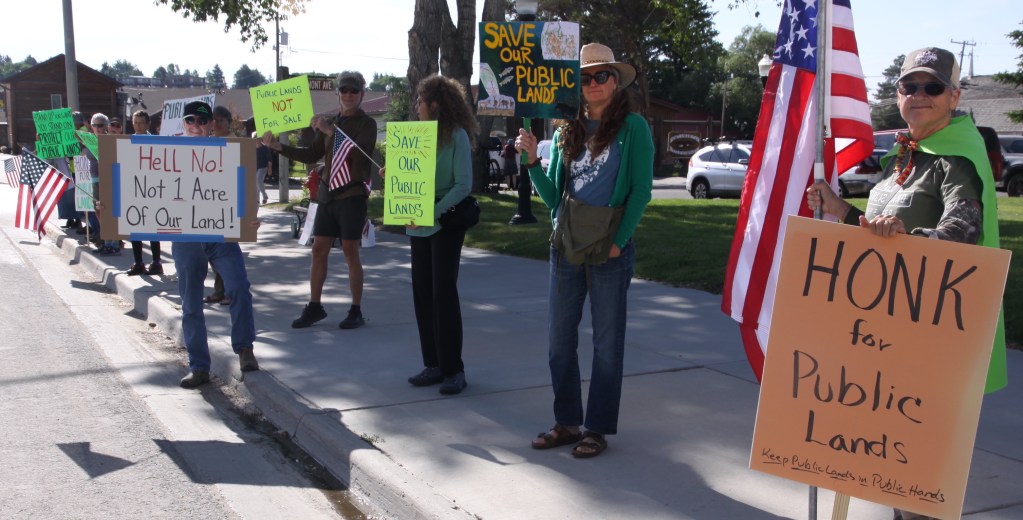
Many described directly contacting Hageman, Barrasso and Lummis to call on them to oppose public land sales and receiving responses benignly accepting Lee’s proposal.
Which public lands are most important to them? “All of them.”
The lack of details, maps and a path for public inclusion bothered Pinedale activist Karla Bird enough to make a presentation to Sublette County elected officials, who sent a letter to the congressional delegation.
Bird first started rallying in February on Pinedale’s main street to register her concerns about the Trump administration. The small weekly gatherings grew, from sometimes drawing just two people to bigger crowds like the 50-plus who showed up June 28. By then, Lee’s proposal had been scaled back, calling for selling off public lands overseen by the Bureau of Land Management within five miles of population centers.
“Even if Lee only targets the BLM, there are migration corridors that we should have a say in,” Bird said at that rally.
Lee withdrew his plan later that same night, a surrender attributed to widespread, grassroots and bipartisan opposition.
At the June 28 rally, a car pulled up to the sidewalk and a small, fragile woman emerged from the passenger’s seat. Juanita Bertoncelj held out her “sign,” a notebook page with the message that Wyoming’s wild horses, which could be removed soon in BLM roundups, live on public lands.
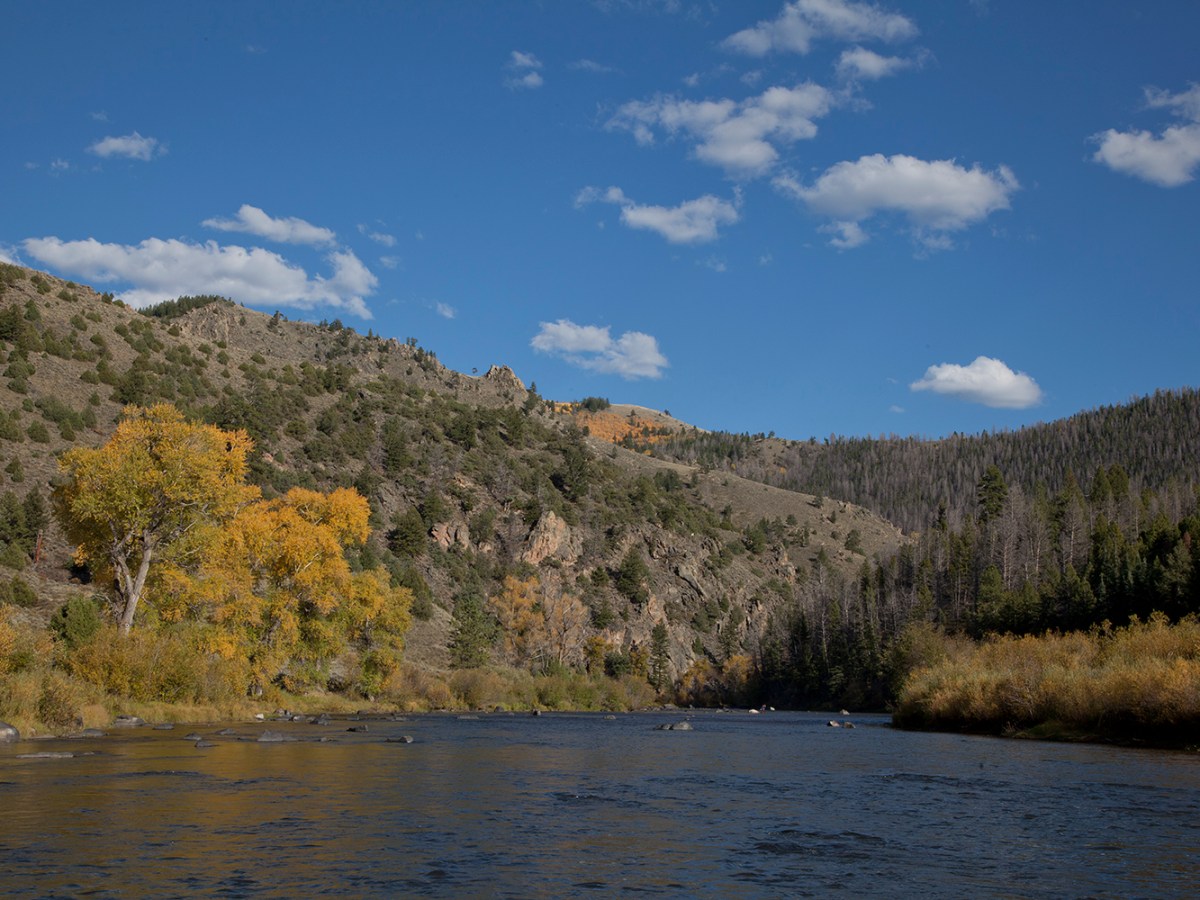
Likewise, other rally goers worried selling off public lands could harm Sublette County’s wildlife migration corridors and habitat, recreation, solitude, future access and Wyoming way of life.
Sublette County resident Dan Stroud spent much of his career, including three decades with the Wyoming Game and Fish Department, working to preserve wildlife habitat.
“Public lands are imperative for our wildlife’s future,” said Stroud, who has come to the public lands rallies. “They provide summer range, winter range, migration corridors, at least here.”
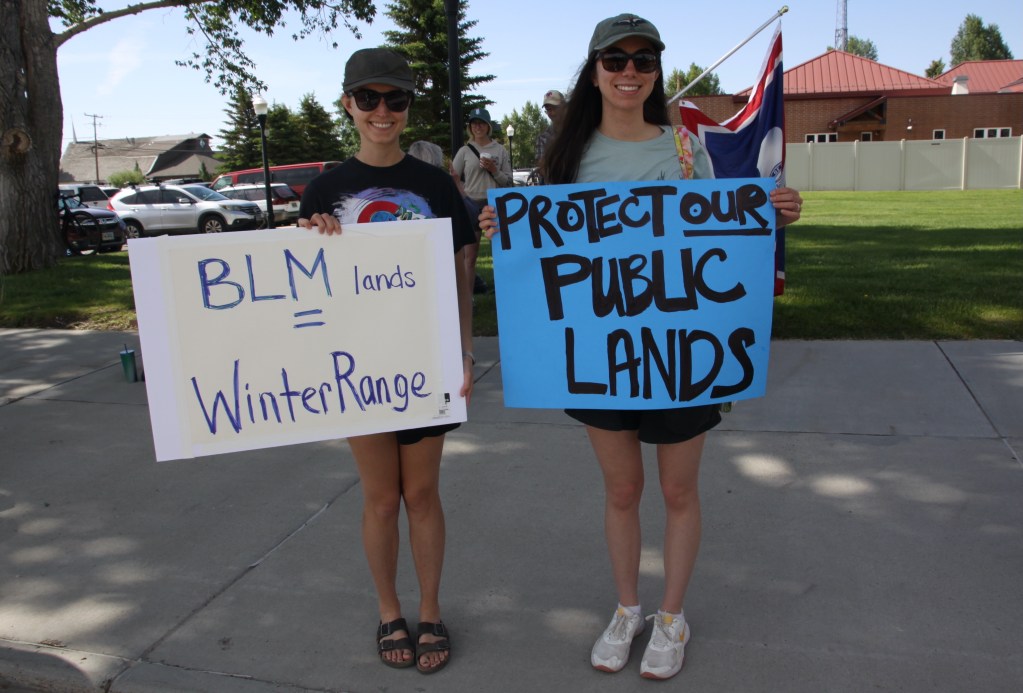
Summer interns Hannah Peters from Massachusetts and Chloe Smith from Colorado are working on a wildlife research project on BLM land.
“So we have a very personal interest in wildlife,” said Peters, holding a sign that said “Protect Our Public Lands.”
Smith added: “We wouldn’t want to see public lands privatized and lose access for the people who live here and vacation here.”
Eric Jahn-Clough, of Maine, came to the rally with a local friend.
“I’ve come out here to go hiking and fishing for more than 20 years,” Jahn-Clough said. “I’ve spent over 600 nights in the Wind Rivers. I was just in Dinosaur National Monument hiking extensively there and in the Wind Rivers, and I fish in public sections of all these rivers.”
His next camping destination — the Big Sandy.
A Forest Service employee, who asked that his name not be used for fear of retaliation, stressed that Pinedale, Sublette County and Wyoming would not have as much of a draw without public lands, mountains, forests and rivers.
“Most of the really big things that have happened to me and changed my life were not sitting in my apartment,” he said. “They were experiences I had on the public lands.”
With the fate of 7,000 Forest Service jobs in judicial limbo, fellow employees are cautious, he said. “They’re probably not going to come out and hold a sign on the street, but they are here,” he said.
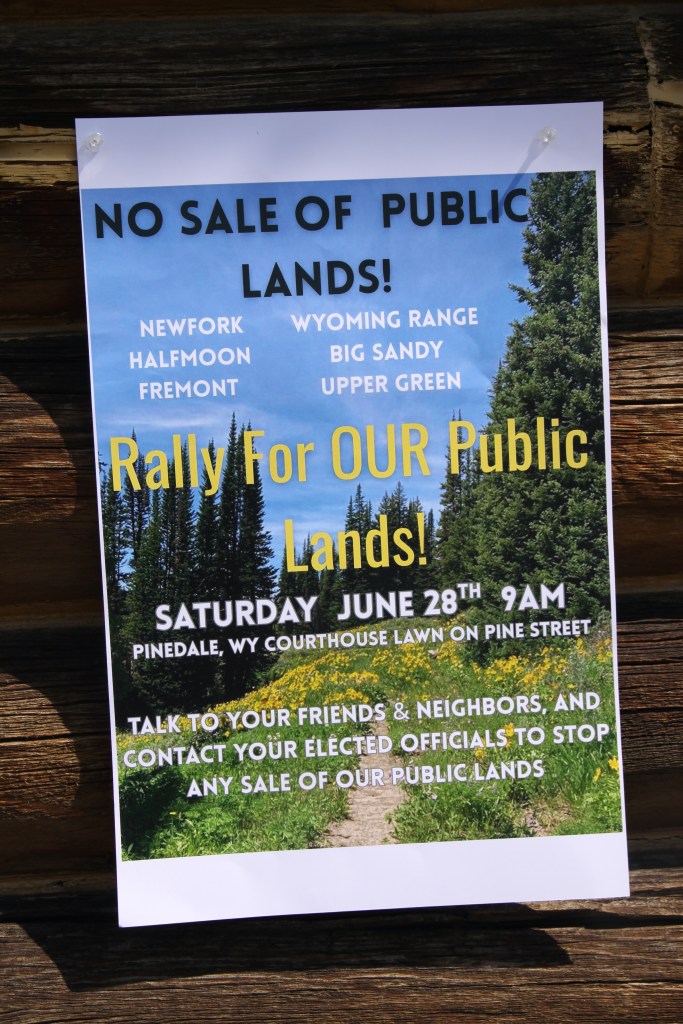
This grassroots rally was the first to be publicly advertised with flyers printed up and posted by activists Bird and Jocelyn Slack with the Women’s Advocacy Group. They and others started DOGE protests, now termed “rallies.” Citizens, federal employees and students — worried about what policies and changes from the Trump administration, Elon Musk and DOGE would affect them — began asking how to participate.
A larger local group coalesced from the initial smaller protests. However, fears of confrontations and retribution from Trump supporters kept publicity at a simmer. Until June, word of mouth and Pinedale activist Kelly Ravner’s growing email list of supporters kept the group feeling safe, but constrained.
For “No Kings Day” on June 14, social media messaging brought 63 people, young and old, new and usual, to carry American flags and signs. Although hecklers interrupted the event, there were no hints of violence. Ravner congratulated supporters, writing: “Wow! Pinedale really knocked it out of the park on Saturday [June 14]. I was hoping for a good turnout but you exceeded all expectations!”
She noted “no specific plans for the next rally.”
Then the national furor erupted over the proposed public land sales and the Pinedale group decided to make that issue its primary focus for June 21 and again on June 28.
Almost 80 people attended the June 21 rally.
Ravner uses clicker-counters to estimate vehicles traveling in both directions with another person clicking waves, thumbs up and horn honks. On June 21, the positive “approval rating” roughly averaged out to 4 to 10%, of all passing vehicles with plenty of County 23 plates. On June 28, the “approval rating” hovered around 30%.
Karl Kuhn and Jennifer Hockenbery, visiting from eastern Wisconsin, were thrilled to see the June 28 flyer posted in a Pinedale restaurant. They spent five days fishing and camping in the Wyoming Range and hiked from the Pole Creek trailhead. After the rally they planned to explore Half Moon Lake. All on public lands.
So Kuhn borrowed an extra handmade sign and Hockenbery scrawled her own message to protect public lands on a brown paper bag and joined the long line of people facing the traffic.
It is sometimes very hard to juggle things to suit everyone. We simply must have foodessentials like food, fuel, etc. Everything requiress the use of nature in one way or another. No farms or ranches mean no food or energy first of all. That makes enjoyment of nature pretty difficult to enjoy and appreciate. Fortunately those who provide what we require to live work constantly to maintain a good balance.