

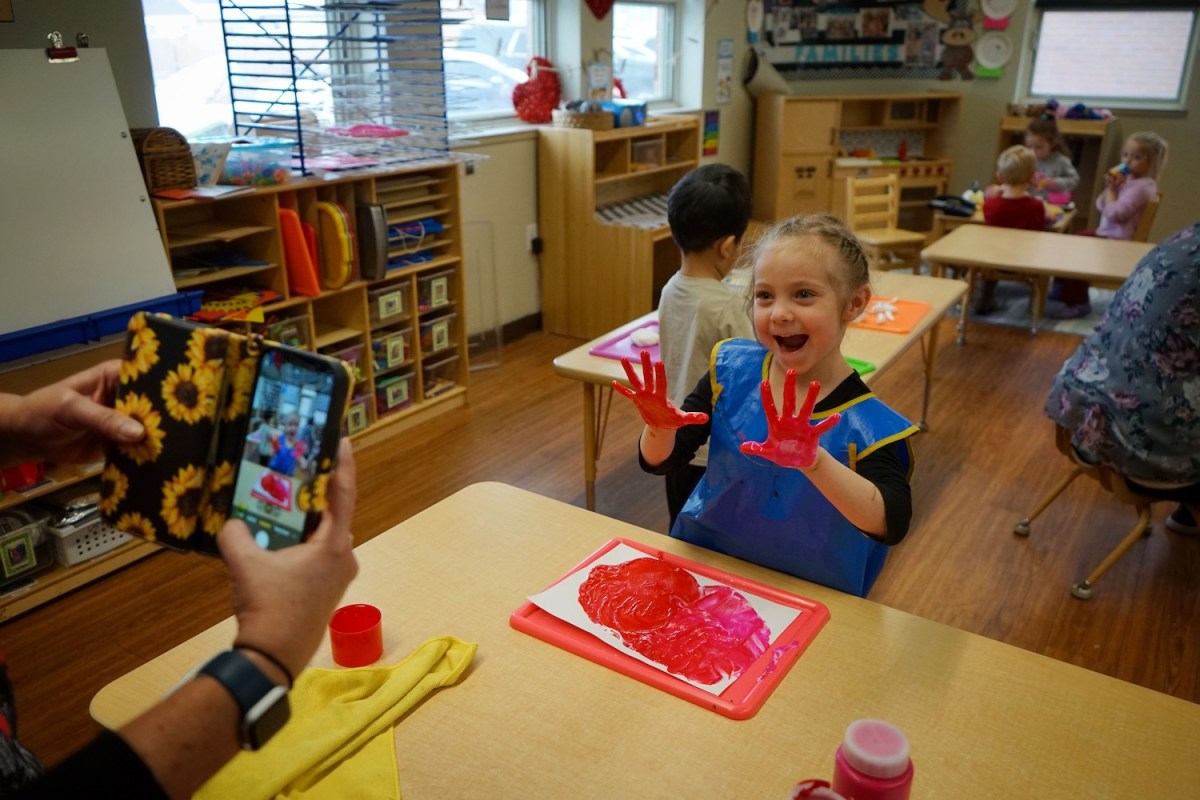
A bill that would have created “education savings accounts” for qualified families to spend state funds on costs associated with preschool or non-public-school education failed introduction Monday, the first day of the Wyoming Legislature’s budget session.
Supporters touted House Bill 19 – Education savings accounts as a tool to address both school-choice interests and early-childhood-education needs in the state. Opponents questioned its constitutionality.
While the Joint Education Committee sponsored the bill, many members of the hard-line Wyoming Freedom Caucus voted against introducing the measure. They were joined by a handful of House Democrats.
Under the measure, Wyoming parents whose household income is at or below 250% of the federal poverty level — for a family of four, that equates to $75,000 annually — would have been eligible for up to $5,000 a year for a child’s qualifying expenses. Allowed expenses would have included tuition, tutoring, after-school-program fees and travel expenses.
The bill would have appropriated $40 million from the general fund, with 70% of ESA funds going to K-12 students and 30% to early childhood education.
“We know that Wyoming has always valued individualism and freedom and it’s no surprise that parents in Wyoming want more options and choices for their children and education,” Rep. Martha Lawley (R-Worland) said Monday on the House floor. “And that’s what this bill is designed to do.”
The measure, however, failed to secure the two-thirds of the chamber’s votes needed to advance, with 41 yes votes and 19 nays.
Following the vote, the Freedom Caucus celebrated House Bill 19’s failure and said in a social media post it will fight for its own version of the bill — which retains the public funds for non-governmental education elements, but removes early-childhood expenses entirely.
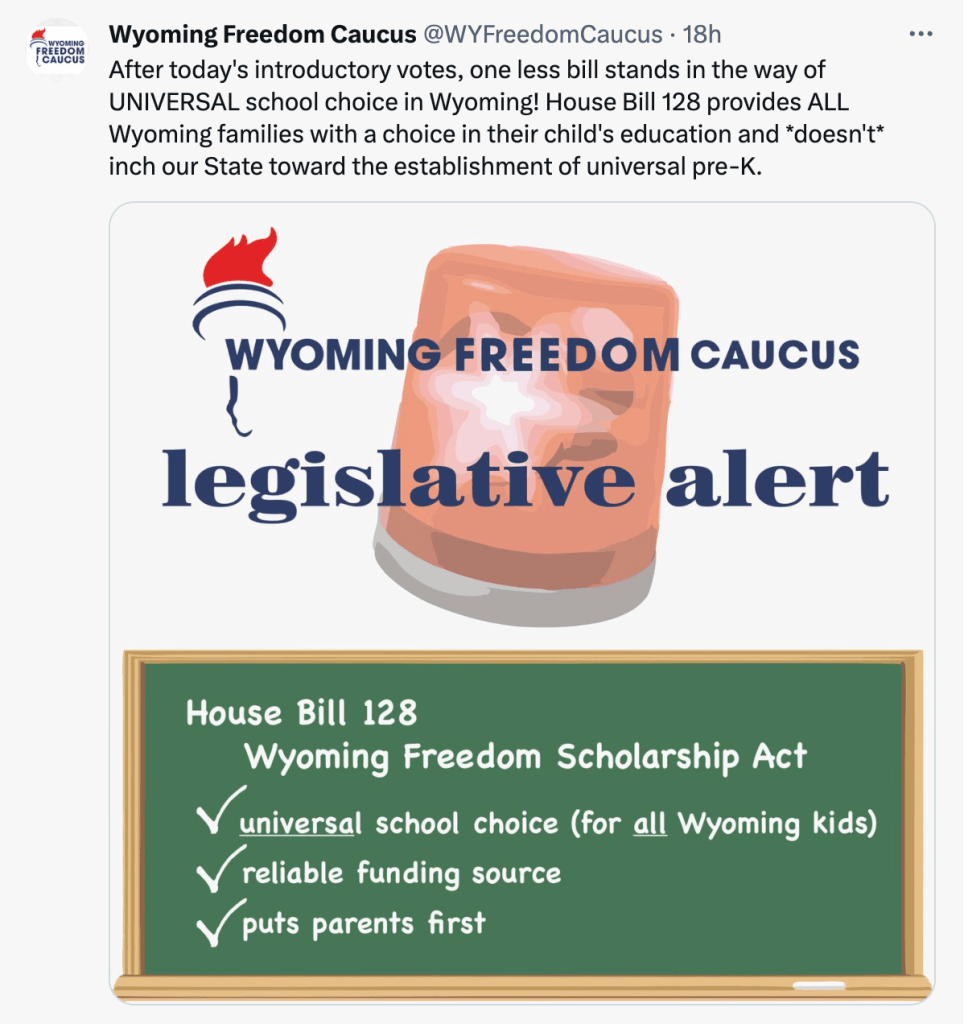
“After today’s introductory votes, one less bill stands in the way of UNIVERSAL school choice in Wyoming!” the post on X read. “House Bill 128 provides ALL Wyoming families with a choice in their child’s education and *doesn’t* inch our State toward the establishment of universal pre-K.”
On Tuesday, lawmakers also introduced House Bill 166 – Education savings accounts-1, ensuring the body will have several opportunities to consider how and if such a model fits in Wyoming.
Two birds, one stone
House Bill 19 was the brainchild of Speaker of the House Albert Sommers (R-Pinedale), who brought it to the committee during the interim. He presented it after taking heat from the far right for the failure of last year’s Senate File 143 – Wyoming freedom scholarship act-2, sponsored by Sen. Cheri Steinmetz (R-Lingle), and a similar House version that would have given families $6,000 per student to go toward tuition at any non-governmental school or for related educational expenses.
Sommers had touted the legislation as a compromise for those clamoring for more early childhood funding and those who want to support parental choice for options like private school or homeschooling.
This time around, Sommers expected a close vote, he told WyoFile Monday.
Though the bill failed introduction, Sommers said there might still be avenues for keeping the idea of an education savings account alive this session.
The bill’s rejection appears to be politically motivated, the more moderate Wyoming Caucus said in a Tuesday legislative briefing. Its demise without a proper hearing is “undoubtedly a setback for Wyoming’s education system,” — particularly vulnerable families — according to the group.
“By allowing families to allocate funds specifically for educational purposes, ESAs could have empowered parents to make choices tailored to their children’s unique needs,” the group said. “This kind of flexibility is crucial, especially for families who find themselves limited by their circumstances and unable to access alternative educational opportunities.”
When politics steer decisions like this, the group said, it’s unfortunately the children who lose out.

The Freedom Caucus, meanwhile, promoted its version, House Bill 128 – Wyoming Freedom Scholarship Act. That bill would also authorize education savings accounts, but with meaningful differences. Those include an increased amount of $6,000 per child, zero income requirements for families and no coverage of early-childhood-education expenses.
And on Tuesday, yet another education savings account bill popped up on the legislative docket. House Bill 166 – Education savings accounts-1 closely resembles House Bill 19. It would create education savings accounts tiered by income level — $5,000 for students whose household income is at or 250% of the federal poverty level; $3,000 for students whose household income is between 250%-350%; and $1,000 for students whose household income is between 350%-400%. Preschool costs are acceptable, but children have to be at least 4 to qualify for the program. It retains the 70%-30% split between K-12 and preschool.
Lingering concerns
Even if the two newer bills advance, questions of constitutionality still linger.
The Wyoming Education Association’s independent analysis of House Bill 19 determined it was inconsistent with Wyoming’s constitution, Government Relation’s Director Tate Mullen said during the interim. Specifically, he pointed to the use of public dollars to pay for private education.
Mullen reiterated that Tuesday.
“The very idea that our legislature is exploring policy options that would allow for taxpayer dollars to go toward funding private and parochial schooling at the expense of our public schools is a slap in the faces of the education employees working tirelessly for students in public schools,” Mullen said in a statement. “It’s an insult to the families choosing a public school for their children; it’s an absolute injustice to the students relying on our public schools to provide high-quality, equitable education.”
Both bills are voucher programs “sold under the guise of school choice,” he said. Mounting evidence shows that voucher programs “harm students and decimate public school systems.”
“Wyoming doesn’t need a voucher program; it needs to protect and prioritize ensuring our public schools have the resources necessary to fulfill our constitutional obligation to provide high-quality, equitable education for all Wyoming students,” Mullen said.
— Maya Shimizu Harris contributed reporting.
Our reps want to fund private ed with public money. The Mothers… and Hageman will love it if it’s right-wing enough to please the Freedom (sic) Caucus. How about adequately funding public SECULAR education– including enough for kids having trouble paying their lunchroom tabs ?
Even if you consider our current public school system to be “good’, make it better — make it great and the education desirable by hiring excellent teachers, paying them well, stressing and enforcing discipline, eliminating the namby-pamby courses except as offered elective options. Some student circumstances will require special educational methods which should be supported while the desire for a private course of instruction, just like a private college, should be at the expense of the parents or student. However, until such an ideal situation is achieved, all bets are off, yet the work to reach this goal must start now!
I am the beneficiary of a religious school education, which my parents, of limited financial means, helped pay for. I am certain that most adults today attended public school, as I also did, and are not the worse for it. If the public school system has deficiencies, it would be much more efficient and cost effective, to fix those problems, rather than create a whole new bureaucracy and fail to improve the system that we have. It is hypocritical to claim that we are for small government, and then create more unnecessary bureaucracy. A first class public school system would be a great benefit to our state, rather than a mish-mash of mediocrity.
The drama can be set aside when discussing public educational funds being redirected to help families choose and pay for private schools. It’s simply Public vs. Private. Private schools may solicit for donations and endowments to support student tuition costs. Public funds are not included in that allowance, and the distinction is legally sound.
All ESA bills should fail. They are unconstitutional.