

Directors of a water district at Hyattville have put off condemnation of private property until after a Nov. 3 district election that could end the eminent domain efforts.
The board of the Nowood Watershed Improvement District agreed Saturday to postpone condemnation until voters elect three board members, a majority of the district’s leadership. The condemnation of easements would enable construction of a controversial dam that’s been estimated to cost up to $113 million.
Incumbent directors John Joyce, Martin Mercer and Mitch Vigil face challengers Tom Shirran, Todd Jones and Doug Hamilton. Should all the incumbents lose, the new leadership might not choose to condemn the private property.

“If they vote John, Mitch, and myself off …I don’t know what that [new] board will do with it,” Mercer said of the condemnation plan. “In other words, the eminent domain’s not going to be put on the table until after the election.”
The board notified the owners of five properties in September that the district was making a final offer to buy options for permanent and temporary easements on their properties. If the offers weren’t accepted, the district “will reluctantly initiate eminent domain proceedings,” the letters read.
The offers were addressed to Paul and Kathy Hughes, Keith Hamilton of the Hamilton Ranch, Tom Shirran, Thomas Searfoss and Gene and Kris Robertson of the Diamond S Ranch, according to letters WyoFile obtained through a public records request.
None of the landowners had signed the options by the time of Saturday’s meeting, according to those attending the gathering.
Water developers estimated the dam and reservoir would cost $20 million in the early stages of the project, which was conceived in 2007. Since then, estimates have ranged as high as $113 million.
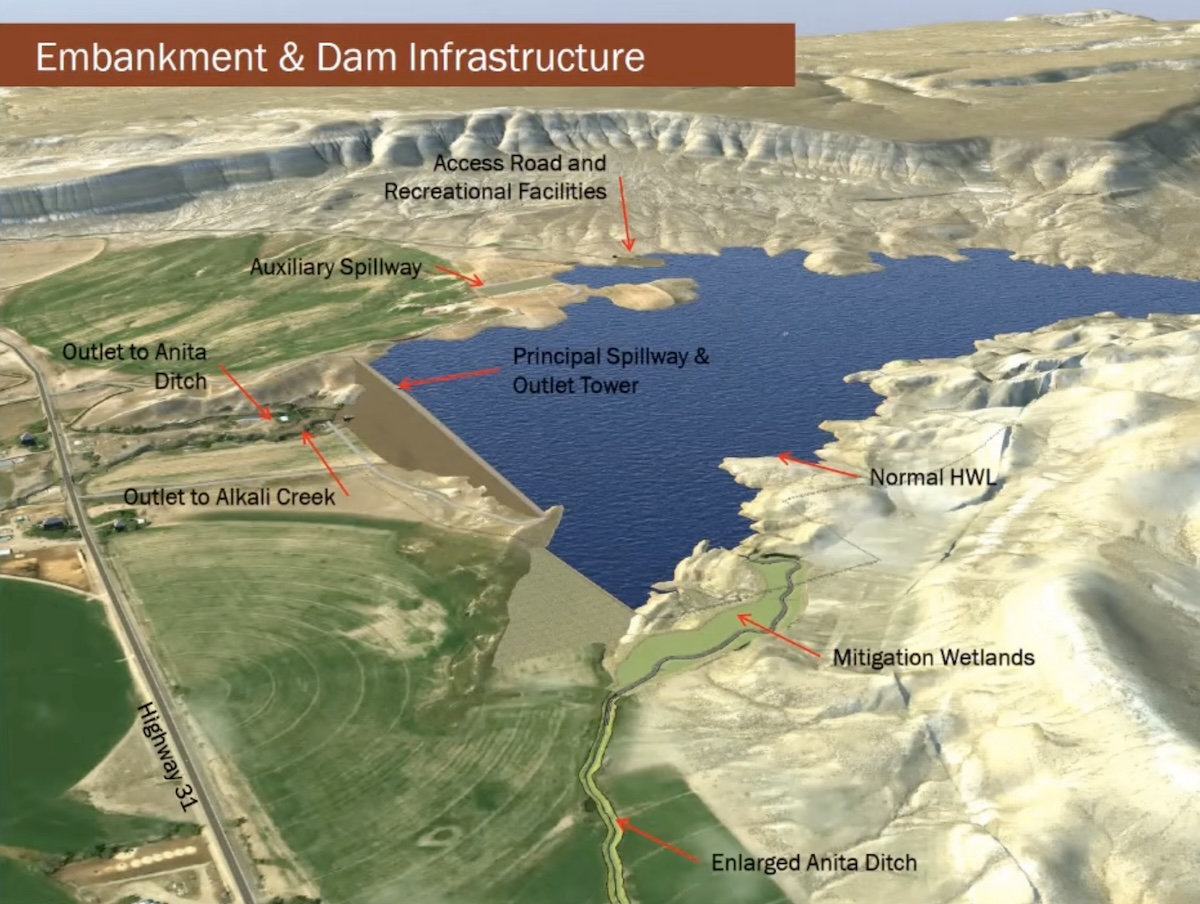
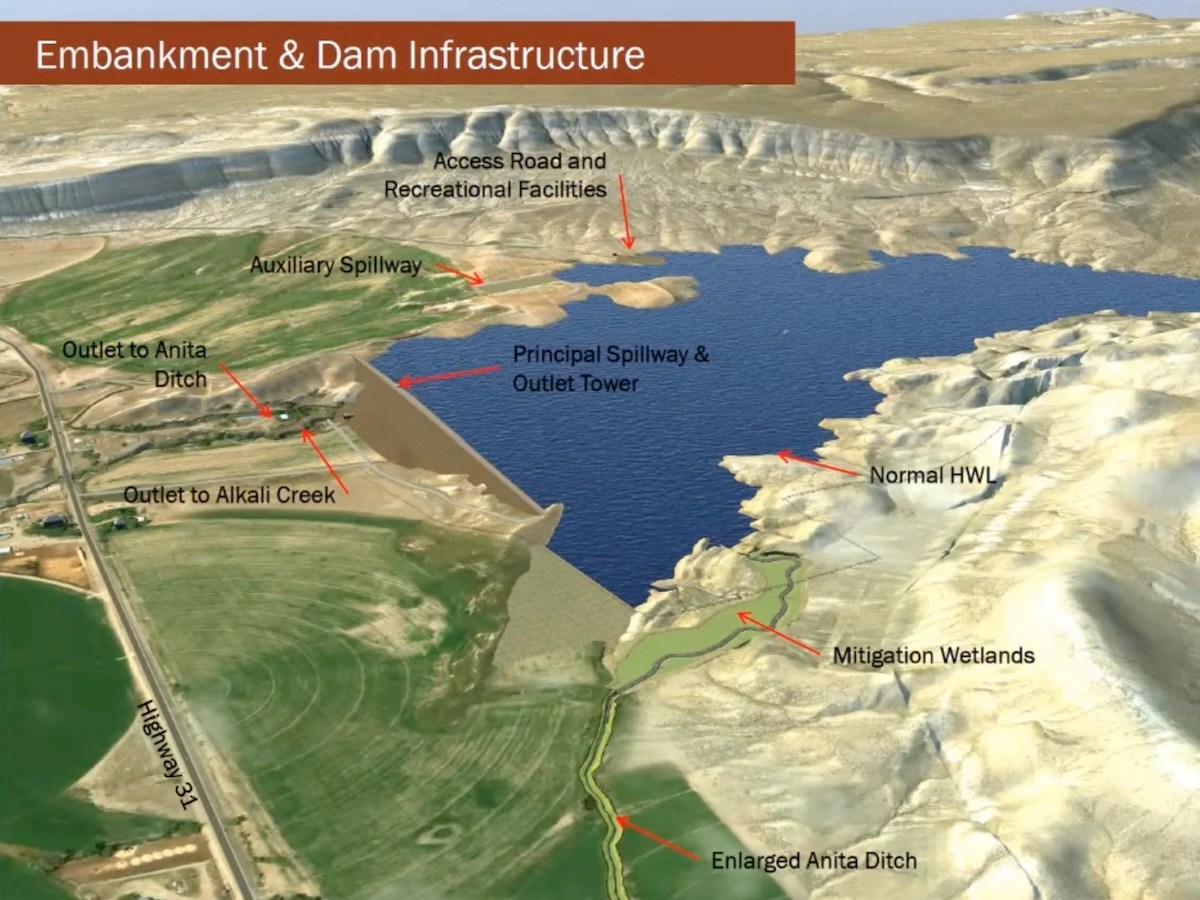
The 100-foot high earthen embankment dam would be almost a half-mile long and impound a reservoir of between 132 and 312 acres. The reservoir would deliver a little more than 5,000 acre-feet of water in eight out of 10 years, earmarked for late-season irrigation for about 33 irrigators.
“The eminent domain’s not going to be put on the table until after the election.”
Martin Mercer
Water developers face an end-of-year deadline imposed by Cheyenne lawmakers, some of whom are skeptical about the project’s worthiness and frustrated by the planning process. The Wyoming Water Development Office and commission have come under criticism for spending money — more than $5 million — without first securing options for the necessary private property easements.
“It is the intent of the legislature that no further time extensions shall be authorized for this project,” a bill passed earlier this year reads. “Beginning January 1, 2027, funds from the appropriation made in this paragraph shall not be expended or used to exercise eminent domain for the purposes of this project.”

Critical landowners have objected to impacts to their ranch land for a project that is downstream from their property. Dam backers say upstream lands can benefit through an exchange.
Saturday’s meeting of the irrigation district lasted about an hour and a half during which landowners raised numerous questions, including how many members of the district are eligible to vote.
Landowner Tim Gardiner has accused district directors of a conflict of interest, charges they reject.
“This project is of marginal benefit to the state as a whole,” he said Saturday. “From its inception, this proposed dam has been tarnished by massive conflicts of interest. The project’s promoters stand to gain financially should the dam become a reality.”
Mercer disagrees. “We followed all the rules,” he has said. “Everything was voted on by our peers. It’s been transparent. It’s been democratic. I don’t know there’s any conflict of interest.”
The project is beneficial, Mercer said Saturday.
“The only reason [we’re] talking about this is they’re about to take their money and leave,” he said of the state and its funding. “We have an opportunity, and the state’s willing to invest money in helping everybody in this room.”


One of the preposterous things about this whole situation is that one of the of the reasons the governments screened out less environmentally and socially damaging projects was because of cost. For example, using conservation (more efficient irrigation practices) to reduce the need for additional storage was deemed too expensive, but now the cost of the only alternatives actually analyzed in detail during the federal National Environmental Policy Act (NEPA) and Clean Water Act (CWA) processes (two laughable variations on their preferred project) is almost twice as much as that “too expensive” conservation alternative. The BLM’s screening process, which completely deferred to the WWDC’s pre-NEPA work, made a mockery of the NEPA and CWA processes. Maybe if BLM and the Corps had done their job and followed the law, they would have analyzed at least a handful of the 53 alternatives they instead screened out (I would argue, disingenuously), and so maybe Wyoming wouldn’t have invested so much in this boondoggle.
For the record, NWID’s Board of Directors own over 50% of the shares in the Alkali Reservoir. These shares depend upon construction of the dam for their value. Any official action that advances the project directly affects the board members’ private economic interests. This is a major conflict of interest.
That circumstance presents more than an appearance problem. Wyoming’s Ethics and Disclosure Act restricts official participation when a public official has a direct and immediate private interest that provides a greater benefit than is available to similarly situated people. (W.S. § 9-13-106 ) In a nutshell this means that all 5 NWID Board Members, (as shareholders in the Alkali Creek Reservoir) are ineligible to vote on advancing the construction of the dam….. This means that any vote by the existing NWID Board to impose eminent domain is illegal and subject to investigation.
Why has the NWID Board not disclosed that, if dam construction proceeds, the president of the Board is in line to receive an additional $1.184 million dollars of taxpayer funds (including a new airstrip and airplane hangar, which has no public benefit)? Does this not constitute a conflict of interest for the Board President?
Good people do not ask their neighbors to put themselves at risk, so that a select group of people can incur a financial gain… Who in the project’s governing structure is representing the people downstream who asked to bear the greatest physical risk?…Is the District willing to indemnify any downstream families against loss?… Will the NWID Board sign a formal, uncapped indemnification agreement fully guaranteeing that the District, will foot 100% of the bill for any property destruction or loss of life caused by structural failure, seepage, piping or emergency spillway breach?… Why has the District not provided downstream owners with exact, engineered inundation maps, showing water levels, mud velocity, and precise time lines for our specific homes if the dam breaches?… If the ACR shareholders are asking me to put my property at risk for their benefit, why are the shareholders unwilling to put their properties at risk…. by offering them as collateral to back a bond issue indemnifying downstream property owners in the event of a dam breach?.. Will downstream families simply be left empty handed, when a multi-million dollar disaster causes the District to file for bankruptcy?
The downstream risks presented by this project need to be addressed. Nobody in NWID’s governing structure is willing to do this…. The prospect of financial gain is warping their sense of public stewardship.
Looks like this entire boondoggle has been a money maker for a very select few, regardless if the dam is ever built: https://wyofile.com/mounting-dam-costs-include-moving-private-landing-strip/ I’ll bet Martin Mercer is still smirking after pocketing $1.6 MILLION selling an ‘easement’ of all things…not land, not improvements, just an easement.
They all know it’s not a ‘worthy’ project. It will benefit very few, and is a typical Wyoming welfare for ranchers/farmers project.