



Litigation over how Wyoming funds public education is on track for a full trial after a Laramie County district court judge on Wednesday dismissed the state’s request to decide part of the case now.
The lawsuit, brought by the Wyoming Education Association in 2022, claims Wyoming has violated its constitution by failing to adequately fund public schools. Eight school districts joined the lawsuit as intervenors to challenge the state.
Wednesday’s decision by Judge Peter Froelicher stymies the state’s latest attempt to avoid having the merits of the case tried in court. In December 2022, Laramie County District Court denied the state’s motion to dismiss the lawsuit.
This time, Wyoming’s lawyers asked the judge to rule for the state against some of WEA’s claims before the trial takes place. It filed that motion in February, and a flurry of responses have been submitted to the court since. Among them was a motion for partial summary judgment by the eight districts. The judge also dismissed that motion in his Wednesday ruling.
In a Friday release, WEA President Grady Hutcherson said time is of the essence in this matter — Wyoming is already losing talented education professionals to other states that offer better salaries and working conditions. Low wages and unfair workloads are contributing to “record turnovers” in Wyoming school districts, according to a press release from WEA, which represents the state’s teachers but is not an actual union.
“Students and educators are suffering because of underfunding,” Hutcherson said.
The case is scheduled for a five-week bench trial in June.
History
The 2022 complaint essentially contends the Legislature has failed to fulfill its constitutional obligation to adequately fund a high-quality, equitable, cost-based public education system. It’s done this, according to the suit, by failing to grant periodic external cost adjustments and underfunding the state’s education model.
Article 7 of the Wyoming Constitution states that the Legislature “shall provide for the establishment and maintenance of a complete and uniform system of public instruction.”
Court interpretations of cases challenging the state’s model have resulted in a system where the Legislature “recalibrates” — or assesses changes in school costs and inflationary demands — at least every five years, and adjusts for inflation annually.
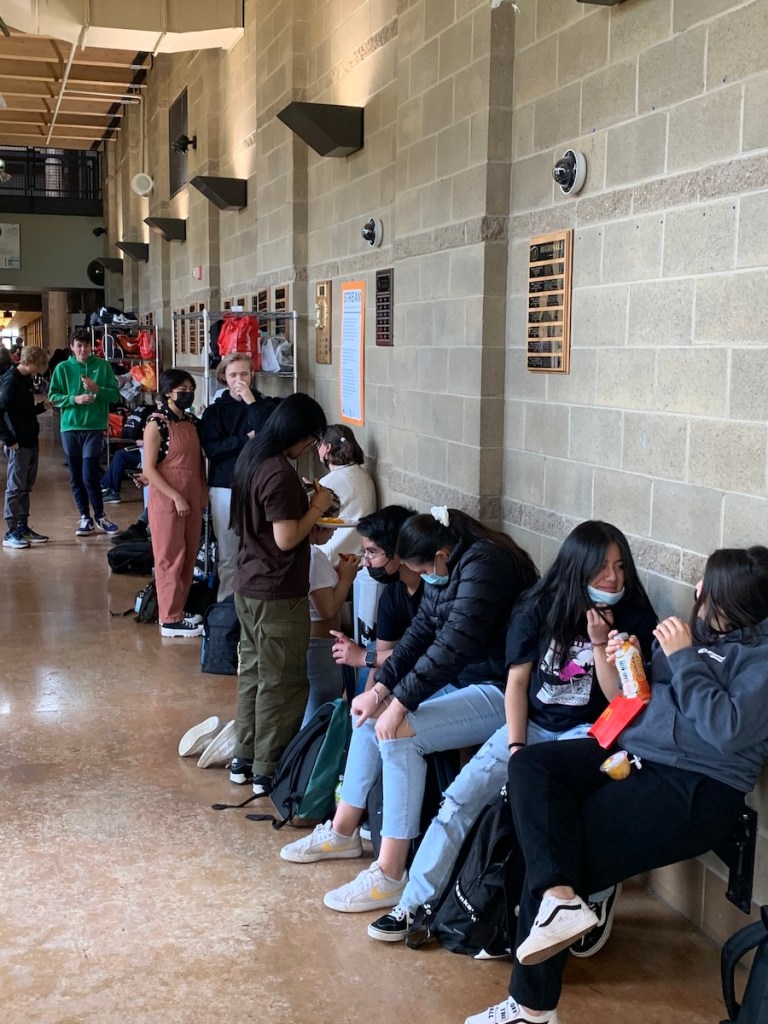
State education spending has increased from $443 million, or $4,372 per student in 1985, to 1.5 billion, or $16,751 per student, in 2022, according to the Legislative Services Office.
But students and educators are suffering because of underfunding, the Wyoming Education Association contends.
Intervening school districts include Albany County School District No. 1; Campbell County School District No. 1; Carbon County School District No. 1; Laramie County School District No. 1; Lincoln County School District No. 1; Sweetwater County School District No. 1; Sweetwater County School District No. 2; and Uinta County School District No. 1.
Allegations
WEA and the districts assert the Legislature is violating the Wyoming Constitution in several ways.
WEA alleges the Legislature has failed to adjust the amount of funding to reflect the effects of inflation, failed to properly assess school facilities for adequacy, technology, and suitability and failed to properly review the components of a quality education. The state has not updated the funding model to reflect actual, current costs and to provide funding for any innovations or changes in the nature of what constitutes a quality education, the WEA claims. In similar claims, the districts suggest the Legislature isn’t adequately funding all essential aspects of a quality public education, including staff salaries, counseling services, nutrition and food services and security.
The result, according to court filings, is that Wyoming’s public education is constitutionally inadequate, with unequal and disparate treatment of various school districts and students.
If WEA and the districts prevail, the court could mandate the Legislature to upgrade the school finance model’s salary schedule; add funding to the model to cover missing components of an adequate public education and/or establish a funding source for school buildings.
Previous challenges
Along with its motions for dismissal and partial summary judgment, Wyoming in 2023 asked the Wyoming Supreme Court to intervene in the case regarding the level of scrutiny appropriate for determining the outcome.
The Supreme Court upheld the district court’s decision that “strict scrutiny” shall be applied, denying the state’s petition for a lesser standard.
In explaining the latest decision, Froelicher’s order said that to gain summary judgment Wyoming had to show there is no genuine dispute over material facts in the case.
Instead, “the parties’ statements of undisputed material facts rarely agree,” the decision reads.
I would like to know how much $$$$ Wyoming is spending on this and why , we seem to be arguing over money not spent by spending $$$$ which should just go the the districts instead of wasting $$$$$ on semantics in court .
Uinta was is a nightmare. So many legal issues the district has to pay for. Staff is highest paid in comparison to other schools. They don’t need more money. They need god. They are currently fighting a suit about sexual misconduct between staff and students. Don’t give them more money until you do a complete audit of how they spend what they already get.
“State education spending has increased from $443 million, or $4,372 per student in 1985, to 1.5 billion, or $16,751 per student, in 2022”
Holy cow Batman…….that’s a lot of money per student. I guess what we don’t have is a breakdown on how much of that is facility, administration, teaching staff, etc….I would be interested to see that broken down. Using the U.S. Inflation calculator, if you plug in the1985 dollars per student, in 2024 dollars it would equate to $12,691. That’s $4060 more per student in adjusted spending…….so where’s the big increase coming from? Why doesn’t someone give examples of surrounding states and what they spend. I hear these talking points “Wyoming is already losing talented education professionals to other states that offer better salaries and working conditions. Low wages and unfair workloads are contributing to “record turnovers” in Wyoming school districts” but no one gives me the data I need in order to make an informed decision. What is the average pupil to teacher ratio, how does that compare? Oh, and lastly, let’s not forget the extra $$$$ Wyoming got in Covid 19 funds from the Feds for ESSER. That was an extra $303.7 million.
IMHO, it’s always easy to throw money at a problem , especially if it isn’t yours.
Much of what you are asking about is on the Legislature’s web site. Trying the term school finance in their search bar will provide numerous links. Your local school district should also be able to provide you with information.
Thank you for the information
Wyomong spends 12 of 50 in the nation on education spending per pupil. New York is #1. This lawsuit is frivolous. The Campell County decisions were judicial activism. If this is upheld the legislature may need ignore it. A sort of Marbary vs Madison but in reverse. Upholding a blatant untruth would hurt the courts credibility.
“The Wyoming educational association is not a union” according to the article. Not sure what a union is other than due paying group of employees uniting for better pay etc. WEA collects dues from over 6000 teachers and has been very effective in representing teachers interests including this lawsuit.
When reporting increases in the education budget and then reporting that the people bringing the suit contend schools are underfunded, good reporting would actually help readers understand why that is so. Capital construction costs due to deferred major maintenance for nearly 20 years as Wyoming was at the bottom of the country 47th in the country in teacher salaries from about 1980 until about 2001 are one major cause. Another major cause is the number of students with legally recognized learning disabilities and students requiring special education services. In addition, the population of the entire state and virtually every community in the state has grown over the same time. Really seems like lazy reporting to me to not include those details.
As far as I’m concerned schools already get more than they need. They find themselves overspending because “if you don’t spend it you lose it” mentality. What we need in Wyoming is more charter schools not more power to the government schools.
The (non) freedom caucus is ruining Wyoming. They take their marching orders directly from the elite in DC and not the people of Wyoming. Nut cases one and all. Please vote out the RINOs.
It doesn’t surprise me with it being a red state. Wyoming is goi g to be crashing the mental health agencies with what they are start to do in July 2024. What they r doing they did in Montana and it crashed mental health. What does that men less mental health for the poor!!!!