

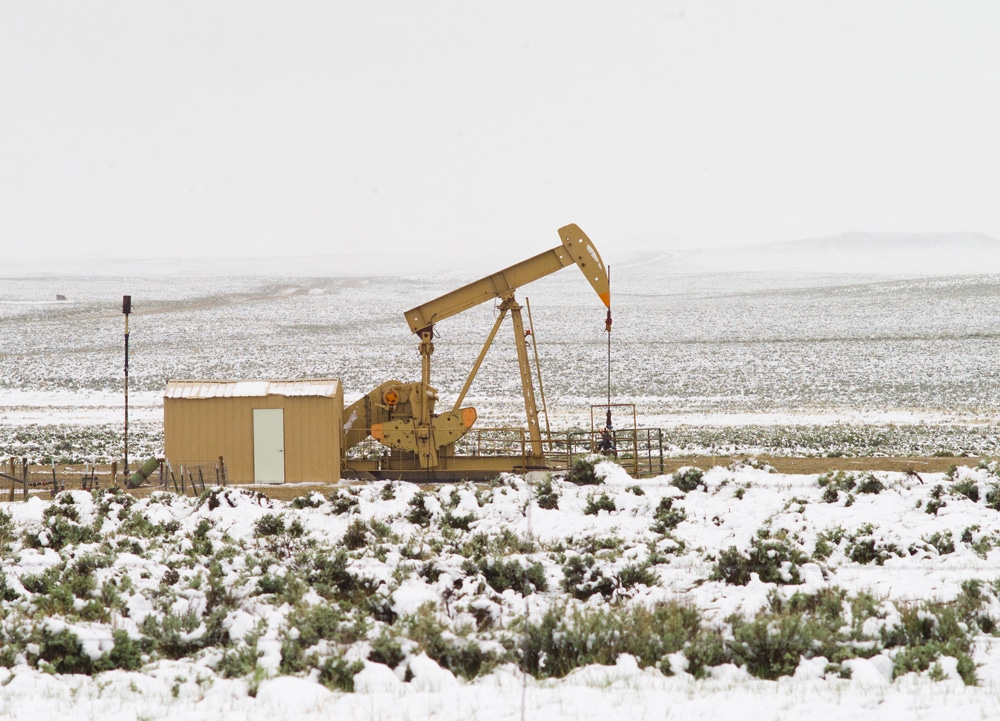
Wyoming regulators voted 4-1 Tuesday to permit Aethon Energy to pump millions of gallons of pollutants into an underground aquifer near Shoshoni that critics say is too valuable to pollute.
The Dallas investment firm argued through attorney Tom Throne that it would be uneconomic and impractical to use the 15,000-foot-deep Madison aquifer for nearby towns’ or cities’ domestic supplies. That’s one reason to grant the company an exemption to federal Clean Water Act rules and regulations, he said.
“We clearly fall into that category,” Throne said, of the “uneconomic and impractical” standard. Nearby municipalities, an Aethon consultant told the five-member Wyoming Oil and Gas Conservation Commission, have ample water sources for at least another 190 years.
Aethon’s request, heard during a day-long Zoom meeting, included science that was “thorough and compelling,” Commissioner Ken Hendricks, a petroleum engineer who supported the exemption, said. Although it was the fourth attempt to secure an underground injection permit for the existing but unused Marlin well, “the drawbacks of the past shouldn’t be drawbacks now,” Commissioner Jimmy Goolsby, a geologist, said.
Gov. Mark Gordon and Commissioner and Director of the Office of State Lands and Investments Jenifer Scoggin joined the majority vote.
But State Geologist and Commissioner Erin Campbell called the venture “a gamble I don’t feel comfortable taking.” Before casting the lone dissenting vote, she asked fellow commission members, “do we want to risk contaminating a viable aquifer?
“What’s impractical now may not be impractical in 50 years,” she said of domestic development of the deep, potential water source. “I’m reluctant to jeopardize our future water needs.”
Battle not over
Wyoming administers the underground injection program under federal laws, rules and regulations. The state’s pending order will go to the federal Environmental Protection Agency “to confirm the commission decision,” OGCC Deputy Supervisor Tom Kropatsch said. If the EPA has significant problems or questions, Aethon could be called back before the commission for answers, he said.
Conservationists who challenged the Aethon proposal “are not giving up,” said Jill Morrison, executive director of the Powder River Basin Resource Council. “This is not over,” she said after the commission’s decision.

Her group has contested using the Marlin well for disposal since 2013 and, along with the Wyoming Outdoor Council, challenged the Aethon application again Tuesday. Wyoming’s own Department of Environmental Quality, she said, concluded the aquifer near the Marlin injection well could be developed as a domestic supply for $169 million.
That’s less than the $200-million-plus spent recently by Wyoming for water for the city of Gillette, she said. Contrary to Aethon’s position, it is practical to develop the aquifer for domestic use, she told the commission.
More than 100 letters of public comment emphasize support for clean water, PRBC attorney Shannon Anderson told the commission. She warned the commission against setting a precedent “that water like that is available to pollute.”
Conservation consultant Sue Spencer said the depth of the Madison at the Marlin Well — one reason Aethon claimed the aquifer would be impractical to develop for domestic use — is essentially immaterial. The Aethon request must be considered in the face of drought and climate change, plus technical advances in drilling and pumps that make deep development easier, she said.
Neighboring communities today also use shallower aquifers that have “kind of unreliable water quality,” she said. In one of those — Pavilion, about 60 miles from the Marlin Well — some residents have seen their shallow domestic wells polluted from oil and gas activity and now get domestic water trucked to their homes.
On the Wind River Indian Reservation, which is scant miles from the Moneta Divide field, “about a third of wells are polluted by uranium tailings,” said Rev. Sally Palmer of the Wyoming Association of Churches.
Many towns in Wyoming “would kill” for a Madison source of drinking water, Spencer told the commission. “I think we can all agree water and groundwater are the lifeblood of our state,” she said.
Water disposal vs. pace of development
Aethon’s predecessor, Encana, had built and operated the Neptune water treatment plant at the Moneta Divide Field, Aethon executive Tom Nelson told the commission. But that facility has become “uneconomical to operate” and has been shut down, he said.
Aethon and Burlington Resources won permission from the U.S. Bureau of Land Management to expand the small Moneta Divide Field by 4,250 wells. But Aethon has not resolved how to dispose of 59 million gallons of tainted water a day that would be produced during peak field development.

Aethon has “very limited” opportunities to dispose of the water, attorney Throne told the commission. Water pumped out of energy wells releases hydrocarbons but laws and regulations limit what can then be done with the briny flow.
Aethon could build treatment plants or evaporation and settling ponds or it could limit the pace of production, the BLM has said.
Wyoming DEQ cut back Aethon’s request to dump millions of gallons of produced water from Moneta Divide into creeks and waterways that would flow into Boysen Reservoir, a state park and a source of drinking water for the Town of Thermopolis. Aethon can also inject some tainted water into 160 disposal wells that are shallower than the 15,364-foot-deep Marlin Well.
All that accounts for only about 26% of the polluted water pumped from Moneta energy wells at full production, according to WyoFile calculations made from BLM and state documents.
On average, the Madison under the Marlin Well would only accommodate a fraction — as little as 0.5% — of the water produced daily during full production, according to WyoFile calculations. Even if the company used the Marlin Well, it would still lack a place to dispose some two-thirds of the contaminated water it hopes to produce.
Geologic structures would contain the injected water within a 3.2-mile-diameter zone around the Marlin Well during the disposal well’s 50-year life, Keith Thompson, hydrologist with Aethon’s Tetra Tech consultants, told the commission. The water in the Madison Aquifer at the well bottom flows only about three feet a year, he said.
Another Aethon consultant, Bonnie Percy, appeared to discount company claims that the Madison is polluted with benzene at the Marlin Well site. Aethon’s application said samples from the well showed concentrations of the carcinogen well above the EPA’s maximum contaminant level for consumption.
Disagreement continues over whether the detected benzene was naturally occurring, as Aethon contends, or introduced during the drilling of the Marlin Well. Naturally occurring benzene would buttress Aethon’s case.
But Percy produced a table that showed how benzene concentrations fell dramatically over a five-week testing period. The decline suggested to critics that the carcinogen resulted from the drilling.
The initial benzene reading registered 110 micrograms per liter, far above the federal 5 ug/l standard, according to Percy’s table. But that reading declined in about a month to near, at or below the federal maximum contaminant level, according to an exhibit she presented.
Subsidizing profits in Dallas
During public comment Converse County resident Maria Katherman told the commission that clean-water rules “are not meant to accommodate a lack of economic water treatment by the company.
“If they cannot treat this water at the present gas prices, don’t produce it.” she told the commission. “If they can’t treat it economically, that meant the State of Wyoming is subsidizing them, allowing them to pollute our water.

“I don’t think Wyoming should bear that cost,” she said.
Morrison agreed the commission approval would allow Aethon to pocket more money at Wyoming residents’ expense. “They are externalizing the cost of producing that gas onto our future generations and our future need for water,” she said after the hearing.
Aethon did not respond to an email seeking reaction to the state approval. The company says it’s a responsible operator, even though Wyoming’s DEQ found the Aethon water discharges from existing Moneta Divide energy wells violated standards.
Support independent reporting — donate to WyoFile today
Albert Huddleston, a veteran industry executive, established the private Texas equity company in 1990, attorney Throne said, “with highest regard for health safety and the environment.”
Aethon is exploring all methods to dispose of the produced water, he said. The Marlin well, located “in the middle of nowhere,” could be used “with no significant environmental impact,” and is entitled to an aquifer exemption, he said.

Water is a guaranteed need in 100 years. Oil?
I do not understand how Wyoming is a “dumping ground” for Texas Industry—how can this be right?
They could frack with propane? 100 percent recoverable.
I didn’t believe this the first time I heard it on the news.
How is this possible?
It is planning to pollute.
It is taking a long time to write this because everything that comes to mind makes me angry.
Remember the Carbon Sink sculpture at UW?
Why should we continue to subsidize such dangerous projects?
What difference does it make if you have a good income if you can’t live here?
Not an unexpected “development”, unfortunately. Humans are natural-born plunderers…and it will be the death of them.