

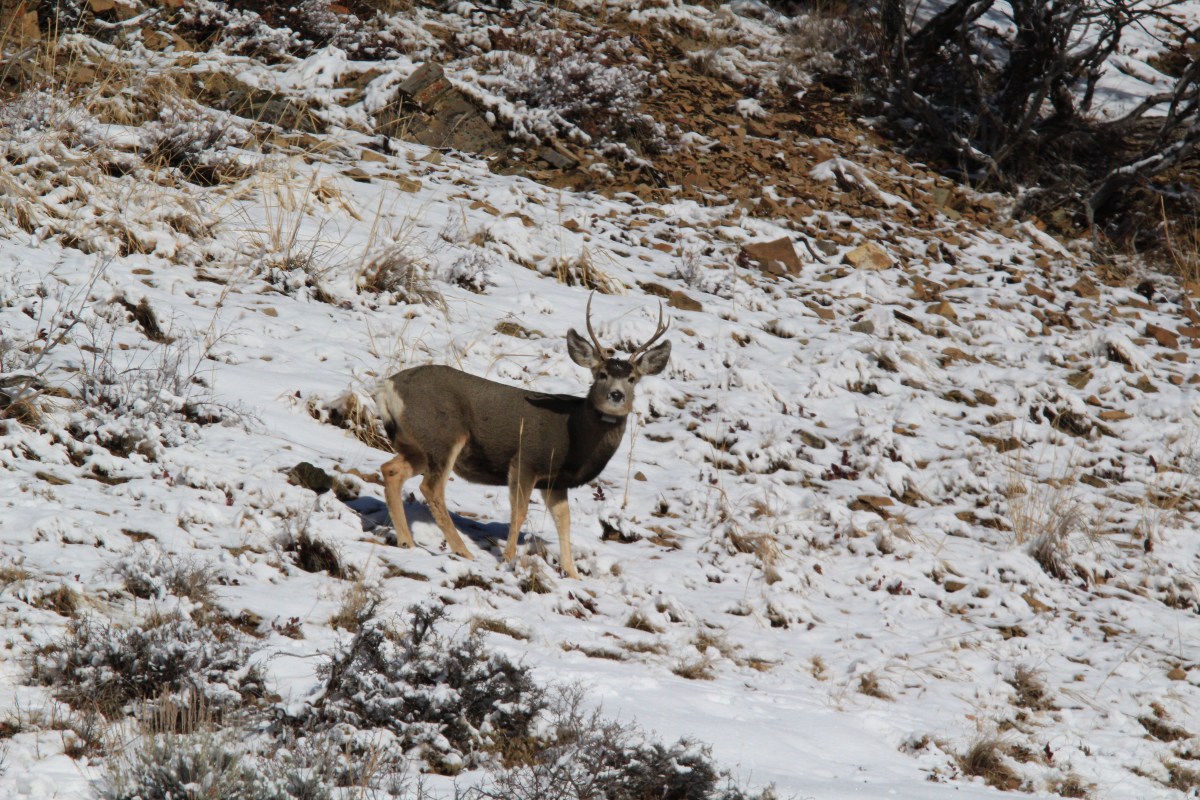
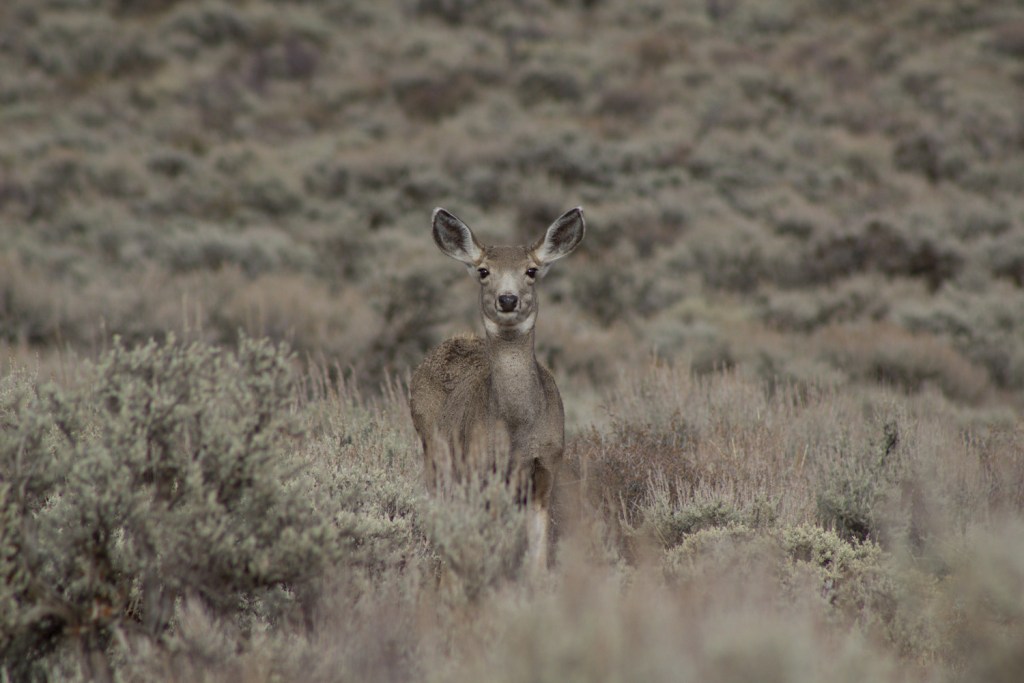
At the end of a devastating winter in which hundreds of deer fell over from starvation and never got up again, a mule deer doe numbered 96 gave birth to twins, a male and a female.
Not only were those twins born alive, but they also survived their first winter with their mother and continued to live. Two years later, the female twin gave birth to her own fawn not 500 yards away from where she was born.
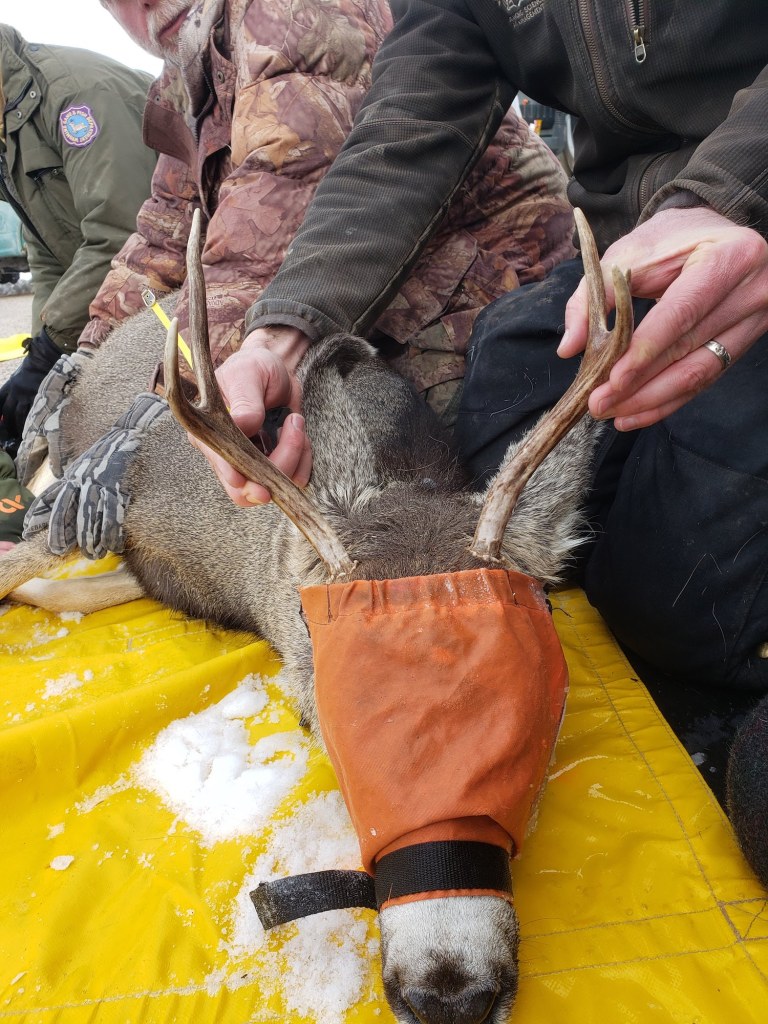
The same spring, a pilot hired to catch does and any collared deer brought back a male with a fawn collar hanging on by threads. It was the other half of those twins and possibly the only male born in 2017 to survive.
Despite a normal amount of body fat, the buck’s antlers were about 30% smaller than typical males in his age class in the population. The next year, his antlers were again about 30% smaller.
Fast forward to the fall of 2021, and a hunter brought that buck and his collar to Tayler LaSharr, a graduate student at the University of Wyoming who has been studying deer in the Wyoming Range for years. His antlers, again, remained small.
“He was a runt of the litter, but also then the runt, period, his whole life,” said Kevin Monteith, a University of Wyoming professor who has been leading mule deer work in the Wyoming Range. “As a 2 year old, anyone seeing him would say he was a yearling. It wasn’t so much he was a year behind in growth, he was just never going to be big. His relative size made him look like he was a year younger than he always was.”
That buck, born with a twin sister to beleaguered doe 96 in the grim depths of 2017 is now the subject of a paper published recently in the journal Ecology. And he’s one of the first examples in the wild of how much the health of the mother at time of birth can determine the entire future of her fawn, said LaSharr, the paper’s lead author.
“Obviously the year he was born was a really bad survival year for fawns, but those that did were most likely going to carry the scar of those conditions as experienced by mom their entire life,” Monteith said.
Benefits of longevity
Doe 96 was collared as part of a long-term Wyoming Range mule deer study that’s been churning out research papers and notable findings for years. The study began in 2013, and over the past decade has looked at everything from the impact of energy development on deer, to migratory behavior, to the intimate connection between an animal and its environment. An extended project like this allows researchers to follow deer and their offspring over the course of their long or short lives, and down through multiple generations. It also allows researchers to study effects on individuals and populations as conditions fluctuate between severe winters and drought.
“We want to connect generations of animals from mother to offspring and grand-offspring, and you can’t do that in a normal two-year study period,” Monteith said.
Monteith first began looking into the concept as he was working on his master’s thesis in South Dakota on captive whitetail deer. The wildlife community generally accepts that as does shed pounds from lack of nutrition and heightened stress in the winter, their growing fetuses will suffer. If food is scarce enough, does will deliver stillborn fawns or fawns so small and premature that they can’t survive in the wild.
But Monteith wanted to know what happens to the fawns born alive that continue to survive. Do they reach their genetic potential if offered enough groceries, or do they stay small because of the trauma their mothers endured? He found, in captive deer at least, the offspring of underfed mothers remained stunted.
Since then, his findings have been bolstered by additional captive deer studies — a much easier way to study animals with fewer variables such as mountain lion and hunter kills, collars that fall off and batteries that die.
LaSharr, Monteith and the other authors wanted to know if the same concepts translated into the wild. Ten years of data that covered two severe winters proved to be the perfect set up.
Protecting against the inevitable
Wyoming’s mountains and high plains have always suffered from brutal winters. But as climate change worsens, so do cycles of extreme weather and fluctuations between drought and record snows — like the one in the winter of 2017.
“Deer can’t always adapt annually to those new extremes,” said Jill Randall, Wyoming Game and Fish Department’s big game migration coordinator. “And that is tough, it’s tough to maintain your population level where you want it.”
Randall is careful to acknowledge the paper is based on one buck, but she also says the buck’s story makes sense on the landscape. And it doesn’t necessarily seem intuitive. Sure, deer may be small after following an early birth or if their mother doesn’t have enough reserves to produce much milk. But those effects carrying through for a lifetime was a surprise even to her.
The central finding, she believes, reinforces the importance of habitat improvements.
“All the projects we’re doing on summer and transitional range are to set mom up as big and fat as possible before she shows up on winter range,” Randall said. Because on winter range, almost no matter what, deer body condition will decline. If a deer can begin with say, 20% body fat and loses 14%, it could still emerge healthy enough to reproduce. If she goes in with 6% or 8% percent body fat and loses almost any at all, she — or her fawns — are likely to perish.
This winter, Randall said, is already filling up with those statistics as deep snow blankets western Wyoming. Collared deer have tipped over from starvation or laid down next to shrubs, never to stand again.
Most of the deer aren’t dying from predation or disease, but hunger. When biologists find dead deer, they break a thigh bone to look at the bone marrow. While normal bone marrow is white and dense, like fat, poor nutrition transforms it to a substance that resembles red Jell-O.
“It means all the fat has been absorbed out of the bones and they have nothing left and they curl up and die,” she said. “We’re already seeing that.”
If the buck from LaSharr’s study is any indication, Randall said this year’s winter could mean another small crop of anemic fawns in an area known for big mountains, rolling sagebrush sea and trophy mule deer.

An excellent article by a world class natural resource reporter!
Great writing about a very interesting study that no doubt crosses many species lines. Thanks for bringing it to us!
nature has a way of selecting survival of the fittest.
Amazing what lack of predation can do to a population.
More liberal hunting quotas and seasons are in order?