


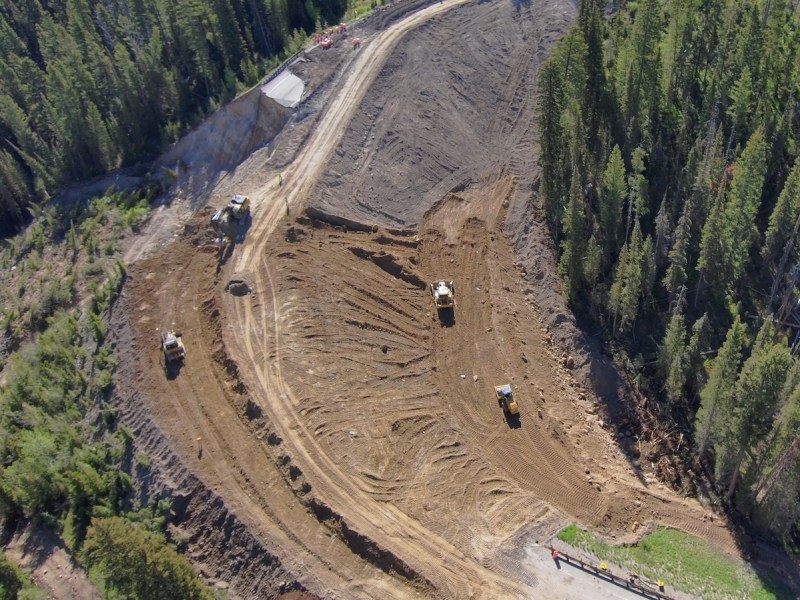
TETON PASS—Highway construction workers Tuesday were paving a detour around a missing section of Highway 22 in hopes the temporary fix will open the vital inter-state link to commuters Friday.
The road is expected to open to all traffic, including semi-trucks weighing up to 60,000 lbs., but will be signed with a 20 mph speed limit through the detour.
“It’ll be a slow-down point,” said Keith Fulton, assistant chief engineer for the Wyoming Department of Transportation who described the detour at the construction site. “A little bit of slow-down is better than a big detour.”
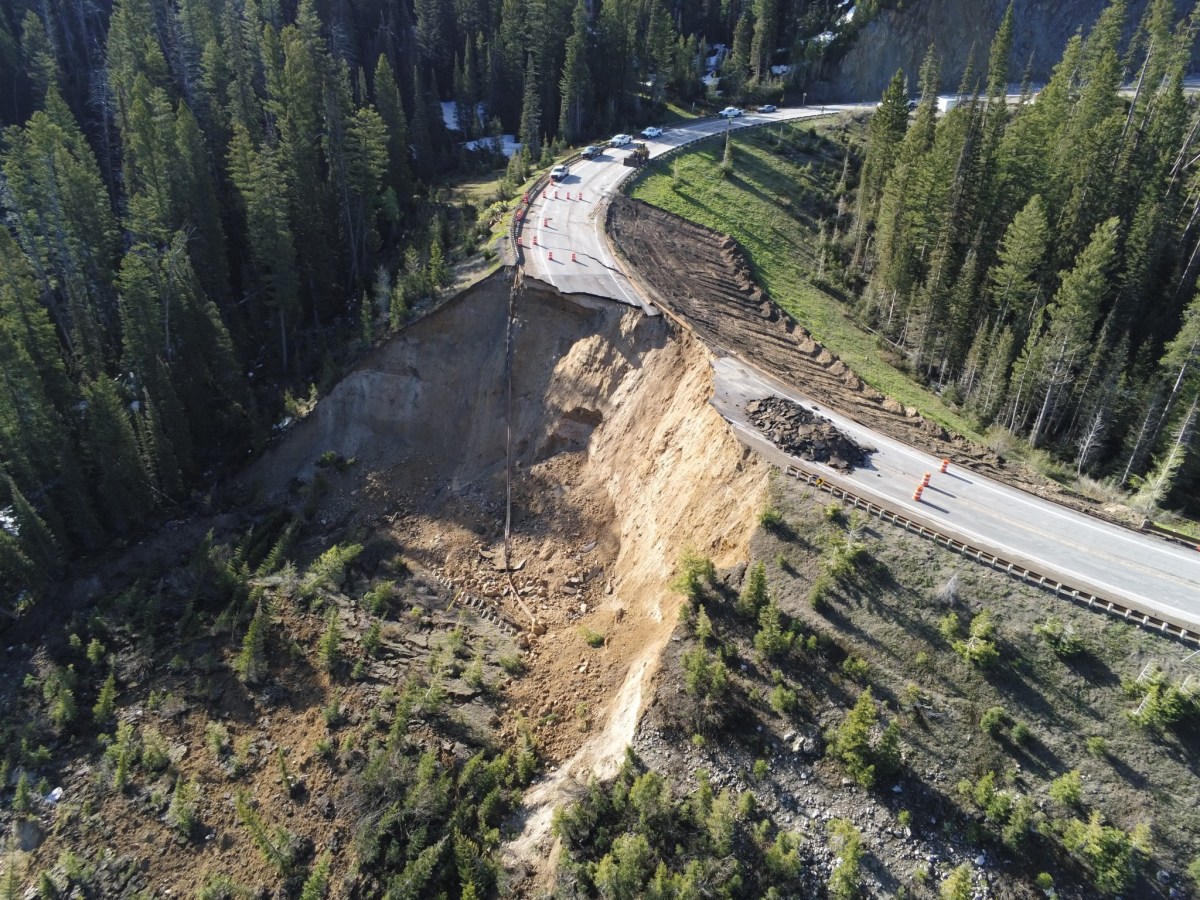
A landslide undermined the route over 8,431-foot high Teton Pass the night of June 7, befuddling thousands of Jackson Hole workers who live in nearby Victor, Idaho, where housing is more affordable. For two and a half weeks, they have had to make an 86-mile commute around the Snake River Range and through the town of Alpine instead of their usual 24-mile trip over the pass.
“We have the utmost confidence in this detour.”
WYDOT geologist James Dahill
The change amounts to about four or five hours of driving a day, commuters say, an unsustainable burden on top of a normal eight-hour workday.
That’s going to end, “hopefully by the end of the week,” said Darin Westby, WYDOT director. He made his comments on the edge of freshly laid asphalt as it was being steamrolled amid the industrial cacophony of road construction machinery.
Concrete barriers will line both edges of the detour, which shortcuts the inside of the now-gone original sweeping curve. The new section has an 11.5% grade, steeper than the old road’s 10%.
“We have the utmost confidence in this detour,” said James Dahill, chief engineering geologist with the transportation department.
The Big Refill
It was “a perfect storm” that led to the failure, Dahill said. Rain fell on snow this spring as the temperature suddenly jumped 25 degrees resulting in unusual runoff.
All that water helped undermine “The Big Fill” portion of the highway that was built up five decades ago to span a significant swale in the route’s alignment. The Big Fill, however, was constructed atop “a little pocket of clay” Dahill said.
A saturated embankment and saturated soils contributed to the failure, Dahill said. “It was wet,” he said of the failure point.

Engineer Fulton said clay layers are “usually the slippery spot.” But he didn’t find fault with the original construction, completed more than 50 years ago.
“It gets used a lot,” Fulton said of the highway. “We keep up on maintenance.”
Landslide dangers are part of the nature of the mountain-pass highway beast, Fulton said.
Wyoming will likely qualify for federal funding for 90% of the expected $30 million cost of a permanent reconstruction, officials said. Plans are to rebuild the road in its original location, albeit with lighter embankment material.
The Big Fill, “that was heavy embankment material,” geologist Dahill said.
Although design and engineering is incomplete, the reconstruction will resolve the clay issue one way or another, he said, possibly with steel shafts or some other ground-penetrating columns. Drill holes have revealed no water problems at this point, he said, and underground sensors will reveal both gradual ground motion and any water flow.
Crews, including from emergency contractor Evans Construction, worked 24/7 for weeks, “through Father’s Day and everything else,” said Bob Hammond, WYDOT’s resident engineer in Jackson. “We wanted to get this done in two weeks; it’s taken three.”

Although the road will be signed with a 20 mph limit, savvy commuters who aren’t in heavy traffic will likely be able to negotiate the detour a little faster, Hammond said.
Director Westby said he hopes the permanent replacement will be completed “before the real big winter sets in.” He touted cooperation across agencies, states, counties and municipalities and the capabilities of his department, too.
“We have the biggest engineering firm in the State of Wyoming,” he said.

The $30 Million of federal funds given to Wyoming for reconstruction of the Big Fill in it’s original location should instead be used as a down payment for a tunnel through Teton Pass beginning just east of Coal Creek and terminating just east of the Phillips Ridge Curves.
I do have a suggestion for repair. I lived in North Carolina and the Blue Ridge PKW had some similar slides as also interstate 40. On the Blue Ridge a Via Duct was built to go around the problem. It is spectacular. Just a thought.
I watch this every day.My grandson and his family live in Driggs and work in Wyoming. They are very happy to live there. I am impressed with the speed of the repair and the people who worked on it. Thank you Wyoming.
Wyoming has a “get her done” mentality. California would take years to tackle a project like this.
I’m curious how the weight limit of 60,000 lbs. will be enforced on the pass. There is a weigh station on the western side of the road fix, but is never used or monitored. A fully loaded single dump truck is well over the weight limit. And before the landslide there were at least 50 loaded dump trucks on the pass running loops from Idaho and back to Wyoming every two hours. There were ever side dump semis and dump truck with dump trailers starting to show up as well. So again I’m curious who going to regulate the weight limit? There’s not even a weigh station on the Wilson side of the pass!?
Finally, Dahill suggests the possibility of stabilization via pilings (“steel shafts or some other ground penetrating columns”). It would seem to be part of a reasonable solution to the problems of a wet load over a clay surface. Clay is very slow to absorb water, hence, the slick surface difficulties. The weather is not to blame. 1960s engineering with next to no correction to an obvious problem is to blame. When building bridges, it is not unusual to build for the 100 years flood. Here, it should be the heavy winter, wet spring runoff and ground water. I have driven the pass since the 1960s (the old road then the new one) for job commute and travel. I saw the remains of the Glory Bowl bridge (1970). It (the bridge) showed what happens when engineering fails to plan for the worst. In engineering terms, that’s called being conservative. I often wondered why for years, the severe dip on that curve was never corrected. In winter, the off camber slope it made would throw the vehicle down slope and to the outside of the turn. On snowy surfaces, one had to be extra careful. Obviously, there was a problem there. WYDOT has my sympathy for the budgetary, political and public pressure that must be endured, but this time, I hope that those can be ignored for awhile and cool, calculating and knowledgeable thinking prevails, rather than “Just git ‘er done.” As for those whining about commuting around the block, no sympathy. I did it too, for years. This is not Paradise regardless of the ads and blogs. One does what one must do to survive here. Sometimes it is not pleasant. No such thing as a free lunch.
If the clay layer is saturated they might consider using electro-osmosis to consolidate it. We did that on a dam failure in Ohio many years ago. You can push water out of clay electromagnetically.
Excellent Job to all the women and men that got the road open.
It is amazing what we can do when people come together to find a great solution!