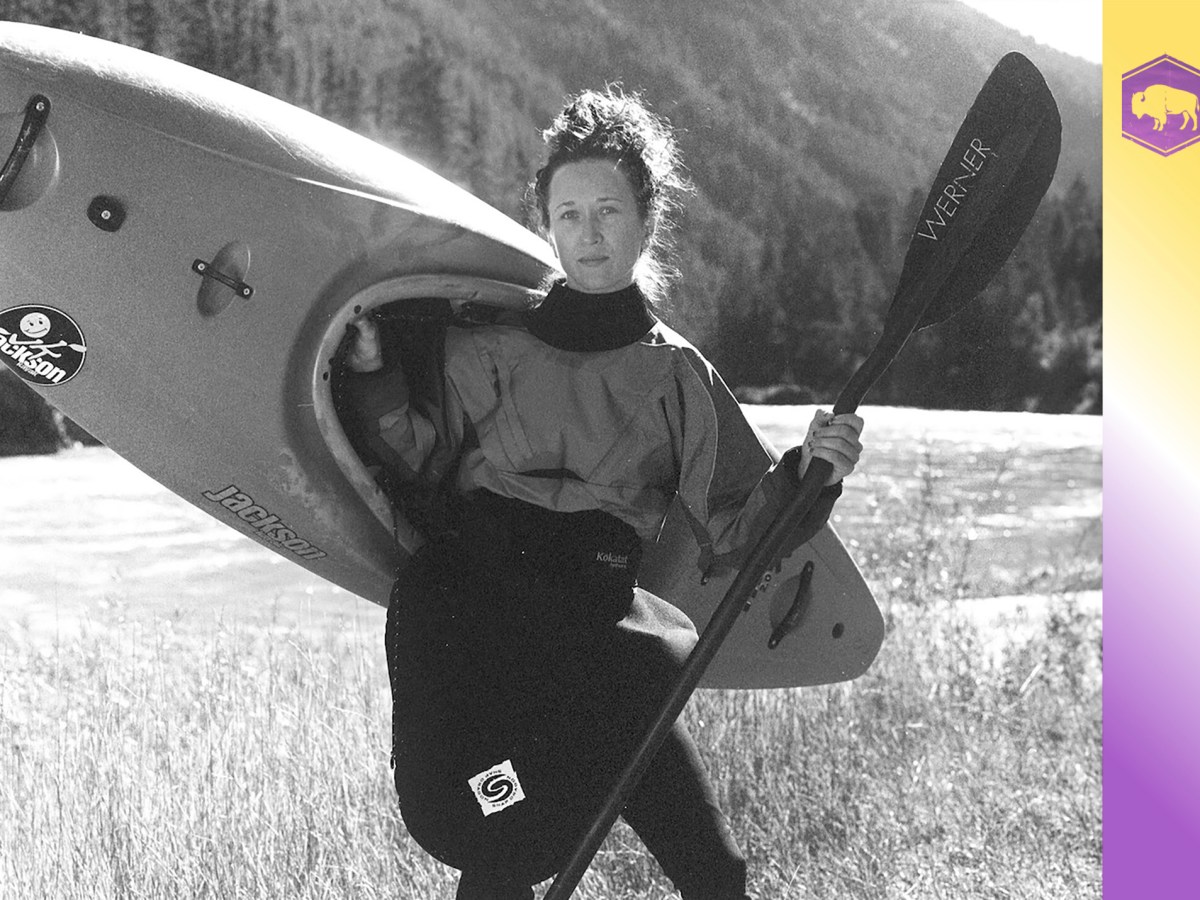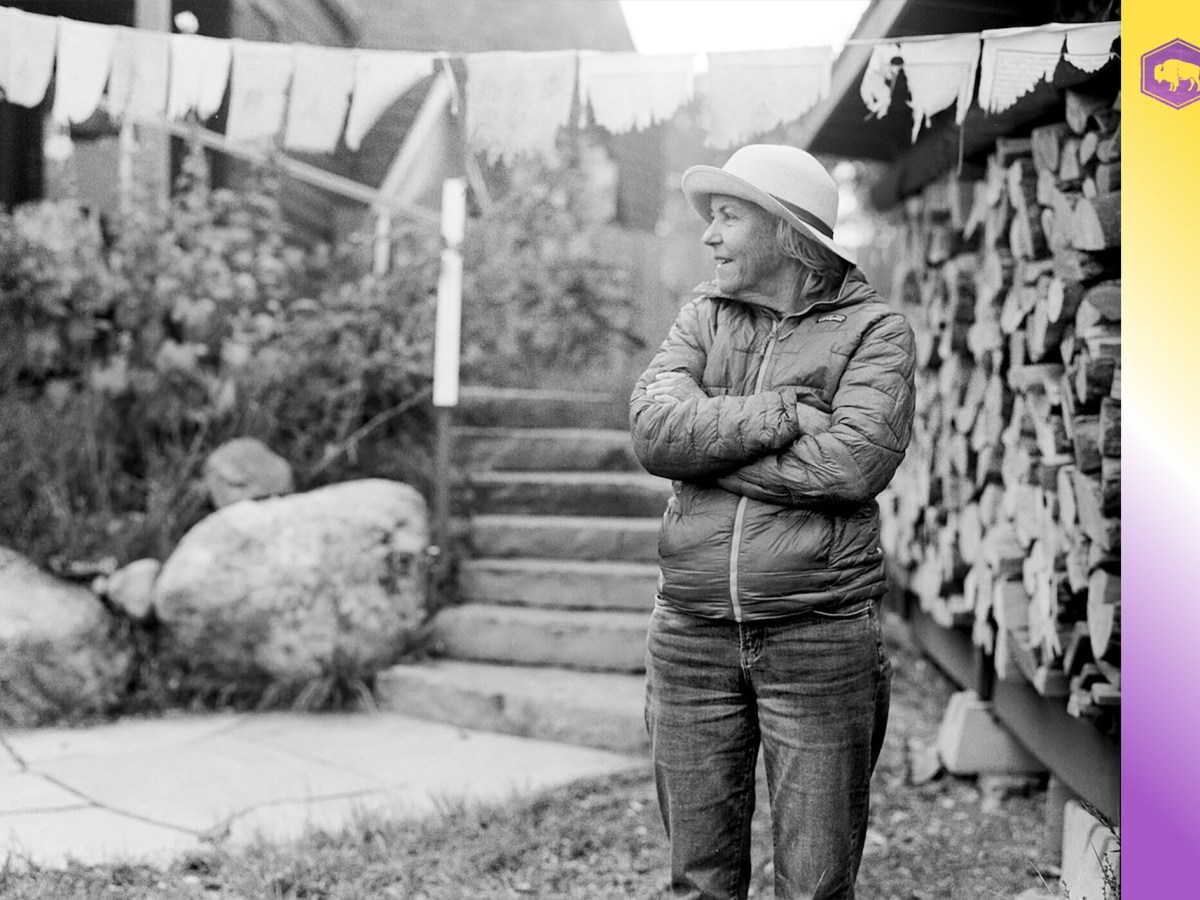
This is the fourth in a series of articles and portraits of elite female mountain athletes — part of WyoFile’s America 250: State of Equality project, which you can read here.
When she was a kid, A.J. Cargill’s parents up and moved from the Midwest to the chic ski resort of Sun Valley, Idaho, setting her and two siblings afloat in a style-conscious culture the youths yearned to join.
Having skied only on 200-foot-high hills, the shy eighth grader was loosed onto the slopes of Bald Mountain, runs that regularly forged Olympic medalists. Competitive skiing, teenage insecurities, a cliquey society and the ski hill itself could have swallowed her up.
Instead, she became a world champion free skier, a 20-year ski patroller and the first woman to descend the Grand Teton on free-heel telemark skis. None of that was handed to her, she said. “I had to earn it all the hard way.”
As an impressionable child, just adapting to a new community was tough. “We were like really bad skiers in Sun Valley,” she said of herself, her brother and sister who were plopped into a challenging crucible. “And some of the other teenagers … like [future Olympic gold medalist] Picabo Street … were already on the U.S. development team.”
A lot of kids they circulated among were from cool, cool California. “We came from Michigan, so that was sort of intimidating,” she said. And nobody was cool unless they wore French Vuarnet cat-eye sunglasses. So the kids pleaded with their mother, hoping to fit in.
“We just begged and begged and begged until we got some Vuarnets,” she said. “It was a big deal.”
Cargill, a bookworm, absorbed a sense of Sun Valley slope style from her aunt who was well-settled in Idaho’s Wood River Valley before Cargill’s family arrived. She was a buyer for Snug Mountaineering, a landmark ski shop.
“She lived in an A-frame with shag carpet and a round fireplace,” Cargill said. “She had the big collars and she went on these sailing trips with her boyfriend. She was the epitome of cool.”
With an inside track, Cargill started to catch up with her peers and was among the first to don a Powderhorn jacket, designed in Jackson Hole, distinctly faddish and sporting a western leather yoke. Then came North Face and other brands.
Out of The Roundhouse
But clothes don’t ski and Cargill barely could. “I never knew what a race turn was at that time,” she said.
“The first race I had to do was a downhill,” she said, a long speed test with few turns. “It’s the same course that they used for pros for a while — right out of The Roundhouse,” a lodge perched midway up the mountain.
She became comfortable on her skis by the time she attended the University of Michigan. She tested the competitive moguls scene, but didn’t find her niche. A free-skiing competition in Crested Butte, Colorado, offered her a new challenge — unbridled skiing down large, gnarly faces where an athlete could show off her abilities.
She wanted access to more of those slopes. Jackson Hole’s geography “just drew me in,” she said, so she settled there in 1994.
The Tetons “taught me everything about humility,” she said. “These mountains shaped who I am, because you have to have tenacity. You’ve got to get back up and try it again to succeed around here.”
She competed in free-sking events in places as far away as Argentina and Alaska. But the women’s events were a sideshow, she said, paying her $500 for first place compared to the men’s prize of $2,500.
“I never made any money in a career as a competing athlete,” she said. She did make a name, however, and was crowned the women’s world free-skiing champion in 1997.
“There weren’t that many women living here doing what I was doing at the time,” Cargill said of Jackson Hole. She had to put up with discrimination and sexism.
“These mountains shaped who I am, because you have to have tenacity. You’ve got to get back up and try it again to succeed around here.”
A.J. Cargill
Early in her Jackson Hole career she was invited onto the “Hollywood box,” the exclusive first aerial tram ride of the day at Jackson Hole Mountain Resort, a ride once reserved for sponsored athletes, the beautiful people and their photographers.
“I was the only female to walk out there,” she said of her first morning at the tram loading dock. “My heart was beating hard, and I was super intimidated because everyone had these long skis, and they’re looking at you, and they’ve got, like, this moxie, this attitude.
“I’ve got my skis up on my ski boot so that my skis look longer,” she said. “They start giving Jason, the guy I’m with, a ton of shit that that we’re sleeping together,” she said. “And I’m standing right there.”
Only after she showed the men she could keep up, “they started slowly letting me in,” she said.
Slowly. Ski photographers at the time favored male models and gave them the first shots at pristine slopes. “I didn’t get that real opportunity to show people what I could do early on because of those types of things.”
Cargill’s off-slope mettle — she was a bartender who wouldn’t take guff at ski patrollers’ favorite pub — earned her an invitation to that elite cadre. She spent 20 years reducing avalanche risks and rescuing hapless skiers from Jackson Hole’s slopes.
Skiing the Grand
The Tetons turned Cargill on to telemark skiing with a free-heel binding that allowed her to get into the backcountry. The telemark gear at the time provided less control than a conventional ski-area binding and using it on steep slopes added a degree of risk.
No woman had descended the Grand Teton on telemark gear; it took Cargill three attempts before she even got to the summit of the 13,775-foot high peak. The ski route is unforgiving. If you fall, you die. The hardest part for Cargill was an ice-coated cliff where her team paused to use a rope to safeguard the short climb down.
“It was just hairball, hairball — taking my skis off, getting into crampons,” she said. “You’re barely on the edge of something. Don’t make a mistake with anything. Everything matters.”
Off piste, Cargill, now 60 (“I’ve always presented young for my age, and acted young,”) followed her aunt’s footsteps and got into the clothing business in Jackson Hole, becoming a buyer for a high-profile downtown sports store. The job fit her like an articulated ski glove.
“You get to go look at all the Patagonia stuff for next year, and you get to decide, like ‘what colors should we have in the store? How am I going to put them together?’” she said. “That’s when it really came alive for me.”
Even before she moved to stylish Sun Valley, what she wore on the modest Midwest hills made a difference to her outlook, she said. It’s part of the reason she and Heather Featherman started Alpine Revival, a sweater company that’s bringing back the bold colors and designs in functional, elegant cashmere wool.
“That sweater changed how I saw myself.”
A.J. Cargill
She tells the story about how she was 7 when she got a ski sweater for Christmas. “It had personality, and it even had frogs on the sleeves,” she told an audience recently.
That it was an advertised label — Beconta — added to its luster. “It was a brand that was known and had some cachet,” she told WyoFile
“When I put it on, I stood a little taller,” she recently told an audience. “I felt like a skier, like I belonged to this world that was so much bigger than our little ski hill in Michigan.
“I started finding the courage to make turns, hit little jumps, and I even started trying the harder stuff. That sweater changed how I saw myself.”
In her journey — it even included a couple of seasons rowing a raft through the Grand Canyon — one decision stands out. Moving to Wyoming was “the best choice I ever made,” she said.
“It just welcomed me with open arms,” she said of the Equality State, despite the sexist remarks she had to endure. “That’s their problem,” she said of the men who made them.
“I do think it’s still true that women have to work harder just to get the same stuff,” she said of today’s world. Nevertheless, “we have it way better than they had it 100 years ago, way better. I really hope it doesn’t go backwards — the other direction.
“That’s the most terrifying and terrible thing about living right at this moment — seeing some of the backward steps that a lot of people, men and women, are willing to allow or choose. It doesn’t seem right or like progress or kind or thoughtful. Everything seems wrong about that.”
Women can hold on to what they’ve achieved, she believes. “So as long as I can keep earning my spot, I think I’m proving it for the younger generation.”