

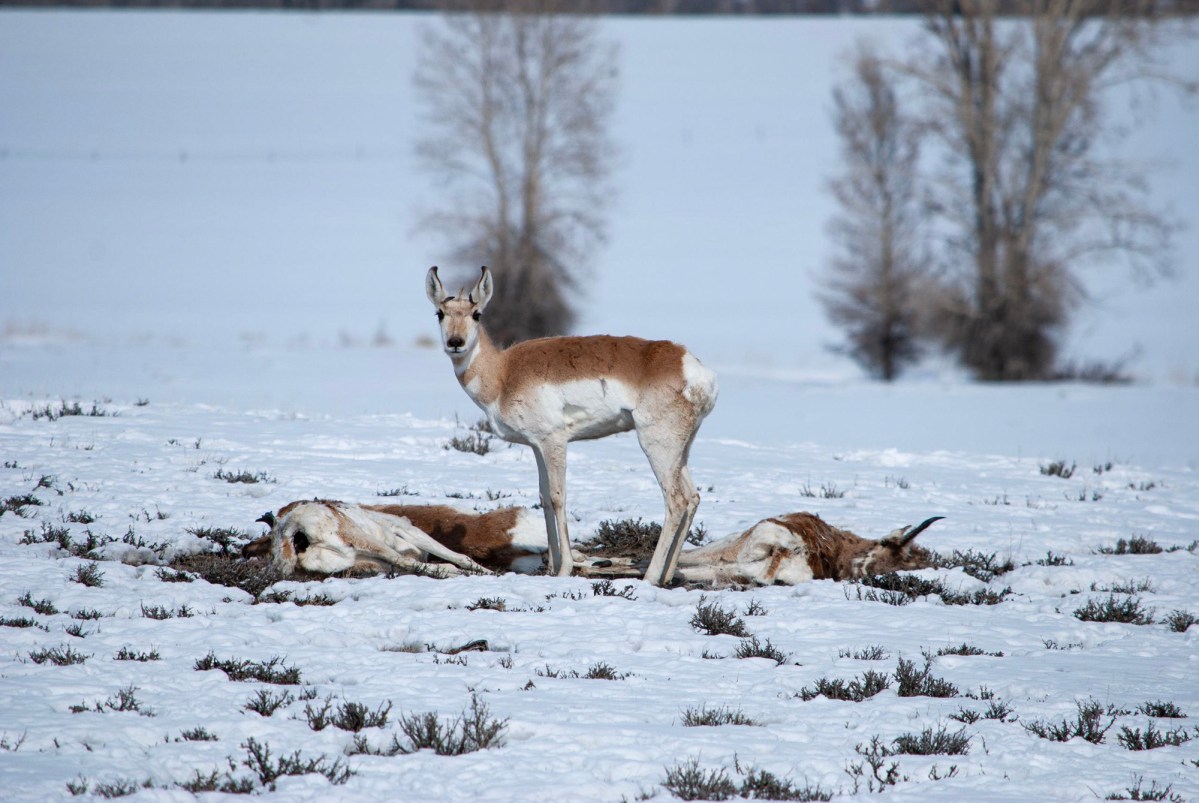
Editor’s note: This is Part 2 of a look at the Sublette Pronghorn Herd. For Part 1, click here.
Yesterday, we examined how pronghorn herds typically recover after a difficult winter. Now, let’s examine a more recent example.
Opinion
Since we’re focused here on the Sublette Herd, let’s consider some of the recent fawn-doe ratios. After the winter of 2022-23, the ratio subsided to 47 fawns per 100 does, an expected consequence of the poor condition of the herd’s females. In the fall of 2024, it rose to 68:100, a moderate recovery. In 2025, it hit 70:100. Is this really “better than average?
In the 10-year span between 1973 and 1982, the Sublette Herd averaged almost 82 fawns per 100 does, with a peak as high as 96:100. In the 1970s, other pronghorn herds in Wyoming produced well over 100 fawns per 100 does. One of the more troubling statistics from the record of the Sublette Herd is the ratio from 2022, the year before the killer winter — that year, there were only 55 fawns per 100 does in the herd.
In fairness, local biologists say that four out of the last six winters in Pinedale country have been “bad” for pronghorns. That may well be, and those winters may offer at least a partial explanation for the lack of a “bounce” in the Sublette Herd. But I’m troubled when I compare fawn-doe ratios from the good old days of pronghorn abundance in the 1970s and 1980s with the numbers today. Take just one other example, the Medicine Bow Pronghorn Herd a hundred miles east of the Sublette Herd. In the decade between 1975 and 1984 — even after the devastating effect of the winter of 1983-84 — the Medicine Bow Herd averaged 80 fawns per 100 does. Between 2016 and 2025, that average dropped to 67 fawns per 100 does.
Enough numbers. Today’s game managers can’t be blamed for assuming that the mean of the last 10 years of data reflects some sort of normal state against which the current year’s estimates can be measured. They’re dealing with a new normal. What, precisely, is “new” about it? Weather, for one thing. We’ve seen four killer winters in the Green River country over the last six years. That’s something new. And, between those winters, we’ve seen a remarkable succession of drought years — without adequate forage, a pronghorn herd simply won’t “bounce.”
I’m tempted to deliver a sermon on climate change here, but, even if we took Bill McKibben’s advice and treated the climate challenge with the single-minded focus we used to win World War II, we wouldn’t see any improvement in the plight of the pronghorn for decades.
We can only change what we can change. The “Path of the Pronghorn” has finally been pried open — the migration corridor for a single herd of Wyoming’s pronghorns. There are other corridors in other parts of the state, just as critical to the well-being of migrating big game but poorly defined and beset with obstacles, both physical and political. Clearing the way for the migrants is important but only if the destinations on either end provide the animals with what they need. Of all the implications of the low fawn-to-doe ratios, this one may worry me the most.
How much forage do we leave for our pronghorns: on the summer pasture, along the migration corridors, down on the critical winter ranges? The fawn counts suggest it isn’t much, probably not enough to sustain the herds at the numbers some of us knew 50 and 60 years ago. If we want those thriving herds again, we need to feed them. According to the BLM’s own data, a vast area of the public range is in fair-to-poor condition. No small part of this is due to a long history of abuse. If we care about pronghorns and much of the rest of our wild heritage, we need to stop that abuse and set about healing the damage.
And, while we’re considering how much livestock the range can really support, we need to turn our attention to the management objectives that have been set for many of our big game herds as well. Just one example: The current objective for the Sublette Pronghorn Herd is 48,000 animals. It will take a hell of a “bounce” to return that herd to the size it attained in the 1970s. It’s worth asking whether that objective is even achievable and sustainable in current conditions. As much as many of us would like to believe it’s possible, ongoing weather patterns and grazing regimes may not allow it. If that’s true, then our efforts to reach the current objective may only damage the habitat that remains. Hard data on the condition of the animals and their habitat could define the dimensions of this issue, but only if we care enough to collect and act on it.
Hunting is not the problem here. The length and timing of hunting seasons, the size of the buck harvest, the number of licenses we issue have little, if anything, to do with the sluggish production of pronghorn fawns in the last 20 or 30 years. Unfortunately, the only management tools state biologists really have to influence pronghorn populations are hunting seasons and license allocation.
The real solutions are controlled by other state and federal entities whose political agendas are set by a host of special interests with little or no interest in pronghorns or any other wildlife. They can be swayed only by massive public outcry. The success of the campaign to open the Path of the Pronghorn shows what is needed, but one migration corridor is just the barest beginning. If we really want to get back to “better than average,” we’ll have to feed our pronghorns better, and that’s not likely to happen until the public at large demands it.

I echo Duane Kerr’s comments from a lifetime of experience, also understanding the effects of cattle and competition for resources on our Public lands, especially during drought periods.
Many thanks to Chris Madson for his expertise and excellent writing for keeping the conversation about this Iconic species at the forefront of our conversation about our Public Lands!
Thanks, Chris, for putting many of today’s pronghorn, as well as lots of other wildlife species, problems into a perspective that should be easily understandable. Not much positive can happen until beneficial moisture falls from the sky. And maybe having fewer other mouths to share it with could help, too.
When our grandchildren ask us, “What did you do to save pronghorn?” How will we respond. Join us at pronghorns.org
After years of BLM allotment data that indicates our grazing allotments are not healthy how can we expect to have healthy pronghorn and mule deer habitat? We don’t need the data to confirm the condition as any fairly well rounded range ecologist/manager can look at conditions and without the political aspect, tell you their status.
Just look at the difference driving up 191 from Rock Springs to Pinedale. I am not saying that the Rock Springs allotment is in great shape but as soon as you cross into the Pinedale Field Office its like night and day. Look at the Similarity Index data collected by the Jonah folk some years back. Most of your tall cool season bunchgrasses are around 10% of potential and total grass production is around 35% of potential. The Pinedale Field Office is allowing the permittees to strip mine the Field Office
Good article. The facts are very disturbing. I think that other species are suffering decline as well. Mule deer have just vanished from Dry Creek near Crowheart. And the Antelope close by are declining as well. It is forage more than anything else. I feel very sad for future generations.