


Every year Wyoming’s Department of Workforce Services releases a grim report tallying up the workplace fatalities for the previous 12 months. The document lists the cause of worker deaths, the age of the deceased, and a few details about the incidents.
“In order to prevent occupational fatality in the state,” the report states, “it is imperative that employers, workers, policy makers and the public have a clear understanding of the nature and causes of these fatal events.”
In 2014, 34 people died on the job in Wyoming, from the following causes:
- 16 – transportation/pedestrian accidents
- 5 – falls/trips
- 4 – accidents with equipment
- 3 – accidents with livestock/wildlife
- 3 – suicides at work
- 2 – fires/explosions
- 1 – drowning
Wyoming has one of the highest per-capita rates of workplace fatalities in the nation, typically second behind North Dakota, and roughly three times the national rate.
From 2008-2013 the state experienced one workplace death every twelve days, on average.
Some excerpts from the report:
“As half of occupational fatalities are consistently due to motor vehicle accidents … fostering motor vehicle accident prevention in all industry sectors should be a main priority in Wyoming.”
“Wyoming’s industry alliance groups are an essential forum for communicating timely hazard alerts, prevention resources, and other information to participants.”
“A good safety culture is difficult to measure, but themes … include management support for safety as a company value, open and honest communication in all directions, continued training and learning, and pro-active efforts at all levels to identify and mitigate hazards.”
“Wyoming is unique with a high proportion of dangerous jobs, long distances traveled for work, and the potential for non-resident workforces traveling across or working in our state. However, Wyoming is not the only state in the nation to be faced with these challenges and there remains the opportunity to become a national leader in efforts to prevent worker injury, illness and fatality.”
Download the full report here, or see below.
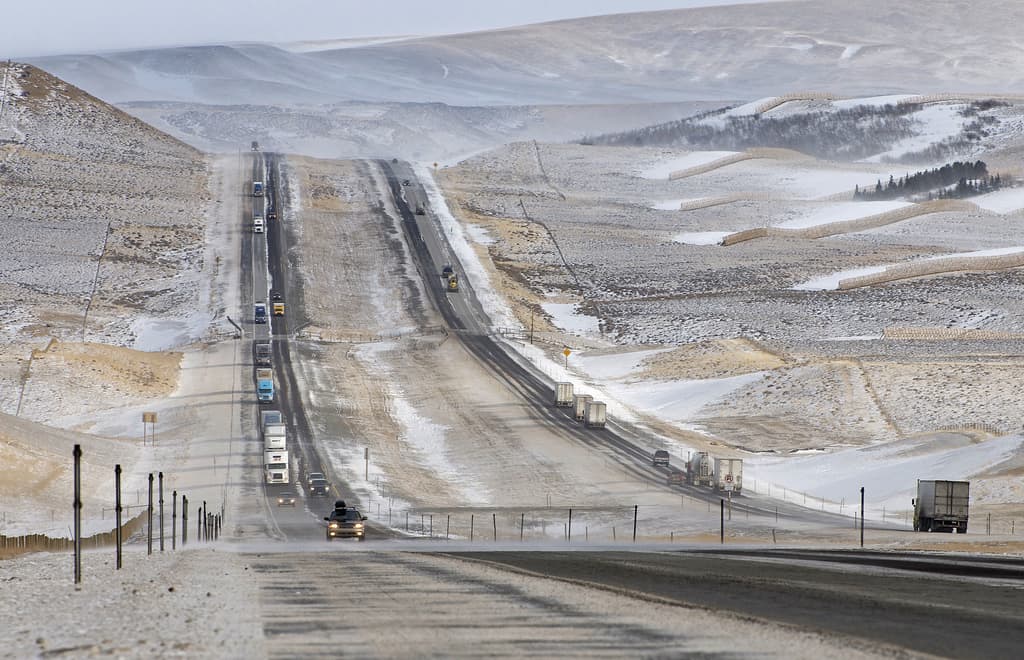
Flickr Creative Commons photo by Tom Kelly.
I’d like to see the absolute figures related to 1000 full-time workers. On that basis, they could be compared to similar industries – such as mining – elswhere. In Germany, with 85 million inhabitants, the per-thousand rate is 0.015 fatalities for the year 2013 [http://www.baua.de/de/Informationen-fuer-die-Praxis/Statistiken/Unfaelle/meldepflichtige-Arbeitsunfaelle/meldepflichtige-Arbeitsunfaelle.html;jsessionid=0F35AC286B9222BD0A373D12517C35D2.1_cid333]
If the corresponding Wyoming rate were significantly higher, those responsible for day-to-day management as well as those authorities charged with oversight over industry might take note and reconsider present work practices.
M. A. Titz
Windach, Germany
Reflecting on my brother’s oilfield death in what would be classified as an at-work transportation accident, I see that the category veils the cause of his death and others, which was that his employer, Halliburton, worked men as if they were machines. I have seen nothing in the nearly 35 years since then that suggests that anyone is looking at worker deaths from this perspective.
I must add that i find the word “angst” in an earlier comment profoundly inappropriate. Indifference to these losses, each unimaginably staggering to the survivors, suggests an appalling lack of humanity.
Jane Ifland
State Epidemiologist Meredith Towle’s report is instructive. It includes an important recommendation that the state should adopt:
“The Wyoming motor vehicle crash report could be amended to include a specific indication of an “at work” accident. This would allow more complete and accurate tracking of both fatal and non-fatal occupational motor vehicle accidents, thus lead to better understanding of whether work-associated crashes have different risk factors compared to all other crashes. A possible model for this data element exists in the nationally standardized death certificate, which collects an “injury at work” data element for vital records.”
In short, we likely are not recording all work-related crashes that injure and kill workers in Wyoming.
An aside to Mr. Vanderhoff – the majority of workplace fatalities are preventable. Certainly you’re not suggesting that we simply must accept what happens when our loved ones do not return from a day’s work, are you?
Dan Neal
For all the angst about ( lack of) workplace safety in Wyoming, neither the quantity nor the cause of the 2014 job deaths annotated here seem excessive. The Grim Reaper is not working overtime in Wyoming.
Only the 3 workplace suicides raises an eyebrow halfway. Yet if we can’t effectively prevent suicides in general in Wyoming , trying to stem it at work would seem exponentially more difficult.
Perhaps we need to recalibrate our angst around here. Wyoming is risky 24/7 , on or off the job.
Dewey Vanderhoff