

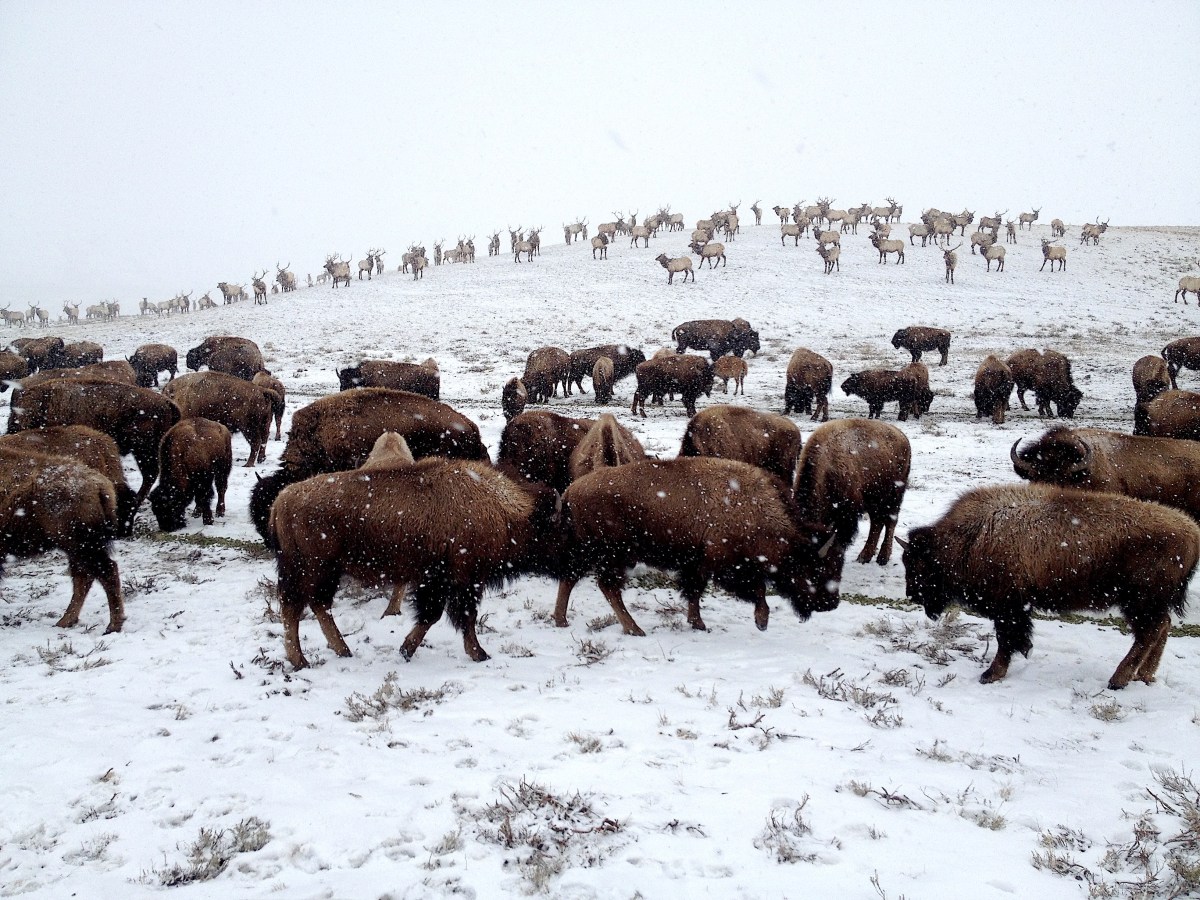
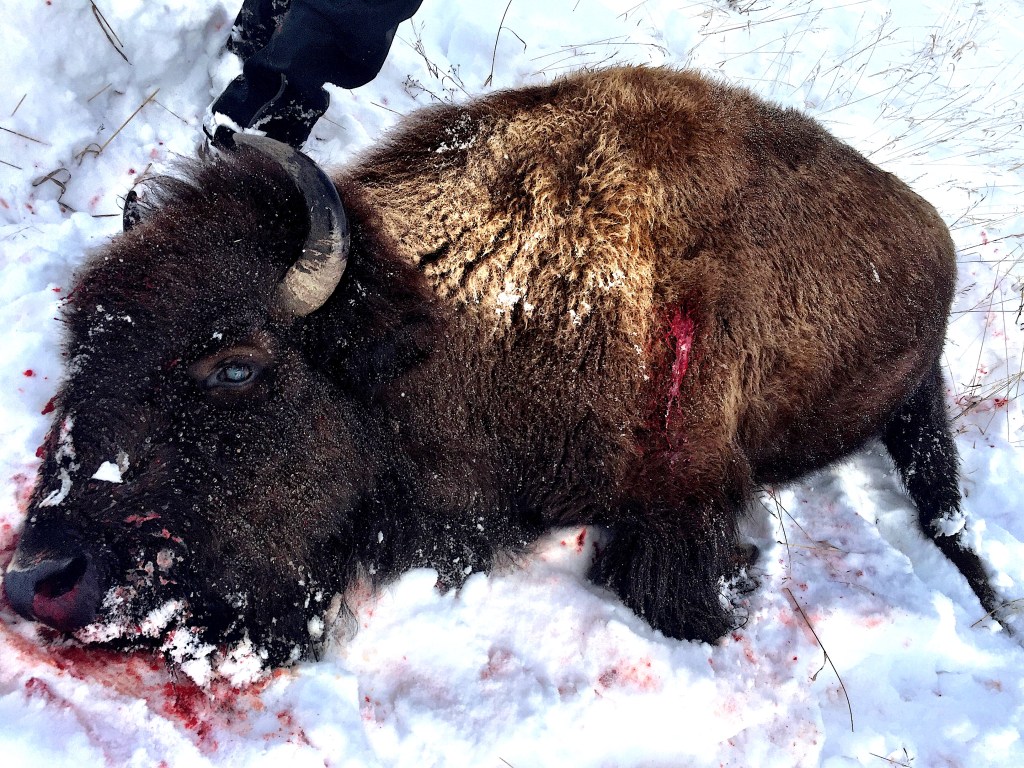
JACKSON HOLE—National Elk Refuge staffer Frank Durbian spent Thursday morning watching members of Idaho’s Shoshone-Bannock Tribes hold a ceremony, then take down three bull bison on ancestral northwest Wyoming lands their forebears once occupied.
“I think it’s wonderful that they were out here on homelands that they historically utilized,” said Durbian, the refuge’s project leader (formerly called manager). “It was a very positive experience.”

The Shoshone-Bannock’s small springtime bison hunt, ongoing for the past 16 years, is a seldom-publicized private event that has historically resulted in the tribe killing up to five bison. This year, however, the traditional pursuit expanded. For the first time since the National Elk Refuge was formed in 1912, the members of the Eastern Shoshone tribe ventured over from central Wyoming’s Wind River Indian Reservation to participate in a ceremonial bison hunt of their own.
“Approximately 2.5 years ago, we were approached by the Eastern Shoshone,” Durbian said. “Since that tribe does have treaty hunting rights that encompass the lands occupied by the National Elk Refuge, we agreed to have them come out here.”
Bison hunts administered by the Wyoming Game and Fish Department are allowed on the National Elk Refuge, but typically not until late summer. Licenses are very hard to draw through lotteries — non-residents had just a 1.1% chance of drawing a tag last season — and those who do acquire tags then face notoriously difficult pursuits because the savvy species has learned to stick to Grand Teton National Park, which is off-limits to hunting.
Through the special ceremonial hunts, the Shoshone-Bannock and Eastern Shoshone tribes have an easier path to harvesting bison.
They got the OK from federal wildlife managers through the completion of a planning document called a “compatibility determination.” That document outlines many of the particulars of the hunt, which has traditionally occurred after feeding ceased in the spring and is more tightly controlled than typical public hunting seasons. Participating hunters, for example, must be accompanied by a “spotter” whose job is to “visually [track] the bison selected for harvest and assess the resulting shot placement and need for additional shots.”
About two years ago, a draft of the plan to expand the tribal hunt was vetted with the public. Although the then-proposed change garnered little publicity at the time, three parties weighed in.
Some changes were made in response to a comment from the Wyoming Game and Fish Department, which manages the Jackson Bison Herd and helps administer the tribal hunt.
One state request caps the number of animals that can be killed via the ceremonial bison hunt at 5% of the Jackson Bison Herd’s three-year average population, which has hovered slightly below the herd’s objective of 500 animals.
Abiding by this cap, the tribes could take a couple dozen bison or so every year. In practice, however, Game and Fish has used a different criteria to determine how many bison the tribes are allowed to take.
Ceremonial hunt cap set at 10% of quota
Essentially, the state agency emulated its standard 90%-10% split that’s usually used to determine the percentage of hunting licenses that go to residents versus non-residents, a split that Game and Fish Jackson Region Supervisor Brad Hovinga called “fair and equitable.”
“We agreed as an agency we’d also allow 10% [of licenses] — similar to non-residents — to go to the tribal ceremonial hunts under the guidelines,” Hovinga told WyoFile.
The tribes’ portion comes off the top, he said, effectively reducing the pool of non-exclusively tribal bison hunting licenses by 10%. The Wyoming Game and Fish Commission recently approved its 2024-’25 bison hunt, setting a 70-animal quota, which means that the tribes would be granted roughly seven animals.
This spring the cap was six, with three bison apiece being allotted to the Shoshone-Bannock and Eastern Shoshone tribes.
WyoFile was unable to reach representatives for the tribes for an interview prior to this story’s publication.

Under the leadership of Jason Baldes, tribal member and executive director of the Wind River Tribal Buffalo Initiative, the Eastern Shoshone people since 2016 have made strides toward rebuilding a bison herd on the Wind River Reservation — and reincorporating the “good medicine” of buffalo into the lifestyles of tribal members.
In a 2013 interview with the Jackson Hole News&Guide, a U.S. Fish and Wildlife Service policy representative for the Shoshone-Bannock Tribes said that just about every part of the animals killed on the National Elk Refuge are put to use.
“Pretty much what was left of them was just the gut piles,” Claudeo Broncho said at the time. “We take the kidneys, we take the liver, we take the heart, we take the tripe, the hooves, the skins.”
In more recent years the Shoshone-Bannock Tribes have vocally advocated for wildlife and land managers to respect off-reservation hunting rights that were granted by the 156-year-old Fort Bridger Treaty. A legal precedent protecting those treaty rights was established in 2019 by the U.S. Supreme Court decision in Herrera v. Wyoming.
Not Herrera related
Wildlife and land managers say the expansion of the tribal bison hunts on the National Elk Refuge is not related to the Herrera v. Wyoming precedent. For one, the National Elk Refuge granted the Shoshone-Bannock Tribes access to the property and resource starting in 2008 — more than a decade before the Supreme Court’s decision.
“This is not considered off-reservation treaty hunting,” Hovinga said. “In talking with the tribes, they don’t consider the refuge to be unoccupied lands.”

Durbian, with the Elk Refuge, said that the decision to expand the ceremonial bison hunt to tribes beyond the Shoshone-Bannock was influenced by U.S. Department of Interior Secretary Deb Haaland’s 2021 secretarial order compelling federal land managers to engage tribes in “co-stewardship.” Haaland, a member of the Pueblo of Laguna, is the first Native American in U.S. history to lead the Interior Department, which is the federal government parent of the Bureau of Indian Affairs, U.S. Fish and Wildlife Service and National Elk Refuge, among other agencies.
“We’re looking at — where we can and where it’s feasible — to co-steward resources with tribes on lands [they] historically used,” Durbian said.
There are “upwards of 29 tribes” that historically used the Jackson Hole area, he said, but that’s not the same thing as having a hunting and fishing treaty right like the Shoshone-Bannock and Eastern Shoshone.

Federal attorneys determined there are “a few more” tribes that would also be eligible for tribal bison hunts per their treaty rights, Durbian said. The refuge manager was unsure exactly which additional tribes would be eligible, but pointed out that as of late April none of those eligible tribes had inquired with the refuge.
Meantime, Durbian has been pleased to accommodate the two tribes that have come forward.
“I’m really happy to have the tribes out here participating in their ceremonial hunts and cultural practices,” he said.
By design, the tribal hunts have largely been private affairs. They have rarely been publicized by the media, and they occur at a time of year when Refuge Road is off-limits and eyewitnesses are few.
“I’m not aware that we’ve ever received comments about that ceremonial tribal bison hunt,” Game and Fish’s Hovinga said. “I’m fairly certain that the majority of people don’t even know that it exists.”

Absolutely wonderful now we’re talking GAME MANAGEMENT 2 ensure healthy populations 4 awl 2 enjoy and hunt 4ever
Least they didn’t have to compete with an outfitter shouting them out from under them.
Good article Mike. Incorporating tribal bison tag allocations into the Wyo G&F tag quota makes sense but the tribes probably don’t pay any hefty fees for those tags so it does cost the commission. Is killing a few bison the extent of the tribes “co-stewardship” that Howland is promoting?
My concern is what condition is the Buffalo in after the long winter? I would think that a late fall or early winter would be better for the quality of the meat and hide etc. ! If they have supplement feed through the winter they might be ok and the type of feed might make them better?
Extremely well written and informative article with an important discussion of off reservation treaty hunting rights.