

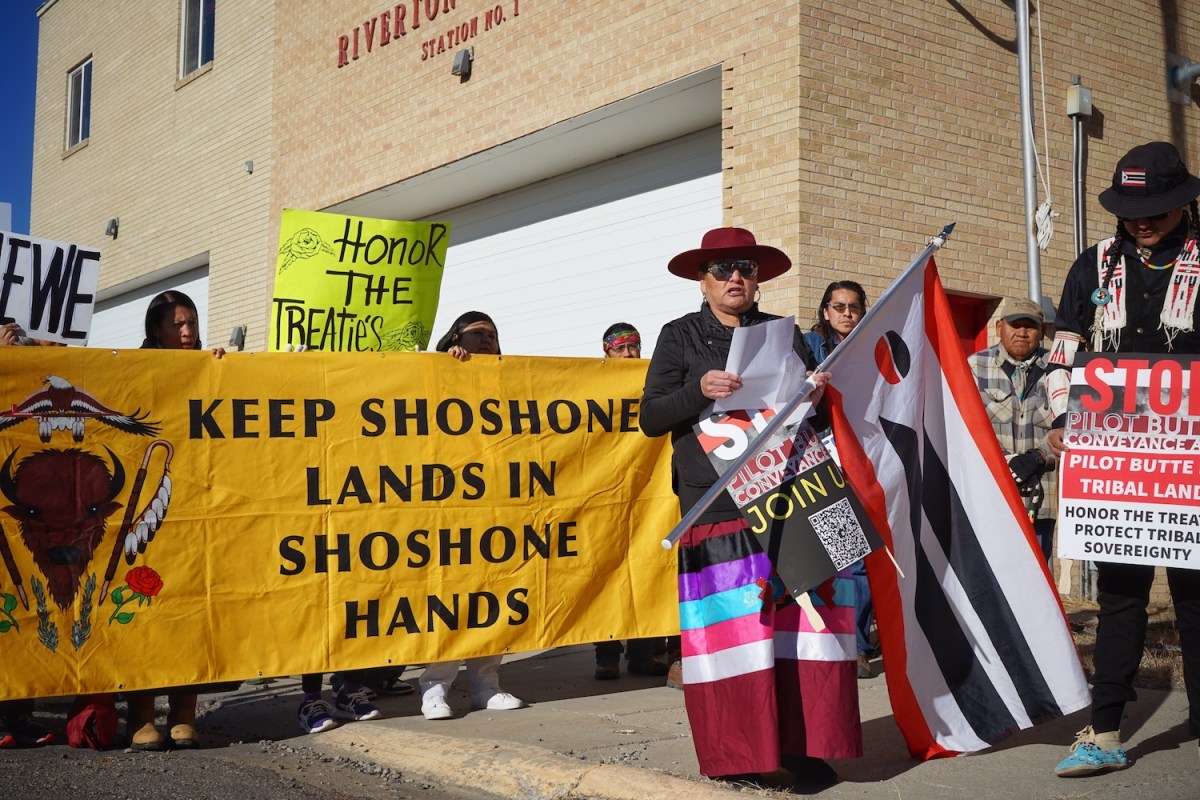
RIVERTON—About 50 people gathered in front of U.S. Sen. John Barrasso’s office Thursday to protest what one tribal representative called “downright theft from the federal government.” The bill they oppose — the Pilot Butte Power Plant Conveyance Act — would result in a defunct power plant on the Wind River Indian Reservation being conveyed to a nearby irrigation district.
Nicole Wagon, a Northern Arapaho woman who helped organize the protest, told the protesters the act is the latest “in a long line of violations” against the tribes.
“The Wyoming congressional delegation never had the common decency to consult with Eastern Shoshone or Northern Arapaho of their intent to continue the theft of Indian land through the Pilot Butte Conveyance Act,” she said.
Barrasso and Wyoming’s lone U.S. Rep. Harriet Hageman pushed companion bills that would require the U.S. Bureau of Reclamation to transfer control of the plant to the Midvale Irrigation District, which manages irrigation water across central Fremont County. The legislation would also shift ownership of the land beneath the mothballed infrastructure. Hageman’s version has passed the U.S. House; Barrasso’s has been introduced into the Senate.
“Senator Barrasso appreciates members of the community sharing their thoughts and keeping Thursday’s demonstration respectful and peaceful,” Barrasso’s Communications Director Laura M. Mengelkamp told WyoFile. “He’s been in contact with members of both the Eastern Shoshone and Northern Arapaho tribes as the Pilot Butte Power Plant Conveyance Act has advanced in the Senate.”
The defunct federal facility on a small piece of land was slated to be demolished, Mengelkamp noted, and the Midvale irrigators are willing to put the money in to get the plant back up and running to use the power locally.
When asked about the act during an October candidate debate, Barrasso cited those reasons when he called it “a win-win for the people,” but said the Bureau of Reclamation should have consulted the tribes.
“I think that was a mistake,” he said. “They should have been informed early on.”
The Wind River Inter-Tribal Council on Wednesday approved a resolution denouncing the act.
Wagon said Thursday’s peaceful protest “is just the beginning for us to come together and take a stand … We’re not going to stay quiet.”
Treaties and water canals
The 1863 Fort Bridger Treaty between the U.S. government and Eastern Shoshone tribe outlined a vast area of more than 43 million acres for Shoshone territory. Five years later, the government reduced the land to less than 3 million acres when it established the Wind River Indian Reservation. The government later placed the Northern Arapaho Tribe on the reservation as well.
A 1905 agreement that opened further reservation lands up to white settlement still does not sit well with many tribal members. The power plant proposal, opponents say, has echoes of what they see as land grabs under the guise of legislation.

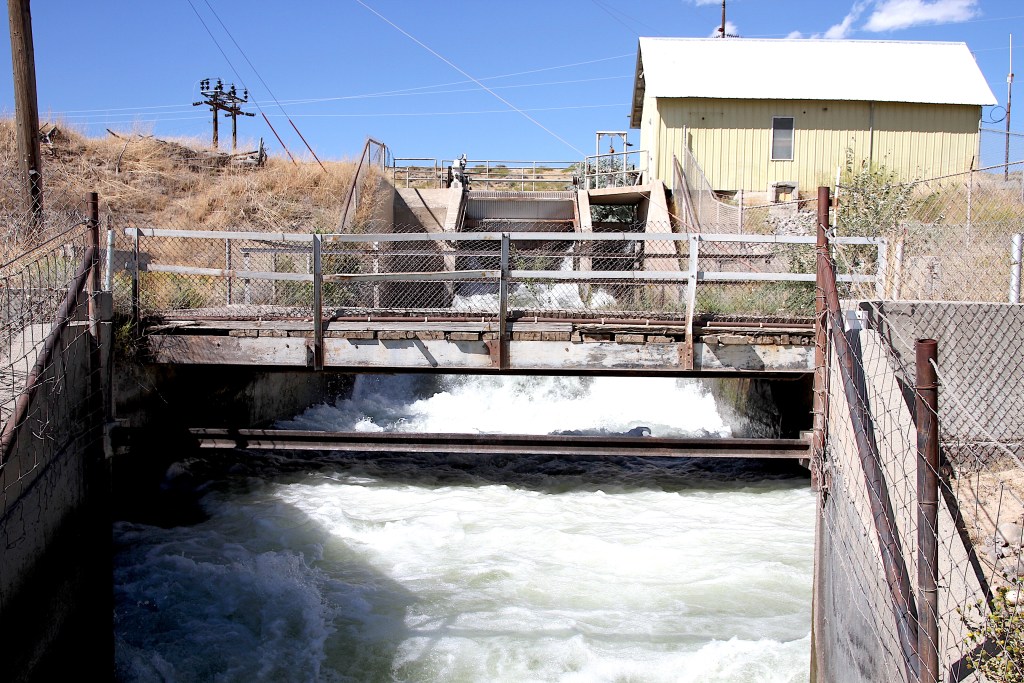
The property in question is owned by the federal government and managed by the Bureau of Reclamation. It consists of a tin-sided building housing a hydroelectric facility unused for more than 15 years as well as a penstock filled with water diverted from the Wyoming Canal. The water, which used to spin a turbine to generate electricity, now bypasses the building, directly feeding Pilot Butte Reservoir.
The Midvale Irrigation District approached Wyoming’s congressional delegation about transferring the title of the old Pilot Butte Power Plant so it could be rehabilitated. Producing power for customers would minimize costs, Midvale Irrigation District Manager Steve Lynn told the House Water, Wildlife and Fisheries Subcommittee in September 2023.
Still, the principle of the conveyance and their exclusion from the process rankles the tribes. Protesters on Thursday held signs demanding treaty rights be honored, filled out template letters to send to congressional representatives, burned sweetgrass and listened to speakers.
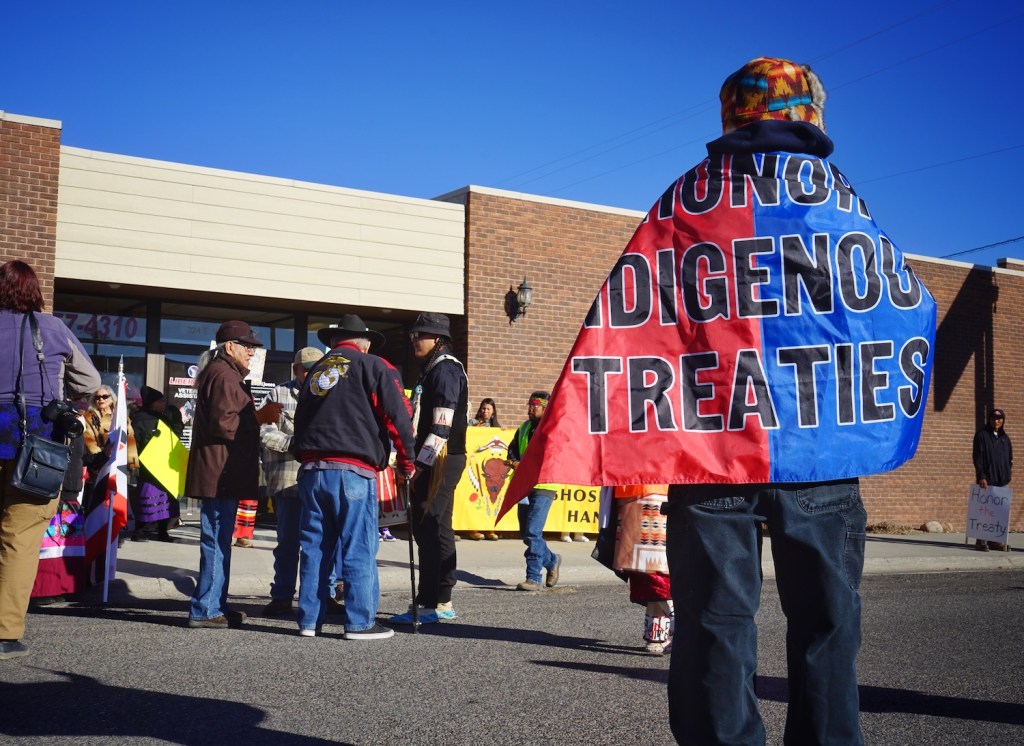
Reading the newly approved inter-tribal resolution, Wayland Large, chairman of the Eastern Shoshone Business Council, said the inter-tribal council has informed the bureau, Hageman and Barrasso of their consultation requirements.
“The Wind River Inter-Tribal Council is staunchly opposed to the legislation,” he said.
Northern Arapaho Business Council member Keenan Groesbeck didn’t plan to talk, but shared a few words when Wagon handed him the megaphone.
“What’s been going on here is just downright theft from the federal government,” he said. “It’s been going on for far too long. It’s time for the tribes to stand up and assert our sovereignty against the federal government.”



Sen. Barrasso blames the BuRec for the failure to consult with the tribes.
He could have picked up a phone and made a few calls himself. I’ll bet he has one in his pocket.
One might expect an apology, but it’s easier to beat on a bureaucrat.
Elect idiots, expect idiocy…
I can’t see why the plant can’t be put into operation and remain as tribal property, if the tribe thinks it is worth doing. If it makes money some of the profit should go to the tribe. It sounds like a land grab for its own sake, not for some practical reason.
We have got to stop allowing local, state, and federal government over reach on tribal lands and respect their sovereignty. Good or bad this needs to be stopped without their input or participation. You all support personal freedom and property rights for yourselves but you continue to harm others like the this.
Barrasso and Lummis are distgusting and not representing the native population of Wyoming. They should be voted down and out. They will and do sell their souls to the highest bidder with no consideration for anyone or anything.
Correction. Barrasso did certify the election, but he has never called out Trump for all of the election lies.
It shouldn’t surprise anyone that these two goofballs are disrespecting our Native Americans. Remember, they also disrespected YOUR vote. They also want to take control of YOUR public lands.
You just weight and see what kind of power contract they will get ,it won’t be feasible to operate. Then you can report how off sided the Wyoming public utility commission is.
Reopening old hydroelectric projects can make sense. In Afton, Wyoming The Town of Afton and Lower Valley energy took two abandoned hydroelectric projects and restarted them. The power generated is clean and the income is paying the bonds to restore them. Moreover the cost to remove the dams was avoided. FERC 13301 is the project. It employs a caretaker and the restoration generated significant economic benefits.
The tribes should be respected as important stakeholders. They should not sabotage economic development and then complain about poverty. This could be a win and wiser minds need to come to the table.
This is terrible but, not uncommon. The US has been steeling from the tribes for over a century. You would think that our Wyo. US Congressional delegation would be ashamed of themselves instead of trying to facilitate it.
The Wyoming Triplets know no shame.