

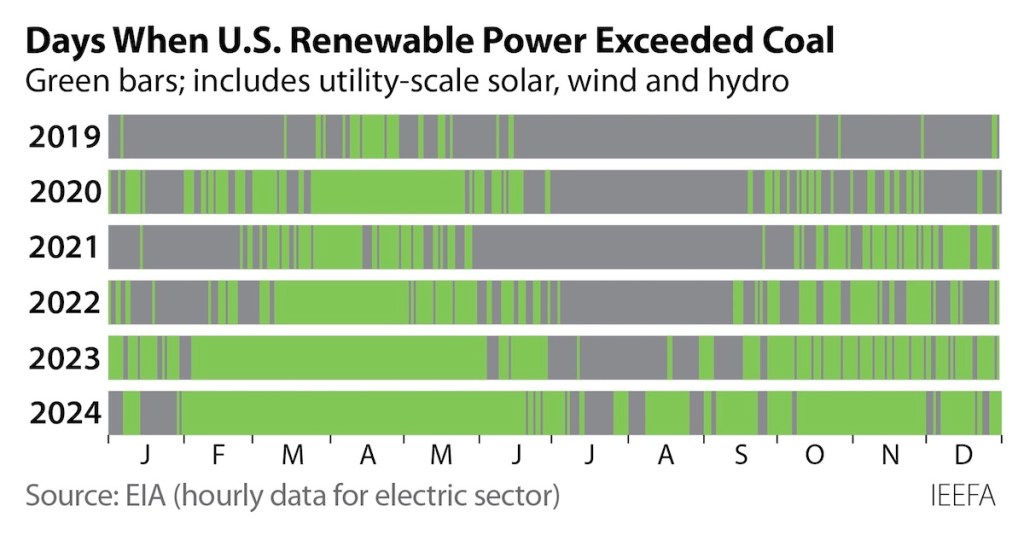
Wyoming’s top politicians have heaped praise on President Donald Trump’s “Big Beautiful Bill” for giving the state’s flagging fossil fuel industries a boost. They’ve also taken swipes at past congressional efforts to support wind and solar — the cheapest and fastest-growing energy sector in the nation, including in the Equality State, federal data shows.
While promoting coal, oil and natural gas via tax breaks, the bill includes several punishing policies for wind and solar: chiefly, a much quicker phase out of tax credits that industry experts say will jeopardize hundreds of projects. The result will be higher electric bills and unfulfilled job growth in a stunted electrical power sector, according to initial reactions and analysis in the industry.
“Today’s Congressional action is a dramatic swing in federal policy, disrupting the good faith investments of American companies that are powering our economy and creating hundreds of thousands of jobs,” American Clean Power Association CEO Jason Grumet said in a prepared statement.
Such grim predictions apply to Wyoming, where electricity customers may experience a 29% increase over the next decade, according to one analysis. There are also several wind and solar developers in the state who were counting on the tax credits for a longer period. How many of those projects might squeak forward and how many may fall by the wayside is difficult to say. But some industry watchers, and politicians, in Wyoming warn that the long-term implications will not be good for ratepayers or local governments.
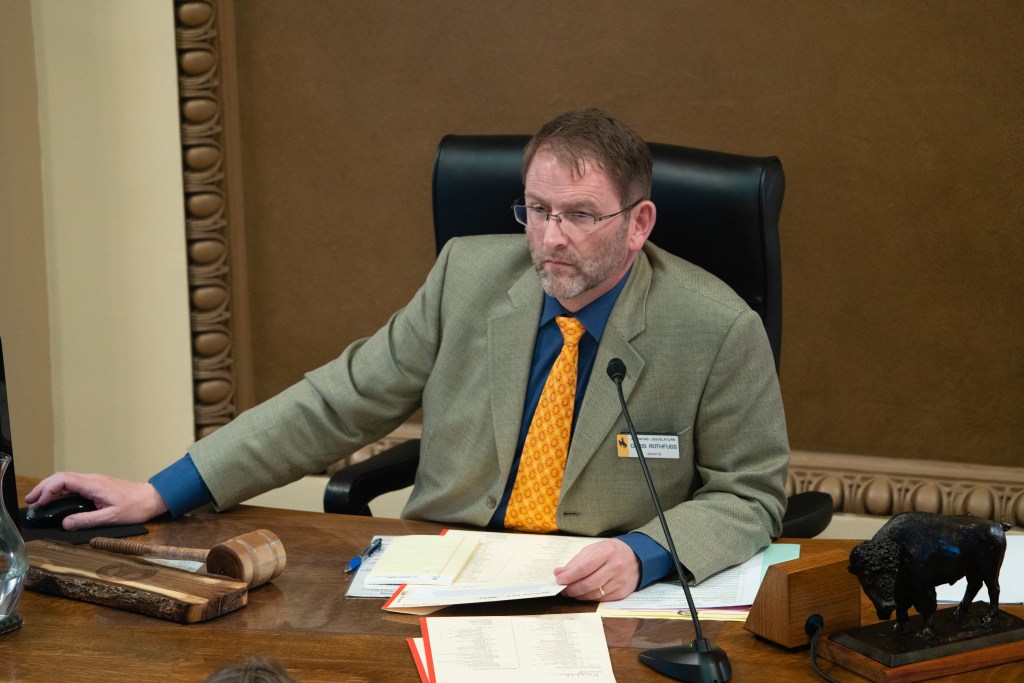
“There’s a clear intent to shut down the renewable sector in the [One Big Beautiful Bill Act],” Laramie Democratic Sen. Chris Rothfuss told WyoFile. “While there’s a lot of visceral disdain for the renewable sector among many residents and many legislators, the reality is it’s an important part of our economy and an important part of our forward-looking economy.”
Others suggest there’s more support for renewable energy in Wyoming than people may realize.
Wyoming Outdoor Council Energy and Climate Associate Jonathan Williams said he joined several city council members and other local officials from Wyoming on a recent trip to Washington, D.C. They implored congressional representatives to maintain support for clean energy, including programs that help municipalities, schools and small businesses cut costs via energy audits and solar panel installation.
Local governments in Wyoming increasingly want to cut their energy costs, Williams noted, yet all of the programs are on shaky ground.
“I think that’s a loss when we’re thinking about, ‘What does this mean for ratepayers, or for businesses, or for investment in our state that we need for keeping our state attractive to young people?'” Williams said. “I don’t know how many people are moving here for coal jobs when the market is deciding it doesn’t want coal.”
Disappearing tax credits
The Trump administration is moving swiftly to strip clean electricity tax credits for wind and solar projects following passage of the One Big Beautiful Bill Act.
The president signed an executive order Monday directing the Treasury Department to “strictly enforce the termination of the clean electricity production and investment tax credits under sections 45Y and 48E of the Internal Revenue Code for wind and solar facilities.”
For the most part, projects must begin construction before July 4, 2026 and be operational by the end of 2027, shaving several years off the previous eligibility timeline.
That means hundreds of project developers across the nation are rushing to move up construction starts — a particular challenge considering that permitting can take years, not to mention the administration has signaled it doesn’t prioritize such efforts.
Some in the renewable energy industry also worry about potential tax credit eligibility clawbacks, noting that Trump’s executive order directs federal agencies to place extra scrutiny on what qualifies as beginning construction. The order proclaims that commercial wind and solar development “denigrates the beauty of our nation’s natural landscape,” “displaces” affordable domestic energy sources, is “unreliable” and poses a threat to national security for relying on supplies from “foreign entities of concern.”
Gov. Mark Gordon praised Congress for tax and royalty rollbacks for coal, oil and natural gas, noting those industries are “critical to Wyoming’s fiscal health.” His press statement following the bill’s passage last week, however, made no mention of the increasing role wind and solar play in Wyoming.
“Wyoming voted overwhelmingly for President Trump for his embrace of free enterprise, freedom and his promise to cut government,” Gordon said. “I am optimistic about our economy, but remain concerned about a burgeoning federal deficit.”
Wind and solar in Wyoming
Wyoming generates about 10,200 megawatts of electricity from all sources, according to state and federal data. Nearly one-third comes from wind and solar. More than half the electrons generated here are exported to customers outside the state.
One megawatt is enough electricity to power about 750 homes.
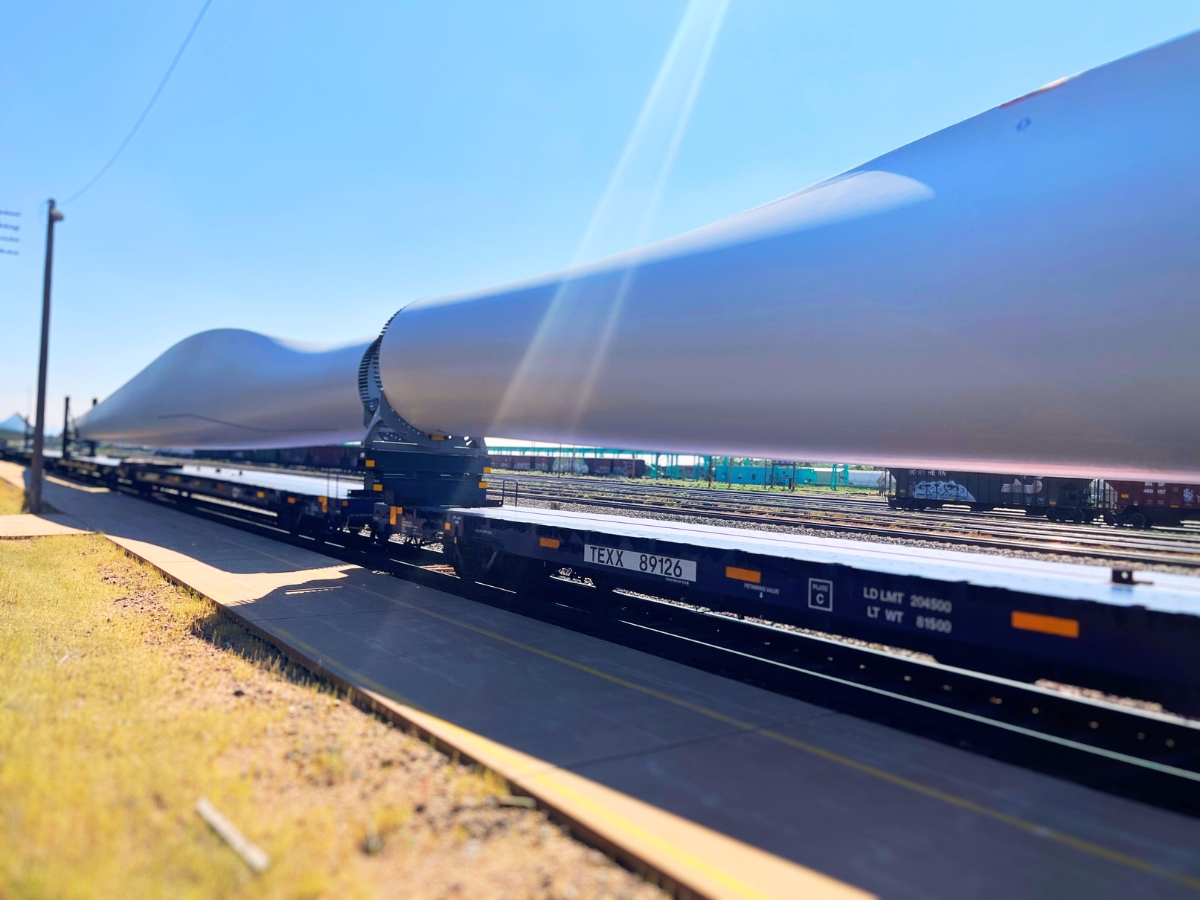
One wind energy project alone, Power Company of Wyoming’s Chokecherry and Sierra Madre Wind Energy Project in Carbon County, will add more than 3,500 megawatts of electrical generation capacity, boosting the state’s power generation by 34%.
The 600-turbine project qualifies for federal tax credits, despite backing from billionaire Phil Anschutz. Construction of the massive “power plant” technically began in 2016, according to the company, and work kicked into high gear about a year ago. The project remains on track, “and is continuing construction,” a company spokesperson told WyoFile via email. Developers plan to begin producing wind energy in phases, and potentially put the project in full-capacity operation in 2030.
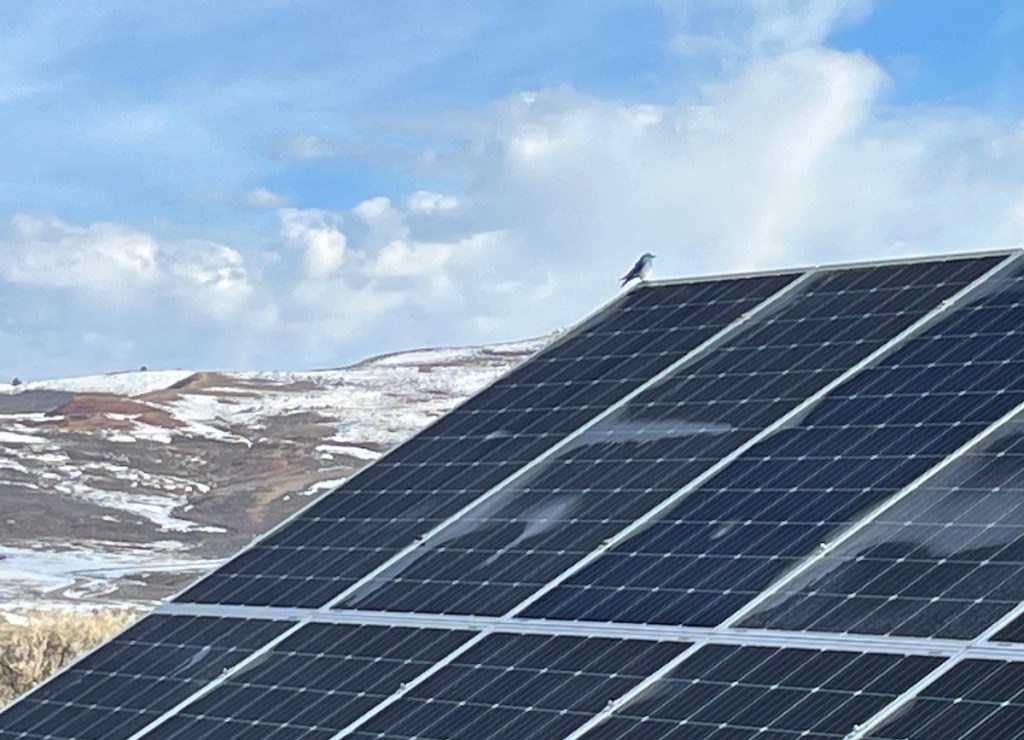
The 330-megawatt Boswell Springs wind facility in Albany County came online recently, according to local reports. NextEra Energy’s 390-megawatt Cedar Springs IV wind project in Converse County is expected to be in operation this year, as is Invenergy’s 590-megawatt Rock Creek wind energy project in Albany County.
Those are all major additions to Wyoming’s electrical generation industry. But the fate of numerous other renewable energy projects is unknown. Nearly a dozen wind and solar projects have come before the Wyoming Industrial Siting Council since 2020, according to a WyoFile review. Each touts hundreds of construction jobs, dozens of permanent and ancillary jobs and significant revenues via rents to landowners and property taxes.
Wyoming is one of the few states in the nation that imposes a tax on wind energy generation, producing millions of dollars each year that are split between the state and the counties hosting wind power plants. One “good” thing in the One Big Beautiful Bill Act for clean energy, proponents say, is a new cost-share that will split federal rents and fees with local governments hosting wind and solar facilities. That may give the industry more favorability with local governments, they speculate.

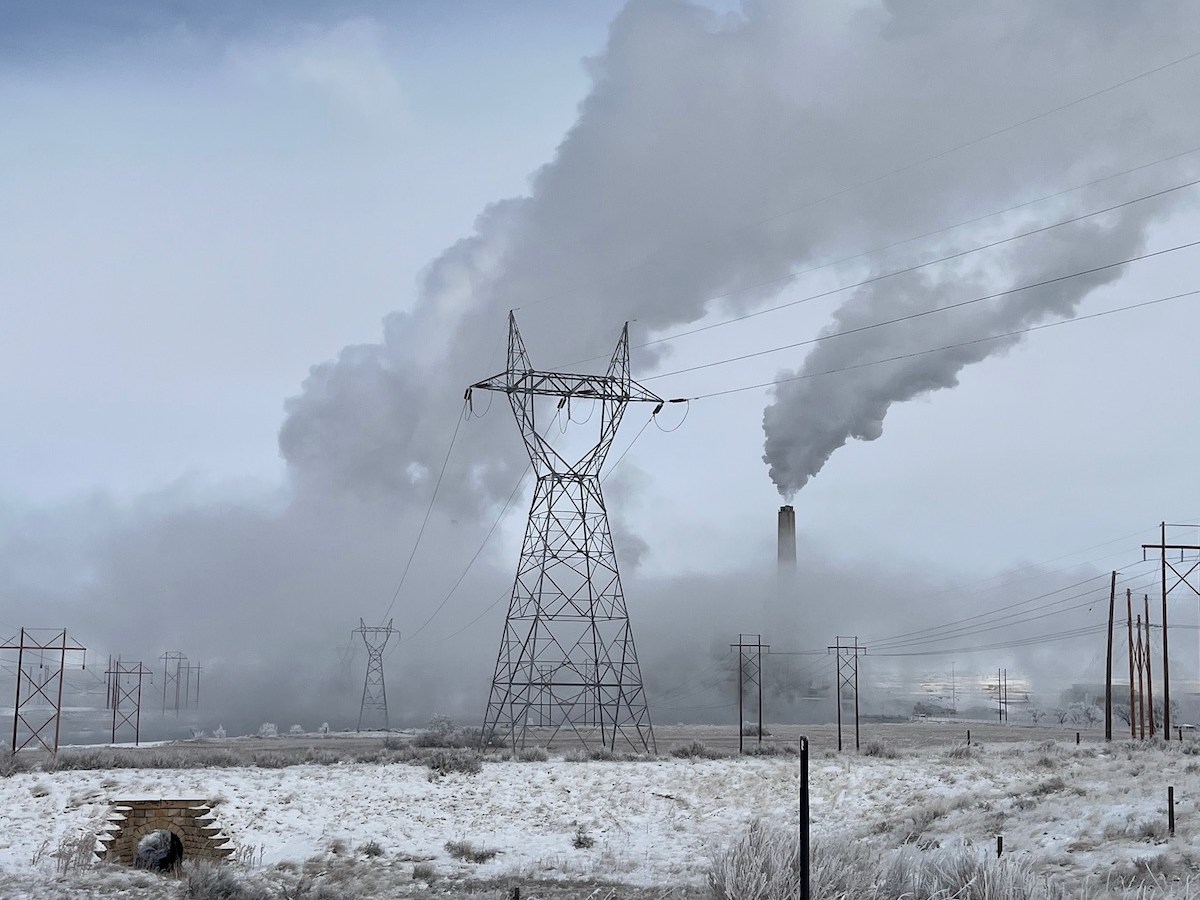
“Honestly, here in Albany County, we have such a poor assessed valuation that property tax is a little bit hard to come by,” Rothfuss said. “And for that matter, this year’s sales and use tax is being buoyed by the wind projects. So we know that our community’s counting on that revenue.”
But there’s no full accounting of wind and solar projects in the early planning stages that may be at risk due to the accelerated phase-out of federal tax credits.
Each project also touts its avoided carbon dioxide emissions as an alternative to fossil-fueled power plants. That’s also in Wyoming’s interest, “because the science is clear about where we are headed in terms of emissions and what that means in terms of a warming climate and weather extremes,” Wyoming Outdoor Council Energy and Climate Policy Director John Burrows told WyoFile.
A recent University of Wyoming survey revealed that Wyoming residents are increasingly concerned about climate change — particularly for its impact on water resources — and that they want their elected officials to do something about it.
The beauty of wind and solar is the fuel is free – forever.
Everyone has their opinions here and I thought it would be interesting to have the subjects analyzed by artificial intelligence. Four different AI platforms basically gave the same information. The most concise one said:
Both fossil fuels and renewable energy sources have environmental and economic impacts, and both receive government support. However, the nature, scale, and long-term implications of these differ profoundly:
Fossil fuels are associated with systemic, global, and direct public health damages (climate change, air pollution) from their combustion, which represent massive unpriced costs to society (implicit subsidies). They also receive substantial explicit financial support.
Renewable energy sources have localized environmental impacts primarily related to land use, raw material extraction, and manufacturing, which are generally mitigable. Their operational phase is largely free of emissions. They receive explicit subsidies, often aimed at fostering their growth and competitiveness as newer technologies.
While significant, the explicit dollar amounts for renewable energy subsidies have historically been lower than explicit fossil fuel subsidies. Unlike fossil fuels, renewables generally do not have the massive “implicit subsidies” associated with unpriced environmental and health externalities during their operational phase.
So you have proven that AI is capable of hyperbole.
I notice NO ONE COMPLAINS about data centers/crypto mining electricity usage, which is HUGE which drives up electricity costs for all of us. Nary a peep. Plus they both use huge amounts of potable water as well.
I always find it interest to read the comments about the articles published here. I think there can be middle ground toward our energy needs. Unfortunately fossil fues are finite and we need them for more than power generation. Calling solar and wind cheaper while receiving subsidies is confusing. If they are cheaper than why subsidies? We need a baseline power with add ons like wind and solar. Fossil fuels can be a short term solution to a longer problem. Hate to say it but nuclear is probably where we’ll have to go.
To state that solar and wind are the ‘cheapest form of energy in the nation and in Wyoming’ is a complete falsehood. The fully loaded costs of additional grid capacities and power lines to remote locations, as well as traditional base load power sources when solar and wind aren’t producing, puts the true costs of solar and wind high above traditional gas, nuclear and even coal. Batteries add even more to the cost. And given the fact that over 80 percent of solar panels and wind components are sourced from China, does it really make sense to put Wyoming and the nation at risk when it comes to electricity generation ( especially since kill switches for solar and inverters from China were recently discovered in the US and Europe).
The land intensity and destruction of viewscapes and natural ecosystems is also a big negative when it comes to solar and wind. Do we really want to see Wyoming turned into industrial solar and wind installations?
My 47 panels were made by an Israeli firm. Your pants and most of your clothes and parts of all your electronics and appliances were made in China.
Wind & solar have their place in specific cases where it’s impractical to get baseload power to remote towns with small populations, or individual homes. However; a stable grid relies on the inertia from baseload power turbines that have the mass to even out fluctuations in the grid system. Solar & wind do not have that ability, and require operational gymnastics to integrate their fluctuating power output into the grid.
I never hear the environmentalists complain about the ‘carbon footprint’ of the concrete and rebar steel used in a turbine’s foundation. Out of sight, out of mind. BESS (Battery Electric Storage Systems) have their own problems as recent fires in California and Queensland, Australia have shown.
Then there is the obscene amount of land required for these large scale wind & solar farms for a small amount energy output per acre.
Have you looked at the mountains that have been stripped and hellscapes surrounding the coal pits of Thunder Basin?
Hard to understand why folks want higher electric bills when renewables are the cheapest and fastest growing energy in the nation. Cutting renewables subsidies from the government will make the cost go up. Oil companies receive government, subsidies coal companies, receive government subsidies such as direct payments and tax breaks. Wind farms do not get reclaimed as they do no damage to the landscape nor does solar panels. And yes, some birds get killed by a windmill, but it doesn’t hold a candle to how many birds your house cat kills. good thing about windmills they don’t pollute our ozone if you don’t like looking at them you’ll drive by him pretty soon. You see oil rigs in the fields powerlines signs huge signs along the roads housing developments. It’s good to see that some people want to keep the land pristine, but only when they see a windmill interesting. Don’t worry, Trump promised to make our power bills go down by 50% and gas at the pump within 12 months and he never lies so you can count on it.
Rod, you’re correct.
A small example. We put solar on our roof 4 years ago. I calculated the payback period at 8 years – good enough for us. Then the electrical rates went up which decreased the payback period to 7 years. Another rate increase is in the works which will further reduce the remaining 3 years to our breakeven point. Next Friday we’re starting the process to add 11 more panels – which will make a total of 58.
No he is not. Wind farms don’t get reclaimed because it costs more than they are worth. Take a wild guess at hoe many tons of steel and concrete goes under a wind turbine pile? You won’t even be close. They stand and rot. Solar panels can not be legally disposed of, why is that?
So you want to take money from me (taxes) to give away as subsidies to keep less reliable emerging technologies cheaper for me to buy….? Am I understanding correctly?
*squints hard*
Thanks?
Solar and wind energy is only cheap because it’s subsidized. It cannot stand on it’s own. It is unreliable and inefficient for the investment involved.
The disruptor in the White House is trying to bankrupt the country, and he’s an expert at it. I get a kick out of the rightwing goofballs that think he’s the holy grail of business people. His father gave him over $400 million dollars, so I guess he’s successful, even after many bankruptcies. This guy is tearing down America and the goofballs follow him like he’s their Jesus.
Gordon. $38 trillion in debt before Trump took over. We were bankrupt even before his first term in 2016. At that time I believe national debt was at $30 trillion. So how do you figure Trump Did it? Actually in case you missed the memo. Congress sets the spending. Which Congress has failed to bring a budget to table in 16 years. I think.
Ok Larry. Let’s quit subsidizing the fossil fuels industry while we’re at it. Throw in mining also.
Gordon. I all for ending all subsidies on everything. I have said that ma
By times on here. Let the true free market run its self. But tariff all forgein made products to level the playing feild. Stop all migrant
Workers as well. At least illegal ones
You are totally right about this buffoon and his worshipers
It is truly getting old. If renewable energy is so cheap than why praytell is cutting their subsidies going to cost the rate payers more money? Is it they either get it from our tax dollars or from our electric bills? The renewable sector rapes the land forever. No reclamation, no bonding, just ugly bird killing whirlygigs sticking up all over our state. So tired of it.
It’s honestly exhausting to keep hearing the same disproved talking points about renewable energy while ignoring the very real, long-term damage caused by fossil fuels.
Oil, gas, and coal industries benefit from billions in direct and indirect subsidies every year.
And let’s not pretend fossil fuels are gentle on the land. Fracking and drilling permanently scar landscapes, poison groundwater, and create waste ponds and tailings piles that can persist for decades. Whole towns have been left with undrinkable water because of oil and gas.
Jeff. Renewables leave tremendous environmental damage as well. Child labor in forgein countries mine nickel/cobalt and other minerals. Wind turbine blades use millions of Baltic birch and Balsom wood for frames of blades. It takes natural gas to make fiberglass and oil to make the fiberglass rosin. Thousands of pounds of copper and aluminum are in the windings and generator housing. All mined. Usually open pit in far off lands. The pad wind turbines sit on is thousands of cubic feet of concrete and tons of washed rock. Lithium for EV batteries uses more fresh potable water per ton of lithium. 500,000 gallon of water per ton of lithium to be exact. Far more water than a fracked oil well. Frack water can be reused. The water in lithium processing is lost for good. So all told renewable energy is far more dirty and scars environment just as much or more than fossil fuels fuels. Nuke power? Very dirty legacy as well. Everything has downside
Yeah, the buggy whip makers want their jobs back too.
Hogwash
The fossil fuel industry is subsidized with billions of dollars of tax payer money, every year. One of their reasons is that it reduces costs to the consumer. I’m not against fossil fuels, but I’m not dumb enough to be against green energy. You might want to investigate the number of orphans wells and who has paid to plug them. In the end, green energy will get better and better, and that’s what the energy industry is afraid of.