


A tsunami of demand for artificial intelligence and data computation promises to plant stacks of servers in Wyoming. Those servers will require a volume of electricity that will eclipse the state’s power generation capacity and transform the physical and regulatory utility landscape in and outside the state, some familiar with Wyoming’s utility industry say.
For example, a joint venture — Crusoe and Tallgrass — recently announced plans for a computational campus south of Cheyenne requiring 1,800 megawatts of electricity, then “hyperscale” to 10,000 megawatts. That’s equal to Wyoming’s existing generation capacity, and it’s merely the latest in a series of data center proposals targeting the state.
Prometheus Hyperscale is partnering with others to add 1,200 megawatts of electricity for data centers in southwest Wyoming, while Microsoft and Meta are spending hundreds of millions of dollars on power-thirsty data centers around Cheyenne. Local utilities say they field new inquiries weekly.
Opinions vary about whether Wyoming is prepared to meet the demand and how it might impact “legacy” or regular utility customers in the state.

“How chaotic can this get?” Gillette Republican Rep. Christopher Knapp quipped during a recent Corporations, Elections and Political Subdivisions meeting. “Eventually it’s going to affect every region and, overall, the state’s typical legacy way of regulating.”
Staggering demand raises questions about regular ratepayers
Wyoming established rules years ago that empower utilities to demand special contracts with “large load” customers like data centers. The intent was to insulate their regular residential and business ratepayers from the risks that big-load customers might pose.
For example, Cheyenne Light, Fuel and Power, and its parent company Black Hills Energy, trailblazed the concept with Microsoft back in 2015, leading to a successful series of data center additions that continues today, according to the utility’s Governmental Affairs Manager David Bush. Rather than build new power plants to feed Microsoft’s data centers, the utility acquires electricity on the open market, and its contract provides it can “interrupt” the power delivery when necessary — in the case of a major outage or grid-locking spike in power demand during, say, a severe cold snap.
The utility’s regular ratepayers didn’t have to help shoulder the cost for new power plants, and their service remains a priority when the chips are down.

Regulated utilities, as well as nonprofit co-ops and state regulators, mostly agree Wyoming’s large-load rule goes a long way to accommodate data centers while protecting the average ratepayer. But, the scale of the digital goldrush is staggering, some warn, and threatens to overrun all manner of business-as-usual.
Consider this: Wyoming’s electrical generation capacity stands at about 10,200 megawatts. All of the homes, businesses, mines, refineries and manufacturers in the state combined require only about 40% of that power, according to federal data. The rest is exported.
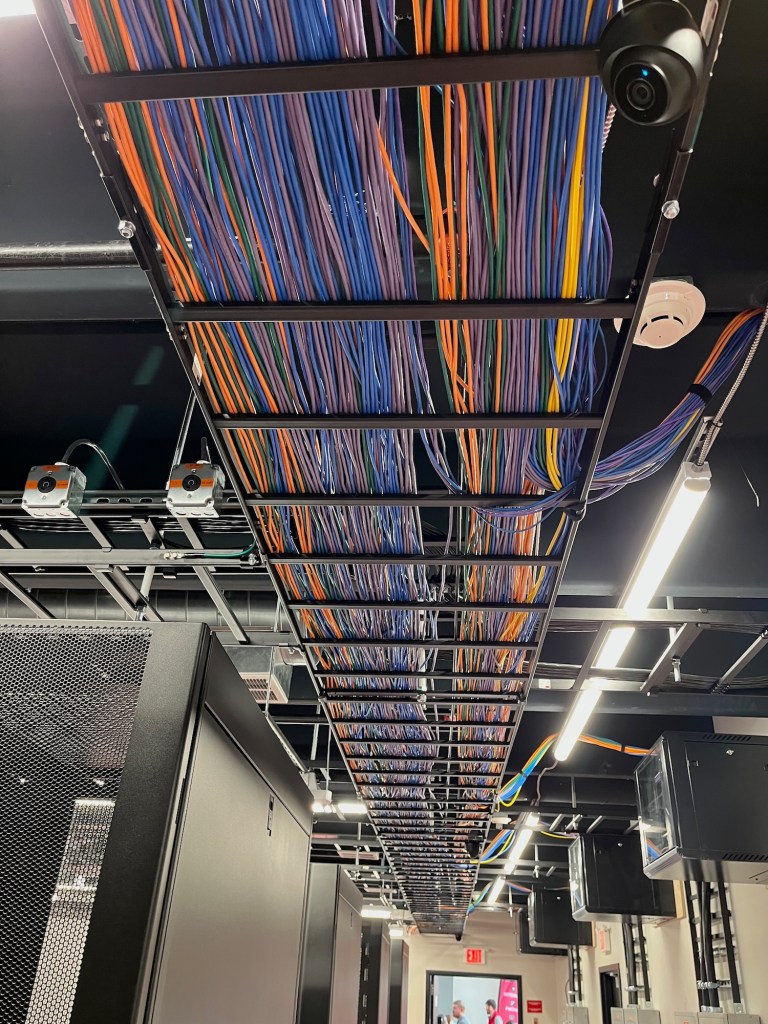
But that “excess” power generation doesn’t mean Wyoming’s megawatts can simply be redistributed to digital cowboys wanting to set up shop in the state. That’s not how utilities work, and besides, data center developers are making similar demands throughout the nation, scouring for whatever new source of electrical generation can be switched on the fastest — be it natural gas, wind, solar or nuclear.
After more than a decade of relatively flat electrical demand in the U.S., AI queries, digital streaming, bitcoin mining and other computations — along with systems to cool hard-working servers — increased to account for 4.4% of all U.S. electrical consumption in 2023, according to the Department of Energy’s 2024 Report on U.S. Data Center Energy Use. The report estimates that by 2028, those computations will account for 12%.
The demand, whether it’s 50% or 100% — or more — of current electricity output in Wyoming and the surrounding region, is likely to stress regulatory safeguards and, depending on how the systems are designed, water resources and air quality.
State’s efforts
The Wyoming Energy Authority is leading a stakeholders’ working group to try to find consensus on a wise regulatory approach that takes advantage of the economic opportunities without putting regular electric ratepayers — and their providers — at risk. Most involved agree that the party that places any new cost on the system ought to pay that cost. However, nothing in the realm of utilities and regulation is quite that simple, Wyoming Public Service Commission Deputy Chairman Chris Petrie warned.
Some data developers propose bypassing existing utilities, or only relying on them for backup power, by building their own electric generating facilities, or striking a deal with a “third-party” non-public utility power generator that serves only a handful of data customers. But what happens if those plans go awry?


“One way or the other, it all has to be sorted out so that costs get allocated to the causer, and it’s a super complicated, involved affair when you’re actually doing it,” Petrie testified. “But the concept is that if you cause the cost you pay the cost.”
Wyoming Energy Authority Executive Director Rob Creager said stakeholders in the working group have not yet reached consensus on recommendations to lawmakers for how to potentially tweak Wyoming’s regulatory landscape to deal with the issue. The group plans to bring its recommendations to the Legislature’s Corporations Committee in November.
Meantime, Creager said, Wyoming must grapple with how wide it wants to open its doors to the data industry — accounting for all its benefits and risks.
“What does the state want?” Creager posed to the panel. “What kind of growth and how do we want to supply that growth? Or do we want to supply that growth?”
Listening to my tech kids (graduates of UW) talk about the energy/water demands of AI ever since it started to become a thing, I really question the way it’s being used. While I think there are some really good uses of AI, do we really need to create memes for us on Facebook? There are so many irrelevant applications they are using AI for at the cost of the environment (though you could say this about many resources) it’s pretty sad overall.
Energy they can generate. The other part of the Data Center equation is water(cooling). Cooling in Data Centers is heavily dependent upon water and evaporation. Water will be the pinch point. Huge quantities of it. How much will water cost after factoring in Data Center demand in Wyoming?
Cheyenne’s water comes from the Little Snake River in the Colorado River Basin, and it’s groundwater comes from the Ogallala Aquifer. Both of those water sources are suffering shortages and will require more regulation. These massive data centers require a lot of water for cooling. Where is this water going to come from? Who is going to suffer from water scarcity? Water has a tendency to always flow toward money. Sorry agriculture and residential users… The US grid lacks the extra supply and capacity to handle the exponential power needs of these data centers. To be sure, the “Tech Bros” will spread their power costs onto the rest of the grid whenever it’s possible. The tech industries, especially AI and Crypto lack meaningful oversight, regulation, or limitations. What’s to stop nefarious, bad actors, or bad outcomes from this technologic “revolution”? AI isn’t guaranteed to be all “sunshine and rainbows” for the human condition. Remember the movie Terminator? We are not asking enough questions and not holding these developers’ feet to the fire. What’s in it for Wyoming? Is it a responsible use of our limited water and power resources? Why do we trust the “tech bros” and believe that they have our best interests in mind? I know that their primary interests are profit and control. I’m sure that their goals and Wyoming’s don’t align. We need to be very careful.
It is long past time to look at our utility regulation laws that came from the 1930’s and have established government monopolies as the model.
This should rise to a higher level of legislative priority.
Some great comments to Dustin’s article. AI is not about ChatGPT. AI will bring advances that will transform our lives. Advances in medicine, eradicating diseases, transforming agriculture, improving transportation, and many, many things we haven’t yet begun to envision. This is our generation’s industrial revolution and stands to be bigger and more positively impactful to the planet. We can stand in the way of progress with the buggy and buggy whip community that fought transformation brought by powered vehicles or we can embrace it and figure out how to drive amazing things from this technology revolution. WY is not the only state asking these questions and I would encourage WY to find a way to participate vs not. Technological advances shouldn’t be constrained by anything beyond our ability to solve those problems. Certainly not by our ability to power the datacenters that will drive those transformations. There are private industry solutions to solving datacenter power demand that take the risks off the utilities and the ratepayers and leaves it with onsite or site-adjacent power asset owner/operators to manage utility grade energy supply. Liberty Energy is one such company that has a multi-generational approach to solving our country’s power constrained ability to advance technology. There is no perfect energy source and we should responsibly use the resources we have to drive the right mix of energy solutions with a constant view to advancing better solutions. We can advance technology and power it responsibly while assisting the utility community and protecting the ratepayers. I recognize that the diversity of the community reading this article will bring some disagreement, but I hope my comments add to supporting AI and embracing all the challenges that will come with its advancement and not stalling amazing advancements within our grasp.
If people would be content to use their own brain power the energy cost is just a ham sandwich.
Some people make a better Sammy than others. Great comment!
Whether we like it or not; large data centers and AI are here to stay.
On site power generation is probably the best solution via SMR’s (Small Modular Reactors) once the technology becomes mainstream, or small hydrocarbon powered plants that can be converted to SMR’s in the future. In some ways, this would be a revival of the cogen power plant the engineering company I was employed at in the 80’s was working on. In that case, the customer wanted to use plant waste from their agricultural products processing plant to power the factory. The big difference is data centers don’t produce a waste byproduct that can be used as a fuel source.
Intermittent (e.g., wind solar with BESS (Battery Energy Storage Systems)) are not the answer as the systems lack the inertia for stable power generation, and batteries discharge rapidly.
The other issue is cooling (e.g., heat rejection) as Mr. Karberg touched on. Liquid cooling (e.g., water) is the most efficient, while air cooling, especially at this scale is inefficient. Given that western states are naturally drier than the eastern part of the country; I suspect that western states are going to have to look into modernizing water laws to deal with data centers and population growth.
With power demands in Wyoming rising rapidly—especially due to the influx of AI data centers—the state government should urgently implement an incentive program for small-scale solar projects. Encouraging residents and small businesses to adopt on-site, self-contained solar systems would help reduce strain on the grid and enhance energy resilience.
A property tax credit or direct installation assistance would be ideal to accelerate adoption. An added benefit is that excess energy from these systems could be fed back into the grid, potentially supporting the very data centers driving the demand.
It’s worth considering whether data center operators—who stand to benefit most from increased grid capacity—could help subsidize these solar installations for homeowners and small businesses. This kind of public-private partnership could be a win-win for energy sustainability and economic development in Wyoming.
The answer is easy – regulate the data centers to produce their own power inside the fence, on the other side of the meter. Force the data centers to pull themselves up by their boot straps without yet another socialization of their costs. They can sell excess power into the grid – they cannot buy power from the grid and in effect manipulate supply and demand and drive up public availability and prices.
After a long career in large power generation, I expect this emergent rapid growth of large electrical loads is not going to end well for the small consumer (and our planet). After all, every single watt consumed eventually is rejected to the environment as heat.
Given the retirement of many, many older coal-fired generating units in the USA, generation will not exist to support these new loads 24×7. The time required to build/install/connect additional fossil or nuclear generation will not match the rise in demand. While new renewable sources can help, they will require significant new storage to cover those times when “the sun doesn’t shine and the wind doesn’t blow”. Then there is the issue of new transmission and distribution development, further increasing overall costs significantly.
A large portion of this new “stuff” (generation equipment, transmission and distribution materials) cannot be sourced within our borders. Much if it will be imported.
The human brain “consumes” about 20 watts (+/-) of power to function, and uses insignificant amounts of evaporative cooling as required. The brain handles a considerable amount of life’s processes even when asleep. “Thinking hard” hardly increases power at all. Compare this with a data center’s power consumption and cooling requirements. Without significant advances in reducing the electric power demand for these new data centers, costs to all consumers will certainly increase in the near future.
Finally, given the rapid advancement in computing power that we can hold in our hand, I would not be surprised if AI will eventually reside entirely in your pocket. This would obsolete all of these new loads within a decade or so.
Hang on! It’s gonna get rough!
Your right Wayne – it could get rough. Looks like a wreck coming to me.
Some one needs to fess up, what’s all this data that data centers will be constantly crunching and why is it so important? We’re supposed to strip mine planet earth so kids can ask ChatGPT to do their homework? Don’t think so. Tracking every move we make, recording and monitoring every monetary transaction we make with new blockchain based stablecoin currencies perhaps? Big Brother wants to know and track everything.
Who knows how many gigawatts of new coal fired power plants China’s brought on line the last ten years. They’re essentially a cashless society under full surveillance too. Is this what we want?
The ramifications to Wyoming ratepayers will be significant unless we act to limit that iimpact and require these power monsters data centers to pay the full cost of pwoer and not regulator consumers. And the water demands are also a huge concern that could use some additional review and discussion. What are the water needs and where will they get the water? Why do we want or need data centers in Wyoming? What is cost to Wyoming ratepayers and citizens?
Excellent article. The surge in demand is also requiring significant upgrades to the power transmission lines throughout Wyoming.I did a simple Google search and it requires upgrades of 110 kilovolts, 230 kilovolts, 500 kilovolts and 600 kilovolts transmitting power within the state and exporting power out of state – primarily to the SW. Reportedly, there are hundreds of construction workers building the new transmission lines today. And, the substations are being upgraded such as the new facility outside of Medicine Bow. I haven’t heard a lot about the sources of cooling water for the new data centers – the Ogallala Aquifer is already stressed in the Cheyenne area and large volumes of industrial withdrawals via groundwater wells would draw down the existing wells with senior water rights.
I did read somewhere that the average monthly power bill for residential customers has risen about $40-45 per month in order to pay for the upgrades to the grid and the environmental expenditures due to power generation. This is going on all over the nation. Closing of coal fired power plants is being delayed and some retired plants are being brought online particularly for bitcoin mining. The speed of the movement towards AI is astonishing; and, an AI inquiry requires 10 times the power and water consumed by cloud computing. In order to meet the demand all sources of power must be utilized including nucular -such as reopening one of the units at 3 Mile Island. unbelievable!!!
It might be time for Wyomings goofball politicians to start working on something important instead of trying to control what people read. If you (goofballs) let the wealthy get wealthier on the back of the Wyoming people you’ll be run out of office- I can only hope.
Well here are some facts. Thermal generation is roughly 40 to 60 percent efficient based on the type and design of the plant, nukes are roughly 70 percent efficient, and wind and solar are are 9 to 11 percent depending on the day.
Because nukes are such a hot bed issue that cause everyone to scream in fear, and the ridiculous HB 200 that ruins thermal plant efficiency to a dwindling 17 percent (if it can actually be made to work, at this time no scale working model exists), I personally would say no thanks.
The only way to make it work would be to repeal HB 200 (carbon capture) and build new HELE thermal plants.