

Opinion
What happens when Wyoming’s constitutional obligation to provide an equal, adequate education to every K-12 student in Wyoming collides with the Legislature’s desire to cut taxes, specifically property taxes? The Wyoming Constitution states in Article 7, Section 9: “The legislature shall make such further provision by taxation or otherwise … will create and maintain a thorough and efficient system of public schools, adequate to the proper instruction of all youth of the state, between the ages of six and twenty-one years, free of charge.”
Constitutional foundations of school funding
Wyoming had five state Supreme Court decisions between 1980 and 2008 that further defined this constitutional right, including how the Legislature must fund K-12 education. The 1995 Campbell County School Dist. v. State decision stated: “Supporting an opportunity for a complete, proper, quality education is the legislature’s paramount priority; competing priorities not of constitutional magnitude are secondary, and the legislature may not yield to them until constitutionally sufficient provision is made for elementary and secondary education.” The court declared education to be a “fundamental right” for every child in Wyoming. I agree that education is a fundamental right for every child, and I believe that education is the foundation of the state’s future.
The courts have continued to uphold these decisions, including in recent litigation over the adequacy of school funding. District Court Judge Peter H. Froelicher issued a ruling in February 2025 and ordered “that the State shall modify the Funding Model and the school facilities financing system in manners consistent with this Order to assure the school financing system for operations and for school facilities are constitutional. The Court notes, because 2025 is a recalibration year, there is an excellent window of opportunity to address these issues.”
To implement these constitutional requirements, the courts and Wyoming law require the Legislature to create a K-12 funding model that adequately and equally funds the education of every child in Wyoming, that examines the funding model every five years through a process known as recalibration, that adjusts the funding model for inflation every year through the external cost adjustment, or ECA, process and adjusts the funding model during recalibration to account for the regional cost adjustment, which differentiates the cost of living in different communities.
Where the money comes from
Why does all of this matter? The total dollars expended on K-12 education funding are comparable to all the money expended by the General Fund for all other agencies of state government. K-12 education receives revenues from several different sources, ranging from property taxes to investment revenue to mineral revenue. To top off this difficult picture, if all of these revenue sources are insufficient to fully fund K-12 schools, then Wyoming’s “Rainy Day Fund” — the Legislative Strategic Reserve Account — is by law required to transfer money to the School Foundation Account to ensure the K-12 funding model is fully funded.
2026 Recalibration: costs and consequences
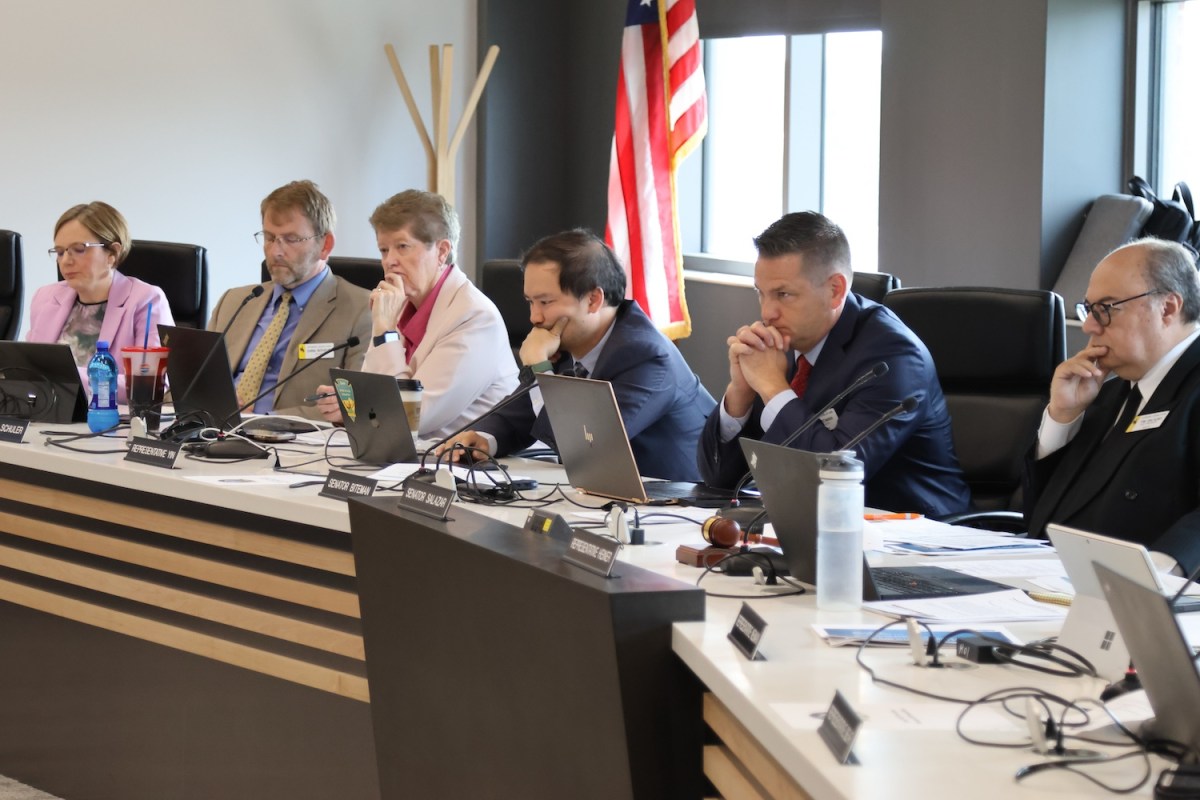
Fast forward to Jan. 22-23, 2026, when the Select Committee on School Finance Recalibration passed a bill with a revised K-12 funding model, something that hasn’t been accomplished since 2010. I was part of three efforts in the last 10 years to address changes to the K-12 funding model, but the Senate and House could never agree on the same path, so the funding model has remained relatively unchanged for over a decade, except for some inflationary external cost adjustments over the years.
With Judge Froelicher’s decision hanging over the Legislature’s head, coupled with the Wyoming Supreme Court waiting for legislative action, the select committee finished its recommendation to the Legislature. You can view the comparison of the current funding model with the committee’s recommendation in the Jan. 30, 2026 Legislative Service Office memo, “K-12 Funding Model Comparisons, by Component.”
The increase in funding proposed … appears to fall short of the evidence-based funding model recommended by the state’s consultants, perhaps leaving our school districts without the adequate funding that Wyoming’s constitution requires.
For school year 2026-27, the funding model recommended by the select committee costs $54.8 million more than the current model, and in 2027-28, the cost will exceed the current model by $102.4 million. It is unclear from the information provided to the public what the evidence-based funding model will cost. The evidence-based model is the funding model that the consultants recommended to the select committee.
The Supreme Court cases have mandated that Wyoming utilize a consultant to assess the adequate cost of education. For the most part, the same consultants have been examining Wyoming’s funding model for a couple of decades. Furthermore, the increase in funding proposed by the select committee appears to fall short of the evidence-based funding model recommended by the state’s consultants, perhaps leaving our school districts without the adequate funding that Wyoming’s constitution requires.
According to my sources, the consultants’ model was nearly $100 million per year more than the existing funding model. That is $200 million a biennium, or two-year budget cycle, plus a yearly inflation rate. This is a huge hit to the state’s budget, especially in light of recent laws reducing property taxes, one of the primary funding sources for education.
Erosions of local decision-making
The funding generated from the consultants’ model has always been considered by many to be the amount that is constitutionally required to fund education. However, the courts have always upheld the fact that local school boards have the authority, within reason, to vary from the recommended model’s individual elements. For example, if the consultants’ model says a school in Timbuktu should be resourced with eight custodians, the local school board could instead decide that six custodians are sufficient. That school board could then put those savings towards another element of the model, like increasing teacher wages. This is called a block grant funding model. A block grant allows local school boards to vary their educational programs to accommodate the desires of the community. I support local control.
Unfortunately, through this year’s recalibration process, local control has been attacked, as has local school boards’ flexibility and decision-making authority to allocate funds to meet the educational needs of students.
According to K-12 educators, some of the hardest-felt impacts from the draft proposed public school finance bill, include a move to categorical funding, which would take away each district’s ability to direct block grant funds to the highest needs. It would move away from a system that gives districts the ability to self-correct through attrition when faced with declining enrollment. Full-time teaching positions would be eliminated next year, which will lead to larger class sizes and fewer course offerings at our middle schools and high schools. Moving to an average teacher salary of $70,560 sounds appealing, but many school districts are already paying their teachers at or above this average rate.
This may also discourage districts from hiring experienced and highly educated teachers, and mandating participation in the state’s insurance plan beginning in the 2027-28 school year further erodes local control and diminishes a valuable benefit for all staff. Collectively, these changes reduce local control and constrain districts’ ability to respond to student and community needs.
Legislative choices and missed solutions
The Select Committee on School Finance Recalibration is usually comprised of legislative leadership and key committee chairmen. The 2025 rendition of this committee was no different, as the speaker of the house, Senate president, Senate and House chairmen of appropriations and education, along with minority leaders, served on this committee. This committee had the “horsepower” to bring a comprehensive solution to the funding challenges created by this updated funding model, which will need nearly $100 million per year to fund. I do not see where such a comprehensive solution was put forward.
In 2017, the Legislature was facing a deficit in education funding. The House Education Committee brought the idea of a five-part plan to fund education that included some funding freezes, increased spending authority, diversion of dollars from savings and the General Fund to education, a half-cent sales tax for education, and utilizing the “Rainy Day Fund” as the backstop for education funding. House Bill 236 was the result.
This was perhaps the first time that a single comprehensive solution bill was brought to bear on a deficit in education funding. Only portions of the bill passed the Senate, but it was a good effort to look at education funding challenges from several angles.
Wyoming’s constitutional commitment to education is clear. Recalibration should strengthen that commitment and not undermine it. A sustainable school funding model requires balanced solutions that respect constitutional mandates, preserve local control and acknowledge fiscal realities.
Unfortunately, the Freedom Caucus appears to want to dismantle the General Fund side of state government to solve the challenge members of the Legislature, including me, created by cutting property taxes, which are the primary funding source for education. What started out in 2024 as an effort to slow the rate of property tax increases, provide reimbursement to those who most needed it and provide time-limited tax relief to every homeowner has turned into a mad dash to erode or eliminate the largest source of funding for education. Based on the bills coming out of the Joint Revenue Committee, the Freedom Caucus wants to cut property taxes even further or eliminate them altogether. Any additional cuts to property taxes will only put more pressure on Wyoming’s “Rainy Day Fund” and the General Fund, and would be unsustainable in the future. The Select Committee on School Finance had multiple levers to pull, but they chose to pull only one. When House Appropriations Chairman John Bear, a Freedom Caucus leader, says the Legislature is looking at an $800 million deficit, he only needs to look in the mirror to wonder why, as he sat on the select committee that could have brought a comprehensive solution to education finance.
Albert, thank you for being a voice of reason in this season of school funding. I so wish you were back in the legislature as you truly listened to us rather than just saying thank you for your comments and then ignoring them completely.