

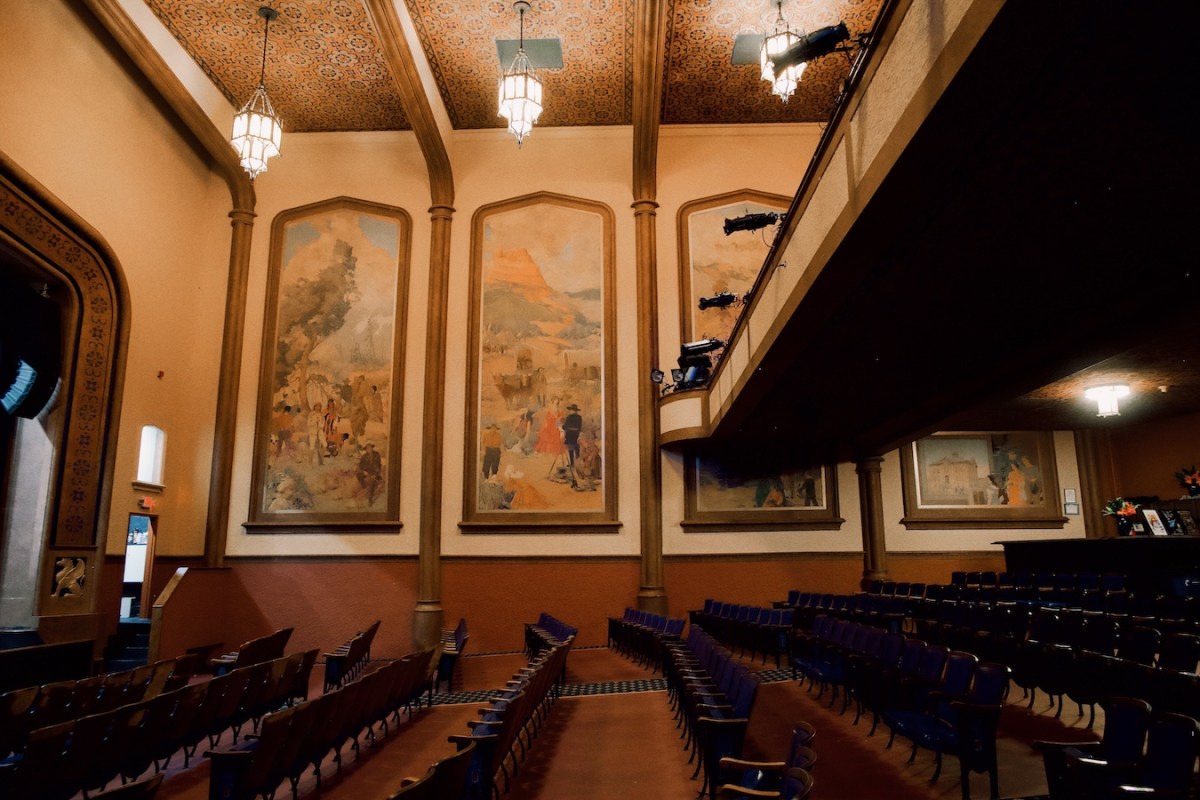
In the Laramie Plains Civic Center, the theatre’s north wall is covered in four framed oil-on-canvas paintings. The panels, painted by Florence Ware of Salt Lake City, depict frontier people across the Wyoming plains.
Opinion
In the murals, women in hoop skirts wave handkerchiefs at a passing steam engine. Children play — a young boy with a bow and arrow, a young girl with a bonnet-clad doll. Men and their dogs rest on a prairie hill, while others move cattle in the background.
Throughout the landscape, Indigenous and settler caricatures stand alongside historic figures from the state’s past — Jim Bridger, Jacques La Ramie, Father DeSmet, Chief Washakie. Yet, the paintings don’t depict the grim truths of settler colonization. That absence unsettles me.
It is my job to steward this building, and thus, these paintings and the story they tell. In one panel, cowboys and their border collie take a break in the foreground. In the distance, there’s a heavenly scene reminiscent of a Renaissance painting. Half a dozen figures in feather headdresses float in a towering pink cumulus cloud. One man stands, while the rest sit in a half circle, with their legs crossed. To me, it would seem, this scene depicts a peaceful gift of the Indigenous land to the plainsmen. The figures ascend from what was once their residence to the sky, passive witnesses to what would become Wyoming.
The artist, granddaughter of a Laramie pioneer couple, is said to have painted the western scene in honor of her aunt who taught in the original school building. She was teaching art and interior decorating in Utah, when she was commissioned in 1929 by Wilbur A. Hitchcock, the architect for the building’s addition, to paint the murals for the auditorium.
“The cut stone and brick building would bring some formal education to the western frontier cubs,” the building’s nomination for the National Register of Historic Places states. What is now the Civic Center was once East Side School, the Wyoming Territory’s first brick schoolhouse.
In 1928, University of Wyoming President Dr. A.G. Crane dedicated the building:
“To truth that shall make men free;
To knowledge in combat against ignorance and superstition;
To America’s search for and development of genius;
And to the great posterity of Laramie.”
Dawn Stagner, Indigenous Affairs writer and enrolled Cheyenne Arapaho Tribe member who is also Eastern Shoshone, wrote “Letter to a future ancestor,” in reflection of America’s 250th this summer. “The government made our ceremonies and traditional ways illegal, and the boarding school system tried to strip us of our languages and traditional ties to our lands. Our languages are now endangered and might disappear in the span of a generation.”
“‘Equality’ did not exist for us here in Wyoming,” she continues.
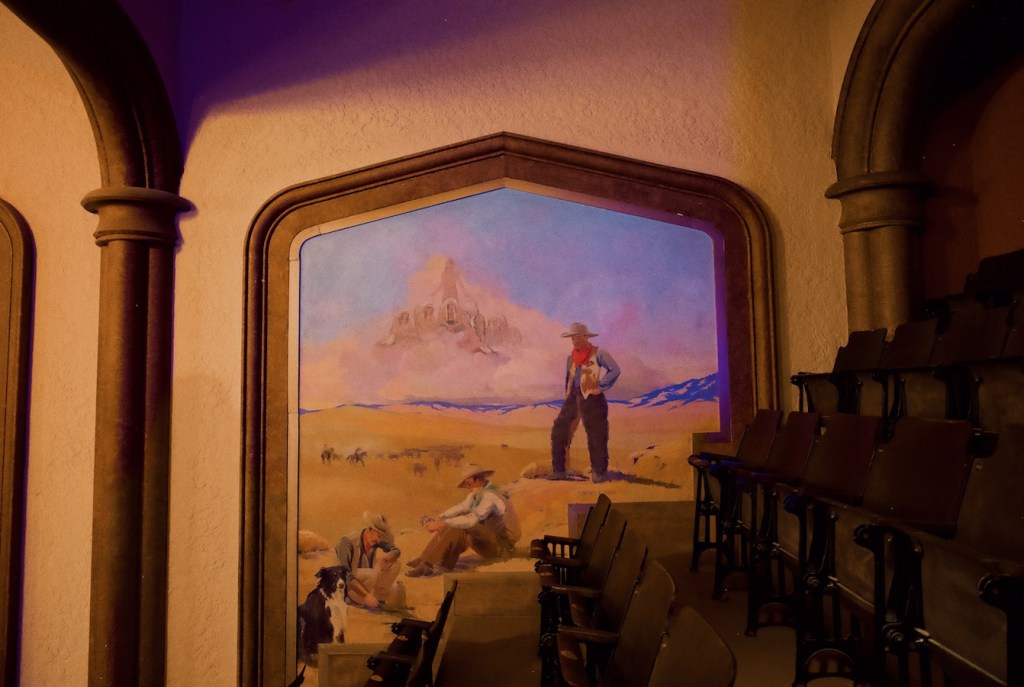
In 1969, Ware told the Laramie Boomerang, “I painted them as a matter of historical record of the state of Wyoming.” She researched the area for many months and aimed to include “as much of the history as she could,” the article states. I don’t know why she painted this scene, or with what intent she painted Indigenous figures floating above the prairie, but it invokes a sense of peace that couldn’t be further from the truth of their violent displacement from this place.
“The weight of this reality is uncomfortable; the misery of guilt makes one hurry toward any reprieve,” scholars Eve Tuck and K. Wayne Yang wrote in “Decolonization is not a metaphor.” Their article aims not to soothe my unsettled conscience, but rather to remind me that decolonization returns Indigenous land. That act decenters settlers like me entirely. “Decolonization is not an ‘and.’ It is an elsewhere,” they say.
Shoshone Chief Washakie is celebrated throughout the state as a man of peace. In the murals, he stands in a sea of American flags alongside cattlemen, fur trappers and explorers. The 1863 Treaty of Fort Bridger granted the Eastern Shoshone around 44 million acres. Five years later, the 1868 Treaty of Fort Bridger shrank this allotment to roughly 3 million acres in the Wind River Valley. In 1878, the same year East Side School opened its doors, Northern Arapaho arrived by Army escort to what is now the Wind River Reservation, despite being promised sovereign land of their own.
Ware’s murals are an artistic feat and a visual asset to a gathering space. Yet, I am haunted by my responsibility to the fabricated history they depict. Stagner’s letter invited an avenue for the settler anxiety this art evokes in me. She reminds me to look closer, not away from this history.
My tools in community building — connective storytelling, philanthropy, mutual aid, attempts to divert the negative impact of harmful policy — aren’t innocent of that history. Ware’s depictions of Indigenous men in the Wyoming clouds don’t make their presence unreal.
The path of least resistance would be to call these painted figures and my disturbances a product of a very old building. I could remove the paintings in an attempt to eradicate any further examination of them. I could avoid drawing any attention to their fraught imagery. But these painted figures are not distant, foggy memories; they are living communities. This peaceful painted story is not the full history.
Stagner writes, “True equality demands a hard look at the past.”
We will not find that past painted on oil canvas panels in historic school buildings. Our innocence is make-believe.
The figures floating in the prairie clouds, for better or for worse, force me to question the stories we tell about the West every single day.