

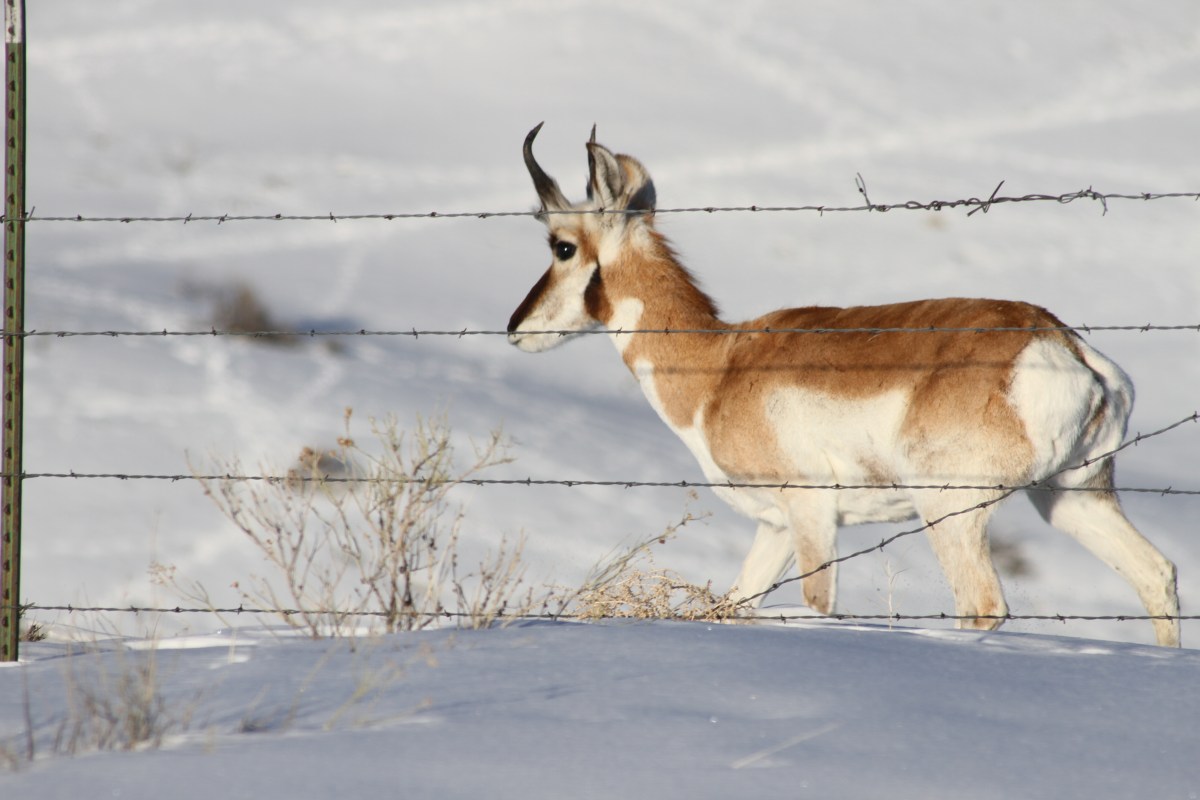
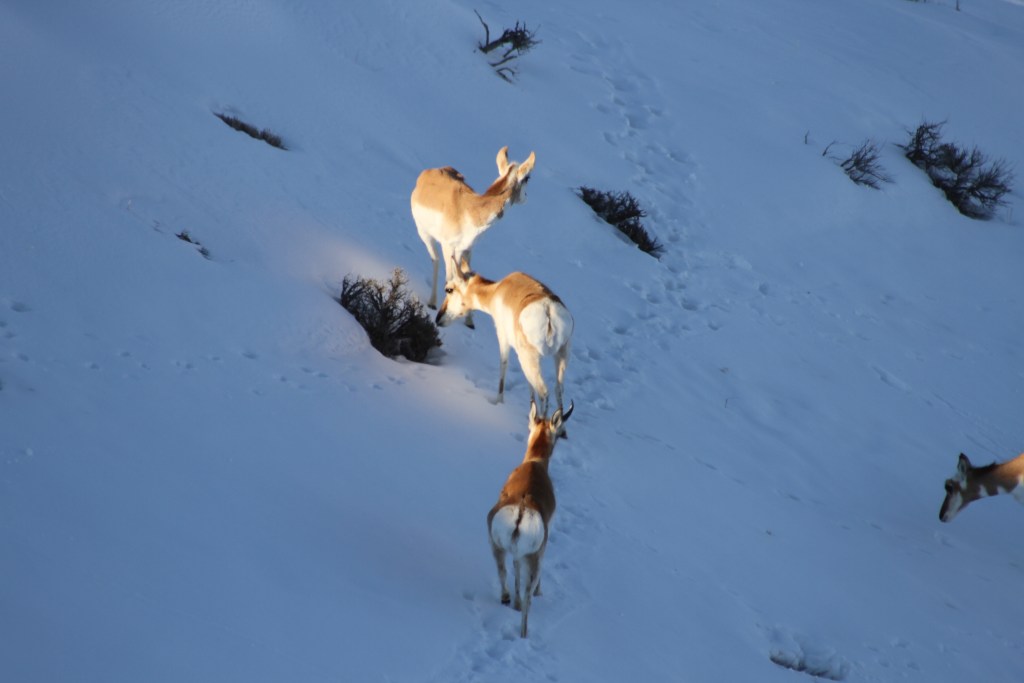
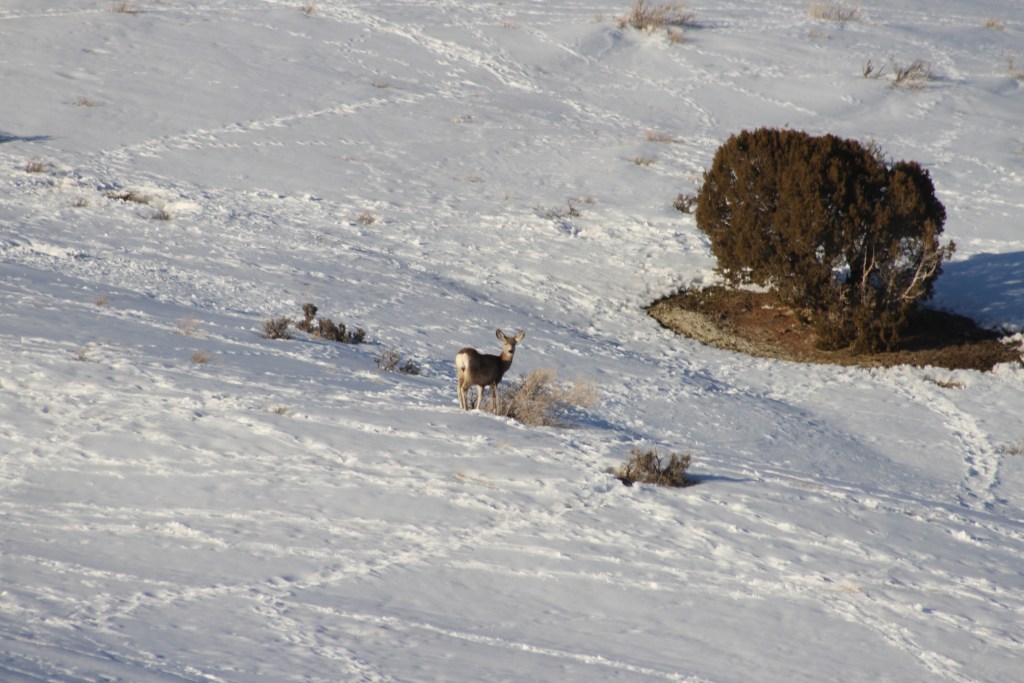
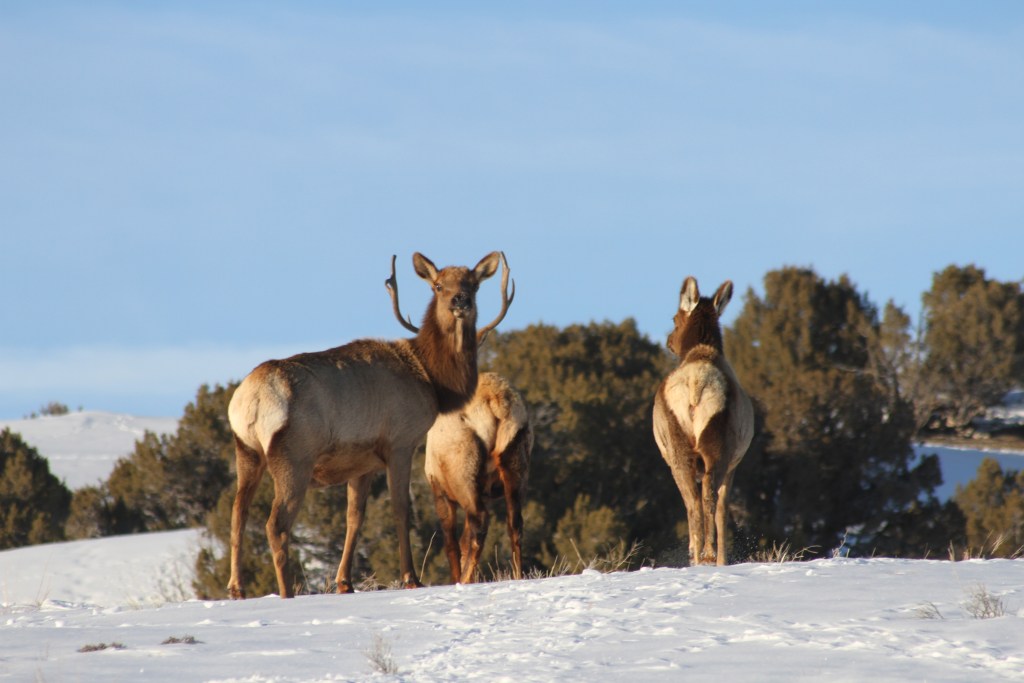
Forced downhill by deep snow, hordes of elk, deer and antelope trying to survive the winter are congregating in highway corridors in southern and western Wyoming.
A WyoFile reporter caught images of all three species of ungulates drawn to melting-out southern-facing slopes near the highway within the Little Snake River Basin, where the snowpack hovers near 140% of the median. The animals pictured were just south of the state line, along the long rural drive from Steamboat Springs, Colorado to Rock Springs.
Reports have filtered into WyoFile of road-killed ungulates littering Wyoming highways in recent weeks.
WyoFile reporter Angus Thuermer observed as many as a dozen dead elk east- and westbound along Interstate 80 near Elk Mountain during the first week of February. Traveling along I-80 the following week, Laramie resident Chris Rynders saw a couple herds of surviving elk as well as roughly five dead cows, plus “quite a few” dead antelope in the interstate median and on the shoulders. On Feb. 11, longtime Wyoming journalist Dan Neal spotted at least another 10 dead elk between Echo Canyon, Utah and Rawlins while headed home toward Casper, also along I-80.
SNOTEL maps show that snow is deepest around the I-80 corridor, but the snowpack remains more than 120% of the long-term median in other pockets of Wyoming. One of those hard-hit areas is near the southeastern tip of the Wind River Range, said Cody Beers, a public relations specialist for the Wyoming Department of Transportation.
“Between Riverton and Rawlins, it looks like the Sahara Desert because the snow has drifted over so much,” Beers said. “It can be rough. We got early snow this year, then it blows around and creates a crust and it makes it difficult for all animals out there trying to survive. Elk, deer, pronghorn, even wild horses.”
Conditions spurred the Wyoming Game and Fish Department to initiate emergency elk feeding. There are “well over 100” being fed at each of several makeshift private land feedlots, including in Star Valley and near Fontenelle Reservoir and Cokeville, said Game and Fish’s Doug Brimeyer.
“We’re trying to alleviate and mitigate the likelihood that those animals go into private land and cause damage to haystacks or commingle with livestock,” Brimeyer said.
Wyoming wildlife officials only feed elk, a practice that’s historic and idyllic but also a disease-susceptible way of managing wildlife that’s being reassessed, however slowly. Managers do not systematically feed mule deer and pronghorn, even during big winters, due to differences in the way they process food.
“They’re so highly specialized and selective in what they forage on that if you switch their diet abruptly you can actually do more harm than good,” Brimeyer said.
That leaves the smaller-bodied ungulates more vulnerable to the whims of nature.
In a bad year, entire classes of fawns die off, as do significant percentages of adults. It last happened in winter 2016-17, which deposited twice the average amount of snow in southwest Wyoming.
Brimeyer sees some signs that 2022-23 won’t prove as deadly. For one, there isn’t as much snow. And the animals went into winter “on a little higher nutritional plane,” he said.
“We’re optimistic that the deer are going to make it through or move into areas where they can make it,” Brimeyer said. “We’re obviously going to see some loss.”
Part of that loss is playing out on Wyoming’s highways, where WYDOT’s Beers has a message for motorists.
“When you’re out driving around this winter, give them a brake,” Beers said. “Give the animals space. You can get pretty close to them because they’re stressed, but view them from afar … they need all the energy they’ve got to survive the rest of this winter.”
Once again “cowboys” in WY and MT expect a handout from US taxpayers because they ranch in marginal areas that are subject to drought and severe winter conditions. Remember the winter of 1886-1877? What is sustainable without the generous contributions of US taxpayers? Why should I subside a way of life for the cowboys that produce a very small amount of beef.
Please change your title, the alliterative charade seems to make light of the tragic scenario that worsens with each new storm system. It reads as morbid insensitivity to a situation that does not need wordplay to describe its inherent significance.
Someone needs to point this out to the Wyoming Game and Fish. They need to stop selling licenses in these areas until the Herds have a chance to recover.
It is rough out there for sure. I imagine in ages gone by when there were also hundreds of bison and way more wild horses that the wildlife survived better because they could move to where the snow was not as deep. Now they are in all actuality confined to where people aren’t with their homes, farms, fences , roads, etc. The apex predators could have survived by taking down weak ones or dead ones. Humans constantly half to figure out new ways to rectify the problem created once they decided which animals could live and where they could do it.
The food processing differences was very interesting and made me appreciate that you hit on the harsh practicality of the feeding programs for each species.
Your story this morning compelled me to contribute to the important WyoFile cause. Thank you