



Wyoming’s legislative budget session is one day old, and I’ve already spotted a trend I don’t like.
At the risk of being dubbed Wyoming’s version of Saturday Night Live’s Debbie Downer, please hear me out.
Opinion
At last year’s general session, the Legislature considered — and fortunately defeated — a bill to give Texas $5 million to help pay for a border wall between the Lone Star State and Mexico. At the time, Texas had a budget surplus of $36 billion.
This year we have Senate File 78 – Carbon dioxide-enhanced oil recovery stimulus. It would provide a $10 million “stimulus” to encourage more carbon capture for use in the oil industry.
The primary potential beneficiary of this bill would appear to be ExxonMobil, the world’s largest publicly traded oil and gas company. It’s valued at roughly $408.5 billion, and turned a tidy profit of $36 billion last year.
Is this an apples-to-apples comparison? No. One proposal tried to use a red-hot political issue to pretend the state is making a meaningful contribution toward ending the border crisis. The other would help Wyoming obtain more tax money by extracting hard-to-get petrochemicals from existing oil fields — despite the desperate need to reduce planet-killing carbon emissions.
Both are bad ideas that show Wyoming’s perilous priorities, but the second is monumentally worse. While the Legislature nixed aid to the border wall, the boon for the fossil fuels industry has so far sparked little opposition from lawmakers.
I know what you’re probably thinking: Does ExxonMobil, with its staggering resources, really need Wyoming’s $10 million?

Well, according to SF 78’s sponsor, the Joint Minerals, Business & Economic Development Committee, companies could use a little extra incentive to capture more carbon dioxide and use it for “enhanced oil recovery,” or EOR.
Here’s how it would work: The Biden administration expanded the federal 45Q tax credit program via the Inflation Reduction Act to encourage both direct carbon dioxide storage and EOR. But the former provides an $85 per metric ton tax credit for “sequestering” carbon dioxide underground, while EOR gets only $60 per metric ton to inject pressurized carbon dioxide into oil fields to produce hard-to-get reserves.
The bill would create a $10 million fund administered by the Wyoming Energy Authority to pay an additional $10 per metric per ton to spur more companies to capture carbon dioxide for EOR. Proponents say it could boost Wyoming’s severance, royalty and property tax revenue by hundreds of millions of dollars while making the process more profitable for corporations.
ExxonMobil is one of only two companies in Wyoming capturing carbon dioxide. In 1986, at the Shute Creek natural gas processing plant near LaBarge, ExxonMobil became one of the first in the nation to employ carbon capture technology to produce natural gas from a field with extremely high carbon dioxide content. The other one operating in the state is Contango Oil and Gas’ natural gas processing plant east of Shoshoni.
Can pumping more fossil fuels out of the ground actually help fight climate change? It sounds counterintuitive, but researchers at the Wyoming Energy Oil Recovery Institute and others contend the process may be carbon negative.
Let’s put that proposition in the “iffy” category at best, because it only exists in an ideal world. If EOR operations drew exclusively on carbon dioxide captured from anthropogenic disturbances like pollution, and sequestered the maximum amount possible, it might make them carbon negative on a lifecycle basis. But today, such sources account for less than 15% of the carbon dioxide used in EOR operations.
Still, even short of this goal, smart regulations and incentives could lower the lifecycle emissions from burning oil and gas, driving industry’s costs down while fighting climate change.
But some members of the legislative panel questioned why Wyoming should provide incentives to huge corporations that could easily afford to expand their own carbon dioxide-EOR operations.

“These incentives go to Exxon, but they’re already selling all that they can, and this would just provide an increased margin for them,” said Rep. Scott Heiner (R-Afton). “How do we get that benefit to the small operator … and utilize money in the state rather than just for a large corporation?”
That’s an excellent question. Peter Obermueller, president of the Petroleum Association of Wyoming, said his group supports the bill no matter who earns the benefit.
But it does matter, if one is thinking globally and not just what’s good for Wyoming or the minerals industry.
The Powder River Basin Resource Council, a Sheridan-based landowner advocacy group, generally supported EOR until December, when it passed a resolution opposing the process. The technology, the council noted, is “more likely to contribute to a greater atmospheric load of greenhouse gasses rather than reducing anthropogenic emissions.”
“There’s a reason why the [Inflation Reduction Act] has a higher incentive for permanent storage,” resource council attorney Shannon Anderson told WyoFile. She added climate is not mentioned once in the stimulus bill.
David Roberts runs the “Volts” newsletter and podcast on clean energy and politics. He examined the pros and cons of EOR for Vox.
“The core of the climate case against EOR is simple: Climate change is an emergency. We need to bury lots of carbon, but it is crazy to let the oil and gas industry set the pace and terms,” Roberts wrote. “EOR under certain rarified circumstances may be carbon negative, but you know what’s aways carbon negative? Burying carbon dioxide without digging up a bunch of oil to burn.”
Roberts explained that while we need oil, companies are driven by the profit motive to sell as much as possible. But humanity’s long-term interest means using as little oil as possible.
“Oil and gas companies are, after all, bad actors,” he wrote. “For decades upon decades, they’ve been lying about climate change, fighting furiously against any regulation that would force them to internalize the costs of their pollution, and lobbying against clean air policies at the federal and state level.”
Lon Whitman, director of the Enhanced Oil Recovery Institute, maintains there’s no financial downside to the state’s proposed stimulus and a high probability of revenue returns.
“What this bill says is, ‘We are open for business,” Whitman said. “We’re trying to find ways to help industry survive and grow with the constraints and the controls that are developing.”
“It’s Wyoming choosing to invest in a way that pushes back against the policy direction of the federal government,” Obermueller added. Yes, if you’re trying to persuade Wyoming legislators, it’s advantageous to bash the feds.
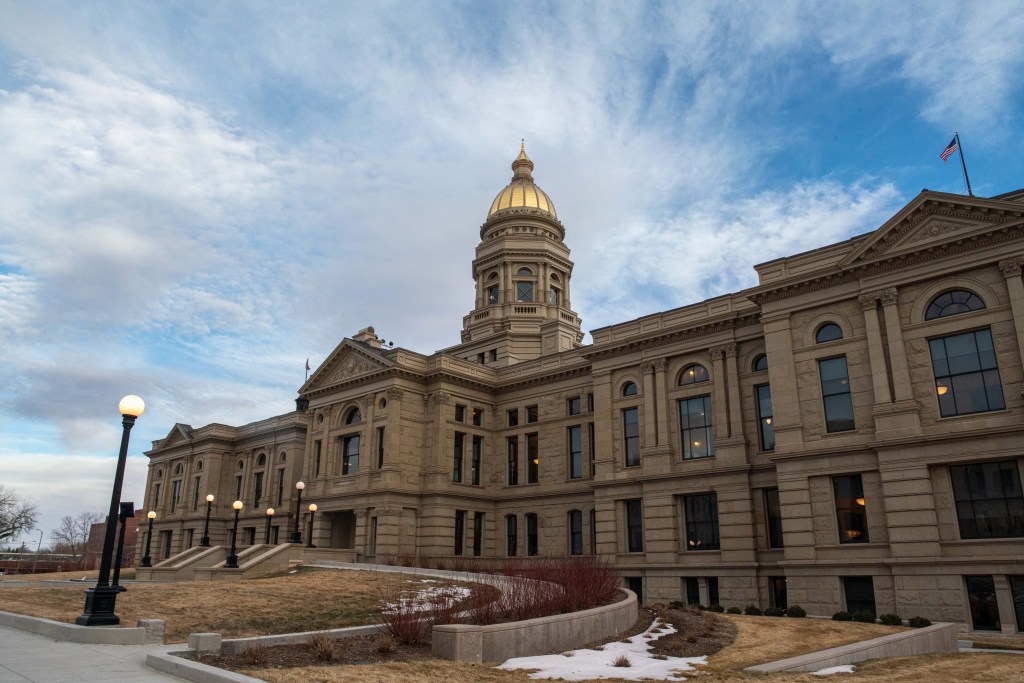
While it’s true Wyoming will simply keep the stimulus money if companies don’t use it, there’s still a cost.
Putting money into a separate account makes it unavailable to use for other needs. There are many beneficial things that aren’t being funded that would help people now.
Here are just two examples: $10 million would nearly pay for the state’s portion to expand Medicaid in its first year. It would fund half of the $20 million in the Department of Health proposed budget that wasn’t recommended by Gov. Mark Gordon, but was approved by the Joint Appropriations Committee.
More state revenue to pay for vital services would be great, but even if oil production is substantially increased, what will those additional dollars actually be used for? More savings?
If the likely result is lining the pockets of Exxon-Mobil, but not more carbon storage, let’s not gamble with the state’s money. The planet can’t wait while Wyoming officials sit around and play politics. Our future is at stake.
I really don’t know much about enhanced oil, recovery and its effect on the environment.. But I think our legislature is motivated by money so they support whatever oil or gas initiative that they feel will get them reelected.
My one big question for Mr. Drake is do you get paid hazard pay for having to deal with our legislators. I really think you should.
Our planet and our atmosphere is being affected by what we do. Will it affect me before I die maybe, I’m 67 and hope to live another 10 to 15 years. The comment by Mr. Koller. Is uninformed. Carbon levels are not the only thing that affects our environment.
I’d like to reiterate one point I’ve made to WyoFile readers before, and I’d sure wish Mr. Drake would understand it. Our planet, in its approximate 4.54 billion-year-history has never had ONE climate, or ONE STABLE CLIMATE of ANY nature!!! It has ALWAYS changed and WILL always change regardless of human presence or absence. During that which we call the Jurassic and Cretaceous Time Periods, atmospheric carbon levels were four-to-five times greater than they are today! We are NOT experiencing a global climate EMERGENCY! At present, we are experiencing an almost all-time atmospheric carbon low!
Eventually, humans may embrace nuclear energy to power high-tech’ societies. But has Mr. Drake ever wondered how much ore must be extracted and refined to manufacture photo-voltaic cells and wind turbines? Has he ever examined and opined how our environment is impacted by that activity alone? As a consistent reader of WyoFile, I can say, “definitely not!”
Robert; It’s true that in Earths more than 4 billion years of existence it has undergone many dramatic changes in climate. However, homo-sapiens have only been around for about 250 thousand years and haven’t experienced and probably couldn’t have survived the 4x higher atmospheric CO2 concentration which occurred many millions of years before their existence. The current rate of increase in atmospheric CO2 concentrations along with average global warming, caused by anthropogenic burning of fossil fuels has never before been experienced by man. Your argument is completely irrelevant to the current climate emergency. Possibly this is why Mr. Drake doesn’t adhere to your rhetoric.