

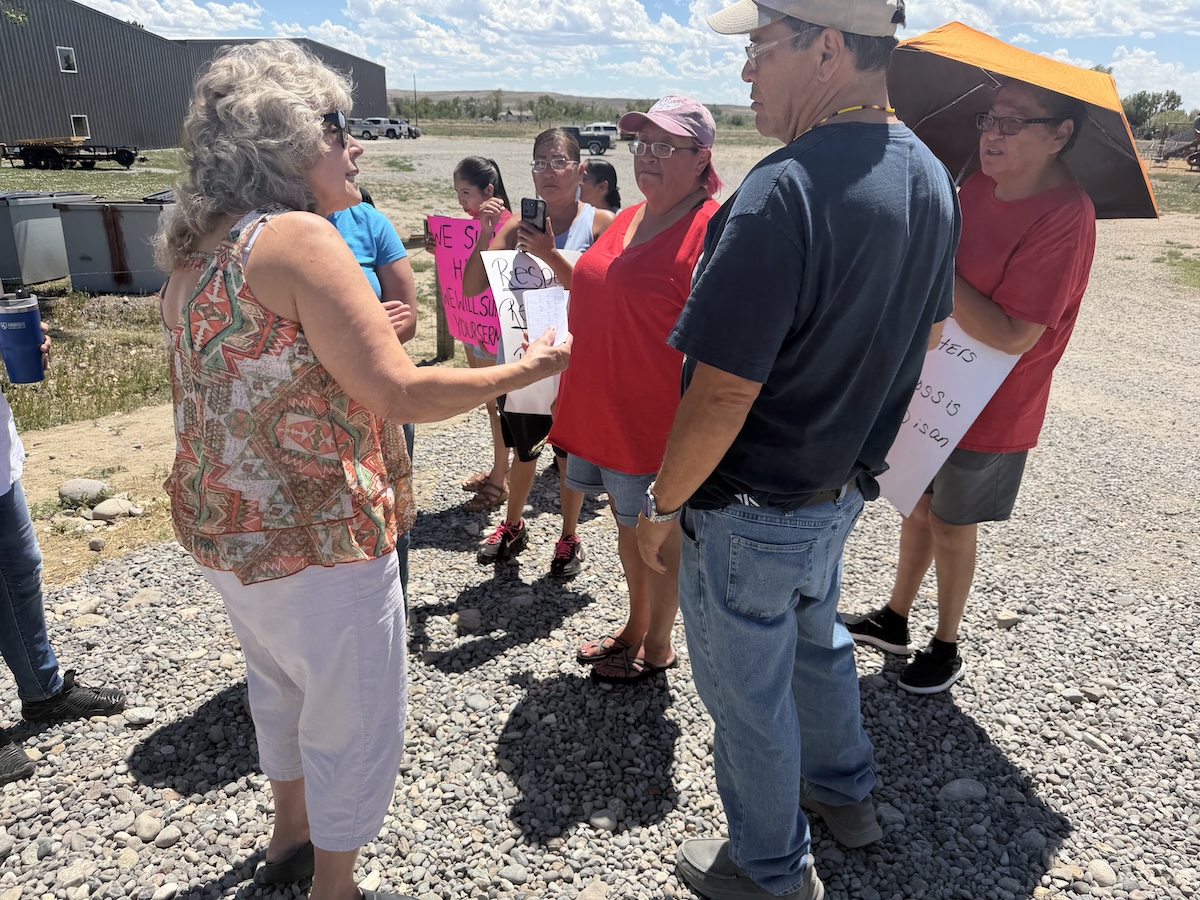
Darci Quiver pulled out her cellphone and pressed record as the law enforcement officer approached her vehicle.
He pulled out a packet of papers. “Anybody can put in the paperwork. This is just to go to court,” he explained. The papers were a petition for a stalking order of protection filed against her, submitted by Foundations For Nations Pastor Sarah Lucas.
The officer told Quiver she could defend herself against the requested order at a court appearance on Tuesday, Sept. 8, and in the meantime, she needed to stay away from the Lucas family — including their church property just outside Riverton on the Wind River Reservation. He advised her to take alternate roads to avoid the listed locations, “because if you’re in observation distance, spying distance, even with binoculars, that would be bad,” he said.
“Thanks,” responded Quiver.
“No problem. Good luck,” said the officer.
“Consider me served,” Quiver replied.
Quiver and fellow protestor Alice Thomas were both served with a petition for a stalking order of protection on Sept. 1. It’s the latest chapter in a mounting conflict between some tribal members and Foundations For Nations Church following a July 5 sermon that many Native community members found deeply offensive. In it, Pastor Sarah Lucas suggested Native people should turn away from their traditional ways, calling them a false “idol.”
Each Sunday since, protestors have lined up along Rendezvous Road outside the church, some carrying signs ranging from Bible verses to those that appear more threatening.
While Sarah and her husband Jason Lucas, who serve as co-pastors and founders of the church, described recent protests as peaceful, they’ve also faced death threats online and significant disruption to their church programming and daily lives.
For the past eight weeks, Sarah Lucas wrote in a statement as part of the order petition, protestors, including Thomas and Quiver, have shouted and displayed signs “that I consider threatening, degrading, or harassing. [Thomas’] repeated presence and conduct have caused me significant emotional distress and have also affected members of our church.”
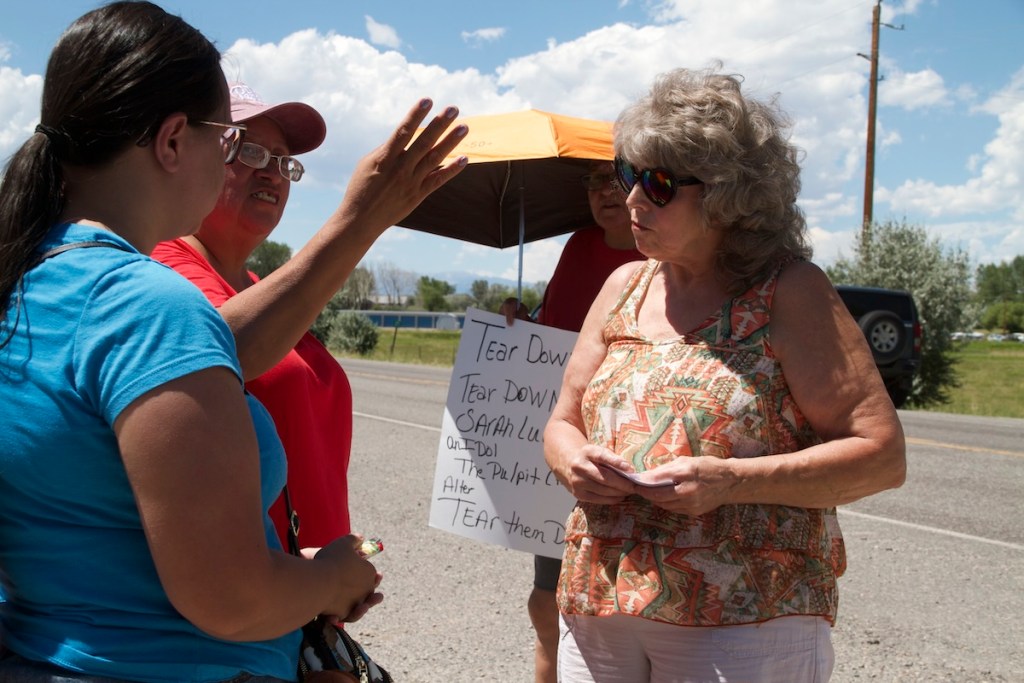
In an interview, Thomas denied making threats of violence against the Lucas family.
“I’ve never threatened her,” Thomas said. “I’ve never voiced that I was going to cause her bodily harm. I have never gone out of my way to seek [the Lucas family] out, other than to protest on the side of the road at the church.”
In an August interview, Sarah and Jason Lucas said that in the days after the controversial sermon, they hoped that the controversy would die down. Instead, they said they’ve faced persistent threats, and are ready to take legal action. “[There are] posts of them scalping me and burning down our church. And so you don’t know if that’s going to be true or not,” Sarah Lucas described, adding that the family had been in contact with the Riverton Police Department, Bureau of Indian Affairs, FBI and the Fremont County Sheriff’s Office. “We’re going to start moving forward with the law on harassment charges and things like that.”
The spark of a sermon
The July 5 sermon came on the last day of the Northern Arapaho Tribe’s sacred Sundance ceremony.
“I pray as the people coming out of Sundance today, their last day, they’re going back into community,” Sarah Lucas said during her sermon, which was recorded on video that went viral within days. “You have generations, generations, centuries of people doing this offering, going in and being, making vows to change, Father God. And we see no fruit.”
The pastor encouraged members of her congregation, which includes Native parishioners, to give up traditional spiritual practices like Sundance that she said included idol worship. She focused on the Northern Arapaho Tribe’s traditional pipe, sometimes referred to as grandfather or old man, which is used at Sundance and is one of the tribe’s most sacred objects.
“The pipe cannot hear your prayers. It’s just a piece of material, right? And this is a cycle that they’re caught up in, and this is all they’ve ever known,” Sarah Lucas said during the sermon. “And the Lord is saying ‘Tear down the idols, tear down the altars, the idol worship.”
Two days after the sermon, more than 100 people gathered for the first of many protests outside the church. The video, memes, threats and criticism have circulated widely on social media.
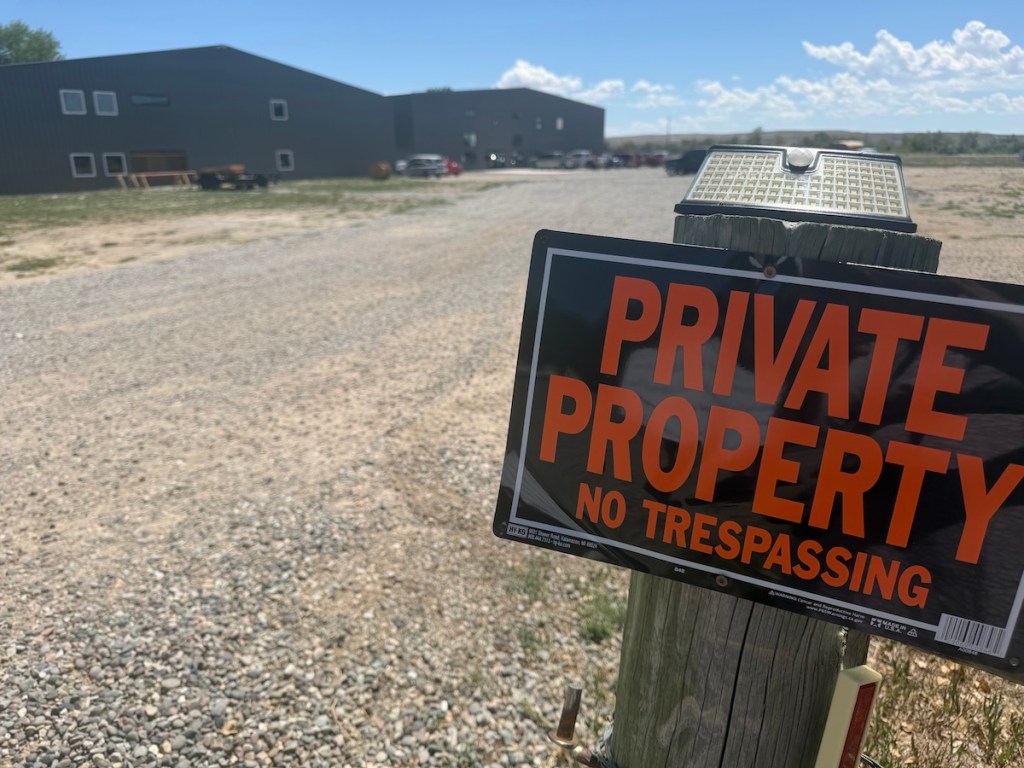
The Northern Arapaho Business Council told the Lucases to leave the reservation. But the Lucas family owns the reservation property and has vowed to continue to share their love of Christ through their church and programming.
Continued conflict
The Lucases also operate a food bank in Riverton, and shortly after the July 5 sermon, the Food Bank of Wyoming halted the contract that had supplied bulk food for distribution there. The Lucases said in an interview that Food Bank of Wyoming claimed to have received a complaint of discrimination. But they contend that they’ve never denied a needy person food at their nonprofit or discriminated against anyone, and that Sarah Lucas’ sermon is protected speech that has nothing to do with their food pantry operations.
The Northern Arapaho Tribe crafted a policy in the weeks after the July 5 sermon, one requiring that outside organizations consult with the tribe to conduct recurring events and operations on the reservation. The Eastern Shoshone Tribe quickly followed suit with a policy of its own.
When it announced the new policy, the Northern Arapaho Business Council said in a statement that after a thorough review of internal documents, it found no evidence of any formal agreements or correspondence with Foundations For Nations leaders regarding their operations on the reservation. The Lucases pushed back on that statement, sharing a thick packet of communication with tribal officials dating back to at least 2020 and showing evidence of repeated meetings and discussion about events and operations at their church property.
“I’m writing in support of your kids’ summer program on behalf of the Northern Arapaho Tribe,” former Business Council Chairman Lee Spoonhunter wrote in a June 9, 2020, email to Sarah Lucas. “Please be safe and have fun!”
After weeks of relative silence following the July 5 sermon, Sarah and Jason Lucas sat down for an interview with The Ranger/WyoToday Media. They described navigating the persistent conflicts that have come as a result of the sermon, including partnering with a national law firm to file a formal discrimination claim with the USDA over their contract with Food Bank of Wyoming. Sarah Lucas reflected on the sermon, sharing an apology for how she delivered it that day. “However, the word of God remains the same. And I can’t apologize for something that I gave my life up for.”
Day in court
On Thursday, Thomas shared photos of the protest signs she’s held week after week on Sundays outside the church. She acknowledged that others have posted threats against the Lucases online, but insists she’s never made threats or surveilled the Lucas family.
“I can’t tell these people, ‘You can’t put that on there,’ because it’s their right to put whatever they want [on protest signs]. They have a freedom of speech; they have a right to protest,” she said. “I have not seen [Sarah Lucas] since July 5. I’ve never seen her in person other than sitting outside her church. I’ve never come face-to-face with her since.”
Thomas shared the papers she was served with for the order of protection petition, and denied many of the claims it contained. The court filing says that Thomas went to the Lucases’ home and photographed it, then posted the family’s address on social media. Thomas claims she simply took a screenshot of a Google maps image, and figured the location was common knowledge. She admitted that she’d taken a photo of the Lucas family’s rental property in an attempt to document that it was occupied.
“The fear caused by Alice’s repeated conduct has significantly changed my daily life and behavior,” Sarah Lucas wrote in the petition. “I no longer feel comfortable walking to or from my vehicle by myself. My husband now escorts me to and from my car because I am afraid of being approached, confronted, followed, or harmed … Because Alice has repeatedly appeared at places where I live, worship, and regularly spend time, and because she photographed and publicly shared information about our property, seeing someone outside a window causes me to become fearful and concerned that Alice or someone acting because of her social media posts may be outside.”
Thomas said she intends to continue protesting, but she’ll move away from the church location and instead find a spot along Mission Road. “If I have to go post up at Mission Road with my protest signs, I will,” Thomas said. “And if that’s what she needs to feel safe, then that’s what she needs to feel safe. But I’m not going to stop protesting.”


Thomas named a spot along Mission Road where the church isn’t within eyesight, but “it doesn’t matter which direction they come from, they will have to drive past us to get to her church, and they will have to see our signs every Sunday … I’ve been [protesting] since day one, and I’m going to continue to do this until she leaves. It’s too late for an apology now.”
The Lucases said they’d prefer not to comment until their day in court on Tuesday. But in their interview last month, Lucas described frustration and fear as a result of the continued conflict, protests, and threats. “Our hearts toward the community remains the same … Our church needs to know that this is a safe place to come to … I had two non-Native Americans this Sunday saying, ‘I’m done with the harassment of the, taking pictures of us in my cars and putting it on social media. When can we get them for stalking, harassment?’ … Where’s the justice for what they’re doing?”
The parties are expected to appear in court on Tuesday afternoon for the petitioned orders of protection.

Religion is a good example of how simple-minded humans truly are. Bringing Christianity to a Native American reservation without permission seems a crime to me. Haven’t Native Americans already suffered enough because of the “white” interlopers? Why should the invaders be allowed to pollute native people with their nonsensical beliefs, even on native lands?
Wondering if Sarah Lucas was your typical holier than though religious freak or a christian nationalist, I found a video of her being interviewed. She has ties to Wyoming with her parents preaching on the reservation, they ended up moving away. Her Dad ended up in prison for 8 years, she did not say why. For her life trauma, she thinks god healed her so she thinks that’s what the tribe needs. She’s not smart enough to realize the tribe has suffered generational trauma from the white man. Their trauma is not from living without christianity, it’s from the white man breaking down their spirit ( trying anyway ). Her thinking “god woke me up one night to tell me to open a church in Wyoming” isn’t any different than a native tradition of a Grandfather Pipe”. She said a wealthy Texan with a second home in Wyoming approached her wanting a tour of the reservation because he was interested in Native American artifacts…that night he wrote her a check for $100,000. I bet he has some nice native artifacts in his home now. She calls him the mystery man. That’s sounds godly, doesn’t it?
Does anyone know a wealthier man who needs a tax write off? He could buy the property and donate it back to the tribe.
And now Sarah Lucas fears for her life? Give me a break, what a whining martyr. Do you think the protestors have a national law firm backing them up? She is of the same ilk as Charle Kirk manipulating college kids with no direction of their own. She touts it’s about the children when in fact she’s manipulating them into her white man cult. Feed and care for your own so outsiders are useless.
I stand with the Northern Arapaho Tribe.
Well said Patricia. And good sleuthing as well
Patricia, you realize that there are many Northern Arapahoe parishioners at her church that fully support her, right?
Indeed I do Chad. I really can’t speak to their choices as I support freedom of religion. Are they turning their backs on their own people, their tribe? Same with obedient woman who support the stagnant white man message by voting against their own rights. Are they turning their back on their own kind?
What should be truly alarming to all is the ongoing overuse of Wyoming’s developing Stalking Laws, Civil & Criminal, to ban, or curtail, US & WY Citizens Free Speech Rights here in Wyoming.
It’s clear to me that Quiver is not “Stalking?” the Preacher! She is just exercising her First Amendment Rights!
There have been a large number of Civil Stalking Protection orders being sought lately by people, or organizations, in Powerful Positions to squash passionate citizen’s First Amendment Rights. I can’t bring them all up off the cuff here, but they exist. This is scary territory!
The Civil Stalking Protection Orders especially because Wyoming does not pay for the appeal procedure as in criminal cases.
Wyoming Stalking Laws are designed for specific reasons not for powerful and wealthy entities to subvert First Amendment scrutiny!
This should be the standard now!:
Counterman v. Colorado, 600 U.S. 66 (2023) ~ SCOTUS (7-2)
In 2007 the late great Christopher Hitchens wrote a book entitled “God Is Not Great – How Religion Poisons Everything” that explains a whole lot of this kind of stuff.
Hitchens states in part that organized religion is “violent, irrational, intolerant, allied to racism, tribalism, and bigotry, invested in ignorance and hostile to free inquiry, contemptuous of women, coercive toward children” and that accordingly it “ought to have a great deal on its conscience.”
Paul, take any bible and you let me know any of the words of Jesus Christ that were “violent, irrational, intolerant, allied to racism, tribalism, and bigotry, invested in ignorance and hostile to free inquiry, contemptuous of women, coercive toward children” .
There’s more than Jesus in the bible. It’s filled with murder and mayhem. Read the old testament.
Jesus said: “And I gave (Jezebel) space to repent of her fornication; and she repented not. … I will kill her children with death; ….
Revelation 2:21 and 2:23
Religion, the biggest trouble maker in Human history.