
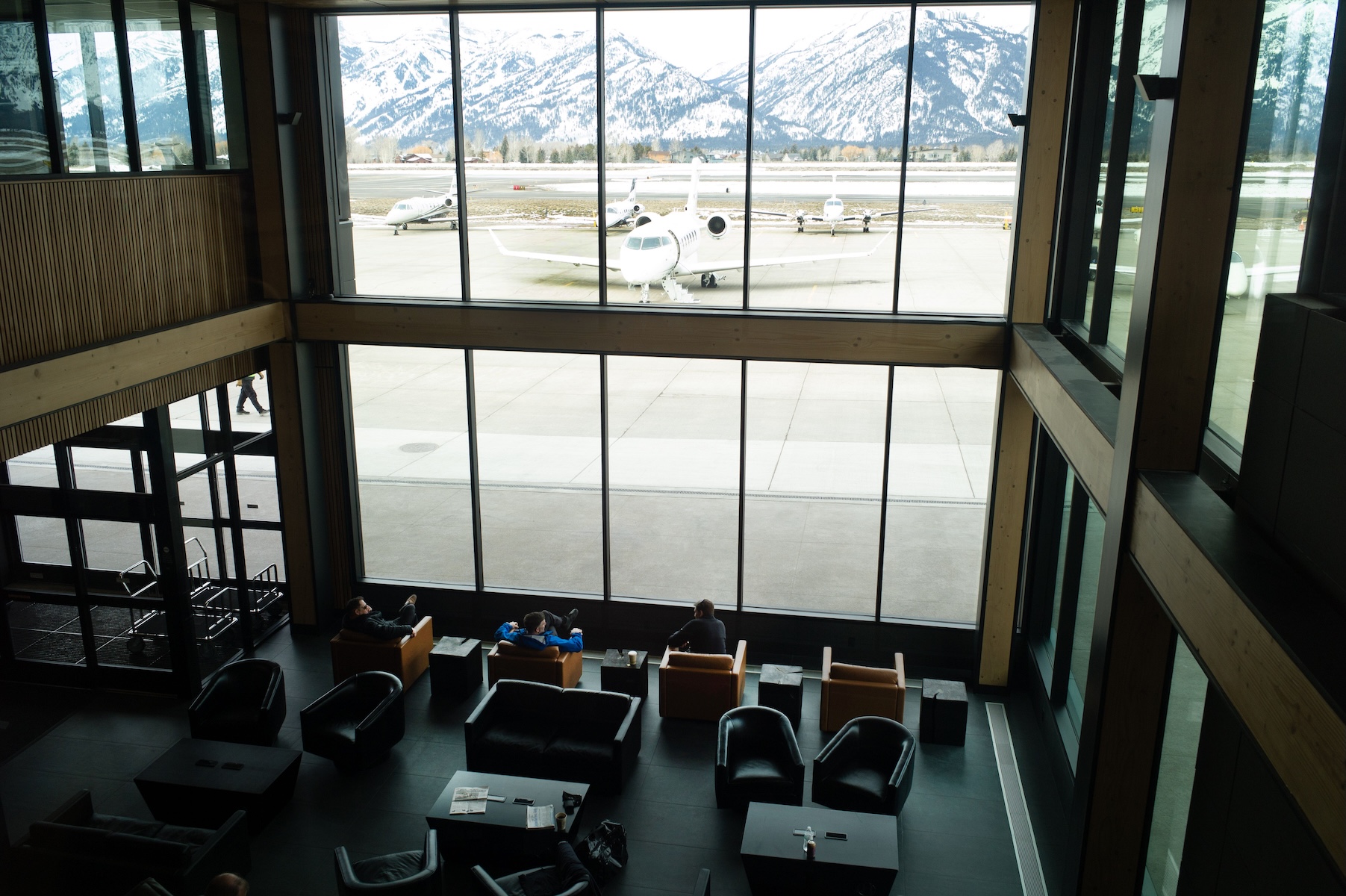

The Jackson Hole Airport in Grand Teton National Park just built a posh lounge for the ultra-wealthy.
The lounge softens the landing pad for members of the upper crust who arrive by private jet to the nation’s wealthiest county. It resolves the ignominy the well-heeled endured for decades as they traversed a low-slung, private terminal at the only commercial airport in a national park, all while en route to their luxe SUVs and finely finished homes.
That now defunct dingy, private lounge was 30 years old and didn’t have proper “life support systems” or bathrooms, airport Executive Director Jim Elwood said. Long in the tooth, “it was constructed in as cheap a manner as possible.”
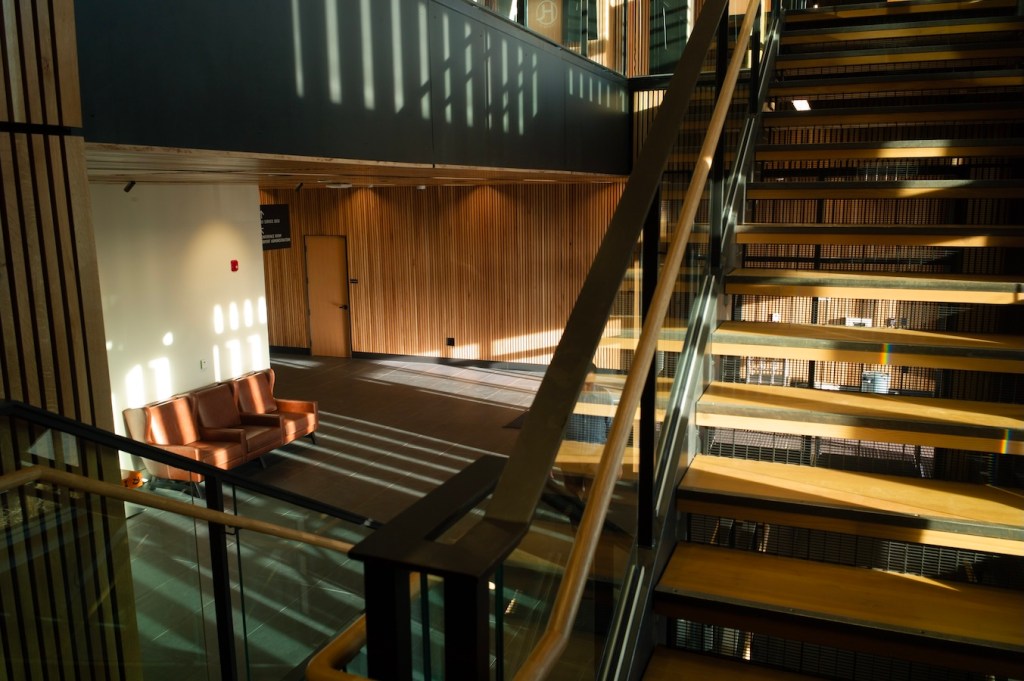
With the completion of a $55.3 million building, the new lounge provides private-jet passengers with two-story, picture-window views of the Tetons, deep easy chairs, a fireplace, a shiny catering kitchen, a pilots’ den, free fruit and popcorn, and coffee from a $22,000 (installed) Franke superautomatic machine with gourmet beans “ground fresh each and every pour.”
The 21,000-square-foot building, plus a basement, houses state-of-the-art offices for airport administration and workspace for an airport-owned entity known as the fixed-base operator that refuels all jets and readies private ones.
The building is “excessive in all regards,” one critic said. “It’s truly a Taj Mahal out there,” said Brent Blue, an aviator and Teton County coroner.
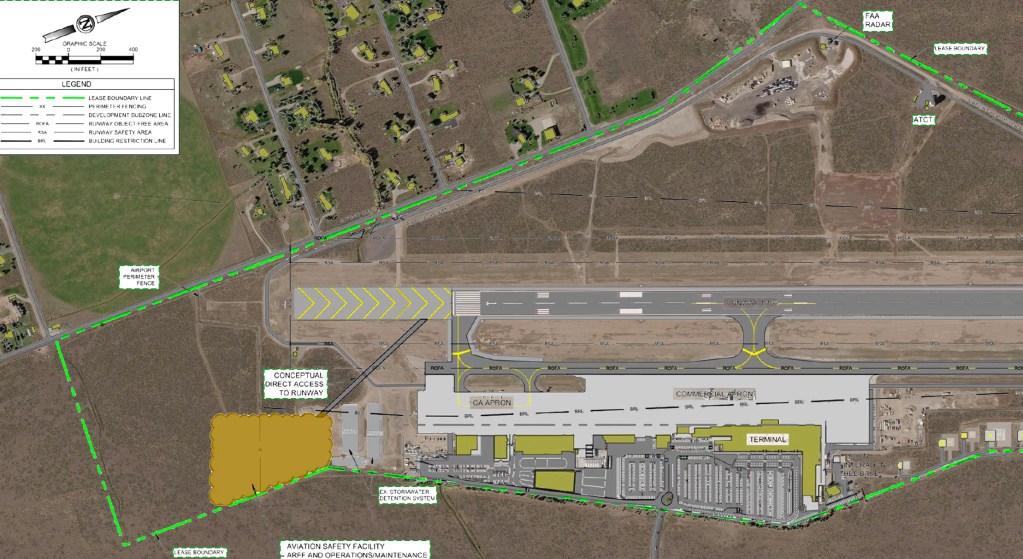
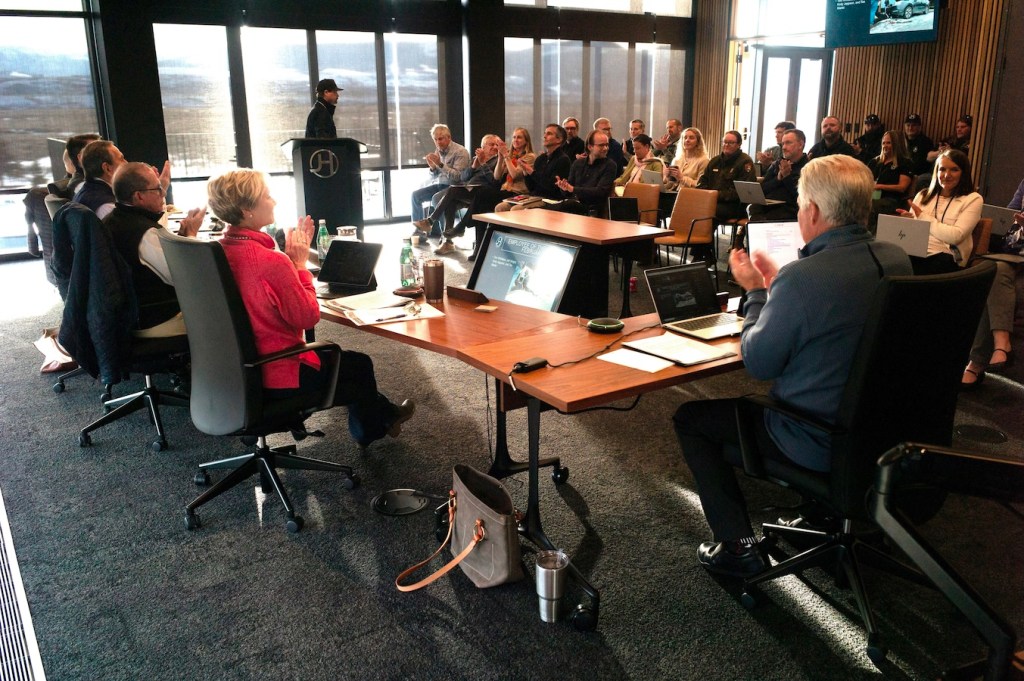
As the Jackson Hole Airport Board met for the first time in its new digs on Feb. 4, administrators turned to another pressing need — a building to house its fire trucks. To shelter them, the airport may broach a longstanding agreement with Grand Teton National Park in which it consented to limit development to a 28.5-acre envelope.
The prospect of building outside the envelope raises questions about whether airport officials are prioritizing nests for elites at the expense of a sensitive national park environment and the safety of the general public. Greater Wyoming and the rest of the country believe “everyone in Jackson Hole is affluent,” Jackson Hole News&Guide columnist Paul Hansen wrote this week.
In reality, the community can’t house its essential and middle-class workers because of exorbitant real estate prices and must contend with state legislation that one judge said “seems to be targeted at Teton County.” In this milieu, Blue has fought for funds to upgrade the county’s morgue, which he described as “the Weed and Pest Department’s old two-car garage … inadequate in many ways,” with an insufficient waiting area for grieving families.
Criticism of the new airport building reflects some of the tension that exists in the county with the nation’s highest per-capita income.
“They certainly seem to prioritize those other buildings,” and not the firehouse, Scott Guenther, a retired Grand Teton climbing ranger, told WyoFile. There are suitable firehouse sites in the development envelope, he said, but a broad community effort working with the airport is necessary to avoid betraying the essence of the development restrictions, a pact with the nation that balances economy and environment, commerce and conservation.
Public forces postponement
Airport Director Elwood painted a complex picture of regulations, restrictions and funding that he said dictated the construction sequence.
“There were other key projects across the airport that needed to be addressed first,” he said of the firehouse. The site of the new private terminal building “is not shown to be a viable location for a firehouse, so the issues are not connected.”
The firehouse falls into a construction program and funding stream related to Federal Aviation Administration requirements that make things like recent runway re-paving a priority, Elwood said. “The sequential nature of security or safety funds through the FAA meant these other projects have to go first,” he said.
The airport sought a new firehouse with “the cleanest, unimpeded access points to the midfield of the airport,” Elwood said. Today, fire trucks would have to cross other lanes of traffic where baggage trollies, fuel trucks and passengers themselves drive and walk.
In contrast to FAA funding, the new building that houses the lounge and administration is financed with revenue bonds repaid with various travelers’ fees. “They’re not related projects,” Elwood said of the new building and the planned firehouse.
All facilities at the airport, however, compete for space within a 533-acre national park site where buildings are constrained to the development zone. A preliminary assessment by the airport narrowed the location of the firehouse, which could also be large enough to shelter snowplows and heavy machinery, to three options outside the development zone.
Those options are conceptual, Elwood said, “not yet anywhere close to being … a recommended site.” But reaction following a public meeting on firehouse sites — “Airport may exceed footprint,” the Jackson Hole News&Guide printed — forced the postponement of an April 14 meeting at which airport officials were to update the community on options for a firehouse location. The Airport Board is scheduled to meet April 15.
“Postponing the meeting gave us more time to be more thoughtful in that public comment,” Elwood said.
Whether the firehouse will be constructed large enough to also accommodate snowplows and such remains in flux, he said. Former ranger Guenther believes co-locating the machinery — an efficiency move the airport touts — would create a facility six times larger than a firehouse alone.
Any square footage suggestions, however, are “purely speculative,” Elwood said. And mere consideration of construction outside the development zone “is not changing the baseline of … the park and the airport [development zone] agreement.”
Not too plush
The director dismissed the notion that the new building is excessively appointed. “The board gave direction that it be roughly equivalent to the commercial terminal building,” Elwood said.
That terminal for travelers on commercial airlines reflects its exquisite setting and is easily a grade above a metropolitan hub. In its own language, the airport seeks to “provide services that exceed customer expectations and world-class facilities.”
One regular visitor from Nashville, Rivers Cornelsen, called the commercial terminal “the nicest-ever small-town airport.”
The airport serves in many instances as a visitors’ center, providing more than half a million travelers their first interaction with Jackson Hole and Grand Teton National Park.
In 2025, 6,323 commercial and 11,568 private jets departed from the airport and, presumably, the same number landed. Commercial flights by Delta, American, Alaska and United provide nonstop service to 14 major cities.
That traffic makes the airport a significant cog in the Jackson Hole tourism machine and Wyoming’s tourism and transportation network. Fully 580,702 passengers enplaned (enplanements are a standard metric) in 2025, up 10.1% from the year before.
The airport did not tally passengers on the 11,568 private takeoffs.
The airport operates with a fiscal year 2026 budget of $105.8 million. In 2023, the Jackson Hole Airport Board took over fixed-base operations and budgeted for gross revenues of $28.3 million in fiscal year 2026. (Teton County commissioners and the Jackson Town Council jointly appoint members to the Airport Board.)
From gross revenue, the Jackson Hole Airport in fiscal year 2025 paid the U.S. Government $1.2 million based on 3% of the first $4 million in operating receipts and 4% on receipts above $4 million.
Construction of the private-jet lounge worried some valley residents that the new facility could cause an increase in noise. Airport officials, however, say private-jet passengers don’t visit Jackson Hole for its private terminal so it won’t necessarily increase that segment of air travel.
Further, the airport touts its fly-quiet program and regulations that ban noisy aircraft and limit the cumulative sound under a “noise budget.” Other noise-sensitive airports — John Wayne in Los Angeles and the Naples Airport in Florida — emulate the Jackson Hole program, officials said.
Technology is creating quieter aircraft, officials told the airport board earlier this year. But private-jet travel is on the upswing, setting a record in 2025 with prospects for more growth this year.
Not all airport neighbors believe noise is under control. “Some of my friends go, ‘There’s no way you’re not violating your noise agreement,’” board member Bob McLaurin said at February’s meeting.
Sidebar: Noise regs kept Epstein’s jet out
Environmental rules at the Jackson Hole Airport kept Jeffrey Epstein from landing his noisy jet on the airstrip in Grand Teton National Park in 2013 after he shelled out $100,000 for an associate’s wedding in the picturesque Wyoming valley, according to emails released by the U.S. Department of Justice.
Because of its sensitive location in Grand Teton, the Jackson Hole Airport and FAA enforce rules that restrict the amount of noise aircraft generate when landing and taking off at the commercial airport in a national park. Among those restrictions are a ban on “Stage 2” aircraft because of their loud engines.
Epstein documented the Jackson Hole rebuff in an Aug. 9, 2013, email addressed to “Sarah K” and released by the Department of Justice as part of the Epstein Files.
The email, complete with typos and abbreviations, reads as follows.
“we tried to visit jackson hole yesterday„ before landing we were told that it is the only airport in the states that totally bans stage 2. , my aircraft type ). as dave said lucky we didn’t just fly in, bill picked it up. Would have been a mess. not sure if we could have flown out. ?”
Sarah K appears to be Sarah Kellen, an associate and employee of Ghislaine Maxwell who was arranging a wedding in Jackson Hole that year. Kellen has been asked to testify later this year before a congressional committee investigating matters related to Epstein. She has not been charged with any criminal wrongdoing tied to Epstein.
Some travelers believe private-jet traffic impedes commercial airline flights to the detriment of the general public. Traveler Cornelson, the Nashville visitor, wrote Elwood that it appears “the few matter more than the many.
“When capacity is tight,” he wrote, “the many should not be penalized so the few can glide through.”
Elwood said the misconception abounds that private jets have priority to land or take off over commercial flights. “However,” Elwood responded, “the simple truth is that is not the case.”
Sensitive crossroads
The airport’s position at the crossroads of economy and environment and its fiscal year 2026 budget that projects $96 million in capital improvements make its programs subject to scrutiny. Grand Teton National Park Superintendent Chip Jenkins underscored that in early 2024.
“It is not entirely clear to us at Grand Teton National Park what the vision is for the airport over the next 10 or 20 years,” he told the board. “We’re not entirely sure where we are trying to go and how the capital improvements that might be made by the board will work to implement that vision and what those consequences of that vision might be on the park and how we can work together to continue to try to mitigate those impacts.”
Today, the airport provides a convenient link with the outside world, allowing thousands to experience Jackson Hole but delivering corresponding impacts to Grand Teton National Park. Travelers arrive to a comfortable reception.
The elite, too, no longer have their furs rubbed the wrong way or risk snagging their puffy Stio jackets and bleeding 800-fill down in a dilapidated private terminal. The new private-jet lounge smoothed those rough edges.
“The fact that it’s been interpreted as being nice,” Elwood said of the new building, “that’s actually good to hear.”
This story was corrected to say that an April 14 community open house, not an April 15 Jackson Hole Airport Board meeting, has been postponed. The board’s April 15 meeting is still scheduled but an agenda has not yet been set. — Ed.


Thank you for your excellent reporting Angus.
If I were a billionaire wanting to park my great wealth in a tax friendly state like Wyoming, I would want to make sure that I had a warm place to store my jet in a hanger with a appropriate lounge for my families’s departures and arrivals. If it has a $20,000 espresso machine and is also situated in one of the most beautiful national parks in the world – that would be quite an amenity that would attract my attention. It might persuade me to build a 13 bedroom, 14 bathroom, 16,000 ft.² home (using basement square footage loopholes) as one of my three or four homes scattered around the world. I could then jet in and out of the valley while my home is being built over a period of three years with approximately 200 trips per day dedicated to the construction of my home – not to mention after completion – the many trips to service my home and keep it functioning at a level to which I deserve and have become accustomed to. Never mind that the workers who are building my home and servicing it can’t afford to live in the valley because of the affordability issue which I have contributed to because of the price I was willing and able to pay for my land. (The high price I paid for the land and demolition of the 5,000 sq ft house already on it is more than made up for by my tax savings – so I consider it a small but necessary tax savings strategy expense). My workers can live outside the valley and commute in on our snowy highways.
So it all starts with making sure that my needs are accommodated at the airport and the downstream impacts of my choice to park my wealth here in Jackson Hole unfolds from my warm jet in the hanger that otherwise would have been used for a fire station. God forbid that the airport board or the 10 elected officials who oversee the Airport board might more clearly see the impacts my presence has brought to Jackson Hole and GTNP. And even worse, I hope the press never shines its light on this situation. If they did catch on and decide to throttle my ability to jet in and out of the valley I will be forced to hire lawyers and lobbyists. I might even offer decision makers occasional trips on my warm jet to make sure they better understand how the lifestyle I deserve and can afford should be accommodated by the citizens and wildlife who came before me.
And by the way, de-icing pollution that contaminated the wells of the neighboring communities to the west of my warm jet in the hanger is not my problem – so let them drink bottled water as I fly by.
I thought at first this was a Casper Planet story about the ultra wealthy lounge ans their $22,000 coffee machine.
The Jackson Hole Airport is the Yellowstone Ecosystem’s greatest point source of air pollution, noise pollution and probably water pollution. The fact that it is tolerated by a valley of so-called conservationists is simultaneously depressing and hilarious. In most of the park it makes a mockery of the notion of the peace and/or solitude of the mountains. It does not belong.
“The airport did not tally passengers on the 11,568 private takeoffs”:
Almost 32 flights/day. At $6,000/hour, given a two-hour flight to and two-hour flight from JAC, that’s $6,000*4*32=$768,000 in revenues/day. Say on average a private jet flight burns 150 gallons of jet fuel per hour, then those 32 flights/day burn 32*4*150gls=19,200 gls of fuel per day, or 7,008,000 gallons of fuel per year. A family driving 2,000 miles to Jackson (4,000 total to and from) at 25 miles/gallon will burn 160 gallons. So, roughly speaking, one private flight uses the same amount of fuel as four families driving by car. Caveat: most private flights are probably in the air more than two hours each way.
The goals should be, (1) Meet the FAA requirements and, (2) Minimize the footprint and presence in the National Park. (p.s. the FAA requirements are already met)
The airport needs to keep new development inside the well-established Development Subzone Agreement with the Department of the Interior. Goals should be to, (1) Meet the FAA requirements and, (2) minimize the footprint and presence in the National Park. (p.s. the FAA requirements are already met)
Uh… shouldn’t the airport wranglers done the more important firehouse first if it was going to be offsite from the get go , before they pad the jet set lounge area ?
… and the billionaire jet setters are paying for at least 51% of the new fire hall up front, right ?
WY priorities: 1) pamper the wealthy 2) SOME of the bare necessities for the working class. What an allegory for the state of the “cowboy” state.
This is a good story, as usual, from Angus. And I don’t wish to rub my friend’s facial fur the wrong way nor snag his aging puffy jacket. But, really, if this Posh story was instead about Race and included so many race-baiting dog whistles as he employs here about the rich, there’d be an outcry about stereotyping and fairness. Just tell the story and spare us the none-too-subtle digs at the lifestyles of the rich and famous.
(And, wait, what? Epstein in JH? Nice touch working in that tantalizing sidebar. Who amongst us – rich or poor – can resist reading that? 😉)
The story is ABOUT the rich and the fancy terminal that has been built for them. Hence, many references to the ultra wealthy. And I didn’t click the Epstein link. The airport director once made a point of showing me a fancy pen he was using to sign documents. He was showing off his pen! This is about power and money.
But it isn’t about race, is it.
Well thank God the truely important people no longer have to be subjected to something as crass as “business class” accommodations. The fact that the downtrodden billionaires of Jackson had to suffer through landing their private jets at such a horrible airport terminal for 30 years is shocking. What is this country coming to?
This was envitable. Thanks to Jim Watt (Regan) running rough shod over the NPS and public input, part of the airport is now being used and publically funded for private purposes. The question boils down to is pernament private exclusive use of public property in a National Park authorized? I doubt it.
“The elite, too, no longer have their furs rubbed the wrong way or risk snagging their puffy Stio jackets and bleeding 800-fill down in a dilapidated private terminal. The new private-jet lounge smoothed those rough edges.”
Repeated for effect.
Of course “private- jet passengers don’t visit Jackson Hole for its private terminal”, but to imply that it’s not a factor in their choice to fly here is a completely disingenuous statement. It may very well increase the amount of private traffic impacting GTNP and all of our lives!