


It can be hard to get to Laramie, home of Wyoming’s only public university. The local airport has just a couple of 50-seat inbound flights every day. It’s often easier to fly into Denver and drive north on Interstate 25. Tucked in Wyoming’s far southeast corner, Laramie is a day’s drive from big chunks of the state.
The distance from everywhere else fits the ethos of a state where the spread-out spaces have matched a conservatism rooted in a libertarian, leave-me-alone-and-I’ll-leave-you-alone political philosophy. It’s why the state traditionally funds the University of Wyoming with a block grant, sending about $366 million for the current biennium for the university to divvy up how it sees fit.
But in recent years, that ethos has changed, thanks to the growing power of the state’s uber-conservative Wyoming Freedom Caucus, which this year flexed its muscles and pursued a $40 million cut to that grant. While the move ultimately failed, the debate that raged in the op-ed pages of local media, in emails to state legislators, and in coffee shop conversations for the first three months of 2026 is far from over. Among the most resonant questions: What is the mission of the University of Wyoming in the years ahead — and who gets to define it?
“I think public scrutiny is going to continue,” the University of Wyoming’s president, Ed Seidel, told The Chronicle. “This year we had our work cut out for us to make clear what the value of the university was.”
Proving value is tough — not only in Laramie, but across other red states like Florida, Texas and Utah, where vast swaths of the public are skeptical and not convinced by studies showing higher ed’s economic benefits. The Wyoming saga reflects a national debate over who should call the shots at public universities.
But it also demonstrates how a campus can win support in the short term, relying on a schism within a legislature’s conservative ranks. Political science scholars say if such a split happens nationally, it could help save universities, especially if establishment Republicans can rally to win those battles.

In January, Gov. Mark Gordon issued his budget request, which included full funding for the university, kicking off a process that in a different political climate might have proved uncontroversial. The energy business is booming, leaving Wyoming with $250 million in excess funds. But members of the Freedom Caucus had different ideas. Those who sat on a key legislative committee entered the session with a goal of making big cuts. In at least one meeting, some members wore red suit coats to showcase their views on the fiscal situation.
The committee voted to slash the university’s two-year block grant by $40 million, but exempted the College of Education and the College of Agriculture, Life Sciences and Natural Resources. “The University of Wyoming is a land-grant university that has forgotten its founding purpose,” Sheridan Republican Rep. Ken Pendergraft, a member of the caucus who suggested the cut, wrote in an email to The Chronicle.
“The only lever we have is the power of the purse. Sometimes it takes a big lever to get attention.”
Rep. Scott Heiner
The budget then went to the full Legislature. The Senate, which isn’t dominated by the Freedom Caucus, rejected the cut. It was a different story in the House, where an ongoing civil war between new-guard and old-guard Republicans reared its head. Rep. Steve Harshman, a Casper Republican of the old guard, proposed requiring the university conduct a comprehensive review to come up with $5 million in cost savings — or face the full $40 million cut. Harshman, the longest-serving member of the House and formerly its speaker, said he was trying to keep funding stable and let the university do the work of trying to find savings.
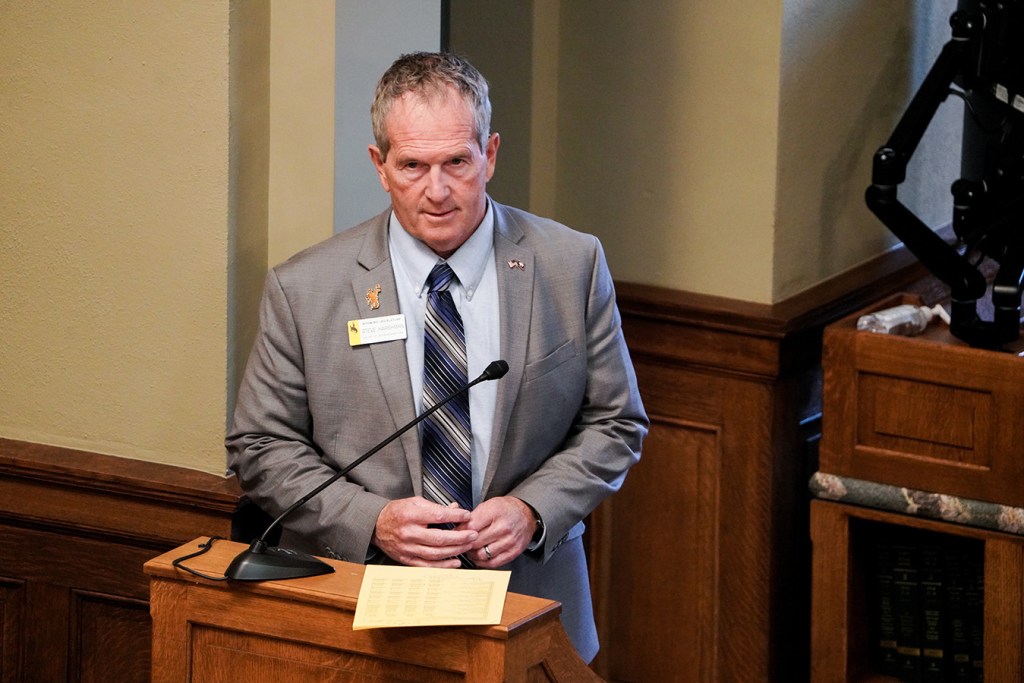
He’s still baffled that such a reduction was suggested in the first place. “The block grant hasn’t changed much over the years,” he told The Chronicle, adding, “What problem were we trying to solve?”
John Bear had an answer. The Republican chairman of the appropriations committee and chairman emeritus of the Freedom Caucus cited during the House debate a number of sticking points: diversity, equity, and inclusion programs, as well as “inefficient and impractical” degree programs.
That launched more than an hour of debate about who should call the shots at the university, with legislators going back and forth over how much control they should have over its operations.
“The only lever we have is the power of the purse. Sometimes it takes a big lever to get attention,” said Green River Republican Rep. Scott Heiner, also a Freedom Caucus member, during the debate. The Legislature needed to get the university’s attention so it would return to being “a better land-grant university to meet the needs of our citizens here in Wyoming,” he added.
Other lawmakers focused on the text of the Morrill Act of 1862, which founded land-grant universities and called for higher education institutions to provide “practical” education. The University of Wyoming wasn’t doing that, they said, particularly in the liberal arts.
But others said there was no reason for any cuts. “There’s no rational explanation whatsoever,” Rep. Landon Brown, a Cheyenne Republican, said during the debate, “other than we have the power of the purse, so we can. Ladies and gentlemen, that’s what bullies do.”
The House ultimately voted to force the university to find $5 million in savings itself or face a $20 million reduction, terms that Bear said legislators had worked out with the university behind closed doors (old-guard legislators were skeptical of that claim). The measure set up a dispute with the Senate, which had passed full funding in line with Gordon’s budget. Full funding won the day, but with a caveat: A footnote calls on the university to conduct a full review of staffing levels and also look at what courses it offers. It did not set any target for savings or any penalties for not coming up with savings.
Harshman acknowledged that voters had spoken up to support the university, and Seidel agreed. “It can’t be overstated that, by virtue of the support of citizens throughout Wyoming and gubernatorial and legislative action, UW is in a much better financial position than we would have been,” he wrote in a letter to the campus about the budget process.
The university’s own data suggest it enjoys broad support statewide. Two years ago, some 50% of respondents to a biannual survey said the university acted in ways that reflect Wyoming values “most of the time” and 9% said “all of the time.” About 9% said “very little of the time” or “never,” and 31% said they weren’t sure.
Still, Seidel, who told The Chronicle there was no explicit deal struck with the Legislature or the Freedom Caucus to get the funding restored, pledged to look for savings. “We’re going to take the extra step this time and look at, Do we have programs that are very low enrollment, or really not producing enough degrees, or really not providing enough value, and so on, or can we find efficiencies in administration?” he said, adding that “we welcome” dialogue with lawmakers — “as long as it doesn’t go too far.”
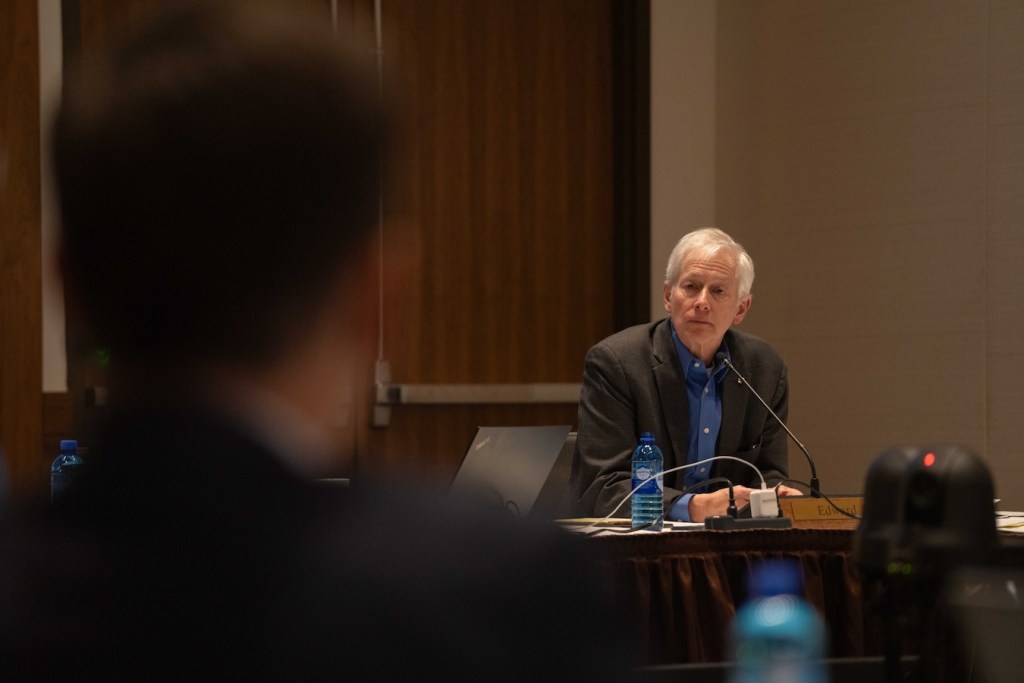
Seidel is leaving the presidency at the end of the academic year, and he knows his successor will face a challenge, especially if that person comes from outside of Wyoming, like Seidel did six years ago.
Having lived all over the world, Seidel considered himself “pretty adaptable,” but struggled to communicate when he got to Laramie. “I’ll give you an example,” he said. “I did talk a lot about AI in my first year, and somebody said to me, after a year, ‘Do you mean artificial insemination?’ And I realized, I’ve been miscommunicating for a whole year.”
The $40 million cut was defeated this time, but the setback is unlikely to quiet the Freedom Caucus’s objections. Its members believe they should have control of not only how much money goes to the university, but also how it is spent. That would be a return to the roots of state funding for the university, when lawmakers would meet in committee with university officials and go over every line of the budget, down to how much each position should get paid. In the 1980s, university board members and administrators began pushing for that practice to end. In 1990, for the first time, the state used the block-grant approach to funding.
There are a few clues as to what empowered lawmakers might push for. Rep. Jeremy Haroldson, R-Wheatland, has carpal tunnel syndrome and burn scars from “welding and mechanicing and slugging wrenches,” and he believes “there’s something incredibly good about dirty hands.” During the House debate, the founding member and vice chairman of the Freedom Caucus introduced a budget amendment to fund three Career and Technical Education positions at the University of Wyoming.
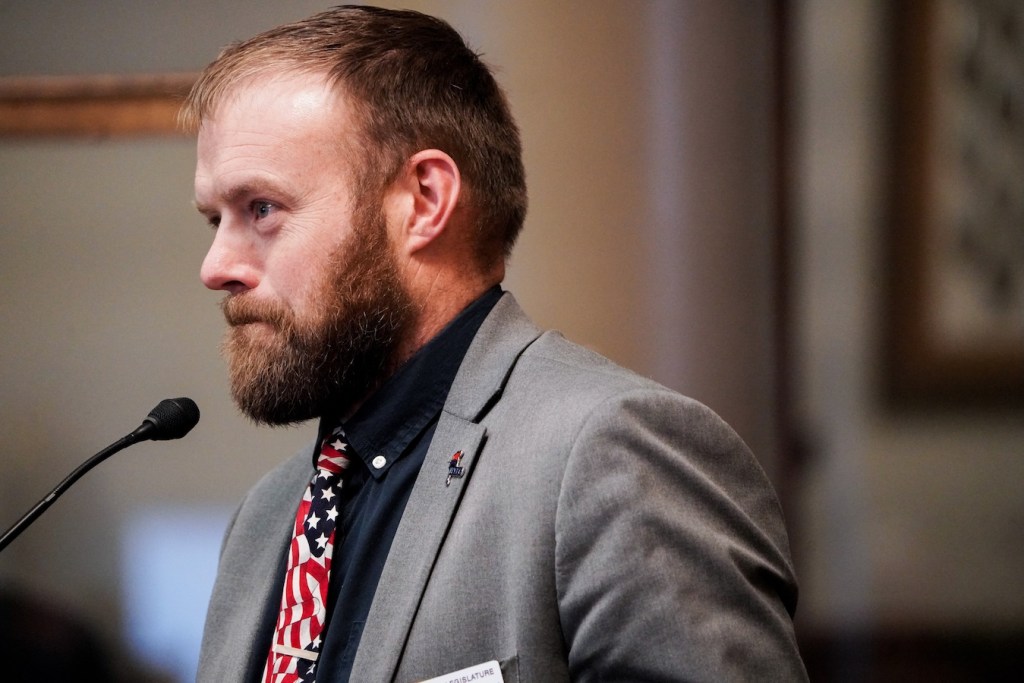
Moments later, a couple of fellow legislators asked Haroldson a question: Did the university ask for the positions? Not exactly, said Haroldson. He had been talking with the CTE department at the university, which primarily trains students to teach CTE courses, and they mentioned they had only two staff members teaching and a third dealing with administrative matters. With the Legislature funding CTE-related facility expansion at the university, Haroldson wanted to “throw some educators in alongside that.”
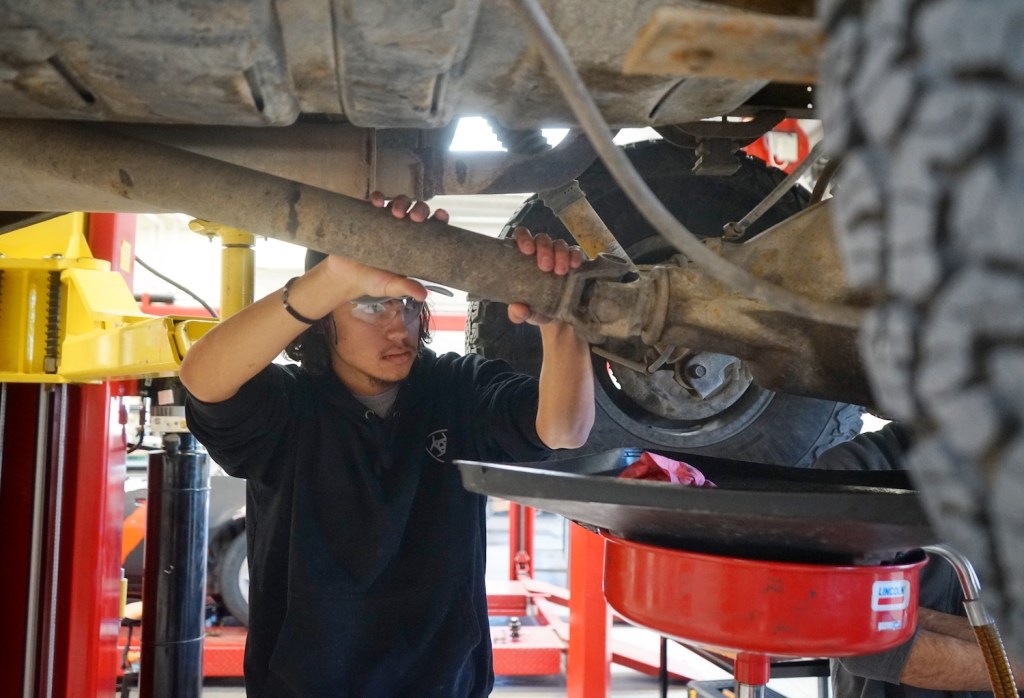
In Wyoming, as in many red states, CTE is the hot flavor among lawmakers. They routinely cite the Morrill Act, arguing that practical education means things like agriculture, teaching, and now CTE, the bread and butter of Wyoming’s eight community colleges and others across much of the country.
The amendment failed — why give the university something it didn’t ask for? — but it reflects a desire for practical education readily found among Wyoming residents. That said, conversations with the lunch crowd in Laramie on a recent weekday suggested a wider range of public sentiment than is represented by the Freedom Caucus.
“If they lost that kind of money it would ruin the school.”
Lisa Montgomery
Carey Mitchell, 27, of Laramie, went to a community college to get a nursing degree. She thinks more money should go to those colleges for programs like nursing, welding and other hands-on trades. A couple of her friends from high school went to the University of Wyoming and got degrees they aren’t using, but they have student loans to pay off every month. “They are waitressing and just sort of making enough money to get by,” she said. “If more people went to a community college and learned a trade, it would be better for our economy because more people would have more money.”
She’s OK with lawmakers being tough on the university. “It’s our money,” she said. “The university should have to account for how they spend it and if they aren’t doing a good job, then folks should step in and demand better results.”
Lisa Montgomery, 23, of Cheyenne, was aghast when she heard about the potential $40 million cut. Her boyfriend is enrolled at the university, studying business management. “If they lost that kind of money it would ruin the school,” she said. “After he graduates, our lives are going to be so much better. There’s so many more options for him with a college degree. There’s no reason to say the trades are the only way to have a good life.”
Gary Smith said there are simply too many programs on campus that don’t lead students to jobs and instead just leave them in debt. The 69-year-old retired oil field worker from Cheyenne knows working in the trades can lead to a good life, but one that’s also hard, full of financial ups and downs. So he was torn on the proposed cuts and more specifically, who should be making them.
“I don’t think the lawmakers should be the ones saying this program should stay or this program should go. That’s up to the university,” he told The Chronicle. “But I do think it’s OK if the lawmakers reduce the amount of money they give the university by some and ask them to tighten their belts some. I think there’s probably too many administrators there and some programs that have no value that could go away pretty easily.”
That reflects an impression of bloat and sprawl common among Republicans, and Wyoming is as red as they come. President Trump won the 2024 presidential election there by 46 percentage points — the widest margin of any state.
So it’s not a complete surprise that, as in other Republican-led states, higher education is under attack, said Jonathan Carrier, an associate professor of higher education administration at the University of Wyoming. “Extremely conservative, and I don’t mean moderate conservative, I mean extremely conservative, hard right-wing legislatures have decided to target universities in their states for being quote-unquote woke or, espousing liberal ideologies to an extent that they’re uncomfortable with.”
That’s a change, said Carrier, who has been in Wyoming for 16 years. He characterized the Legislature’s attitude toward the university historically as, “‘Hey, you have some weird ideas over there at the university, but we value you, live and let live, as long as you don’t tell us what to do, we won’t tell you what to do.’ And that has changed significantly.”
So far, not all conservative lawmakers have embraced that change. The failure of the $40 million cut reflects a battle for the soul of the Republican Party, said Stephanie Muravchik, an associate fellow at the Institute for Advanced Studies in Culture at the University of Virginia, and Jon A. Shields, professor of American politics at Claremont McKenna College. The fight is the subject of their book, “The Republican Civil War: What Liz Cheney’s Wyoming Tells Us About a Divided American Right.”
“The through lines for this battle are the through lines for much of the MAGA/establishment divide,” Muravchik said. “Partly it’s the divide of class” between blue-collar and some middle-class folks on one side and the professional class on the other side.
In their book, Muravchik and Shields write that many of the new-guard Wyoming legislators didn’t graduate college. According to their research, as of June 2024, 16 of the hard-right Wyoming Republican lawmakers didn’t have a college degree as compared with only three of the establishment Republicans. Many of that latter group have advanced degrees, but “Postgraduate degrees are rare among the new-right legislators — and not a single one possesses a law degree,” they write.
The new guard has led the charge against the University of Wyoming, often parroting the talking points of national Republicans. During the 2024 budget battle, legislators successfully pushed through a budget that mandated no funds be spent on DEI efforts at the University of Wyoming. At the time, Seidel said the university would make the changes directed by the Legislature and get rid of its DEI office. It has since done so.
The difference in that cut and the failed effort this year? There was a clear target and political will, Harshman said.
The budget fight lacked both, Shields and Muravchik said. New-guard legislators across the country often are more focused on national issues and in proving themselves to be “true” conservatives, especially in areas like Wyoming, where the number of Democrats is shrinking.
“It’s a fight over what it means to be a conservative,” Shields said. “If you are running against just other Republicans, you have to prove that you are more hardcore and conservative than the person you are running against. You have to argue that we need to purify the state and remove any faint trace of progressivism.”
Carrier, the UW professor, said the Wyoming funding battle “might have pushed past what voters wanted the Legislature to do.”
I think they got the message from the people of the state to back off: ‘We didn’t sign up for any of this.’”
As for what’s next, Carrier said, it comes down to communicating a university’s value, a more straightforward task in a state that has only one. “Let’s get out there and press the flesh a lot more, get the university in front of people so they can see its value and really hawk that. I do think that is a lesson that Tennessee and Florida and Texas and Kansas and whoever else is dealing with this can learn from. Their challenge, though, is you’ve got umpteen universities in each state, all getting a slice of the state-funding pie.”
“You still have to communicate your value to the electorate,” he added, “or they will vote people in that will take away your finances.”
This story was produced with support from the Education Writers Association’s Reporting Fellowship program.
For more legislative coverage, click here.
Correction: A previous version of this article incorrectly attributed a quote to Wyoming Rep. Gary Brown, a Republican. It was Rep. Landon Brown, also a Republican. —Ed.

Curious that Freedom Caucus owners/donors Koch brothers give hundreds of millions to their alma mater MIT, but order their hired help to slash UW. Should higher ed be off-limits to the working class?
Freedumb caucus clowns don’t have a clue as to what is taught in higher education.
The lack of degrees cited in this article should prove that.
‘Do you mean artificial insemination?’ And I realized, I’ve been miscommunicating [about AI] for a whole year.”
Like other canards about Wyoming, I anticipate loud guffaws at polite dinner parties as Ed delivers the punch line.
Perhaps it tells us what Ed needs to believe about our state as he heads out the door
One thing that the Chemtrail Caucus in particular, and the Legislature in general seem to want to ignore is the mandate placed on them in the Wyoming Constitution (which the want to wave in your face on every other issue) that education at the University of Wyoming be as nearly free as possible.
Article 7, Section 16 Tuition free.
The university shall be equally open to students of both sexes, irrespective of race or color; and, in order that the instruction furnished may be as nearly free as possible, any amount in addition to the income from its grants of lands and other sources above mentioned, necessary to its support and maintenance in a condition of full efficiency shall be raised by taxation or otherwise, under provisions of the legislature.
If the whole purpose of the section is to make tuition free, then obviously raising tuition cannot be one of the methods considered to fund the university. It’s time we hold them to their oath to uphold the Constitution and present funding solutions that include eliminating or at least lowering tuition.
A “FREE?” well-educated society in the liberal arts, history, and geography is an essential component of a healthy liberal democratic republic because it fosters the critical thinking, informed citizenry, and civic engagement necessary to sustain self-government. This foundational knowledge prepares citizens to analyze complex issues, resist manipulation, and participate constructively in democratic processes.” ~ Common Sense, or perhaps Socrates?
And helps prevent the election of Ignorant Buffoons like King tRUMP!!!!! …. along with Sinator Driskill & Chip Neiman!!!
A Jubilee on ALL Student Debt Post Haste!!!!!
Some people think a philosophy degree is useless. And that is why I think a voter ID should be required – at no cost to the voter and after the hopeful voter passes a test that includes questions on how the government works, ethics, and mental stability. An uneducated population has brought us to where we are today.
Perhaps candidates for public office should have to pass that test before their name goes on the ballot.
fascinating, the uneducated far right representing the uneducated!
Even if these right wingers get their way and turn UW into a trade school, do they really think all the young nurses, welders, mechanics, etc will stay in Wyoming for below-market wages? STARTING nurses make $12k more/year in CO than WY.