


Wyoming’s nearly two-decade-old mountain lion management plan lays out three primary strategies for the native felines.
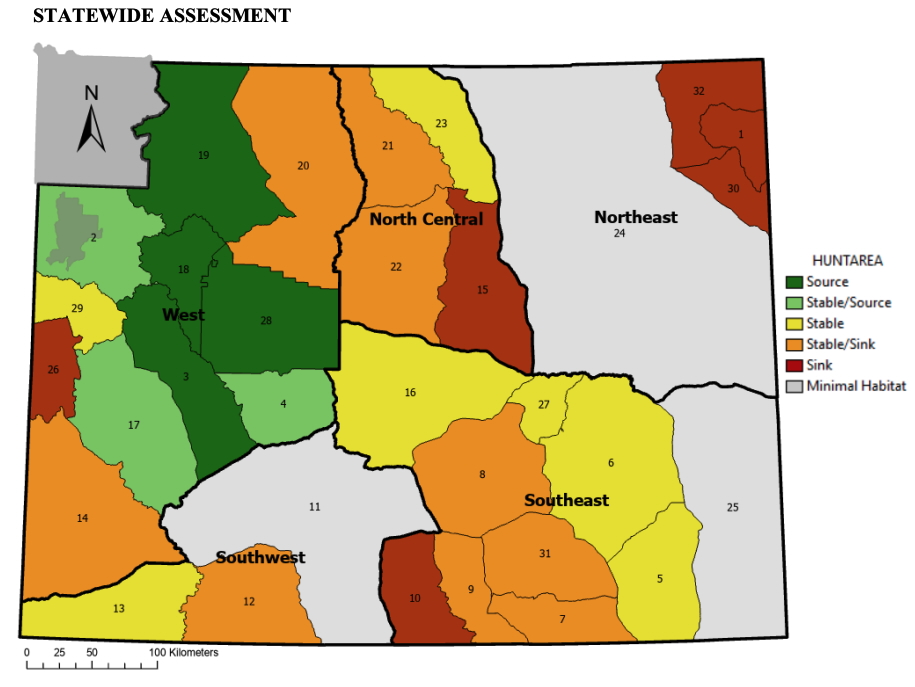
Areas where lions exist at healthy, natural densities that are managed for long-term hunting of the big cats are classified as “sources.” Regions with densities deemed “relatively high” — where the goal is to maintain lion numbers — are labeled “stable.” And then there are “sink”management areas, where hunting seasons are set with the goal of reducing lion numbers.
In 2006, when Wyoming embarked upon its source-stable-sink lion management regime, a dozen of the state’s 29 lion areas were managed as “sources,” and a 13th area was marked a blend of “source” and “stable.” A single area in the southern Bighorns was then branded as a “sink.”
Times have changed.
The Wyoming Game and Fish Department, which typically updates its lion regulations every three years, has retained only four areas as population “sources,” according to the latest statewide mortality report. “Sinks,” meanwhile, increased from one in 2006 to six hunting areas during the last cycle, from 2022 to 2024.
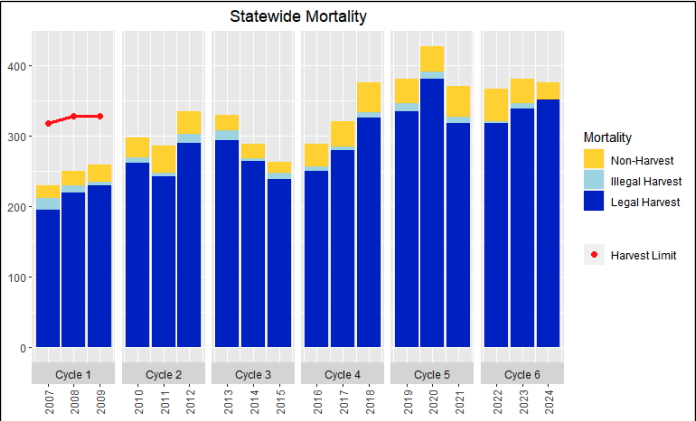
The maximum number of lions permitted to be killed by hunters across Wyoming has steadily grown. And the number of cougars actually killed has risen in tandem, and is now approaching or exceeding 350 cats killed annually, according to the state’s data. Populations, of which there are no good estimates in the state, are now hunted so heavily that in many places there are very few remaining mature animals. It’d be the equivalent of an elk herd that’s almost exclusively calves, yearling cows and spike bulls.
Luke Worthington, president of the Wyoming Houndsman Association, has seen it firsthand. A houndsman who guides clients along the west slope of the Bighorn Mountains in areas 21 and 22 — both managed as a blend of “stable” and “sink” — he’s grown accustomed to seeing very few signs of lions overall, and then treeing only youngsters.
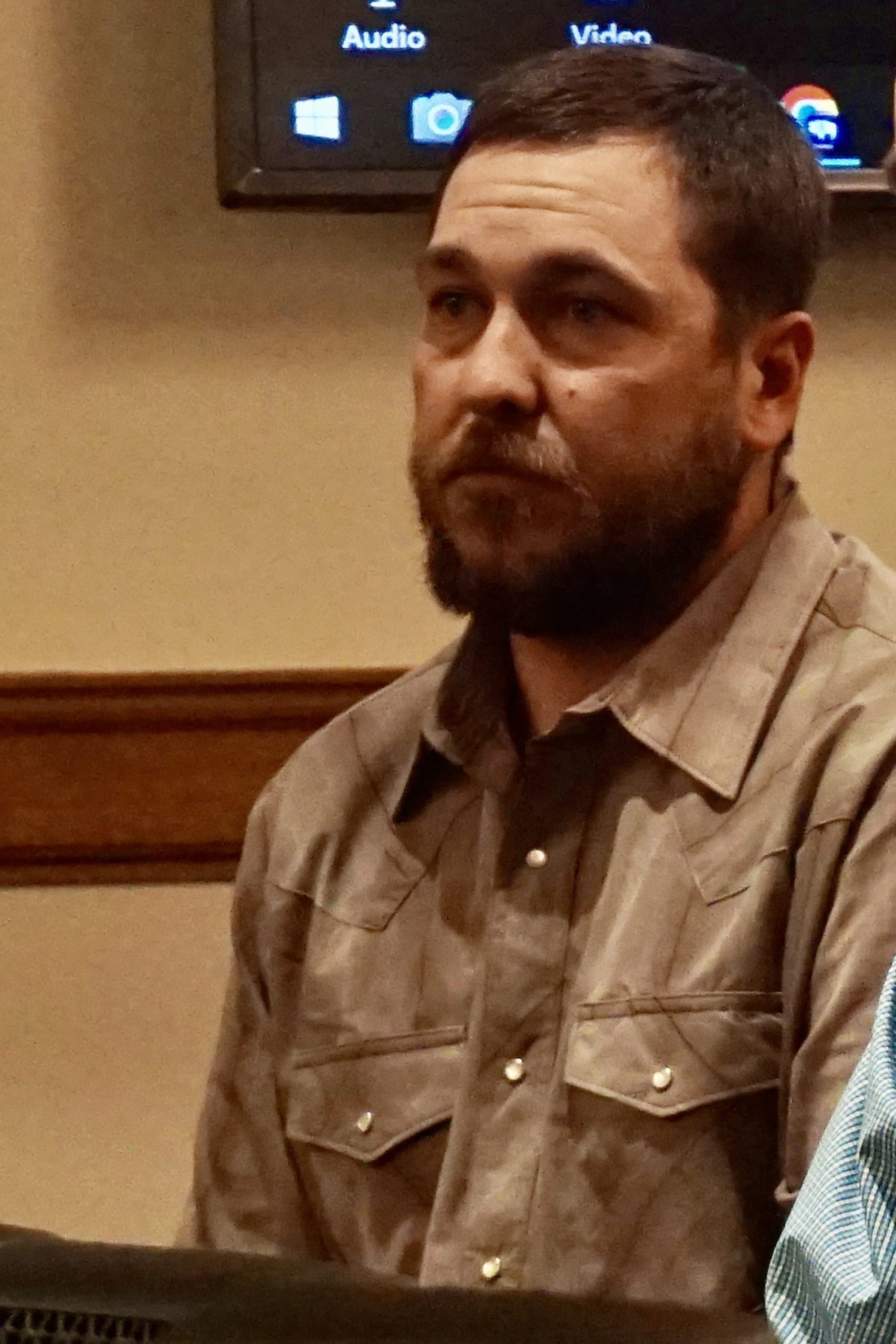
“There’s no age structure there at all, it’s all young cats,” Worthington said. “I drove almost 5,000 miles in 14 days and cut less than 10 tracks.”
Over the two weeks of hunting there last winter, he found a single mature tom.
Worthington tried to tilt the hunting regulations in the mountain lions’ favor. The houndsman lobbied to drop the mortality limits in areas 21 and 22 — and thought the idea had some traction.
“We had all the game wardens and bios in those areas on board,” Worthington said. “They see the problem. And it was not even brought to the [Game and Fish] Commission.”
When Game and Fish rolled out its draft lion hunting regulations this spring, the maximum number of cats that could be killed in the two western Bighorn hunt areas stayed the same, at 45 animals.
Statewide, mortality limits either rose or stayed the same. One area, in Wyoming’s far southeast corner, is positioned to transition into an “unlimited” hunt, joining other “unlimited” hunt areas in the southern Bighorns, Powder River Basin and the Casper Mountain region.
Even in the Wyoming Range, Gros Ventres and western Winds, wildlife managers held onto 50% higher mountain lion hunting limits that were put into place due to big game outfitter pressure following an especially deadly winter for mule deer and pronghorn. The changes were made despite a lack of evidence that killing lions would help bring the ungulate herds back.
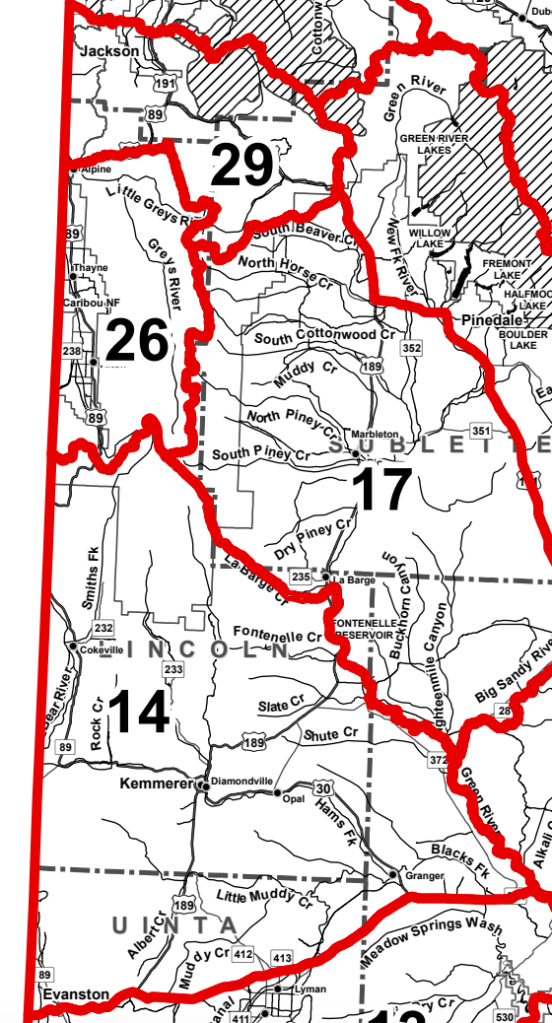
Two years later, Game and Fish proposed to retain 50% higher quotas in hunt areas 14, 17, 26 and 29, continuing with management that allows a maximum of 61 cats to be killed in the western hunt areas.
Like in the western Bighorns, it’s an approach that’s working to drive down lion numbers.
“In areas such as Wyoming Range, where there was a great deal of public interest to kill as many lions as possible, we’re seeing that come forth,” Game and Fish Large Carnivore Supervisor Dan Thompson told WyoFile. “Once you start getting any adult female segment, then you start ramping into everything, and you get a younger age class and less lions overall.”
While trapping lions for research along the Wyoming Range’s western front, state biologists saw indications of the reduced numbers.
“It was harder to cut a track this last winter, for sure,” Thompson said. “It was pretty few and far between.”
Worthington, who lives in the Gillette area, heard the rumors from across the state.
“For that Cokeville study, Game and Fish went up there and they found no lions,” the Wyoming Houndsmen Association president said. “That’s pretty freaking alarming.”
Maps presented at the Game and Fish’s lion season-setting meetings illustrated the heavier hunting in western Wyoming, and its population effects. During the last three-year cycle, for example, virtually all the lions killed along the Salt River Range front in eastern Star Valley were immature animals.
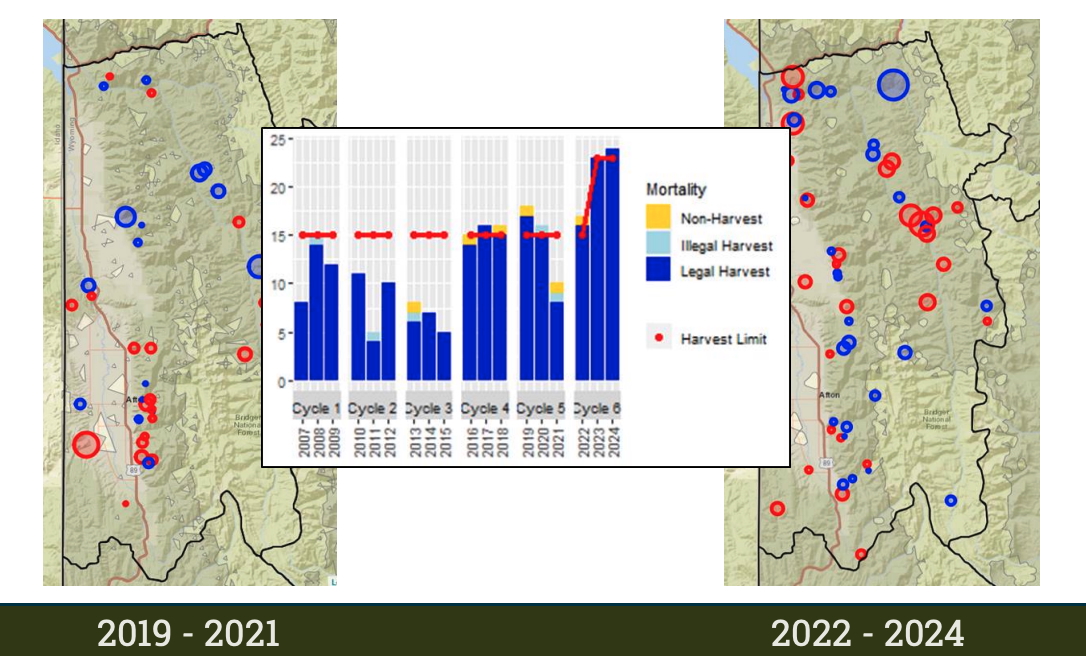
There was a discussion about returning to the lower quotas, Thompson said, but ultimately, in conjunction with Game and Fish’s regional offices, they opted to keep the pressure ratcheted up.
“We want to maintain our ability to manage mountain lions as Game and Fish,” Thompson said.
Last winter, Rep. Mike Schmid, a La Barge Republican who lives butted up against the badly winterkilled mule deer range, ran a bill that would have essentially stripped state wildlife managers of their authority over lions. The idea met overwhelming opposition and died.
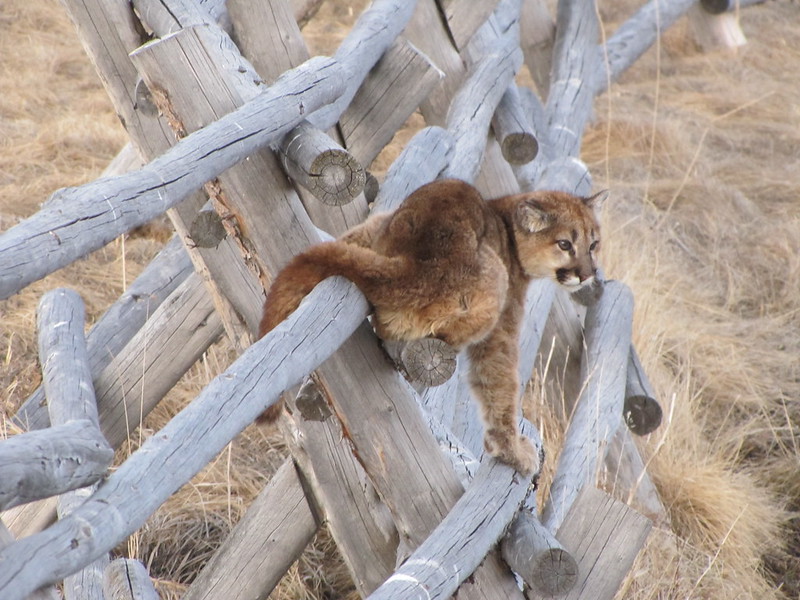
If Wyoming wildlife managers do someday opt to allow for healthier mountain lion populations, they know from experience that the big cats can bounce back. Even where mountain lions were extirpated during the settlement era, like the Black Hills, cats eventually reoccupied and thrived due to the normally sturdy deer population. In a place like the Wyoming Range and western Bighorns, lions haven’t been hunted out of existence — just greatly reduced.
“If there’s adequate immigration, it takes three years to get some of the densities back,” Thompson said. “Five years to get that social structure back.”
Game and Fish commissioners still must OK the draft mountain lion regulations, which will govern what the state’s hunting seasons — and, in turn, cougar populations — look like for the next three years. The governor-appointed body is set to review the proposal on July 16 in Casper.
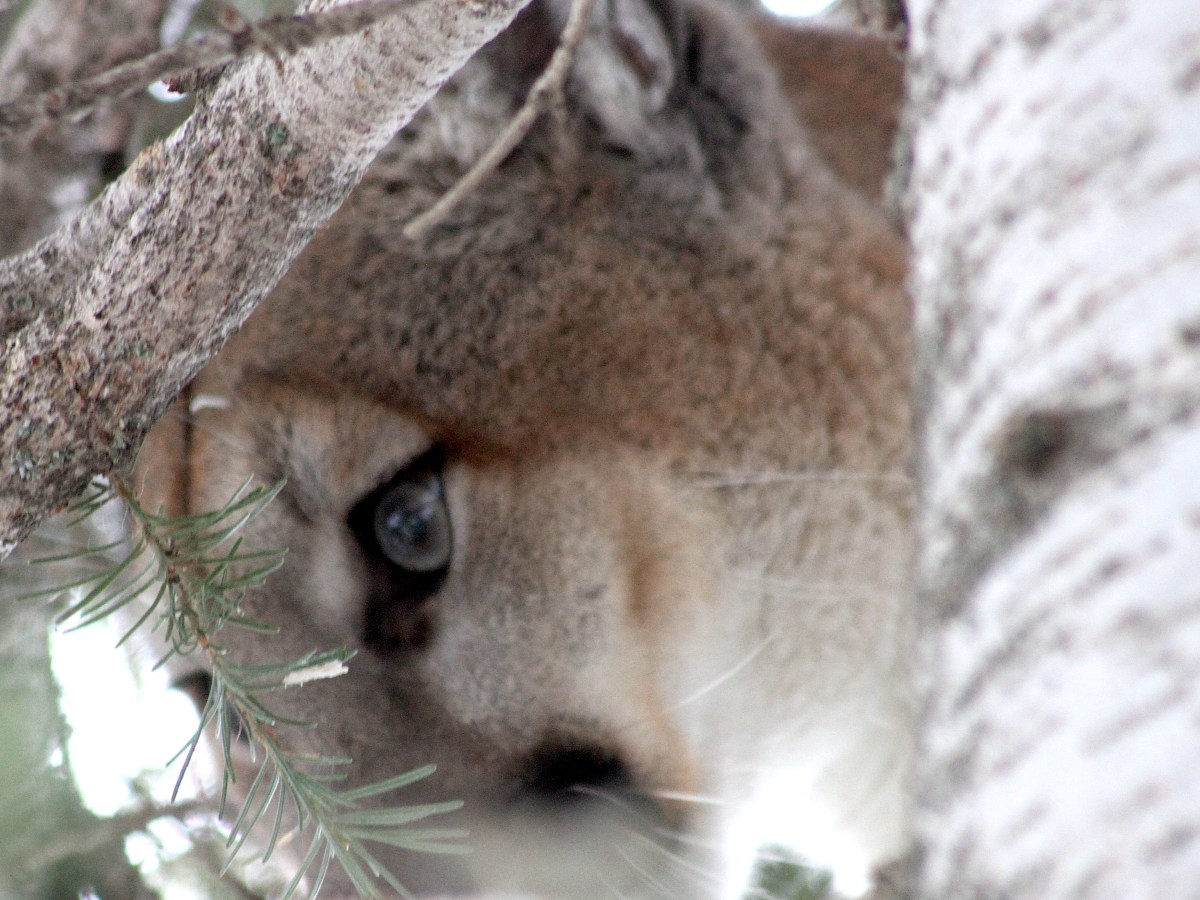
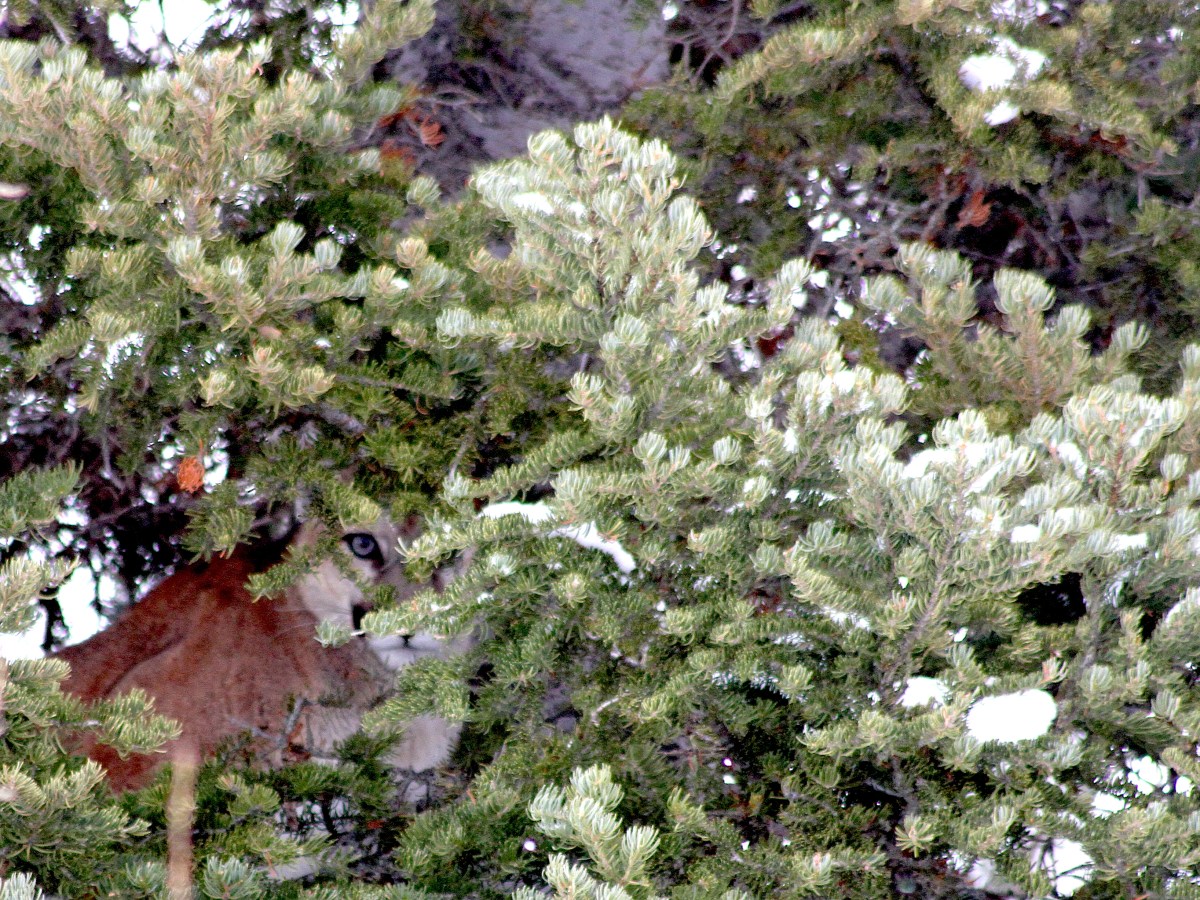
Commission meetings provide a stage for the public to weigh in on mountain lions, whether they want to urge killing more of them or advocate for taking it easier on Wyoming’s population. Houndsmen typically play the role of mountain lion advocates, but they largely didn’t appear, at least during the public meetings about the draft regulations. In Pinedale, for example, zero houndsmen turned out to hear about plans to retain 50% more mortality in a region where hunting pressure has been taking its toll.
Worthington is frustrated.
“The houndsmen not commenting?” he said. “I don’t even know what to say about it.”
Please 🙏 stop killing our beloved mountain lions
Predator pit. It’s a term used to describe the effect of predators on a big game herd that is attempting to grow its numbers back to a size comparable to what it was before the herd downfall occurred. I’m sure most of you remember the winter of ’22-’23. The killer winter that killed upwards of 80% of the deer in areas of western Wyoming. That winter created a form of “predator pit”, whereas the deer would have a much harder time of repopulating to hopefully get their numbers back up. I applaud G&F for putting more pressure on the predators until such time as the deer herds can recover. The predators will be back-you can count on that as sure as death and taxes. It won’t take them long, either. Once the deer recover, then ease up on the lion pressure. It’s called wildlife management.
I think that there is seriously something wrong with people that would go out of their way to kill an animal like this .. it doesn’t have it hard enough with us taking the forests. Smashing them with our cars . Etc . Now it’s Saturday let’s go kilnus some cougars . They just got back into a decent population.. you know after the last massacre.. if you have fun killing something awesome as a big cat. Might be time to go have your heads examined
The people of Wyoming must be embarrassed to see that most of their men or should I say morons enjoy killing animals for nothing more than sport, and the killing of these lions is an absolute disgrace . You can’t be a conservationist because you can’t conserve something by killing it. It just goes to show you the hypocrisy and absolutely insanity connected to hunting animals for sport. The day is coming and it’s coming soon when honey will be relegated to the dustbin of history right alongside slavery. And by the way, I’m not a level I’m a stat republican that respects all forms of life.
The big game outfitters must not have their way in how mountain lions are managed. God created mountain lions and all life for a purpose. The pro-death outfitters are going against God and nature. To me, outfitters are rotten, selfish bastards. May the judgment of God be on these satanic outfitters.
I am a hunter. But they need to back off the cat kills. Lo cattle numbers on the range and in ranchers inventories has NOTHING to do with wolf/cat or any predator kill of livestock. That is due to market conditions. Elk are overrunning pastures so you need more predators to cull and scatter elk herds
Unfortunately the whole problem started years ago with the great wolf plant. That provides entertainment for those who enjoy watching a wolf eat another animal alive. It has cost food producers who provide our beef, leather, and wool a big chunk of money.
Oh the big bad wolf. I’m so scared. I guess from your perspective everything should revolve around ranchers. What about the other 99% of the population? Predators are important for a healthy wildlife population.
I wish you would check your sources and quit using a habitual poacher for information
I don’t think your capable of making the right decision, proof came out in the Cody Roberts wolf case. It’s shows the Wyoming game and parks don’t know what they are doing especially when it comes to natural resources.
Marvin keep Wyoming out of your uninformed lips.
It’s called Wyoming Game and Fish Department and the Large Carnivore Managers of Wyoming have no equal, period. Leading science based management and effective strategies that are the gold standard world wide.
Go back to worrying about your own cats!
Another example why demand that states take over management of endangered species is misguided–though under Trump, currently there is no difference.
Research has found Mountain Lions can help stop the spread of Cronic wasting disease. Balance is key and CWD can eliminate large populations of deer and elk plus make it unsafe for human consumption. Time to listen to the wildlife biologist and keep the mountain lion population healthy.
This nation wide infatuation with deer at the expense of everything else is mind addling.