


Wyoming leaders and advocacy groups reacted with cautious optimism after the Biden administration released its plan for protecting the greater sage grouse, a chicken-sized bird whose future has major implications on energy development here.
The Bureau of Land Management draft plan published Thursday would revise sage grouse management on federal lands in 10 western states including Wyoming, which is home to more than a third of the remaining greater sage grouse population.
The draft plan includes six proposed alternatives “informed by the best-available science and input from local, state and federal partners,” according to the BLM. It is a culmination of “the most successful components” of previous iterations adopted in 2015 under President Barack Obama and 2019 under President Donald Trump but never fully implemented.
The BLM’s approach acknowledges the fact that federal plans to protect the iconic, imperiled bird have varied greatly between presidential administrations for more than a decade. Wyoming leaders have sought to avoid land use restrictions that might limit industrial activities — oil and natural gas development, in particular — while steering clear of potential Endangered Species Act protections, which could override the state’s proposals to revive sage grouse populations without impeding its energy and agricultural industries.
BLM Director Tracy Stone-Manning said her agency’s renewed effort is rooted in long-existing collaborations with state and local governments, even as the agency lays out a plan revision that takes into account new information about mounting threats to the West’s sprawling sagebrush ecosystem posed by climate change, wildfires and invasive plant species.
“Joint efforts to conserve the Greater sage grouse and its habitat led to the largest collaborative conservation effort in our history, and we are building on that work, together with our partners, to ensure the health of these lands and local economies into the future,” Stone-Manning said Thursday in a prepared statement.
Though multiple groups and state agencies are still poring over the voluminous BLM document published on Thursday (its contents can be accessed on this BLM website), some of the toughest critics of past federal efforts in Wyoming expressed cautious hope for a final plan with meaningful conservation measures that don’t threaten Wyoming’s core industries.
“The BLM has provided alternatives that recognize the monumental collaboration between federal, state and local officials, the oil and natural gas industry, mining, agriculture and many others across Wyoming to protect sage grouse, improve habitat and keep the Greater sage grouse off the Endangered Species List,” the Petroleum Association of Wyoming said in a prepared statement. “The BLM should align its sage grouse management provisions with those of the state of Wyoming to remain responsive to local conditions.”

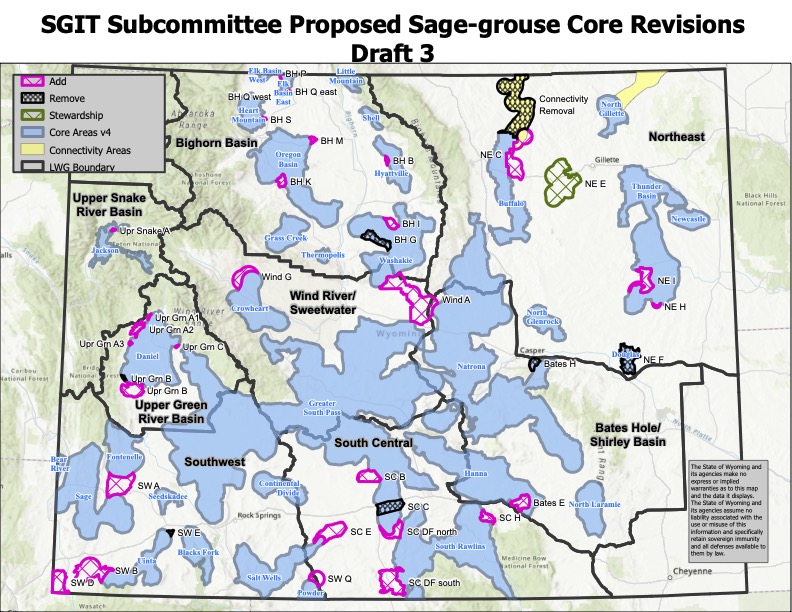
Gov. Mark Gordon indicated that any hope he places in the federal government’s revision effort depends on deference given to the state’s proactive efforts, particularly its “core area” sage grouse management plan.
“Since this [BLM] plan could have a disproportionate effect on Wyoming citizens and industries,” Gordon said in a prepared statement Thursday, “any proposed BLM actions that do not align with the core areas established through our state-led process will be closely scrutinized.”
Why sage grouse?
Sage grouse populations have declined 80% throughout the West since 1965, with more than half of that loss occurring since 2002, according to a study by the U.S. Geological Survey. The species garners a lot of attention because its health serves as an indicator of a massive sagebrush ecosystem that supports a variety of plants and some 350 other wildlife species, including mule deer and pronghorn.
Despite some conservation successes, including in Wyoming, sage grouse and its habitat still face increasing pressures from climate change and rural development. A five-year monitoring study completed by the BLM in 2020 suggested that more conservation and habitat restoration efforts are needed.
“These collaboratively developed landscape-level plans will ensure that other multiple uses of BLM sagebrush lands — including clean energy projects — move forward in a manner that limits impacts to sensitive resources and can also help combat climate change — a main driver of Greater sage-grouse habitat loss,” the BLM stated this week.
What’s in the plan revision?
The draft environmental impact statement will amend 77 BLM land use plans encompassing some 68 million acres across the West. The agency proposes to restore some energy development restrictions originally proposed under the Obama administration while allowing for some “flexibility” in implementing a congressional goal of permitting 25,000 megawatts of new solar, wind and geothermal energy on federal lands by 2025.

Of the six proposed alternatives put forth in the BLM’s sage grouse management plan revision, the agency’s preferred option includes designating 8.6 million federal acres in Wyoming as “priority habitat” and another 8.9 million acres as “general habitat.” A priority habitat designation is applied to “public lands that have the highest value for sustaining sage-grouse populations,” and come with restrictions to reflect those land values, whereas a general habitat designation provides for conservation measures with fewer restrictions.
Gordon said he appreciates that the preferred alternative doesn’t yet dictate broad use of the agency’s most stringent land use classification known as Areas of Critical Environmental Concern. Some conservation groups, however, say that limited use of the designation “falls woefully short” of actions necessary to protect the sage grouse and its habitat.
Without broader use of the designation, the BLM’s efforts “will do little to improve recovery of the sage grouse, or to make a meaningful contribution to fighting climate change,” American Bird Conservancy Vice President of Policy Steve Holmer said in a prepared statement.

Sen. John Barrasso (R-Wyoming) echoed Gordon’s warning that, unless the BLM follows Wyoming leadership on sage grouse conservation, the effort only stands to threaten the state’s economy.
“Imposing sweeping regulations has hindered these efforts in the past and will only be ineffective in the future,” Barrasso said in a prepared statement on Thursday. “The [BLM] should rely on local experts in Wyoming and across the West as it updates its plan.”
What’s next
The BLM will announce a series of public informational meetings across the West and will accept written public comment on the draft environmental impact statement through June 13. Visit this BLM website for more information regarding upcoming public meetings and how to comment.

When will the self-serving greed in Wyoming end.. Their continued war on wildlife to satiate interest groups is pretty pathetic. They would build high rises inside GTNP given any loophole.
THE BLM HAS MADE A HUGE MISTAKE!!! Prior to implementing the administration’s goal of 25,000 mega watts of renewable energy, the agency should have conducted a western US inventory of which Federal lands are best suited for solar and wind. There are many areas in the western US that are devoid of almost everything and would be excellent choices for solar and wind projects – but that isn’t the way it has happened. Right now, Federal lands which have high values for wildlife, plant species, scenic, recreation, etc. can be proposed and probably approved for solar and wind. Do we really need to bull doze thousand of acres in southern Wyoming’s high desert for solar? Don’t think it can happen – remember the solar project near Pinedale straddling the State highway right in the middle of the antelope migration corridor??? How could BLM make such a monstrous mistake – but they did. I’m very pessimistic about the solar and wind projects not being located in areas where they will have the least impact on the environment – in the rush to solar and wind many more mistakes will be made – and many of them will be in Wyoming. And, it isn’t just antelope migration corridors that might be affected – sage grouse are likely to be affected. Is the BLM willing to say there will be no solar and wind projects approved in sage grouse core habitat areas in Wyoming – that’s where this issue is headed. Sounds like an excellent issue to be resolved in the Rock Springs RMP revision – are we talking about no surface occupancy designations in order to protect sage grouse core habitat? Everyone likes to think about restrictions on the oil and gas industries in the core habitat areas; however, sage grouse are equally jeopardized by solar and wind development projects in Wyoming. The BLM can’t have it both ways – they can’t claim they are protecting sage grouse and then approving solar and wind in core habitat.