


The global oil market’s reaction to rising conflict in the Middle East has been subdued, so far, as supplies remain flush and shipping routes mostly uninterrupted. That could change, however, if Iran makes good on a threat to shut off the Strait of Hormuz, according to energy analysts.
The key petrol shipping route connects 25% of the world’s oil and about 20% of the world’s liquified natural gas from the Persian Gulf to the Arabian Sea and on to, mostly, Asian consumers like China. Though speculation abounds about whether Tehran might try and succeed at closing the vital shipping pinchpoint, such an action would most likely send oil prices soaring with implications for Wyoming’s energy-dependent economy.
Yet even if that were to happen, according to market watchers who spoke to WyoFile, the U.S. is far less prone to global supply and price disruptions than in decades past. That’s because the U.S. reversed a 30-year decline in oil and natural gas production to reach record highs, becoming a net exporter of petroleum products in 2020 and surpassing Saudi Arabia and Russia to become the top oil producer in the world today.
“We’re way less vulnerable than we’ve been in years past,” Washington D.C.-based Bracewell partner and energy policy analyst Frank Maisano told WyoFile. “We’ve just seen much more minimal impacts [from world oil markets] because we’re inoculated against it — because of all the production we have going in the U.S.”

The U.S. accounts for about 22% of world oil production, surpassing the second-largest producer Saudi Arabia, which accounts for about 11%, according to the U.S. Energy Information Administration. The U.S. is also the top natural gas producer, as well as the largest exporter of liquefied natural gas.
Following decades of decline beginning in the 1970s, the U.S. regained its foothold in oil and natural gas production, thanks to advances in hydraulic fracturing and onshore directional drilling in the mid-2000s, particularly in shale formations in places like the Permian Basin underlying New Mexico and West Texas.
Though oil prices shot to more than $100 per barrel following Russia’s invasion of Ukraine, the industry was still on its heels, trying to backfill operations from the COVID-19 pandemic, Maisano noted. Suppliers have regained footing since, and so far world oil prices have oscillated only slightly since the U.S. bombing in Iran. The Brent crude spot price — the benchmark for two-thirds of the global market — slipped by about $5 per barrel to settle around $71 on Monday, according to Reuters. The price remains within the past year’s average.
U.S. oil benchmarks have mostly tracked, with the West Texas Intermediate price briefly up then settling to about $65 per barrel, about $3 less than before the U.S. bombing over the weekend, according to market reports. Though the world market absolutely still influences the U.S. market, Maisano said, it is far less prone than it was 15 years ago.

“There’s always some potential impacts when you talk about conflicts, especially in the Middle East,” Maisano said. “But global markets today are just more resilient compared to where we used to be. It’s because we’ve transformed ourselves into a global energy superpower.”
The situation in the Middle East remains volatile, however, stoking fears of retaliatory efforts by Iran or rogue actors who might want to interrupt shipping routes and tankers.
For now, Wyoming can take solace in robust regional oil and natural gas production, as well as refining capacity, which makes the broader region even more resilient than other parts of the U.S., according to Maisano and others.
Wyoming oil
Pump prices in Wyoming in recent days have tracked slightly lower than the national average of about $3.22 per gallon, according to GasBuddy. And that’s during the onset of the summer travel season.
That’s owed, in part, to regional production and refining capacity.
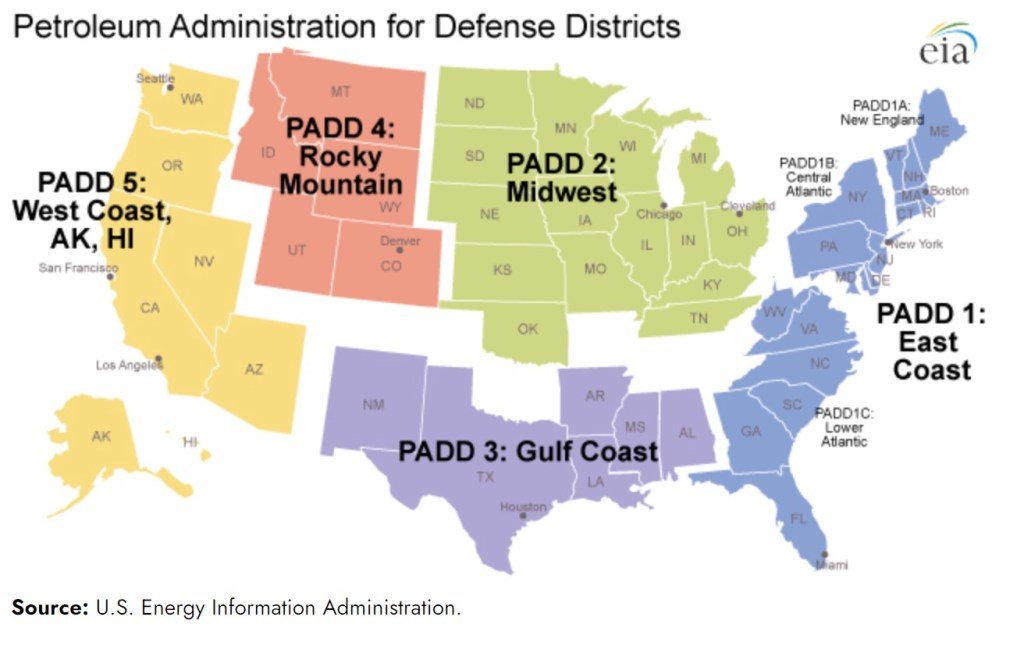
Wyoming is the eighth-largest oil producer in the nation and ranks ninth in natural gas, according to federal data.
Though its refining capacity of about 126,000 barrels per day is a fraction of the industry’s heyday in the 1970s, the combined production and refining infrastructure in the broader Rockies region supports a relatively stable market, said Grier Bailey, executive director of the Colorado Wyoming Petroleum Marketers Association.
“I think gasoline and fuel supply for Colorado and Wyoming will be okay even if there is a slight increase in the price based on the global commodity exchanges,” Bailey told WyoFile via email. “The U.S., led by states in our [region], have the supply to handle our needs.”
Maisano credits the region’s long history in oil and gas, as well as state leaders throughout the Rockies who are supportive of the industry.


“You have both Democratic and Republican state leaders who have not been shy about putting domestic production and in-state production as a priority,” he said.
Whatever happens to oil prices related to rising tensions in the Middle East, many producers here still bemoan what they see as Wyoming’s disadvantage — more federal mineral ownership and regulatory hurdles — to be responsive. Producers in New Mexico, West Texas and Pennsylvania can be far more responsive than Wyoming to meet an unexpected spike in demand, said Steve Degenfelder, land manager for Wyoming-based Kirkwood Oil and Gas.
“If you do have a price spike that people want to take advantage of, chances are they’re probably not going to be able to take advantage of it in Wyoming,” Degenfelder told WyoFile.
