


Fall’s cooler temperatures send Wyoming’s prairie rattlesnakes slithering home to hang out closer to their dens.
“Your highest occurrence of crossing paths with the rattlesnake is going to be May, June, July, August and September,” said Matt Rasmussen, vice president of the Wyoming Herpetological Society.
For ophidiophobes — those with a fear of snakes — hoping for a firm date, when all rattlers tuck themselves in for winter, Rasmussen says there is no such thing.
“You can expect to see a rattlesnake in most of Wyoming below about 7,200 feet until there’s snow on the ground, because even if there’s a warm day, they can be out,” Rasmussen said. “I’ve seen rattlesnakes every month in Wyoming, except for December, January and February, but that’s typically because I look for them and I like them, and I’m going to where they are.”
Driving the backroads between Pathfinder Reservoir and the town of Medicine Bow, WyoFile reporter Andrew Graham and his editor had a near miss with two rattlers within a few miles.
“That particular area of Wyoming is the highest density of rattlesnakes anywhere in the state,” Rasmussen said. “And it’s one of the highest densities of rattlesnakes anywhere in the country.”
The Shirley Basin’s rock pile hills and lower elevation mountains are home to huge rattlesnake dens, Rasmussen said.
He’s heard talk of rattlers traveling 3 miles from their dens, and is certain they can range up to a mile.
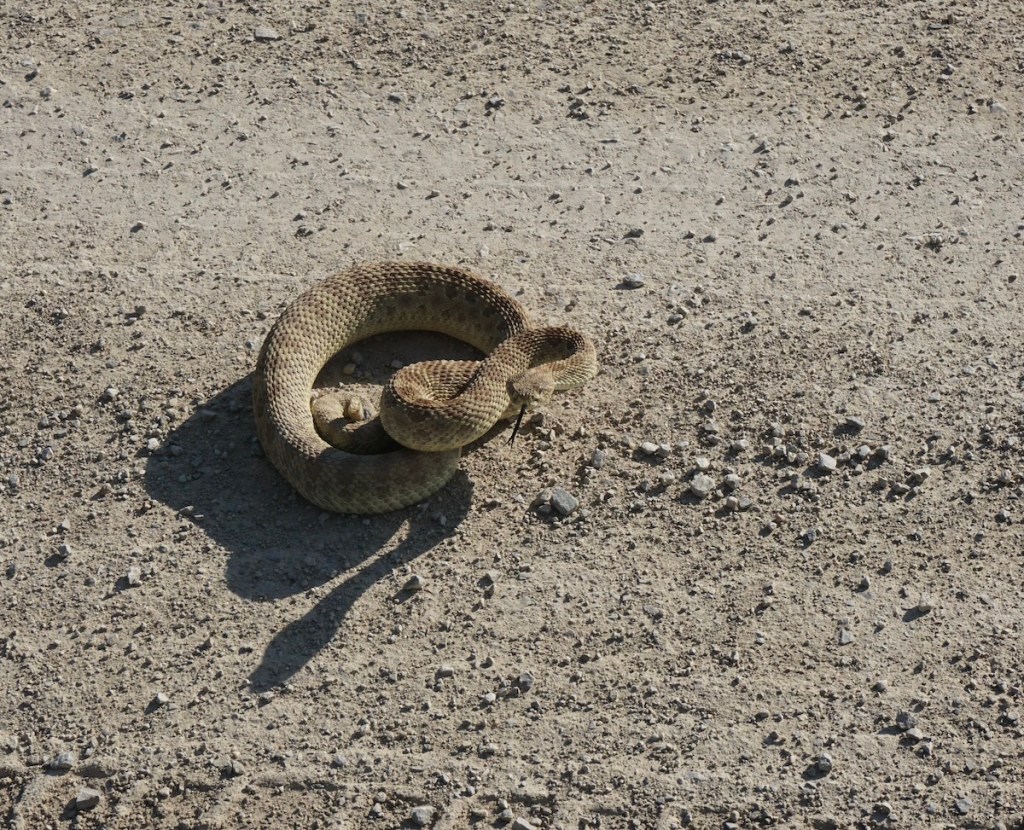
The WyoFile staffers were delighted to catch a glimpse of snakes slithering and sunbathing from the safety of their pickups. The first snake was more of a brunette, while the second leaned blonde.
“They’re highly variable in their phenotype and appearance,” Rasmussen said. “Their name, Crotalus viridis, is green rattlesnake. And some of ours that we have here are extremely green. They’re just beautiful — glowing chartreuse and green. And others, they’re just chocolate or gray or kind of muted sandy colors. In the same area, in the same population, there’s wide, wide variability in their appearance.”
If you see one, and you don’t want to get bitten, all you have to do is walk away. Rasmussen advises: “A snake will never chase anyone.”
But seeing them is key?
“You cannot see a rattlesnake if it doesn’t want to be seen,” Rasmussen said. “But you can see the sagebrush that it likes to coil underneath. You can see that small pile of rocks out in the prairie that it likes to hang out by. So if you can identify these small, sun-dappled, shaded areas where they could feel comfortable, and you avoid those, you’ll be fine.”
Rasmussen stands by that advice even after being bit by a rattlesnake last year.
“It was a complete one in a million fluke,” Rasmussen said. “I work for the railroad in eastern Wyoming and I knelt down to pick up something in between the ties, and it was underneath the foot of the rail, and it got me.”
That painful encounter — which he said left his arm looking like a football — didn’t undermine Rasmussen’s admiration.
“They are an important part of our ecosystem,” Rasmussen said.
Many humans appreciate them for eating rodents, Rasmussen said, but the benefits extend beyond pest control. “They’re proven to be seed dispersers, because they don’t digest those seeds that are in the stomach of the rodents that they eat.”
He said they’re also an important food source for other animals from badgers and bobcats to raptors and hawks.
“They’re just really cool,” Rasmussen exclaimed. “I mean, it’s an animal with no legs that lives in a state that gets down to 30 below. They’re only active typically for three or four months of the year and can live for over 20 years with that activity level. And there’s been studies that some adults only eat once a year.”

Glad to see George the ophidiophobe so nicely outweighed by other commenters. The only snakes I’ve regretfully killed are some that have hopelessly entangled themselves in anti-deer fencing around our garden. I did not wish them to endure a lingering death.
Only good venomous snake is a dead one. That’s one less that won’t bite anyone.
That’s about the most ignorant comment I hear constantly repeated. Are you going to go out and maintain rodent control?
Thank you for a solid grounded common sense science based article that devilifies a creature that is much maligned but very important.
They are so shy, and so willing to warn people to please stay back. Such amazing, beautiful creatures. As Rasmussen says, a very important part of our ecosystem.
Thanks for the article. I was glad that it spoke of respect and admiration for the rattler.
God put snakes here. They do good things. Leave them alone.
AMEN…perfectly created to be a perfect part of creation made by a Perfect creator
Thanks for speaking up for rattlesnakes. So often we are most afraid of what we don’t understand. Rattlesnakes resonate with me from my childhood in Montana.