


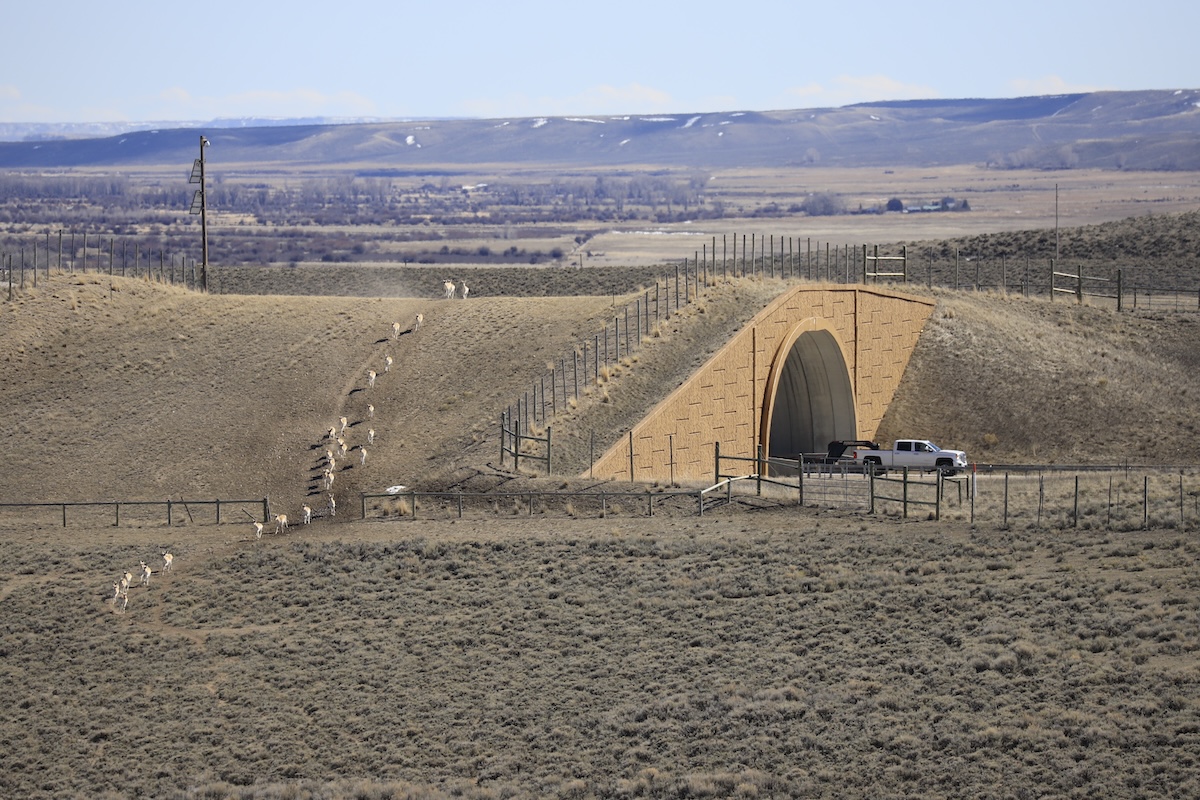
Wyoming’s track record helped secure the largest federal grant in a new program that will see mule deer and pronghorn wildlife-crossings built along a 30-mile stretch of Highway 189 south of Kemmerer.
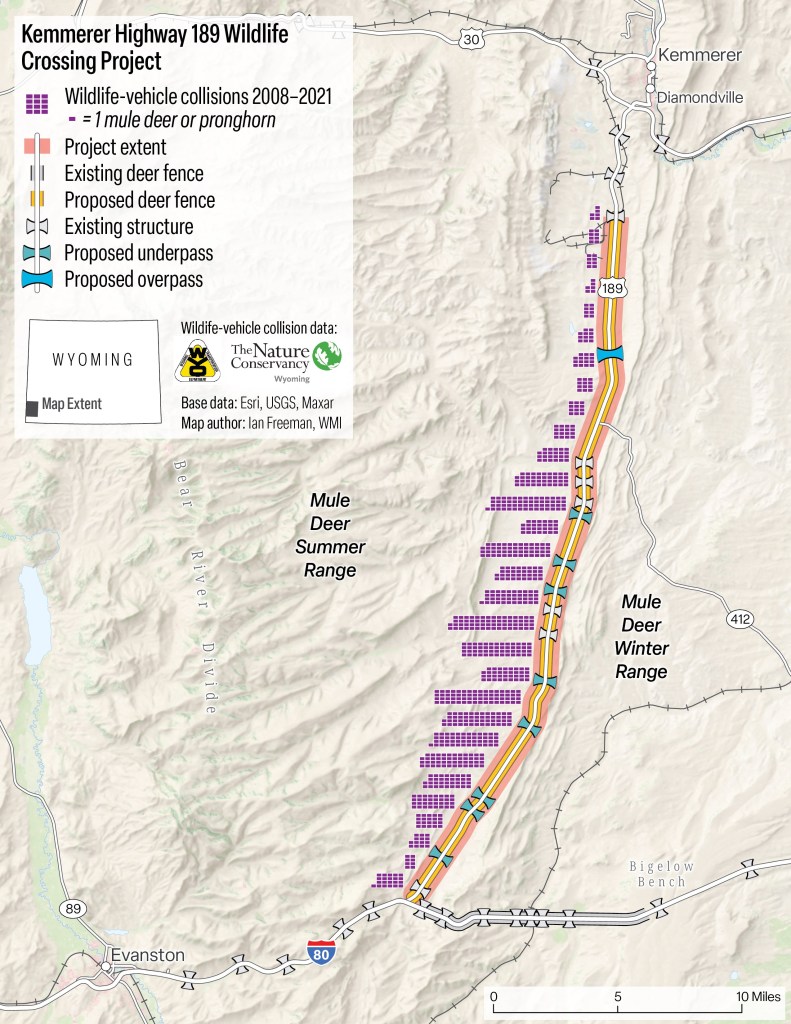
The $24.3 million federal grant to Wyoming was the largest made from the U.S. Department of Transportation’s first tranche of $109 million for a novel Wildlife Crossings Pilot Program. Wyoming will use the money to fund the bulk of the $37 million construction project that will involve fencing 30 miles of the highway, building six or so new underpasses and a wildlife bridge for skittish antelope that won’t go through a tunnel.
About 80 deer or antelope are killed in collisions along the stretch annually, state agencies calculate. The average big-game collision costs $11,600 in injury and property damage, Wyoming Game and Fish Department estimates.
The crossing project is expected to prevent most of those crashes as soon as it is completed, proponents say.
“I like to believe Wyoming set the stage.”
Angi Bruce, deputy director of Wyoming Game and Fish Department
Fully 76% of the crashes from 2013-2022 along the route involved wildlife, said Angi Bruce, a deputy director for the Game and Fish Department. That compares to 15% across the rest of the state.
Wyoming wildlife-crossing projects have proven to reduce collisions, and this one is expected to trim them by 80% to 90%.
The USDOT has supported the state before, granting Wyoming $14.5 million for the Dry Piney wildlife-crossing project. That grant was made based on safety criteria; the new one is the first oriented ecologically toward wildlife.
Wyoming received more than 20% of the program’s first round of $110 million in grants, Bruce said, because it could demonstrate a need, could show almost immediate results of earlier projects and had a suite of collaborating funders.
“I like to believe Wyoming set the stage,” Bruce said. “This shows how well we are doing wildlife crossings, with [the Wyoming Department of Transportation] and all the other partners.”
‘Meat gauntlet’
Different seasonal ranges and subsequent migration urges make deer and antelope cross the road. The fencing and under- and overpasses will connect the summer and winter ranges of the Wyoming Range and Uinta deer herds, as well as the Carter Lease pronghorn herd. Resident deer and antelope also will benefit.
“It’s certainly a needed fix,” said Josh Coursey, CEO and co-founder of Muley Fanatics Foundation, a nonprofit that pitched in with some funding. He called the highway a “meat gauntlet of carcass carnage.
“The only big game critter I have ever hit was a deer on this stretch … unfortunately,” he said. “These [projects] work and they work well. You can quantify success immediately.”
The federal funds come from the Bipartisan Infrastructure Law that will dole out a total of $350 million in the pilot program over five years. Too many Americans are injured or killed in crashes involving cars and wildlife, especially in rural areas, Secretary of Transportation Pete Buttigieg said in a statement.
“President Biden is tackling this challenge,” he said of the grant program that will “save American lives.”
The award “exemplifies Wyoming’s leadership in demonstrating a collaborative approach where we work together to solve problems,” Gov. Mark Gordon said in a statement. Partners include the WYldlife Fund, Wyoming Transportation Commission, Wyoming Game and Fish Commission, Wyoming Wildlife and Natural Resource Trust, the Wyoming Legislature and Wyoming’s congressional delegation, he said.
Non-governmental entities, including conservation groups, energy and mining companies, a family foundation and others, rounded up nearly $1 million in contributions.
Considering the cost of the improvements, it’s necessary to have a significant funding partner like the federal government, Coursey said. As a conservative, however, he’s troubled by the national debt, he said.
Nevertheless, “if they are printing money,” it might as well come Wyoming’s way, he said. “I’m certainly glad to know Wyoming is in the driver’s seat.”
Wyoming identified crossing locations using years of radio-collar data, Bruce said. Tunnels and wildlife overpasses are also placed with an eye toward whether they might alter natural behavior and what impact they might have on private property.
Traffic analysts expect the highway between Interstate 80 and Kemmerer will become busier with the proposed construction of a nuclear plant in that town.
Altogether the government received 67 applications from 34 states requesting $549 million from the program. Seventeen states received money for a total of 19 projects.
WYDOT will contribute $4.2 million to the project and other state agencies will put in $8.8 million. Bids will be let in 2024 for what’s expected to be two to three years of construction.
That area definitely needs the help. I lost count of the number of dead deer and pronghorn when I travelled that route one day last winter.
Hmmm… those arched wildlife overpasses and underpasses appear to cost more to engineer and build than a new steel deck and concrete bridge.
While I believe Wyoming needs all the wildlife mitigation funding it can get its hands on, one wonders if the huge costs to build these structures is an accurate reflection of time and materials expensed. I do wish someone would do a deep dive on that with a round of ” follow the money ” and find an outside emeritus construction engineer with no Pronghorn or hard hat in the fight to look hard at the real costs. My gut feeling is the wildlife over/underpasses are gouging the government funders. But how would we know ?
I agree on the cost also. I drive this road frequently and it is bad for wildlife, especially the deer. Is it just me but it seems on the map that even the areas where they already have these they still have a high amount of accidents related to the animals on the rode. So, are they really working? For the cost I think that would be a big question. I question the overhead structure since this area is mostly flat on one side of the road? Also, is this just because of the new Nuclear Plant? Otherwise would this be such an important issue or we doing this for the ‘Big Boss-es’ who will be flying into Evanston and driving over to the ‘Nuke’, is this just one more way to pacify the big “guy-ies”.
I think this is a wonderful thing to do to save the lives of animals and humans. It will also help the species survive. When us humans build roads and cut animals off. That keeps animals that are related to keep breeding with each other. I love these they need these overpasses and underpasses in every state all over the world.
And imagine that – the money came from the big bad federal government to help out Wyoming wildlife.
A leap forward that will payback perpetually in driver safety and in wildlife protection! A genuine success story that will benefit generations.
Awesome!!! Real amazing progress utilizing Game and Fishes Best Available Science – keep it up.
This is a great idea and it works I buy conservation plates to help fund wildlife crossings . I see 2 deer a day killed between Powell and Cody on hwy 14a it’s unbelievable the amount of wild life loss from traffic