


State regulators this month approved a $1.1 million annual “low-carbon” surcharge for Black Hills Energy’s Wyoming customers — an overall 0.67% increase that will be added to monthly bills beginning in February.
That’s just the beginning of what could add up to $1 billion in additional costs for the company’s 145,000 customers in the state, and more than $2 billion for Rocky Mountain Power’s Wyoming customers, according to preliminary filings with the state, if the utilities move forward on a state-imposed mandate to retrofit coal-fired power plants with mechanisms to scrub carbon dioxide from smokestacks.
Wyoming lawmakers, who frequently warn against the hidden costs of abandoning coal-based power in favor of renewable energy, passed the controversial House Bill 200 – Reliable and dispatchable low-carbon energy standards law in 2020. The mandate is intended to compel utilities to retrofit coal plants with carbon capture technologies rather than retire the facilities. Proponents say it’s an effort to maintain electric reliability and to keep Wyoming coal plants viable amid increasingly ambitious climate policies in other states.
But the law presents several questions of fairness and practicality, according to critics including the Wyoming Office of Consumer Advocate. The primary concern is cost.
The commission-approved rate hikes thus far only cover the cost of analyzing the viability of installing carbon capture systems. Actual deployment would cost much more.
According to a preliminary report filed by Black Hills Energy in March 2023, applying the technology could cost more than $500 million at the Wygen II coal plant and about $475 million at the Neil Simpson II plant — both located at the Wyodak complex outside Gillette. Both price tags far exceed the original costs of the plants, according to filings with the Wyoming Public Service Commission. Neither estimate accounts for the cost of replacement power; adding carbon capture would reduce total power generation output at the plants by 15% to 36%, according to the company’s 2023 analysis.

In addition to Black Hills Energy’s Wygen II and Neil Simpson II, Rocky Mountain Power operates three coal-burning units in the state that are subject to the law: one at the Dave Johnston plant near Glenrock and two at the Jim Bridger plant east of Rock Springs. The utility began charging its 144,000 Wyoming customers a 0.3% carbon capture compliance surcharge last year to collect an estimated $2 million annually.
In addition to the giant price tags, critics point to costly budget overruns and operational challenges associated with past efforts at retrofitting existing coal plants with carbon capture technology.
“We’re being asked to pay for unproven research and development-type of projects that, at least at this time, do not show a viable path toward being implemented,” Office of Consumer Advocate Administrator Anthony Ornelas said.
Moving targets
The coal power plant carbon-capture surcharges that Black Hills Energy and Rocky Mountain Power are charging their Wyoming ratepayers — $1.1 million and $2 million, respectively — represent ongoing costs of complying with Wyoming law by hiring engineers and consultants to measure the viability of adding carbon capture to the utilities’ five coal-burning units.
House Bill 200 does allow the utilities to apply for an exemption, which could be granted if they prove to the Public Service Commission that adding the technology would be too expensive or result in less reliable power availability.
The first opportunity for such a request or determination could come soon after the utilities file annual progress and updated cost estimate reports in March. However, lawmakers may consider a draft bill this session that would revise some targets.
Senate File 42 – Low-carbon reliable energy standards-amendments would push back the deadline to install coal plant carbon-capture retrofits from 2030 to 2038, and change the minimum standard of capturing 90% of the greenhouse gas that would otherwise be emitted into the atmosphere to 75%. The bill would also exempt regulated utilities with fewer than 10,000 customers.
“We’re being asked to pay for unproven research and development-type of projects that, at least at this time, do not show a viable path toward being implemented.”
Anthony Ornelas, Wyoming Office of Consumer Advocate
While those revised targets may give emerging technologies the time needed to become commercially viable, continued engineering studies will only become more expensive, the Office of Consumer Advocate has noted, even if the companies and the state ultimately decide not to retrofit the power plants.
Black Hills Energy has estimated that the second phase of engineering analysis could cost between $8 million and $12 million, according to filings with the state. That would result in a higher carbon capture surcharge. The same rising costs of engineering studies to comply with the law apply to Rocky Mountain Power and its customers.
Ornelas, the Office of Consumer Advocate administrator, is doubtful that the engineering studies — pending legislation notwithstanding — should move on to the next, more expensive stages. However, his office is reserving judgment until after the utilities file their new estimates in March, he told WyoFile.
Who benefits, who pays?
The recent Black Hills Energy request to impose a carbon capture compliance surcharge, which was challenged by the Office of Consumer Advocate and some of the utility’s largest electric consumers, revealed many more questions of fairness and affordability regarding the 2020 mandate.
Black Hills Energy is the parent company of two separate, regulated electric utilities in Wyoming: Black Hills Power, which serves about 2,600 customers in the Newcastle region, and Cheyenne Light, Fuel and Power, which serves about 44,000 customers in the southeast corner of the state.
A handful of Cheyenne Light, Fuel and Power’s largest customers vigorously argued over who should share the financial burden of engineering studies to comply with the carbon capture mandate.
Microsoft, which operates a growing data center complex in Cheyenne, said it shouldn’t be forced to pay because it doesn’t rely on either of Black Hills Energy’s coal-fired power plants. Instead, Microsoft has an arrangement with Cheyenne Light, Fuel and Power to rely only on power market purchases — most of which come from renewable energy resources, in line with the company’s own initiatives. None of the data center’s power comes from the coal units in question, the company argues, so Microsoft shouldn’t have to pay for their retrofits.
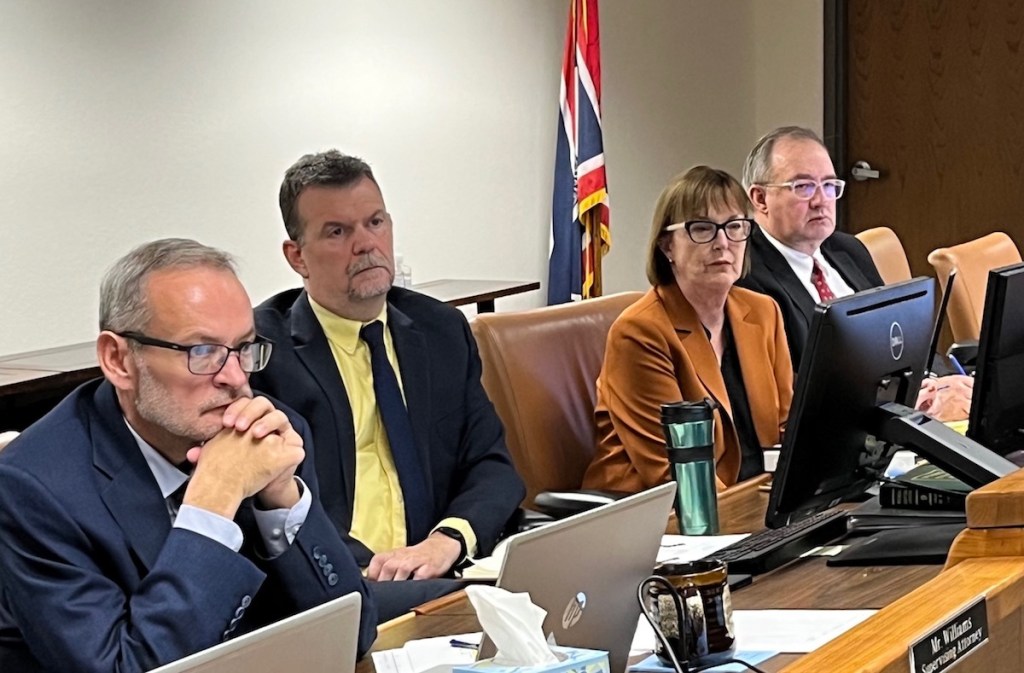
The 3-member Public Service Commission, however, ruled last week that the costs and potential benefits of the state’s carbon capture mandate apply to all utility customers, regardless of such power supply arrangements.
“My view is that the Legislature stated a policy of favoring coal-fired generation,” Public Service Commission Chair Mary Throne stated in the commission’s hearing regarding Black Hills Energy’s surcharge request last week, “that it’s a good that [power from coal] should be encouraged in Wyoming, and that therefore all customers of a utility should pay.
“It doesn’t exclude any customers,” Throne continued, and added that the time to make such arguments is when lawmakers consider such laws. “All the participants in this proceeding certainly had the opportunity to make that argument to the Legislature.”
That interpretation of HB 200, Ornelas said, could discourage climate-conscience companies like Microsoft from coming to Wyoming.
“This could have the effect of really discouraging future investments in and around Cheyenne and other parts of Wyoming. These are large industrial customers, often data centers. These customers do not rely, in any way, shape or form on Wyoming coal-fired generation to meet their energy needs.”
‘Vigorous pursuit of grant funding’
The initial cost estimates — ranging from $500 million to $1 billion to retrofit a single coal-burning unit — are driving the push to possibly amend the 2020 HB 200 law in the upcoming budget session in February.
Proponents of the existing mandate, including Gov. Mark Gordon, hope that the recently expanded federal “45-Q” tax credit program for carbon capture facilities, along with technological developments, will bring down the cost of retrofitting existing coal plants to emit less carbon dioxide.
Still, the Public Service Commission, which is charged with implementing the mandate, has expressed concerns that the state law is pushing it beyond traditional rate-making principles of “just and reasonable” costs that are prudent to pass on to ratepayers.
All three commissioners — Throne, Chris Petrie and Mike Robinson — have said they hope Black Hills Energy and Rocky Mountain Power can find financial support for such carbon capture analysis from sources other than their ratepayers.
“I’d like for the companies to proceed from here with the clear understanding that the vigorous pursuit of grant funding, or other non-ratepayer funding, should be given a very high priority in this process,” Commission Deputy Chairman Petrie said.

So, when you have killed off the growing plants that need the CO2 and you have frozen out many who live in this part of the world who WILL resort to burning our trees to keep warm, to cook, etc. will you then understand that you have been duped? Taking the most efficient and affordable energy from the human race is the most ignorant move you have made thus far. But since you are on path to kill off as many of the human race as you can, you are on path to do so. You are not only destroying our ability to provide food, energy and services to keep the human race in existence but condemning the rest of the planet as well.
500 million to 1 billion for 1 unit? How much does it cost to convert these units to natural gas, which is cheap and readily available in Wyoming.Would this be with-in CO-2 limits? What about wind? God knows we don’t have any of that?
Thanks Dustin, that was a great article.
10% of Wyoming’s economy and state revenue is still tied to coal, but that same WY coal industry has been declining every year for the past 20 years, and it will not stop, no matter what the legislation does. Coal consumption has been and will continue to drop in all the industrial countries, even China’s coal diet will start dropping in a year or two.
This year in the USA, for the first time, wind and solar will produce more electricity than coal will.
Coal is the dirtiest fuel people can burn, and it produces the most CO2 per watt, with the exception of tar sands oil. WY’s coal plants also produce a lot of other air pollution, along with over 3 million tons of coal ash *per year,* and every one of the ash landfills and impoundments are leaking toxic metals into WY groundwater.
Coal is more cumbersome to use as electricity, requiring a lot more material movement and manpower. And all of this is coming to a head with climate change, and the advance of renewable energy.
At some point, Wyoming will have to acknowledge the demise of a century-old industry. Its citizens cannot escape the trend in coal consumption, and with it 10% of the state economy. If the state plans for the eventuality now, instead of punishing its taxpayers to prop up a failing industry, then that 10% will be replaced with something else.
Very biased, many half truths from both sides of the issue EV, wind and solar are receiving tens of billions in subsidies (money out of taxpayers pockets) both sides of the issue are full of crap it’s all about control and money period.
Engineers should do a cost benefit analysis. How much coal revenue to Wyoming governments is preserved compared to added cost to electric customers in surcharges.
That’s not a bad idea, but we already know the answer. The few coal plant units that are being studied for carbon capture use a very small percent of Wyoming’s coal production and the very specific unit-by-unit studies are not easily replicable elsewhere in the country (and nor are there ratepayers in other states to pay for carbon capture at coal plants outside Wyoming). Regardless, even if carbon capture would keep a small percentage of coal revenue going, it’s not just about revenue. Carbon capture has a host of other issues (water consumption, parasitic load, need for additional NOx controls on some units, ability to keep running for decades more when the plant is already decades old, ongoing operational costs, etc.) and ratepayers shouldn’t be forced to pay for technology that is economically or technically infeasible.
Closing out 2023 the US Energy Information Administration projected that the wind share of the U.S. electricity generation mix increased from 11 percent to 12 percent and from 2022 to 2023 that solar grew from 4 percent to 5 percent during the period. Natural gas in the electrical generation mix was expected to remain steady at 39 percent, and coal was expected to decline from 20 percent in 2022 to 17 percent in 2023. Factoring in all renewables (hydroelectric) and we see that coal once a major (and low cost) source of generation, has lost out to clean, lower cost renewables.
As this article states, Carbon Capture Technologies are heaping additional cost on ratepayers atop an already high cost source of power (coal), and these technologies are unproven experiments at the expense of ratepayers (higher cost coal electricity when lower cost renewable energy is readily available).
The basic duty of Public Service Commissions is to protect ratepayers from poor corporate business practices, and associated decisions that con ratepayers out of their hard earned money. In addition it has been reported that Pacific Power (Rocky Mountain Power) has been attempting to shutter their existing coal fired generation in favor of lower cost renewables. The content of this article and the reported actions of the Wyoming Public Service Commission speak to the need for a large class action law suit. The very actions of the Wyoming Public Service Commission fly in the face of their duty to protect Wyoming ratepayers and consumers.
So it is ok to force consumers to use sources of energy that tout themselves as clean/green and are heavily subsidized by government, it is ok to ultimately have to charge more for those so called green sources of energy, but it’s not ok to put forth effort and funding into a known energy source readily available that provides a consistent stream of energy that needs refinement so it is more clean and environmentally friendly? It is ok open expansive mining operations in foreign countries to extract the rare earth minerals needed for solar, batteries for electric storage, to erect massive windmills that kill millions of birds a year, all subsidized by the government, taxpayers and rate payers, but spending additional resources to work on options for coal is just some far right extremist republican conspiracy?
Therein lies the problem. Short sighted politics and propaganda at the expense of investing in technology that could create energy sources with less environmental impact.
Also curious about those large diesel generators used by the data centers, or when the wind is not blowing or the solar panels are covered by snow? Do they just shut down for day?
If you truly want cost effective, environmentally friendly source(s) of energy you look at all options, not just the sources that appear to be politically friendly with an ugly underside.
Maybe let the market decide rather than Wyoming policy makers?
The market has turned against coal. The State of Wyoming’s heavy-handed market regulation trying to prop up coal, despite its market failure is not conservativeism.
Absolutely true, the whole issue on both sides is nothing more than money and power.
Your argument assumes that wind and solar energy sources are more expensive than fossil fuel sources. This simply isn’t true. If you exclude any subsidies and use LCOE (Levelized cost of energy: includes capital costs, fuel, maintenance, etc), wind is about $50/MWh; solar is about $60/MWh; gas combined cycle is $70/MWh; and coal is in the $117/MWh range. Even adding battery storage to either wind or solar adds about $20/MWh, still making them less expensive than coal. Add to this the fact that the “fuel” for wind and solar is free, thus insuring long term price stability, and that wind and solar capital and deployment costs continue to decline (while fossil fuel related costs increase) and it pure madness to keep these coal plants open, much less mandate that they be kept operational.
Sources?
The cost of unproven, unpredictable, and often wildly optimistic promises of ‘green’ energy have been shown time and again to cost more than conventional energy.
Companies like MS use the ruse that their datacenters use ‘green’ energy (which is a lie) to secure billions in tax exceptions, all at the expense of local & state citizens.
Electric companies are more than happy to take advantage of any excuses they can find to raise rates, and the geniuses in our state legislature are providing them with plenty of excuses.
The basic problem is the chemistry, engineering, and economics of carbon capture. No matter one’s ideology, reality rules and all these ideas about saving Wyoming’s coal industry are just peeing in the wind. Please get real, Republicans.
What were the legislators thinking? Totally unproven that lowering CO2 will be beneficial. Eliminate all CO2 & all plants and vegetation die. Coal fired power is safe, reliable & clean with present scrubbing. Where is the proven science behind this nonsense? Waiting to hear…..
Only the excess CO2 that is causing our weather to change is trying to be scrubbed out. If you are old, you don’t care about the future. If you are young, you do.
That is the biggest load of horseplop I’ve ever heard in my life. My god, do you even listen to yourself? What right wing talk radio nutjob told you that that carbon capture is going to eliminate all CO2 everywhere and plants everywhere are going to die?
Where did you even come UP with that assertion?
And I find people’s complaints about subsidies to green energy companies laughable in light of the massive subsidies we give to the oil and gas industry who certainly doesn’t need it.
It’s definitely messy like peeing in the wind, but I think it also throws that current elected leaders are not committed to conservative principles. They’re more committed to fighting culture wars and ideologies no matter the cost.
Sure.
Let’s kill all the conventional power plants because ‘renewables’ have proven themselves to be so cost effective & reliable.
How’s those lithium batteries doing in the cold?
LOL