


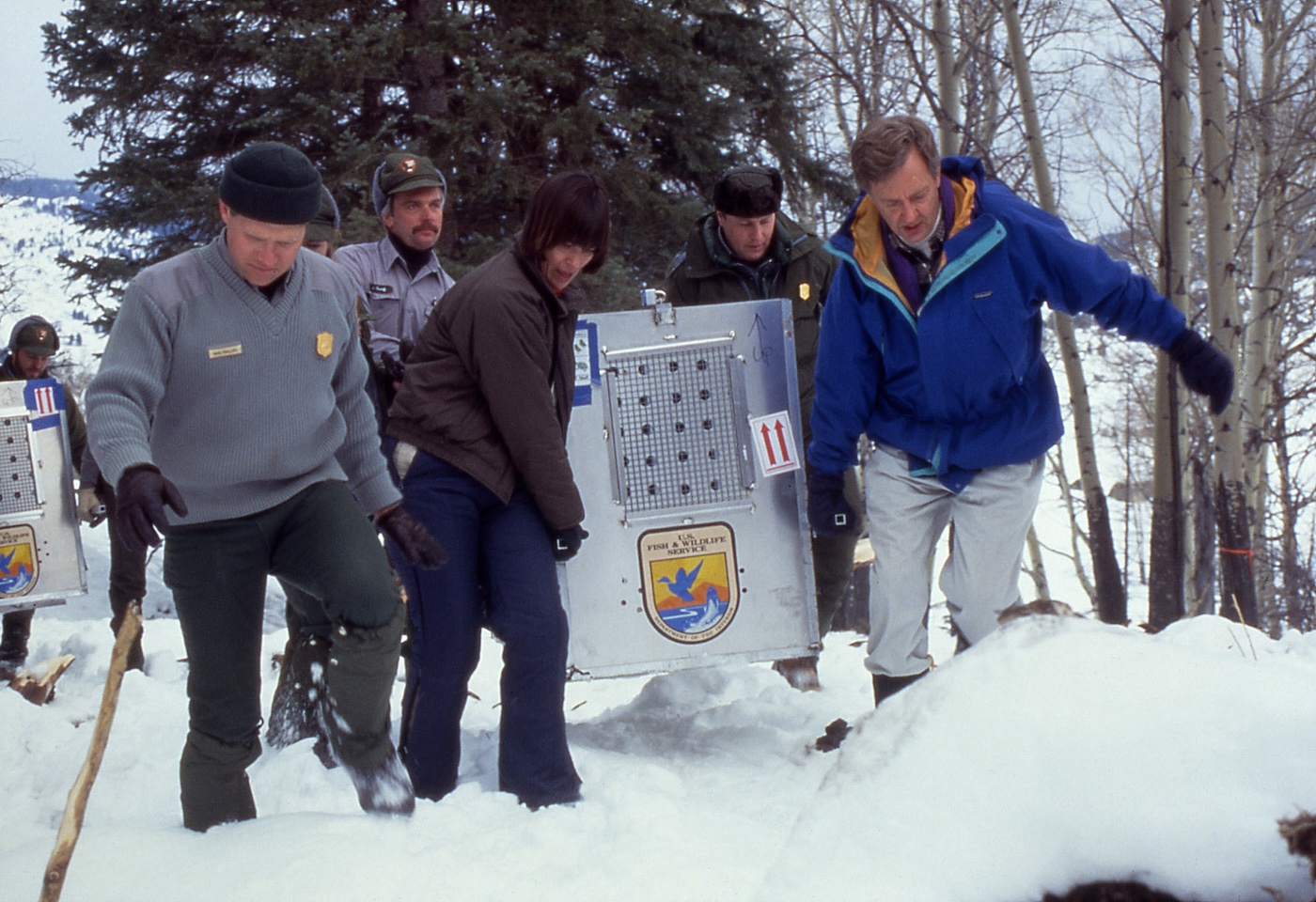
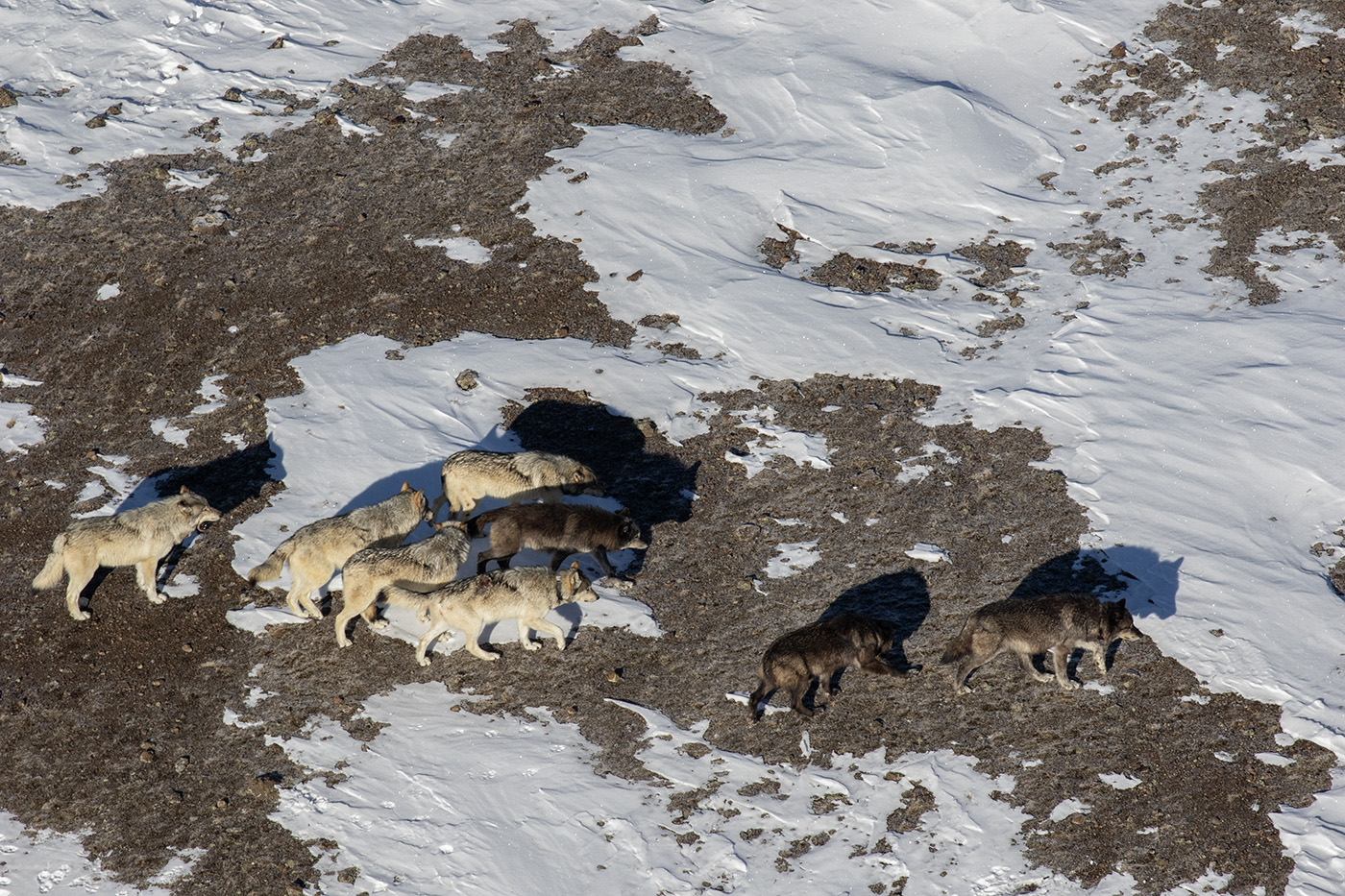
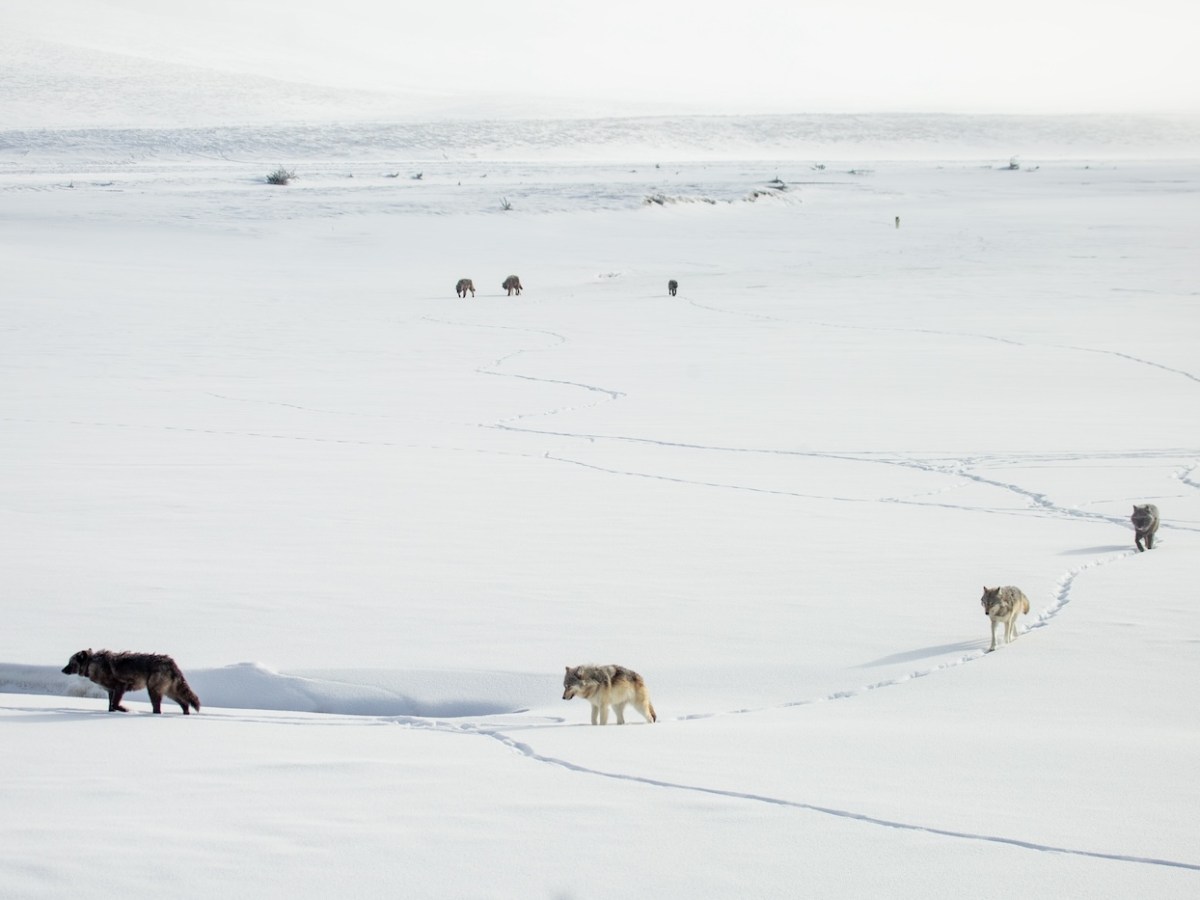
A historic wolf pack whose bloodlines and territory trace to the 1995-96 reintroduction of wolves has mostly returned to its traditional Yellowstone National Park turf, increasing the odds that its naive-to-humans members will survive a Wyoming hunting season that starts Tuesday.
Named after former U.S. Fish and Wildlife Service Director Mollie Beattie, who died of cancer during the reintroduction, Mollie’s Pack made waves early this summer when the pack shifted its primary territory to the Absaroka Range northwest of Cody outside of the park. The move drew threats from hunters vowing to go after the pack and, in a tit-for-tat, an offer of a $10,000 bounty intended to identify and doxx anyone who legally kills the animals.
Since July, however, when WyoFile first reported the pack’s move, the dynamic has flipped, and the pack has predominantly remained inside park boundaries, where hunting isn’t allowed.
“They’ve mostly been back in the park, and that includes the pups,” Yellowstone Wolf Project Leader Dan Stahler told WyoFile. “The last couple months, they’re back in their home core territory.”

That territory stretches roughly from Yellowstone Lake, up through Pelican Valley and north all the way into Lamar Valley.
Stahler declined Thursday to discuss the precise makeup of the pack, though he noted that there are “some surviving pups” as of a couple weeks ago. In July, Mollie’s Pack consisted of five adults, three of which were equipped with tracking collars, and five pups.
One of its remaining members, 12-year-old Wolf 1090F, is among the oldest wolves on record for both Yellowstone and Wyoming. (The record-setter, Wolf 840M, survived to age 13 living in the western Teton Range foothills, where wolves are hunted.)
“We’re not missing the reality of this,” Wyoming Game and Fish Department Deputy Director Jeff Davis told WyoFile this week. “This would be a big damn thing. She is dangerously close to being the oldest wolf ever recorded in Wyoming.”
Because of the vulnerability of the Mollie’s Pack generally and Wolf 1090F specifically, state wildlife managers have faced repeated calls to close down the portion of Wyoming’s tightly managed hunt, specifically hunt area one, where the pack denned and localized earlier in the summer. Up to four wolves can be killed in the zone, which is being managed collectively with hunt area two, located just to the south.
The Wyoming Game and Fish Commission rejected requests to adjust the hunting seasons to give the pack relief from hunting when the panel approved the wolf hunting regulations in July. Talking with WyoFile on Wednesday, Game and Fish Interim Director Eric Wiltanger stood behind that decision.
“We manage our populations not based around one animal,” Wiltanger said.
Game and Fish staff has been inundated with requests to do otherwise.
“I got 1,100 emails in five minutes last week,” Wiltanger said, recounting a barrage of form letters that all hit his inbox at the same time.
There is some precedent for Wyoming adapting its hunting seasons to protect wildlife that’s become famous. In 2018, when state wildlife managers were setting seasons for their first grizzly bear hunt in four decades (a hunting season that never happened, because of a judge’s decision), the state imposed an expansive no-hunting buffer area to protect the roadside grizzly bears of Grand Teton National Park, especially the celebrity matriarch Grizzly 399.
Eight years later, wildlife managers went in a different direction, declining to adopt special management aimed at protecting the well-known Mollie’s Pack, which has been the subject of an IMAX documentary. They’ve also faced pressure to not bend to wolf advocates’ requests. MeatEater founder Steve Rinella, perhaps the most famous hunter alive, said on his podcast that the Mollie’s Pack naturally returning to Yellowstone “might be the best thing,” but he also implored wildlife managers to not give in to wolf advocates’ requests to adjust the hunt.
“The national forest and the state cannot capitulate,” Rinella said. “You cannot capitulate to the mob and say, ‘OK, we’re going to extend park jurisdictions way out into the national forest.’”
Rinella also had a message for hunters who may target the Mollie’s Pack: “I don’t hate you,” he said.
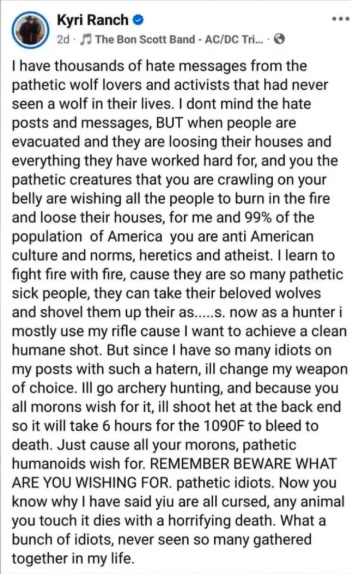
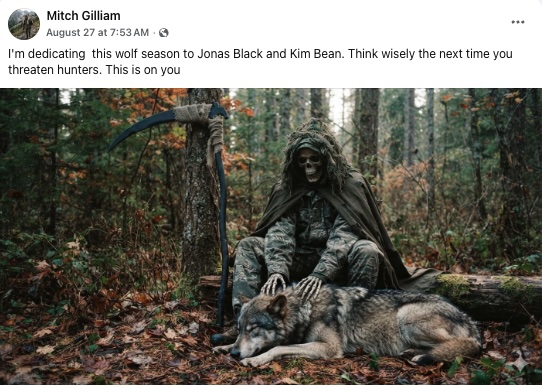
Facebook-posting hunters have threatened to go after the pack and specifically 12-year-old Wolf 1090F when the season begins Tuesday. A Nevada man who operates a Facebook page made bombastic threats to “shoot her at the back end so it will take 6 hours for the [wolf] to bleed to death.” And a Big Piney resident fond of AI imagery has tried to divert attention to his own Mollie’s Pack declarations, posting repeatedly about his own supposed hunting plans.

Those who seek to protect the Mollie’s Pack from hunting have also engaged in the social media theater, which has been amplified by the Wyoming news outlet Cowboy State Daily and other publications. Jonas Black, a Texas dog handler and social media influencer who became engaged in Wyoming wildlife controversies in the aftermath of the Cody Roberts felony animal cruelty wolf capture case, offered a $10,000 “bounty” payment to anyone who identified a Wyoming hunter who legally kills a Mollie’s Pack wolf. Black later withdrew the reward offer. (Wyoming has a statute protecting the identity of legal wolf hunters that’s been interpreted very broadly.)
“What this has turned into is a fiasco of passionate people on one side and passionate people on the other side, trying to out passion each other,” Game and Fish Large Carnivore Supervisor Dan Thompson said.
Amid the drama, Thompson and his fellow wildlife managers have been preparing for what’s shaping up to be a high-profile wolf hunting season opener. Where wolves are managed as trophy game in the Greater Yellowstone Ecosystem, the season runs from Tuesday until the end of December.
“What this has turned into is a fiasco of passionate people on one side and passionate people on the other side, trying to out passion each other.”
Dan thompson
Game and Fish officials have declined to discuss the location of Mollie’s Pack or any wolf pack with the hunting season fast approaching. But they’re cautioning wolf hunters who don’t want to kill one of the famous wolves and risk being doxxed, that just because Mollie’s Pack has mostly been in Yellowstone doesn’t mean that its members will stay there.
“We’re reluctant to say anything,” Thompson said. “These are unprecedented moves, so it’s hard to predict what may or may not happen.”


Help these wonderful wolves live out there lives in peace.
Amazing to see the complete disconnect from the natural world so many pro wolf commenters have across social media.
The more invasive canis lupus occidentalis are removed from the lower 48 the better.
Wolves are part of the natural world, so you’re the one with the disconnect. Oh, a wolf is a wolf.
“A wolf is a wolf”
Gordon, its a scientifically INCORRECT broken record with you.
Your mistaken belief would equate a brown bear from Kodiak island with a brown bear in the GYE because they are both Ursus arctos. Would you support releasing Kodiak brown bears in the GYE to diversify the genetics that are often cited as a problem?
One mor time…
Canis Lupus Occidentalis ≠ Canis Lupus Nubilus
the same way
Ursus Arctos Middendorffi ≠ Ursus Arctos Horribilis
Stubborn ignorance is not a virtue.
If you put a brown bear in Wyoming, it wouldn’t grow as big. The diet of the brown bear (salmon, berries) is what makes these bears big. So i doubt it would make a difference. So, a wolf is a wolf is a wolf.
Oh Gordon, diet would slightly effect middendorffi’s size but GENETICS would still have them MUCH larger that horribilis in the same environment with the same diet.
Lets move to humans to help you. If you take a baby from a family of 6’6 swedes to be raised by a family of 5’4 irish. How tall will that baby be when it reaches adulthood???
Does that help you understand?
Or will you say a homo sapien is a homo sapien?
On another note, how tall would your baby be if it didn’t have the proper nutrition. Some genes can only be expressed when conditions are right.
So, toxically masculine MeatEater founder Steve Rinella eats wolf meat? I doubt it. Looks like he’s one of that ilk that kills anything that moves. His podcast is genuinely disturbing. Thank God Mollie’s Pack Wolf 1090F followed her instincts back to protected Yellowstone.
The desire for schadenfreude is disheartening, and underscores man’s ability of intended insensitivity.
Your choice to relay the comments of the Nevada man,goes squarely against your intentions of this news letter.Inflame,raise tensions and blood pressure by giving people a visual in their head that can’t be avoided.Disappointing.Future(not now)of a financial contributor.
Thank you for posting this article.
My thoughts are always with wild animals; my entire life has been devoted to respect and admiration for the wild kingdoms of animals, “all animals”
My concerns are multiple. Please keep in mind: innocent A-Pex Predators.
Like humans, they have to eat and feed their families. A true gift of life for all living creatures matters too much to most of society; therefore, deep thought should be of utmost importance for anyone in command of the health and welfare of animals. The popular area of Greater Yellowstone, which people absolutely love to go to view animals and visit in Wild Places, is a true gift to experience. Sadly, hunting is allowed; I ask myself why any individual would enjoy taking a life instead of respecting LIFE. For these reasons, my hope and wish is for all our wild animals to be able to live in their given homes with peace and respect. I cannot imagine anything other than complete love for innocent animals just living free in the homes God has provided for them, in the wilderness. This is especially important for the elderly populations of animals to live a beautiful life of peace and pass with utmost respect from humanity.
“MeatEater founder Steve Rinella, perhaps the most famous hunter alive” “shoot her at the back end so it will take 6 hours for the [wolf] to bleed to death.” “social media influencer” “$10,000 “bounty” payment to anyone who identified a Wyoming hunter who legally kills a Mollie’s Pack wolf.”
This verbal sparring thru social media is ridiculous. and I’ll add that both CSD and Wyofile are just as much to blame for pandering to it. Stop catering to this kind of sensationalistic BS.
The people that want to kill for sport are not “harvesting” anything. Harvesting means you raise it, then eat it…. I don’t believe they’re eating elderly wolves.
People who hunt for sport are no different than other psychopaths that kill for fun….,they literally enjoy taking life.
Leave wolfs alone if not hurting any your live stock to kill them for fun cruel how you like they had gun to shoot you
Can’t something be done to motivate the wolves to remain inside the park and away from sadistic hunters. The loss of these majestic creatures to satisfy someone’s blood thirsty entertainment is something I don’t understand. I am left with a jaded view of the shameful behavior the human race exhibits
There is not passion on both sides of the issue. One side is driven by viciousness and brutality and juvenile arrogance.
Nicely put!
Please do NOT kill Mollies pack!!