

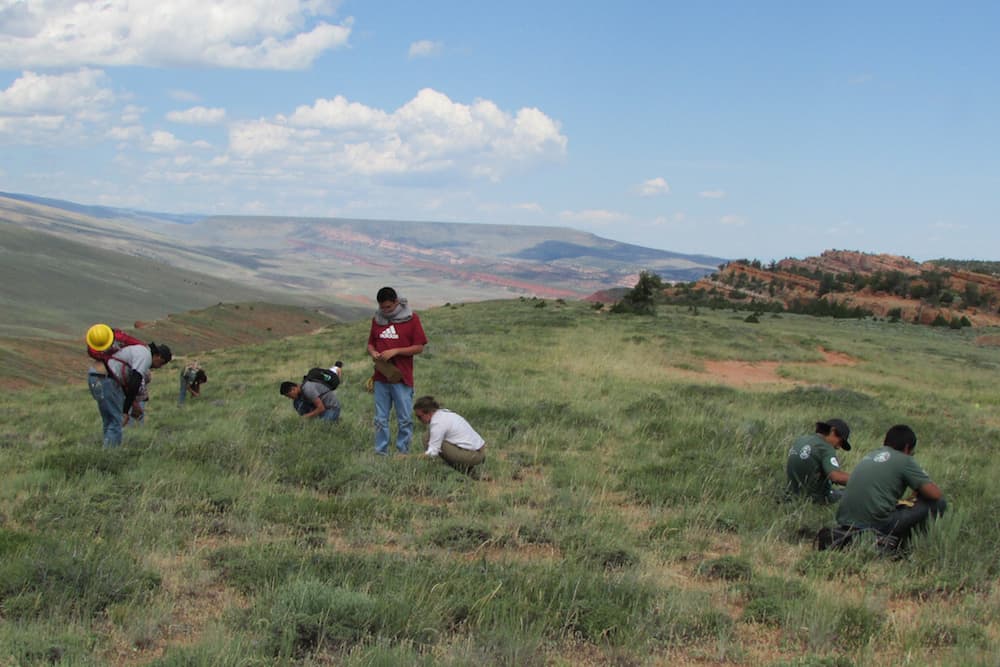
U.S. District Court Judge Scott Skavdahl on Friday peppered counsel on both sides of a lawsuit challenging Wyoming’s new “data trespass” laws, giving each reason to believe the state’s motion to dismiss might not be granted.
Judge Skavdahl questioned the expansiveness of the state’s “open land” application to the laws, which seek to limit the collection of environmental data. He also probed into aspects of the legislation that make it illegal to submit information to government agencies if it is collected in violation of the new Wyoming statutes.
Justin Pidot, an attorney for plaintiffs challenging the state, said after the 2-hour hearing that he felt optimistic the case would continue, particularly because the judge was interested in the expansiveness of the laws. Wyoming Stock Growers Association executive vice president Jim Magagna, a proponent of the data trespass laws, also said he expects the case to continue.
“I think he sees enough issues here that need to be resolved that he may not want to dismiss,” Magagna told WyoFile.
Western Watersheds Project, the National Press Photographers Association, PETA and others filed suit against the state on Sept. 29, arguing the laws were specifically intended to chill data collection on public lands by citizens and activists seeking to document environmental violations. The laws state that data trespass occurs if a person enters “open land” with the intent to collect data and submit it to government agencies without first gaining permission from the public or private land manager.
The controversy gained national attention when Pidot published a column in Slate claiming the laws are so expansive and vague that a person who merely takes a photograph on public lands — Yellowstone National Park, national forests, etc. — without first gaining permission to collect data could be prosecuted under the law.
The state and sponsoring legislators and proponents argue that the laws would not be applied in such a manner, and that the intent is to codify existing trespass laws and better protect private property owners and state lessees. Judge Skavdahl asked why the term “open land” is spelled out in the law rather than private land. “There must be some intent behind the Legislature’s distinction.”
Wyoming’s senior assistant attorney general for natural resources Erik Petersen said the intent of the term open land is to exclude municipalities.
Judge Skavdahl also asked whether a person could be prosecuted if he or she took a picture of private land from Interstate 25, or whether a person could be prosecuted for collecting data on Bureau of Land Management property without first gaining permission.
Petersen said no; “What we’re getting into are complicated hypotheticals that are more appropriately adjudicated as they occur.”
Pidot said the state is attempting to punish people for activities that were previously legal under the traditional set of trespass laws, and to punish people for providing “truthful” information to their government. It is not legal for the state to apply criminal trespass differently based upon a constitutionally protected activity such as data collection, he said.
“The notion that this is about trespass and trespass alone is a fiction,” Pidot said.
— For more information on Wyoming’s new data trespass laws (SF 80, enacted on July 1, 2015, and SF 12, enacted on March, 5, 2015) read these WyoFile stories:
WyoFile showcases potentially illegal photos of Wyoming, Oct. 19, 2015
Lawsuit challenges constitutionality of data trespass laws, Oct. 2015
Groups sue Wyoming over “data trespassing” law, Sept. 2015
Critics say Wyoming data trespassing law criminalizes science, May 2015
Data trespassing bill is aimed at public lands grazing battle, May 2015
High-stakes suit pits ranchers against water-sampling greens, by E&E, Nov. 2014
Great comments, BC and KC.
Duane Short
A totally Orwellian law which, in a state like Wyoming, virtually oozes irony!
Bob Cherry
Cody, Wyoming
Wyoming has been run by the stock growers since its inception. I’d invite you to find a copy of the book The Banditti of the Plains and read up on the problem. They went too far this time.
Keith Collins