


Since the grizzly bear population hit rock bottom in the Greater Yellowstone Ecosystem some four decades ago, biologists have kept close track of the population and generated an annual estimate.
For the last 20 years, the Interagency Grizzly Bear Study Team has produced a yearly population estimate using a relatively simple calculation centered on the minimum known number of females with cubs at their side. Essentially, the team counted family groups from the ground and sky and then adjusted the numbers based on estimates of missed bears. In a separate step, they’d use survival and reproduction rates to estimate numbers of male bears and solo females. The computation would ultimately churn out an estimated headcount.

But recently, federal and state biologists who keep watch over the isolated, southernmost grizzly population in the United States adopted a whole new system. Peer-reviewed in the journal Global Ecology and Conservation, the new method is an “integrated population model” that essentially mirrors how a demographer would make projections about human populations.
“In principle, that’s exactly what we’re doing,” Interagency Grizzly Bear Study Team leader Frank van Manen told WyoFile. “Demographers use things like census data — how many people are in a country — reproductive rates, longevity, that sort of thing. That’s more or less what we’re doing with this grizzly bear population.”
The integrated population model relies on computer calculations made with many more categories of data to generate an estimate. In development since 2018 and launched in 2023, the new model initially predicted 965 grizzlies in the 19,278-square-mile “demographic monitoring area” in the core of the Yellowstone ecosystem. (On the outskirts of the region — about 40% of the occupied range — grizzly numbers are unmonitored.)
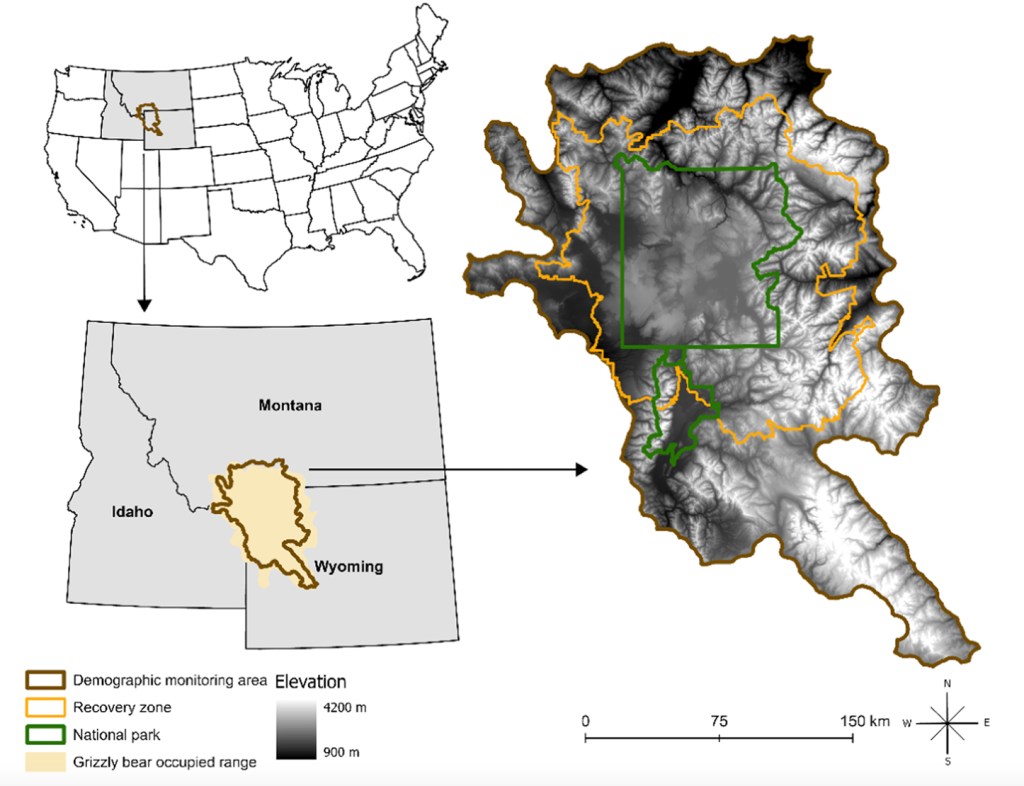
The model requires that different grizzly population indicators jibe with each other. It wouldn’t allow, for example, for an increasing population projection and a declining reproductive trend to exist simultaneously.
“The model self-reconciles all the numbers against one another,” van Manen said. “By doing so, it improves the accuracy of all the numbers — and the accuracy of the population estimate.”
Improved accuracy
The improved accuracy comes, in part, from taking human error and subjectivity out of the equation. That’s according to Josh Nowak, who presides over Speedgoat, the wildlife consulting business that handled the coding for wildlife managers’ new grizzly-counting technique.
“When we do [estimates] mentally, we don’t have to make everything agree,” Nowak said. “We’re free to take all sorts of liberties. The model takes us to task, and makes sure that everything agrees.”
The finished product that Nowak left grizzly bear biologists with is basically computer software. Flaws in the model can easily be rectified, he said.
“By building software and testing it and implementing it, the results are repeatable,” Nowak said. “If a bug were found, it could be fixed. And that fix would propagate everywhere — through all years, space and time.”
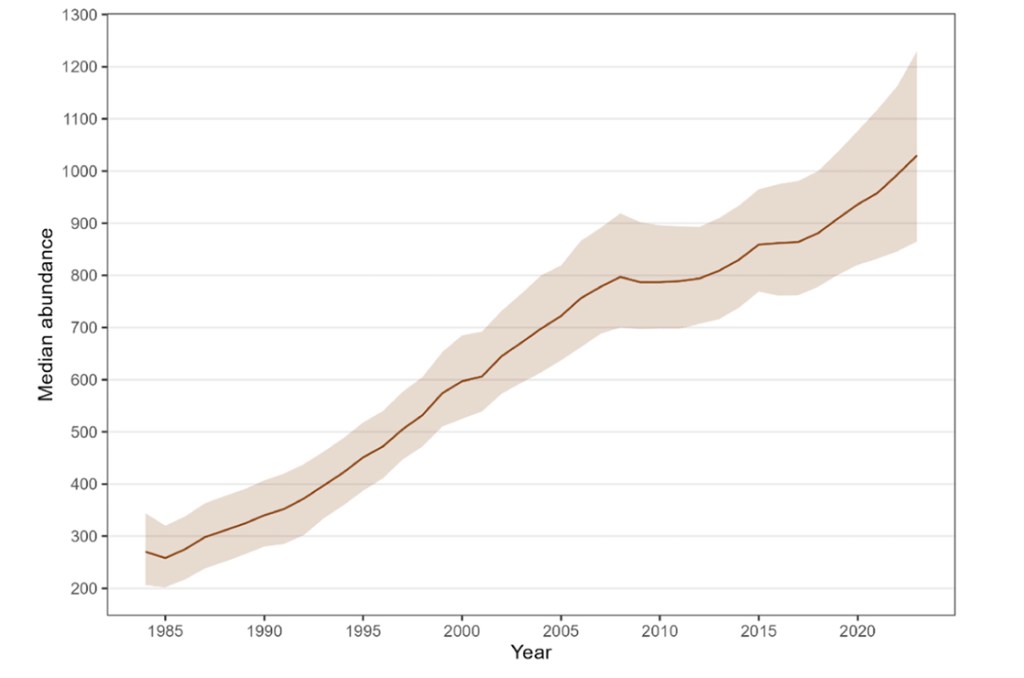
The newly adopted integrated population model estimates that there were around 250 grizzly bears in 1983 . That’s the first year of data that went into the model. The estimate more than quadrupled to 1,030 grizzlies in the Greater Yellowstone Ecosystem’s core most recently. There’s “no doubt,” van Manen said, that it’s a more accurate population estimate than before.
Until a few years ago, grizzly bear scientists knew they were underestimating numbers. The old Chao2 method — named after a researcher — estimated that there were around 700 grizzlies for much of this century. But in 2021, they updated the criteria for qualifying unique females with cubs — the effect being a 34% to 43% on-paper jump in the population, though the number of flesh-and-blood bruins roaming the landscape was likely largely unchanged.
Adaptable
Wildlife managers will continue to hard count unique females and use the old estimates as feedstock for the new integrated population model. Some types of data are harder and costlier to collect than others, and the new population model, van Manen said, will help bear biologists identify what’s most critical to judging the numbers.
“We all have limited budgets,” he said. “This would also help us identify data sources in the future that we could maybe let go.”
Yellowstone-region grizzly managers also have access to a new tool that will allow them to assess grizzly population dynamics based on geography. Currently, metrics like survival rates are evaluated across the entire tri-state ecosystem — but going forward they could “partition” different areas, discerning differences in how grizzlies are faring, van Manen said.

It’d take a lot more data collection and funding, but theoretically the new population model could even open the door for generating an ecosystem-wide population that includes areas outside of the demographic monitoring area.
“There would be some challenges in doing that,” van Manen said, “but in principle it’s possible.”
Grizzly bears are still protected by the Endangered Species Act throughout the Lower 48 states, though Wyoming is petitioning to again gain jurisdiction. If that happens — and a decision is overdue, to the frustration of state officials — the new integrated population model will factor into how decisions are made during expected future grizzly bear hunting seasons administered by the Wyoming Game and Fish Department.
In general, the population model will allow the state agency to have a better grip on what’s going on with the Yellowstone region’s grizzly bear population.
“It allows us to make some projections,” said Game and Fish large carnivore supervisor Dan Thompson, a co-author on the peer-reviewed study. “How quick can the population grow or stabilize?”
The plan, he said, is to stick with the new population modeling tool into the next era of grizzly bear management.
“We’re committed to using this unless something better comes along,” Thompson said.


Hmmm… Just how would we achieve an accurate physical count… short of putting out large carcasses on a grid across the entire range of occupied habitat, each with a high end digital camera and some means of collecting hair samples for DNA harvesting. Big $$$, and lotsa risk for the sampling crews. I’ll volunteer to fly the carcasses to their grid location if the guys and gals who want a massive effort to accurately count bears want to pony up the money. :-0 On second thought, I’d have greater confidence that the demographic models are likely more accurate, waaay less expensive, waaaay less likely to have serious L&I risk, and (ultimately) fewer perturbed grizzlies put down for DLP (Defense of Live and Property).
Nothing the IGBST says about the number of grizzly bears in the GYE can believed. A physical
count is the only method to get an accurate count, and that is impossible. Thus, over the years the
IGBST and other wildlife officials interested in the number of GYE grizzlies have resorted to
abstract formulas performed with software on a computer. The “integrated population model,”
which replaces the “Chao 2 method,” is just the latest abstract software model. The problem is
that the integrated software model, and any software model that preceded it, can be, and are,
easily manipulated by wildlife officials to achieve the results they want. Here the results they
want are (a) removing ESA protection for grizzly bears for which petitions have been filed with
the US Fish & Wildlife Service by ID, MT and WY and litigation is pending (The USFWS has
entered into a settlement agreement in one litigation that clearly contemplates on the public
record that delisting will take place within the next year or so.) and (b) increased trophy hunting
of grizzlies after delisting under the egregious 2016 Memo of Agreement (as amended) that
divvies up trophy hunting mortalities among the three states. I remember that about 10 years ago
the FWS’s then Grizzly Bear Recovery Coordinator stated publicly and inaccurately that there
were about 1,700 grizzlies in the GYE. Litigation certainly will follow the next (third) delisting,
and I hope that this litigation will produce the same result as the first two litigations (i.e., wins
for the grizzly bears). Bottom line: Don’t trust any numbers placed on the public record by the
IGBST.
GARBAGE!!!! ( On the outskirts of the region – about 40% of the occupied range – grizzly numbers are unmonitored.) Grizzly population numbers mean nothing unless they include all of the occupied areas – that being, core habitat, data monitoring area and occupied land outside of the monitored areas. By excluding the land outside of the monitored areas the actual population numbers are grossly understated. The graphs in this article are more accurate estimating the true population numbers – the ” Total abundance at den emergence” graph is whats called a linear progression curve whereby the actual population can be estimated by extension of the linear curve or straight line – the linear line shows a population in 2023 of over 1000 bears and that number is increasing at a fairly constant rate year-over-year; and, this graph apparently does not include bears outside of the data monitoring areas. Therefore, we must have something in the range of 1200 to 1400 bears if the entire occupied habitat was included.
Another graph in this article entitled ” Greater Yellowstone Ecosystem’s demographic monitoring area” shows the “grizzly bear occupied range” and ” the “demographic monitoring area” – examine it closely and you’ll see where significant grizzly bear populations are not being counted in the YES in three states.
Grizzly bear population estimates mean absolutely nothing unless all bears in all of the occupied range are included.
Oh wonderful. The Grizzly bear gurus are now hiring away from the US Census Bureau , or something…
Sounds like innovative way to get more money for budget