


Only about 35 miles separate Yellowstone’s relatively small, isolated grizzly bear population from the expansive contiguous population of Montanan, Canadian and Alaskan grizzlies that numbers in the tens of thousands.
Bridging the gap, and diversifying the Greater Yellowstone Ecosystem bruins’ genepool, has been a longstanding goal, a centerpiece of the debate over bear management and thus far, a vexingly elusive accomplishment.
Yet, grizzly researchers expressed hope last month that population “connectivity” may soon be within reach, despite also reporting at the same meeting in Cody that Yellowstone region bears have stopped expanding their range.
“I’m optimistic,” Interagency Grizzly Bear Study Team leader Frank van Manen told WyoFile. “The reality is we are really close.”
Why, after a half century without any interpopulation exchange, and in the face of a stagnating range, would connectivity happen now?
Biologists have assembled something of a Yellowstone-region grizzly family tree by capturing, extracting blood from and mapping the genes of more than 1,000 bears over the decades. The project has yet to produce firm evidence that even one animal has trekked south and mingled its genes with the locals.
But at least one grizzly has gone in the opposite direction.
In 2021 a 5-year-old male was caught and killed for preying on cattle near Montana’s Little Snowy Mountains, far to the east of the grizzly population swelling into the plains from the Glacier National Park-anchored Northern Continental Divide Ecosystem. Surprisingly, the itinerant bear came from somewhere else. From the grizzly family tree, van Manen and other biologists deduced that the boar moseyed 110 miles from the Greater Yellowstone Ecosystem’s Beartooth Mountains, where it was likely born and raised.

“It’s in the wrong direction, but it shows the potential of connectivity,” van Manen said. True connectivity, from a wildlife biology perspective, requires an influx of fresh genetics into the more isolated population — in this case the Yellowstone Ecosystem bears — meaning a bear trekking north doesn’t check the box. But, the opportunity is “there, if we just had a bear do the opposite. And there’s no reason to think that would not be possible, right?”
Biologically, yes. But 21st century grizzlies inhabit a human-dominated landscape in which politics, policy and the behaviors of people arguably have as much influence over connectivity as biology.
Conflict conundrum
Montana’s grizzly bear management plan “basically says we are going to allow for connectivity,” said Cecily Costello, a research biologist with Montana Fish, Wildlife and Parks.
But can the bears avoid deadly conflicts as they head south? The prospect of conflict is much lower in the ecosystem cores than in the intervening landscapes. Some 84% of the Northern Continental Divide Ecosystem’s grizzly recovery zone is public land, and the figure is a whopping 98% within the Greater Yellowstone Ecosystem. But only 54% of the connectivity area is publicly managed ground, according to data Costello presented at the Cody meeting.

Conservation groups are mounting efforts to create more bear-friendly landscapes in the connectivity areas, but that’s a long-term and costly endeavor. It might take 20 years of hard work, guessed Gary Burnett, a managing director for the Missoula-based Heart of the Rockies Institute.
“From a connectivity perspective, we think there are two things in particular you need to have,” Burnett said. One, he said, is an “open landscape” — achieved through means like conservation easements. The other component is diminishing the harmful “attractants” that come with humanity, be they agricultural or residential.
Some causes of grizzly mortality are easier to eliminate.
Former U.S. Fish and Wildlife Service grizzly bear recovery coordinator Chris Servheen believes Montana’s management plan doesn’t do enough to safeguard grizzlies in the connectivity areas. He’s also optimistic that a Montana grizzly will successfully disperse south — it’s likely to occur within “three or four years” — but worries state management could jeopardize the chances of such a movement occuring.
“Every year we see bears further and further out and closer and closer together,” Servheen said, “but that’s happening while they’re listed [under the Endangered Species Act] and that’s happening without any hunting in that connectivity area.”
Factoring in hunting, Servheen said, the three- or four-year estimate for a successful disperser “would be completely out the window.”
“In my mind, hunting would put connectivity at grave risk,” he said. “I really object to the tone of intolerance that exists in many of these state plans. They look at grizzly bears as a competing interest with everything else.”
“In my mind, hunting would put connectivity at grave risk.”
Chris Servheen, Former U.S. Fish and Wildlife Service grizzly bear recovery coordinator
Montana officials, he said, are talking out of both sides of their mouths by prioritizing connectivity while simultaneously saying they would allow hunting in linkage habitat.
The Fish and Wildlife Service is weighing whether to attempt a third go at delisting grizzlies — a process Wyoming is suing over to move it along.
Ahead of the federal agency’s analysis, the states of Wyoming, Montana and Idaho forged a pact that outlined the parameters of grizzly bear hunting — potentially with few restrictions along the ecosystem’s periphery — and other aspects of management. That agreement called for a 13% reduction in the grizzly population within a monitoring area where bear numbers are counted. There would likely be even heavier hunting and no firm requirements to maintain grizzlies at all outside that zone. Roughly 40% of occupied grizzly range is outside of the monitoring area.
Just passing through
If hunting were layered atop other conflicts already constraining the grizzly range, bears would have an even tougher time establishing and persisting in the most people-packed connectivity areas of west-central Montana.
Connectivity, however, does not require persistent habitation.
“That’s sometimes misinterpreted by some people: That you need occupation,” van Manen said. “You don’t. You don’t need resident bears to connect genetically.”
A single dispersing male that successfully makes the trek south and spreads his genes would do the trick, he said.
Costello shared preliminary findings at the Cody meeting from research investigating potential Yellowstone-to-Glacier region grizzly bear corridors. U.S. Geological Survey ecologist Sarah Sells, University of Montana biologist Paul Lukacs and Montana Fish, Wildlife and Parks employees Lori Roberts and Milan Vinks collaborated on the study.
There are several primary linkage paths, according to maps Costello presented and discussed with WyoFile. The two most direct routes shoot more or less straight northwest to southeast. The easternmost corridor skirts Helena and Bozeman, Montana by way of the Big Belt, Bridger and Gallatin mountain ranges, while another direct linkage route runs from the Boulder and Highland mountains down the Tobacco Roots and into the Madison Range.
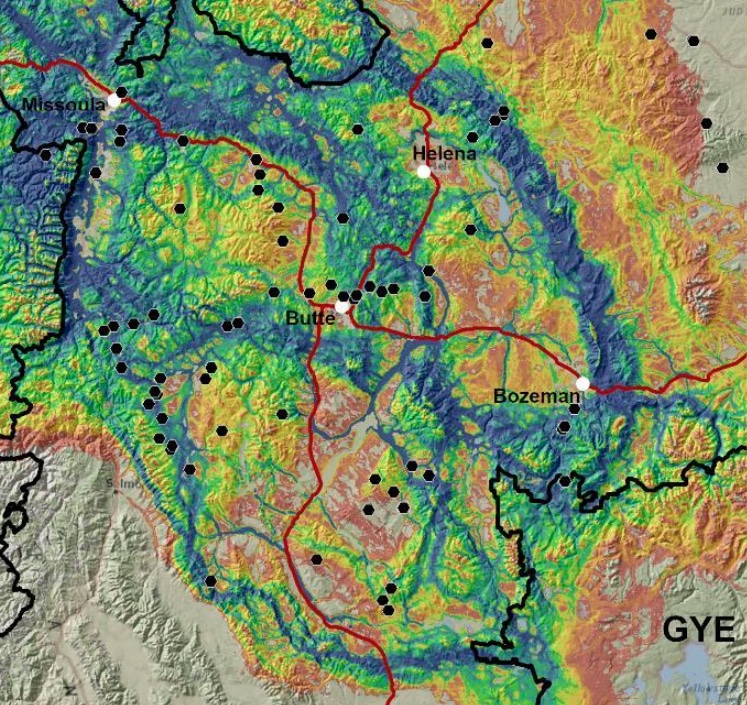
“We have observations of bears in all of the mountain ranges I just mentioned except for the Tobacco Roots and the Bridgers,” Costello said. “So they’re halfway there.”
The modeling predicted grizzly bear use of linkage areas based on several habitat qualities, but foremost was the greenness of the landscape. Mountains, forests and riparian areas rank higher, whereas sagebrush steppe and high plains environments rank lower.
Another component tracked the “forest edge,” Costello said, which is a particular productive part of the landscape that grizzly bears prefer.
The model also factored in the habitat preferences of real-world Northern Continental Divide Ecosystem grizzlies.
“The way that we ran the analysis is we simulated each bear’s model on the landscape,” Costello said.
Similarly, the model accounted for habitat qualities that grizzlies tend to avoid: roads and housing. The likelihood of conflict nearer to humans is another important factor for predicting where grizzly bears can persist in the currently grizzly-less void.
Island life
Even without connectivity, van Manen said, the Yellowstone ecosystem population is on good ground genetically. “With the current population size,” he said, “that concern is decades away — and probably more than decades.”
In the absence of a successful grizzly bear dispersal south, wildlife managers have pledged to force the issue. The tri-state pact commits the states to translocating “at least two” bears from outside the Greater Yellowstone into the region by 2025 unless migration is detected in the interim.
That’s not an ideal outcome, in Servheen’s view: “Allowing this to happen naturally is really important,” he said.
Moving bears from one ecosystem to another is dependent on “political whims” and agency administrators. Having that fallback option also deprioritizes good planning, he said.
“The end result is really poor conservation and poor management,” Servheen said. “I don’t think driving them around is a good solution.”

If a grizzly bear does bridge the 35-mile gap it will have to cross interstate highways, settled valleys and other human obstacles. Those barriers, van Manen said, inhibit the already sluggish expansion of a species that biologically has a slow “life history strategy.
“They live longer, and can afford for that process to take a longer time,” he said.
Even so, due to decades of conservation and range expansion, connectivity might have already occurred. There is a time delay in crunching data and completing parentage analyses from grizzly bear bloodwork, van Manen said. The bear that showed up in the Snowy Mountains, for example, was sampled in 2021, but biologists didn’t realize it came from the Beartooths until this year due to normal delays in processing its genetics.
“For all we know,” van Manen said, “we might already have genetic connectivity, but have just not documented it yet.”

Maybe it is time to literally share the bear to its former range.
I guess I disagree with Servheen. If genetic connectivity is the key for bears, and unmovable human presence is in the way, then “driving them around” is an excellent solution. In fact, the only solution. As for hunting bears, I don’t see it as an issue if hunting is focused on problem bears, or bears that are in areas where they aren’t a good fit. The idea that every bear is a good bear, and bears are appropriate in all places is simply not correct. I think is worth noting that other states, well within historic grizzly range, with areas of good habitat, such as Colorado, New Mexico, Utah, Oregon and Washington want nothing to do with grizzly. Why should the entire burden of preserving bears rest on Montana and Wyoming? Isn’t it time for other states to step up? Could it be they are scared that lawsuits will make it impossible for them to manage bears if they did bring them back?
Robert: Recovery of grizzly bear populations is a national issue and of very considerable importance to advocates all over the US. So yes, grizzly populations should be reestablished in the other states particularly in California which has millions of acres of prime habitat in the high Sierras. One thing we have proven in the Yellowstone Ecosystem is that an absolute minimum of 2,000,000 acres of contiguous Federal land is required in order to support a distinct population – and , preferably more like 5,000,000 acres without well established roads. The high Sierras meet this criteria and most of these acres are already national parks. We have several hundred excess bears they should be able to acquire from Wyoming Game and Fish.
Another strong argument for expanding grizzly bear habitat to other states is the financial burden Wyoming has incurred in support of grizzly reintroduction in YES. Its probably approaching $70,000,000 now and its paid for by hunting and fishing license sales by Game and Fish. This is a real burden on Wyoming and an expense which should be borne by all of the people in the US since they support grizzly reintroduction. We’ve done our part in Wyoming and its time to move on to other states. Thats why Wyoming’s congressional delegates have prioritized the grizzly bear situation in Wyoming – and, it could even lead to revision of the ESA.
OUR GRIZZLY BEAR RECOVERY IN THE YES IS A NATIONAL SUCCESS STORY ON THE LEVEL OF THE BALD EAGLE -LETS RECOGNIZE IT AS SUCH AND MOVE ON!!!
The disputeable “connectivity” argument has been used for over a decade to bolster the anti-hunting crowds obstruction to return management of the bears to the states by removal from the endangered species listing. Rather than restricting management of the bears throughout their existing ranch why not just mandate a protection or no hunting regulation in the connecting corridor? Of course this simple solution does not meet the anti-hunting crowds agenda.
Much to do about nothing. Ranchers genetically improve their herds by purchasing bulls and bringing them in constantly. What do you think are in those hundreds of horse trailers seen traveling all over the west. And, they use frozen semen for artificial insemination constantly – the technology is readily available through the livestock industry.
And Wyoming Game and Fish traps grizzly bears for relocation every summer – they are already in “custody” and could easily be transported to Montana by Game and Fish personnel. It makes no sense for this genetic issue to be receiving so much attention when the solutions are simple and already available. sounds like another case of grizzly bear researchers trying to extend their job and get more and more grants to study the issue to death.
wyoming has the ability to send male grizzly bears north at any time and in considerable numbers – lets get on with it – and gee, maybe a rancher could offer some free advice on genetics. Dah!!!
“Diminishing the harmful attractments that come with humanity”. What a line, spoken by a true politician that can’t speak English. But a more accurate statement there never was! At the rate we’re going our grandchildren won’t even be able to see a grizzly bear!
Do you not understand they are increasing and have significantly exceeded recovery thresh holds? It’s a conservation victory that should be celebrated; the glass is not just half full, it’s overflowing. AND long over due to return management to state control, state game agencies are the professionals best equipped to facilitate connectivity. It would be very easy to implement regulations to protect bears in the connectivity zone just as the currently proposed management plans protect bears in tourist zones and celebrity bears despite living on “huntable” public lands. We have the tools to meet connectivity goals.
Sorry , Jason , but three or four wrongs do not make a right. Recovery thresholds are meaningless when millions of acres of habitat that used to sustain grizzlies only a couple human lifetimes ago are purposely empty. There is no conservation victory to celebrate. The State game and wildlife agencies are the very LAST people you want managing grizzlies. It’s faulty thinking to presume the bear is even a state resource in the first place , not when the bears cross statelines. Those state GAME agencies treat all huntable wildlife as an agricultural cash crop better termed Game. It is Wyoming GAME and Fish , not Wyoming Wildlife, raising fields of ungulates for harvest , and doing Put & Take harvests of upland fowl and the six species of nonnative trout they erroneously reintroduced to the State. Wyoming G&F is more of a domestic livestock agency that a true wildlife natural resource manager. Money driven at that. We all have known since the Grizzly was first listed that it needed to be reconnected/repopulated all up and down the Continental Divide from New Mexico to the Yukon and over to the Cascades. The bear is not recovered where it needs to be. Without repopulation it will never be sustainable. Yes it would be easy to do that but the states , the Stockgrowers, the trophy hunters and outfitters , and other stakeholders simply won’t allow it for reasons of politics and greed favoring their economic interests, not the bear’s biological needs. Yes we do have the tools to move bears, just not the will. Idaho and Montana positively hate bears, and if Wyoming were being honest they would admit as much . There’s more to grizzly recovery and sustainability than having a few hundred bears inside the artifical man-made Zoo Zone of Yellowstone and the wilderness immediately surrounding it. We can move a Giant Panda from the bamboo jungles of south China to the Berlin Zoo , but can’t seem to move a bear from Wapiti Wyoming 180 air miles to the Selway-Bitteroot wilderness on the Idaho-Montana border. Not for lack of ” tools” , only because we really don’t want to at all. Humans have put up a bunch of obstacles preventing bears from emigrating on their own, and now climate change has added an immense amount of friction to any natural bear-driven conenctivity. There isn’t enough time left for bears to make it on their own thru the minefields and barriers we’ve put up.
Our state bear management plans are really selfish human plans, written for us by us .
Every bear matters. Most humans in the overlapping region don’t really matter nearly so much except in their own clouded minds.
Griz are already outside of YNP naturally. A hunter in the Cody area killed oen, thinking it was legal black bear last fall. He is paying a very heavy price for that mistake.