

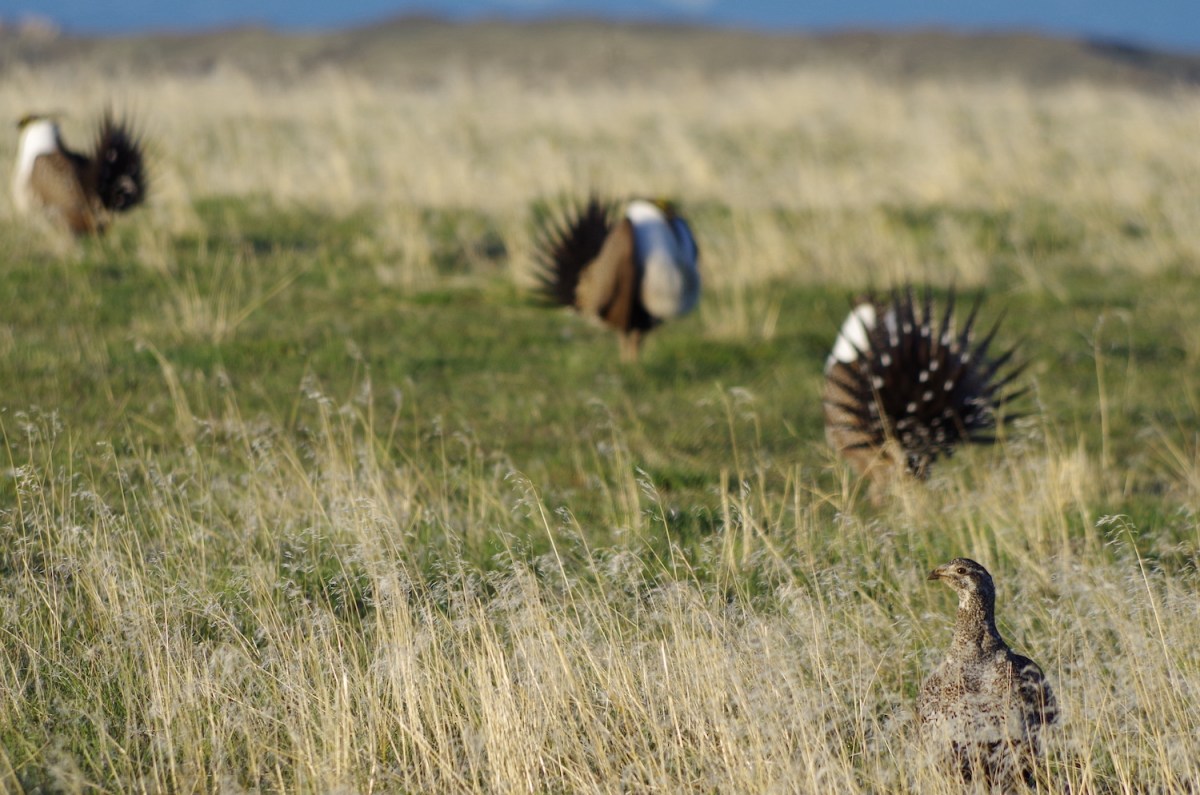
Plans to better conserve sage grouse on 65 million federal acres of the imperiled birds’ embattled habitat are being simultaneously cast by competing interest as either overly burdensome on western states, a script for extinction or a Goldilocksesque ideal level of protection.
Drafts of the Bureau of Land Management’s divisive plans were met with cautious optimism early this year by Wyoming leaders and advocacy groups with a stake in sage grouse management. But that support evaporated last week when the BLM rolled out its final environmental impact statement outlining its revisions to the 9-year-old plans that guide sage grouse management today.
“The thing that changed — which changed the tenor of our comments — is that nothing changed,” said Bob Budd, who chairs Wyoming’s Sage Grouse Implementation Team.

Budd and others in Wyoming had been optimistic because the state thought BLM was working “together on it” and that changes requested by state managers would be accommodated, he told WyoFile.
“We brought science to the table and said, ‘Look, here’s the way this ought to be handled,” Budd said. “It was ignored.”
BLM’s final proposal amends 77 resource management plans across sage grouse habitat in 10 western states — revising policies on about 45% of the remaining sagebrush-studded landscapes where the chicken-sized birds dwell. The policies, according to the BLM, blend a “west-wide management approach with unique policies in the individual states.”

“Our environmental analysis, aided by a wealth of information from our partners, indicates that these proposed updates — which are the result of decades of sustained collaborative efforts — are the best way to ensure the health of these lands and local economies now and into the future,” BLM Director Tracy Stone-Manning said in a statement.
The revisions intend to reverse sagebrush habitat losses that are contributing to the long-term decline of sage grouse. Populations naturally swing up and down — Wyoming bird numbers are up, at least at the moment — but recent nadirs in the cycle hit all-time lows in most western states, according to the BLM’s final EIS. Rangewide, sage grouse populations declined nearly 80% from 1966 to 2021. There are few bright spots in the modern era: Since 2002, sage grouse have continued declining on 87% of their range.
Grouse groups trade takes
Some environmental groups say BLM’s final environmental impact statement doesn’t go far enough to stem the declines. Western Watersheds Project, American Bird Conservancy, the Center for Biological Diversity and Advocates for the West maintain the plans will exacerbate the sage grouse “extinction spiral.”
“Letting anti-conservation states and extractive interests get their way above all else is something we expect to have to fight in the next administration, and it’s disappointing that this is what the Biden Administration is leaving us with as well,” Western Watersheds Project Deputy Director Greta Anderson said in a statement. “What a squandered opportunity.”
In 2019, Western Watersheds Project and a consortium of other groups successfully challenged BLM’s re-write of its West-wide sage grouse conservation strategy. That re-write was spurred by the energy dominance agenda of the first Trump administration.
The plans being finalized now are intended to address the court’s concerns: that BLM’s 2019 revisions lacked a range of alternatives, did not take a hard look at environmental impacts, and improperly analyzed cumulative effects and required habitat replacement, known as compensatory mitigation.
Other conservation groups felt that the BLM mostly hit the mark in its 2024 revisions.

A coalition including Audubon Rockies, The Nature Conservancy, National Wildlife Federation, Backcountry Hunters and Anglers, Natural Resources Defense Council and Pew Charitable Trusts signaled they’re “optimistic” about the final plans.
“With grouse populations on the precipice, now is the time for action,” Natural Resources Defense Council staffer Bobby McEnaney said in a statement. “By issuing these land management plans, the Bureau of Land Management has identified science-based approaches to manage the habitat that the iconic sage-grouse need for survival.”
Lee Davis of The Nature Conservancy’s Sagebrush Sea Program said in a statement that it’s “crucial” to implement a “balanced, pragmatic and durable” plan that “not only halts habitat loss but also averts the risk of an [Endangered Species Act] listing.”
“Without collaboration and compromise,” Davis said, “we all stand to lose.”
Wyoming gripes
In Wyoming’s comments submitted in response to the BLM’s draft plans in June, state officials sought adjustment to “10 areas” of the federal agency’s proposal. Gov. Mark Gordon, who signed the state’s letter, wrote that he would not support any designations of extra-protective “areas of critical environmental concern” for sage grouse in Wyoming.
“One-fourth of our state is currently designated as ‘Core’ habitat for the species, and we have imposed significant restrictions on development, and dedicated hundreds of millions of dollars to habitat improvement in those areas at great economic cost,” the governor wrote at the time. “There is simply no need to add more designations, restrictions and possible confusion on those landscapes.”

Gordon’s request was reflected in the final version, at least partly. Five months later, BLM’s final EIS analyzed the possibility of 636,352 acres of potential ACECs for sage grouse in Wyoming — down from 839,225 acres in the draft plans. But the agency actually proposed switching to a different land classification called “priority habitat management areas with limited exceptions.” Those areas don’t allow for surface oil and gas drilling, and wind and solar development.
Those “priority habitat management areas with limited exceptions” included the area known as the “Golden Triangle,” which the BLM described as a “large expanse of intact sagebrush that supports portions of the densest population of [sage grouse] across its entire range.”
Budd reiterated the belief that the extra layer of safeguards for sage grouse isn’t necessary.
“The Golden Triangle is already in a core area, it’s in a migration corridor,” he said. “It has tons of protections already there.”

Another big sticking point, he said, concerned how the BLM addressed “adaptive management.”
“We have a process in Wyoming to deal with incidents, like the fires we recently had,” Budd said. “They came in with their version of how adaptive management would be done, down to the level of what metric or what model might be used.”
The BLM is accepting protests of its final EIS through Dec. 9. Gordon and other western governors will also lead a “Consistency Review” process designed to ensure that the policies align with those of the states. That review won’t wrap up until Jan. 7 — two weeks before the change in presidential administrations.
“I am hopeful that as we move into a new Trump Administration that we can shape a functional Record of Decision in the New Year,” Gordon said in a statement.
Correction: This story has been modified to correct information about the BLM’s proposal for the area known as the “Golden Triangle.” -Ed.


We need more than “protections.” We need on the ground projects to enhance sage-grouse habitat.
Sage grouse are gorgeous birds and a tradition in WY. Facts are their populations are down 80%. There are probably a lot of reasons for the decline in the population but the state better try something to help the grouse population while MR. Gordon want to admire the problem. The other choice is we just let them go extinct which would be so sad.
This comes just in time for the Republicans and the Trump administration to gut all protections for not only sage grouse, but for most wildlife species in the west, all for more money and more oil and gas production! Bob Budd and others have worked for almost two decades to protect sage grouse from an ESA listing, but you can bet your ass that Budd and most of his SGIT members voted for Trump. Let’s also not forget that our Trump lovin’ governor Mark Gordon supports Utah’s attempt to transfer all BLM lands to the states. When that happens, kiss your hunting, fishing, wildlife and recreation on PUBLIC LANDS goodbye!
Why is Budd worried about the feds adding another designation if the land is already off-limits? Seems like redundant protections are only a concern if you were hoping to remove the original protections and now you’re worried that you won’t be able to remove the new protections. Some people in Wyoming (including Gordon) seem to forget that the BLM and other federal land managers are managing the land for all Americans and not just the Americans that happen to live in WY. There is a time and place for local input, and it seems like BLM has received that input and made adjustments as they could (200,000 acre reduction in ACECs).
One of the things that are endangering them are predators and the influx of new preditors. foxes wernt here in 1960 raccones wertn here in 1970. Crows wernt in S/W in Wyo the 60’s and people everywhere new roads everywher!
Your right. During that period of time you never saw a raven outside of Yellowstone National Park. You can thank the livestock producers for that, particularly the sheep producers for spreading so much poison (strychnine, 10-80, thallium sulfate, etc.) throughout Wyoming that almost no predators or scavengers could exist. We’re heading back to that under the Trump administration!
Nature Conservancy? Hmm, always seems to be an ulterior motive with that cabal
There won’t be anything ‘functional’ during the Trump administration.