

After Stacey Mittelstadt retired from teaching in Wyoming, she and her husband, a retired Casper firefighter, found health insurance plans on the Affordable Care Act marketplace. It seemed to be the cheapest and best option to tide them over until they could enroll in Medicare, she said.
But when ACA enhanced tax credits expired at the end of 2025, plan premiums jumped dramatically — and Wyoming customers experienced the highest price hikes in the country. Suddenly the cheapest ACA option for the Mittelstadts came with monthly premiums of $3,100, she said, which was too much. The Lander couple left the marketplace, but weren’t satisfied with a non-mainstream option that ultimately didn’t provide great coverage.
When 2027 ACA plan enrollment opened Nov. 1, Wyoming residents discovered that costs will again see double-digit percentage jumps, adding to the sticker shock that drove enrollees like the Mittelstadts to drop their plans last year. This time, the couple’s cheapest option for an ACA plan would cost more than $3,300 in monthly premiums, Mittelstadt said.
“So if I’m paying my monthly payments of $3,300, and I don’t use the insurance … I’ve spent nearly $40,000 a year,” she said, and that doesn’t even factor in a $23,000 deductible. “It’s just crazy.”
It’s another example of fluctuating costs and market conditions that make healthcare affordability a huge challenge in Wyoming. Many residents on private plans offered through employers have also seen premium costs rise in recent years. The problem has become acute enough that the Legislature created a task force this year to tackle insurance affordability.
Coverage choices are also getting winnowed; UnitedHealthcare is ending its supplemental Medicare Advantage program in Wyoming at the end of the year, which means its customers have to shop for and switch plans.
These are symptoms plaguing the entire healthcare system, an insurance executive said.
“Like healthcare organizations across the country, insurers are also facing rising medical costs, increased utilization, changing federal requirements, and ongoing workforce challenges,” said Connie Trowbridge, president of WyoBlue Advantage, a company created in partnership with Blue Cross Blue Shield of Wyoming. “These factors don’t just affect one type of coverage. They impact the entire healthcare system and ultimately influence premiums across both the individual and Medicare markets.”
The Medicare market
Mike Garduno of Casper realized something was going to change with his UnitedHealthcare Medicare Advantage plan around September, when he started getting calls from insurance agents trying to enroll him in a new plan, he said.
The 63-year-old has lived with multiple sclerosis since his early 20s. He worked for four decades before retiring and going on disability.
When he called UnitedHealthcare customer service, he said, it seemed like the agent had been advised not to disclose the company’s plan to end its Medicare Advantage plan in Wyoming until later in October. But Garduno was able to confirm that the only way it would be available to him come 2027 is if he moved to Colorado.
That’s because UnitedHealthcare is withdrawing the remainder of its Medicare Advantage plans from Wyoming. The company, like many major American insurers, has been shuttering plans it deems unprofitable; it began phasing out Medicare Advantage from several Wyoming counties last year and will pull the remainder by year’s end.
Medicare Advantage plans are offered by private insurance companies as an alternative to original Medicare. Customers often choose them because they include extra benefits related to things like dental coverage or prescription drug coverage.
A UnitedHealthcare spokesperson told WyoFile the company has equipped affected customers with information on next steps.

“UnitedHealthcare is making targeted changes to its individual Medicare Advantage offerings for 2027 to help ensure long-term sustainability for the members we serve,” Jessica Kostner wrote in an email. “Some of these changes include plan closures and market exits, and individuals impacted should have received a CMS-required notice in early-October, including guidance regarding their options and next steps.”
Customers can visit Medicare.gov to view their plan options for 2027, she said.
People like Garduno don’t have to move out of state, said Tisha Tuttle, with the Wyoming State Health Insurance Information Program. The federally mandated program helps seniors and others on Medicare understand their rights and navigate healthcare.
“That does create quite the change, but it also gives those individuals losing that plan kind of this golden opportunity,” she said. “When they lose that plan or any plan through no fault of their own, they have guaranteed issue into any plan of their choice. Whether that be another Medicare Advantage plan or going back to original Medicare, they have that opportunity.”
For the more than 7,000 Wyoming residents Tuttle believes will lose their UnitedHealthcare plans, there are Medicare Advantage plans available through BlueCross Blue Shield’s WyoBlue Advantage. Humana also offers plans in some Wyoming communities. Original Medicare is another option.
Customers have until Feb. 28 as a final deadline to choose a plan, Tuttle said, but if they take medications, they should find a plan before the end of December so they have coverage in January.
Still, finding a new plan is a headache for Garduno. He felt that the rug was suddenly pulled from under him, he said, and he wished the company gave him notice earlier. The news created a lot of stress for him, and for a person living with MS, stress can exacerbate the condition.
ACA costs
The Affordable Care Act marketplace, created in 2010, is available to people who don’t qualify for Medicaid and don’t have insurance through an employer.
Congress created the Enhanced Premium Tax Credit during the COVID-19 pandemic to make marketplace insurance more affordable. That program provided subsidies that drastically reduced premium costs. For some low-income customers, monthly premiums went to $0.
The program helped contribute to an all-time low in America’s uninsured rate, health advocates say. But they were not cheap — and fiscal conservatives argued they were unsustainable. Congress extended the credits in 2022, but did not extend them again in 2025. As a result, plan costs shot up.
The 2027 enrollment period opened this week. It’s the annual window when individuals and families can sign up for ACA health insurance, adjust plans or cancel coverage.
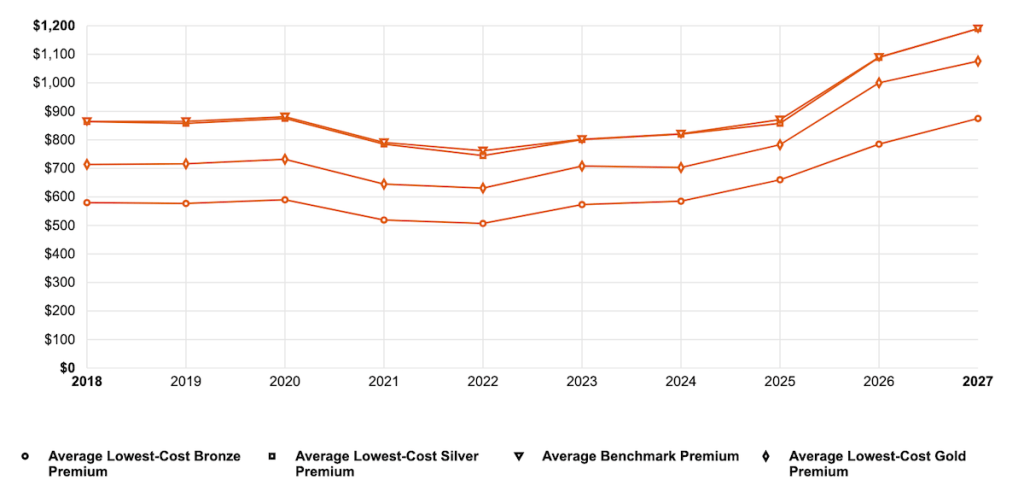
Individual plans vary based on factors like household size and income. But in Wyoming, the average lowest-cost Bronze Premium is $875, while the average lowest-cost Silver Premium is $1,190 and the average lowest-cost Gold Premium is $1,076, according to KFF. Those are among the highest prices in the nation.
Cheyenne resident Jason Mincer’s premiums will be nearly $1,500 starting in January. Along with worrying about his own financial impacts, Mincer sits on the board of Healthy Wyoming, a nonprofit that works on healthcare affordability and access.

“As a board member for Healthy Wyoming, I am equally concerned that hard working people in Wyoming are going to drop their health coverage because they cannot afford it, leading to premature death and needless health problems for so many of our neighbors,” he told WyoFile.
ACA enrollment in Wyoming fell from 46,643 in 2025 to 37,643 in 2026, a drop of 9,000, according to the Wyoming Department of Health.
When Mittelstadt asked an insurance broker for advice navigating the Lander couple’s situation, the broker said her options include: make less money, go without health insurance, pay the $3,300 a month or go back to work.
The couple is on Wyoming retirement fed by pensions they earned. Making less isn’t really an option. And though they are healthy, Mittelstadt said, they don’t want to gamble with no coverage.
Instead of going back to the marketplace, they have joined a Health Ministry, which relies on a pool of patients — often affiliated by religion — to help one another pay for healthcare.
“So basically we’ll just be uninsured,” she said. “And then it’s a health share where you submit your bills and other people help you pay them.” They’ll forgo things like yearly health checks that could come with unexpected costs, she said.
Both are 57 years old, which means they are years away from qualifying for Medicare. Between now and then, Mittelstadt said, “I’m hoping something changes at some point.”