

The National Elk Refuge will once again examine the future of its elk feeding program, revisiting a reliably fraught topic that’s sure to elicit strong calls to stay the course.
A new study by the U.S. Geological Service, however, suggests that continued feeding would likely transform the Jackson Elk Herd into a population that bears little resemblance to the group that’s been intensively researched since the days of pioneering biologist Olaus Murie.
The scientific investigation is intended to help U.S. Fish and Wildlife Service officials anticipate what lies ahead as they chart the Elk Refuge’s future.
“Continued feeding is not the same thing as the status quo, because it does not maintain the current numbers of elk that we’ve seen in the past,” USGS disease ecologist Paul Cross told WyoFile. “People might be hoping for that, but [the status quo] is not something that our models suggest is likely.”
“Continued feeding is not the same thing as the status quo.”
USGS disease ecologist Paul Cross
The USGS’ modeling provides a preview of some of the likely options, or “alternatives,” outlined in the forthcoming environmental impact statement that will guide the revision of the refuge’s bison and elk management plan. That revision will replace the refuge’s 2007 management plan and subsequent “step-down plan.” Those regimens were mostly ineffective at reducing the number of elk on the 24,700-acre property to 5,000 animals. Fewer elk would theoretically allow federal managers to forgo feeding during the average winter.
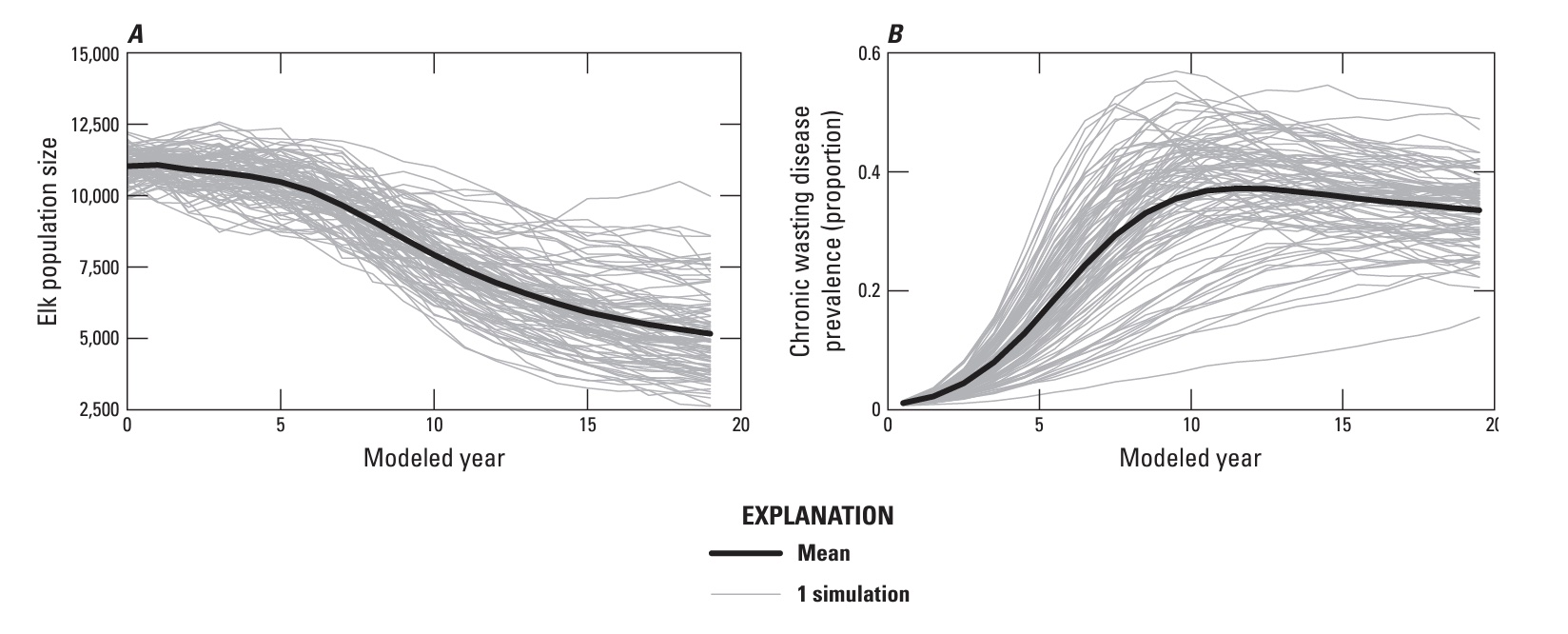
In the new study, USGS, Fish and Wildlife Service and academic research scientists projected how the Jackson Elk Herd would fare 20 years into the future under five different management scenarios while lethal chronic wasting disease propagates through the feedground region. The modeling assumed starting points of 11,000 elk and 1% CWD prevalence — which are both higher than the on-the-ground conditions today.
- Continue feeding: Unchanged elk feeding on the National Elk Refuge would ratchet up the prevalence of chronic wasting disease to an average of 35% of the herd. Meanwhile, the Jackson Elk Herd would decline by more than half to 5,200 animals.
- No feeding: Ending the refuge’s feeding program abruptly would reduce the size of the Jackson Elk Herd sooner, but the herd size would only dwindle to 6,700 — a 39% decline. Rates of CWD in the herd would reach an estimated 24%.
- Increase harvest, then stop feeding: This management option assesses five years of heavy hunting to drive down the refuge’s population to 5,000 before stopping feeding. The herd is projected to decline by 45% to 6,000 animals in this scenario. CWD prevalence in the herd would reach 27%.
- Reduce feeding: This strategy would taper alfalfa rations over 5 years before halting feeding altogether. The USGS’ modeling predicted that the herd population would decline by 45% to 6,100 animals while CWD prevalence would top out at 26%.
- 3% disease threshold: The last scenario analyzed in the USGS model calls for continued elk and bison feeding on the refuge until CWD prevalence reaches 3%, then stopping feeding. The model predicted a 37% population decline to 6,900 animals and a 23% CWD prevalence under this management option.
Complexities and assumptions
The research scientists selected the potential management options after querying Fish and Wildlife Service officials about their goals, management directives and constraints. Other agencies and stakeholders, including the National Park Service, Wyoming Game and Fish Department and hunting outfitters, were also consulted.
“Oftentimes there isn’t direct research available to inform the performance of the alternatives in an [environmental impact statement],” USGS research ecologist Jonathan Cook told WyoFile. “The role that USGS had was to think in advance of the drafting of the EIS: What are the results that would be most informative? We spent over a year developing the models and the analysis.”
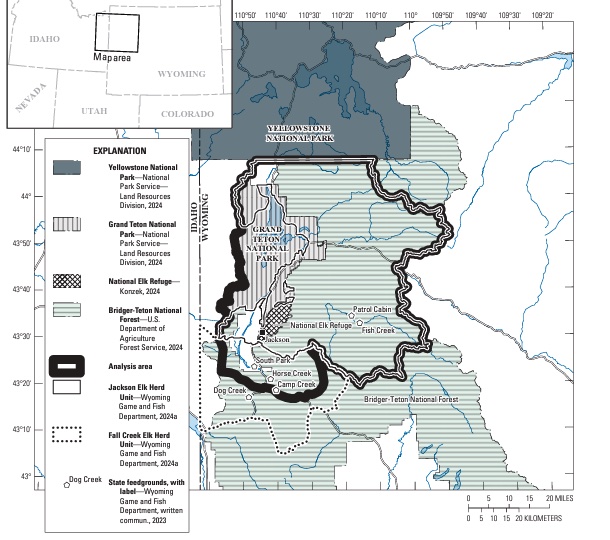
Recognizing that the refuge doesn’t operate in a vacuum, researchers attempted to factor in real-world conditions. It was assumed, for example, that Wyoming would continue feeding elk on state-run feedgrounds up the Gros Ventre River drainage and in the Fall Creek Elk Herd. That assumption helps explain why projected chronic wasting disease prevalence was so high, even when elk were no longer fed — and densely concentrated — on the National Elk Refuge.
Whether Game and Fish does keep feeding elk on its feedgrounds long into the future remains to be seen. The state agency recently completed its first-ever feedground management plan. A targeted review of feeding operations for the Jackson Herd is also underway, though making wholesale changes will require broad buy-in from the public. Even the Wyoming governor would need to be on board in order to close a feedground.
The USGS’ modeling also used 1% prevalence of CWD as a starting point, which is higher than current infection rates. A single elk, killed by a hunter in Grand Teton National Park over four years ago, has tested positive for the always deadly prion disease. Meanwhile, CWD was just discovered for the first time in the adjacent Fall Creek Elk Herd.
Expert projections, combined with modeling, were used to estimate how quickly CWD prevalence will climb within the feedgrounds. There’s “a lot of uncertainty,” said Cross, the lead USGS researcher. But there are also the prospects of very high levels of the disease, he said, citing a Wyoming study that found 37 out of 39 captive elk died from CWD at the Tom Thorne/Beth Williams Wildlife Habitat Management Area and catastrophic consequences for some wild mule deer herds.
“The Wind River population — it is mule deer — but it shows that CWD can go really quickly to high levels,” Cross said. “Zero to 70 [% prevalence] in 10 years.”
Redistributed
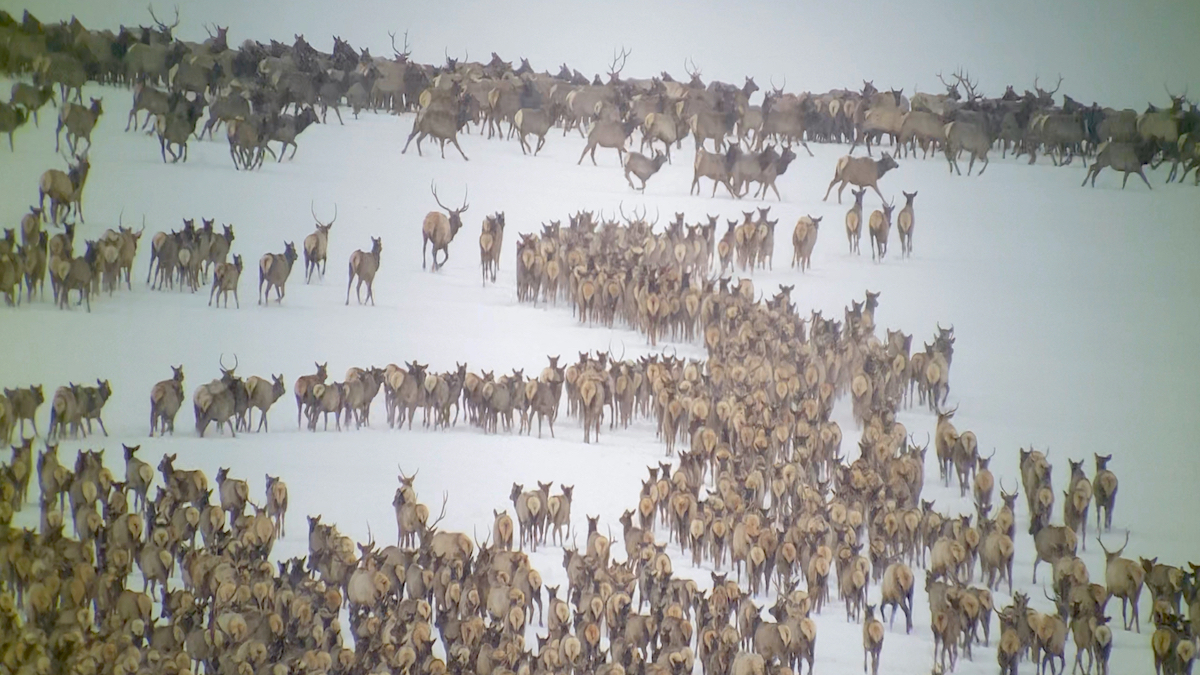
The USGS analysis also predicted how elk would redistribute across the landscape if the feeding system they’ve been drawn to for a century disappears.
Exactly half of elk would stay on the refuge in the absence of feeding, the modeling predicted. A recent mild winter, 2017-’18, showed that virtually the entire Jackson Herd can dwell on the federal preserve under the right conditions.
In the absence of feeding, about 14% of the refuge’s elk would move into the Fall Creek Herd — mostly moving to the state-run South Park, Horse Creek and Camp Creek feedgrounds. Another 19% of the elk, the research predicted, would spend the winter naturally foraging out on the landscape in the Jackson Herd region. The last big cohort — about 18% of the refuge’s elk — would leave to spend their winter eating hay on the elk feedgrounds up the Gros Ventre River drainage.

Bison, which cannot contract chronic wasting disease, were also assessed in a separate chapter. The analysis found that continuing with feeding resulted in the highest number of bison, with herd sizes and hunting opportunities slightly lower under all the other scenarios.
Another chapter of the USGS research takes stock of the social and economic consequences of the various management options. It spells out, for example, how hunting license revenue would vary. Hunters, the study predicted, would spend $76 million on tags over the next 20 years in the no-feeding scenario, but $101 million if the refuge selects the “increased harvest” option. Regardless of what managers choose, hunting opportunities are expected to eventually plummet relative to the status quo because of the effects of chronic wasting disease.
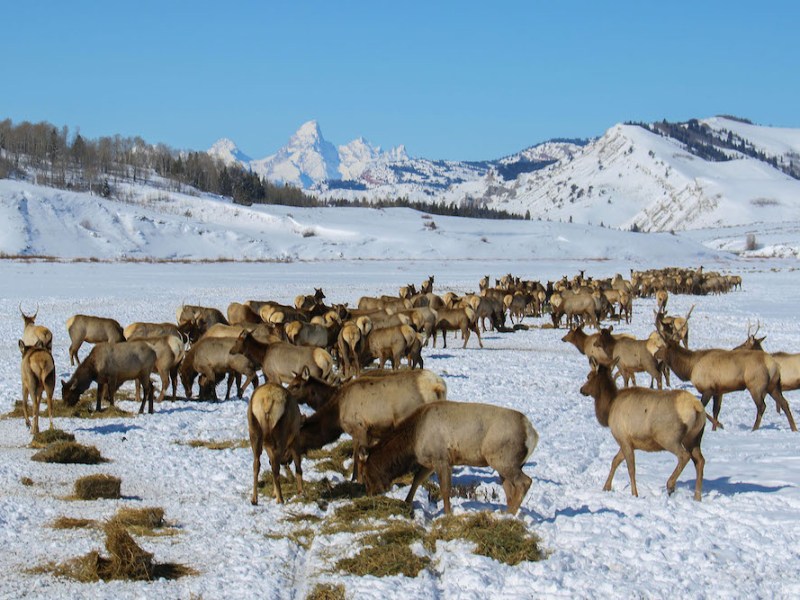

“Projections are for the harvest declining by up to 75%,” Cross said. “There’s a dramatic decline in harvest, in all scenarios, though the depth of it is a little hard to say.”
The USGS’ data and analysis are intended to help wildlife managers understand the tradeoffs of the elk feeding equation in a new era with chronic wasting disease on the landscape. The findings, Cross said, suggest that the ecosystem is at “an inflection point.”
“Regardless of the decision made, things will be different in the future than they have been in the past,” Cross said. “It’s a really important moment.”

The U.S. Fish and Wildlife Service’s regional office did not grant the National Elk Refuge staff permission to give an interview for this story.
The Wyoming Game and Fish Department has yet to formally review the U.S. Geological Survey’s final analysis, which published last week. In advance of that review, Brad Hovinga, the agency’s Jackson Region supervisor, has a number of questions.
“Certainly, we have concerns with the amount of assumptions in this analysis,” Hovinga said. “There’s a lot we don’t know about the disease or what could happen.”
The USGS’ entire 146-page analysis is available for review below.

First the wolves were introduced to decrease the “over populated elk herds”. Now we have disease decreasing the herds even more. How is the disease spread? from saliva, urine,blood, feces, air….all of the mean of spreading it? No one is ever going to admit that an abundance of wolves and other predators has anything to do with the problem. What year did the first CWD show up? I can’t remember. I hope we finally get on top of this problem.
Yes Marion, CWD prions/spread has been documented in wolves scat.
They eat weakened infected animals and spread it through their waste.
There’s speculation that it started from domestic sheep. It’s very closely related to scrapies in sheep. Sorry to disappoint you. Keep going after the big bad wolf.
The refuge will become nothing but a giant killing field on a harsh winter if they stop feeding. It doesn’t matter how much natural feed the biologists claim is on the ground if it is covered in two feet of frozen snow. The elk are trapped there. Look at that eight foot fence keeping them out of town and the surrounding hillsides. Starvation will cause mass die offs, CWD proven not so much. Of course they do have the new incinerators to burn the bodies.
Colorado is the same size state as Wyoming. Colorado’s human population is 6 million, ten times Wyoming’s 600,000 people.
Colorado has over 300,000 free-ranging elk. Wyoming’s elk population is about 109,000; only 3 Wyoming counties have elk feedlots which confine about 20,000 of those elk in disease-ridden conditions that kill many elk each winter from bacterial infections; conditions will get even worse as the years go by and CWD permanently contaminates the environment. Those 3 large counties are more than 80% public lands. Mule deer in western Wyoming migrate each year to and from their seasonal ranges literally walking past all the elk feedgrounds, thus showing the migration routes are functional. In all western states mule deer and elk share winter ranges. Vulnerable hay and cattle can be fenced in on private lands where needed to protect from elk. All these issues are readily solvable. There is plenty of winter range in western Wyoming.
Congregating the elk helps feed them but also helps spread the disease. Their range has become relatively small due to humans though so congregating is inevitable.
Why not consider transplanting some of them annually? Wichita Mountains in Oklahoma is home to a small herd that could usemore genetic diversity. Other reserves have tremendous holding capacity too.
Just a thought.
I believe 20 years ago, the elk were all gonna be dead by now if cwd was around. As usual, anything from the feds is money wasted and never accurate. Politics gets injected into the picture too often. The same people writing the fiction, are receiving the dollars and being told to write the fiction. The elk are landlocked and have no where to winter. Grizzlies, wolves, lions and loss of habitat are bigger threats.
Enter stage right the anti-science reps from team orange, blaming wolves, grizzlies and Nancy Pelosi. No problem they can’t dodge responsibility. No way this is an issue with CWD, livestock overgrazing and mismanagement, or habitat reduction/destruction.
Spot on Ken.
CWD or not, one thing is certain, these people want fewer elk no matter what the cause. They completely ignore the fact that elk are not nearly as susceptible to CWD as the deer population is.
Wolves, bears and starvation are what these people push on the elk populations of the GYE.
You can’t just stop today feeding the elk on feed grounds. The elk show up at the feed grounds cause they know there is food for them there. We need to get off our butts and figure out how we possibly can get this CWD taken care of . I have found zero info on getting CWD treated. Gee figure out a treatment and all we have to do is mix it into the feed at the feed grounds. Plus the feed grounds are not a tourist site. People need to stay away from areas, just the guys feeding the elk should be there. This is why we put areas off limits and use horse’s the haul the hay.
So far there is no treatment known for any prion disease, including Mad Cow, despite serious research attempts for decades. We can hope that some natural immunity arises with mutation in the affected protein, but that is just a hope.
Well said
Sheer speculation.
The elk gather regardless. Want to end the supplemental feeding, Remove every single human residence from the elks historic winter range.
Only a handful of elk have tested positive in the entire GYE for the past decade that Deer have tested positive in the same area.