

This story is part of WyoFile’s collaborative legislative initiative — a coordinated effort by partner newsrooms to deliver comprehensive coverage of Wyoming’s 2025 general session.
CHEYENNE—In the waning days of the 68th Wyoming Legislature’s general session, House leadership made one last plea with the Senate to resume supplemental budget negotiations.
“The House stands ready for the hard conversations that attend the annual task of developing a budget,” House Speaker Pro Tempore Rep. Jeremy Haroldson, R-Wheatland, said Monday in a statement from House leadership responding to the Senate’s Feb. 26 decision to end supplemental budget discussions.
But Senate leaders maintain the budget failed due to an unwillingness to compromise in the House, a propensity to shirk the rules of their own body and the House itself adding funding for non-emergencies to a supplemental budget bill.
Senate Majority Floor Leader Sen. Tara Nethercott, R-Cheyenne, said the state is well-funded through the fiscal biennium, which will not end until June 30, 2026, and there is no need to pass a supplemental budget bill this session.
“Everything is well taken care of; all programs are funded,” Nethercott said.
How the House and Senate got to this point
Sen. President Bo Biteman, R-Ranchester, has said that behind the scenes, a joint conference committee could not reach an agreement on a 2025 supplemental budget bill.
State operations are funded on a two-year biennium, and during a short, four-week session, lawmakers craft that budget. During a general session, Wyoming’s governor has historically made a request for supplemental funding, largely for emergencies not covered during the immediately preceding budget session.
“A supplemental budget should not be used as a continuation of another year of a budget bill,” Nethercott said. “Rather, it should be limited in scope to emergent needs [and] unforeseen needs. … That way we can have a normal session that is not consumed with another budget year.”
For the first several weeks of the session, the House and Senate discussed and amended mirror versions of a supplemental budget bill. However, the Senate and the House did not agree on the funding difference between the two bills: Haroldson said the House presented “a responsible, balanced budget proposal of $235 million less than the governor’s recommended budget, and $110 million below the Senate’s supplemental budget.”
Haroldson said that supplemental budget proposal “was rejected by Senate leadership without a vote by any single member of the Senate nor any vote of concurrence from the House,” and Friday, the House offered the Senate a budget that only contained items of which both chambers had approved.
“Again, three members of the Senate rejected it without discussion on either floor,” Haroldson said.
According to Nethercott, the state’s budget was balanced during planning for the 2025-26 biennium. The House’s position, she said, would have resulted in a total budget expenditure of $1.3 billion.
“That is what the House asked us to do,” she said on Monday.
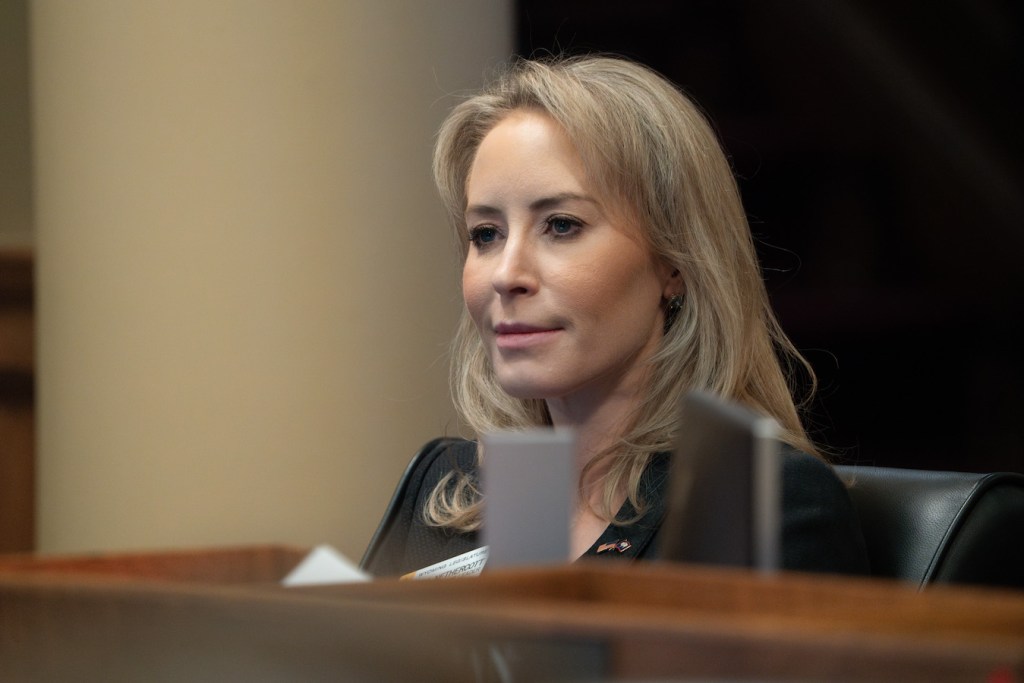
Rather than agree, Nethercott said the Senate focused on funding three major needs until planning for the next biennium begins.
The first is restoring the full $66.3 million allocation for an external cost adjustment, or ECA, to the K-12 education resource block grant model, which was added to House Bill 316, “School finance-model recalibration-2.” Second is $2.75 million included in Senate File 152, “Wildfire management-amendments,” for direct fire response, as well as $49.5 million for conservation districts to restore grass, hay and other vegetation destroyed by wildfires. A final $10.5 million was added to House Bill 279, “Property tax exemptions-order of application,” to fund the state’s property tax refund program.
Several times in the days since supplemental budget negotiations have failed, the House has raised the possibility of a special session. On Monday, Rep. John Bear, R-Gillette, the former leader of the Freedom Caucus, said that if the chambers do not pass a “budget balancer,” Gordon could call lawmakers back to do just that.
“What the budget balancer is — it is where we remove money from our savings account into our checking account to cover our expenditures,” Bear said.
However, Nethercott said that because the 2025-2026 budget was balanced during the previous budget session, there is no need to do what Bear suggests.
“That is a lack of understanding of the budget. There is more than enough money in reserves to cover the expenditure of this [session],” Nethercott said.
‘Porking out’ bills with amendments
Haroldson said that adopting a supplemental budget “would have been the most transparent way to allocate taxpayers’ funds, and it would have demonstrated responsible governance.”
Instead, the Senate is now playing a “legislative shell game,” Haroldson said, in which the Senate is “busy slipping funding measures into a variety of other bills, effectively hiding from the public the expenditures that are normally contained in the budget.”
“The problem with this sort of gamesmanship is that it is reflective of D.C. politics, not Wyoming — a fact that saddens many members of the House,” Haroldson said.
But Senate leadership says the gamesmanship started in the House.
“This leadership has not attacked the House, it hasn’t attacked the House leadership. I think that is because everything is calm over here. We are doing the people’s business,” Senate Vice President Sen. Tim Salazar, R-Riverton, said on Monday. “We have rules, and we are trying to follow them, and the money is still available to get through the next eight months.”
When asked about whether the Senate is slipping funding measures into other bills, Nethercott said, “It is not happening at all.”
Biteman said that his body adheres to the Wyoming Constitution, which does not allow for unrelated amendments to bills that are limited to a single subject.
“These D.C.-style tactics are new this year, and I don’t like it,” Biteman said. “I don’t think the people like it.”
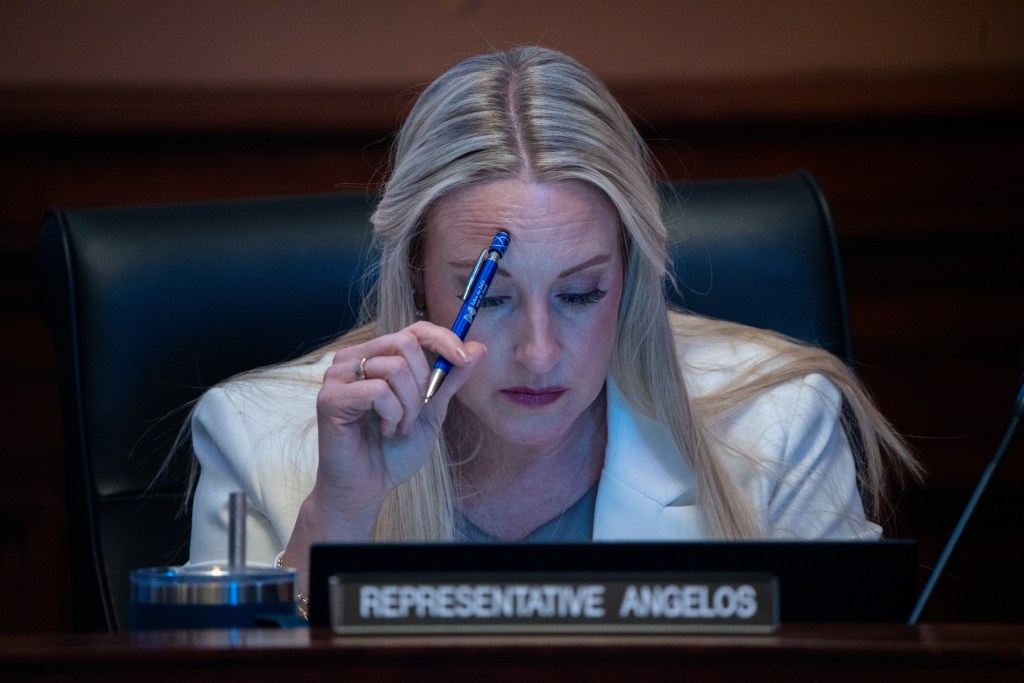
On Monday, Rep. Abby Angelos, R-Gillette, brought a failed amendment to the House floor on Senate File 10, “Settlement agreements for minors-parental authorization,” to add $3.86 million in general fund dollars to the Department of Health to provide payments to home and community-based service providers for those with developmental disabilities.
Rep. Karlee Provenza, D-Laramie, said that she supports the program but could not support it as a rider on SF 10.
“It doesn’t fit,” Provenza said, adding that the constitution stipulates no bill “shall be so amended as to alter its original purpose.”
“In this bill, I get that you can create a connection between the two, but I don’t think the court will,” Provenza said.
Rep. Martha Lawley, R-Worland, successfully amended Senate File 104 “Probate code revisions,” to add $180,708 in general fund dollars to the Wyoming Supreme Court administrative office for two full-time employee positions. That amendment carried a stipulation that if either chamber’s supplemental budget bill were to pass, the appropriation would be reduced dollar for dollar.
“These employees will effectuate the smooth running of our court system, including the probate the courts do,” Lawley said.
Rep. Ken Chestek, D-Laramie, said he would vote no on that amendment, for the same reason he had voted no on other appropriations added to bills following the Senate’s decision not to pass a supplemental budget.
“It is not only unconstitutional, in this case, I think it goes beyond that and it is confusing,” Chestek said.
Another bill, Senate File 17, “Carbon dioxide-enhanced oil recovery stimulus,” was amended in the House to include $10 million in funding previously appropriated by the House’s supplemental budget “for the design and engineering of a project that burns, combusts or gasifies Wyoming coal.”
That amendment, proposed by Rep. Scott Hiener, R-Green River, passed. The Senate failed to concur on that bill, and SF 17 went to a joint conference committee before it passed Wednesday.
Biteman said there are politics involved at every turn, and did not deny when asked if the House maneuvering could be aimed at gaining Senate seats.
“They have mastered the art of projection. They are projecting onto us what they are doing. They are the ones porking out bills all afternoon. We are not,” Biteman said.
Is there a path forward?
Biteman said that while the Senate will continue to follow its rules, which allow for the process to work, much of the messaging coming from the House is negative.
“We have accomplished so much collectively this session, but all you are hearing is the negative,” Biteman said.
Salazar said he’s proud of sweeping property tax relief passed this session.
“Property tax reductions were really critical, and it looks like we are accomplishing that. We also wanted to reduce spending, and I think we are in the process of doing that,” Salazar said.


Nethercott said that a tendency to “to blame others for their own failures” is an “unfortunate political tactic.” However, Senate leadership remained optimistic for the next round of budget negotiations, which will begin for the 2027-28 biennium next winter.
“I am very hopeful that we are going to work with the House on a good biennium budget,” Salazar said. “This is the first time the more conservative members of the House have taken a majority lead in that chamber, so we are kind of figuring out where we can work together.”
Nethercott said that she, too, is hopeful.
“A 2027-28 budget is a totally different analysis, and a new day,” Nethercott said. “We passed a thorough and healthy 2025-26 biennium budget, making the critical need of a supplemental budget less.
“I am hopeful … that we can re-evaluate a biennium budget, recognizing the critical time to establish a two-year budget is during the budget session,” she said.

This article is full of lies and inaccuracies. I am curious if Ms. Haderlie asked any follow up questions or did any research on the numbers that are espoused here or the claims of “behind closed doors meetings?” Very dissapointing.