


Lawmakers failed to pass a slew of bills that might have clarified where the Legislature stands on state-versus-local control controversies regarding small mining operations and other business activities on state lands.
Following more than a year of packed meetings in which residents and local officials demanded greater transparency, input and a nod from the state to local regulations, most of the matters now are left to the courts to determine. The discussion occurred as residents in Natrona County debated a controversial gravel mining project and officials in Teton County battled with their state counterparts over the ability to regulate a glamping operation.
At issue is whether the State Board of Land Commissioners can lease state-owned lands without notification or acknowledgement of local zoning and safety codes that may otherwise limit or modify state-sanctioned activities. Parallel to that question is whether the state ought to expand a rubberstamp environmental review exemption for “limited mining operations” beyond inert materials such as gravel to include toxic resources like rare-earth minerals, gold, lithium and other hard-rock commodities.
The House considered four separate measures. None found their way to the Senate.

Rather than wrest control of state lands, county officials say they simply want a seat at the table and collaboration with the board of land commissioners when it comes to potentially concerning development proposals on state lands.
In addition to possessing statutory authority to determine zoning, counties must be responsive to their residents’ concerns — even if what’s happening next door is on property owned by the state, Natrona County Commission Chairman Dave North told WyoFile.
“I think the locals need to have some input, because we’re the ones that are closest to the people,” North said. “We’re the ones that hear this. We’re the ones that listen to it. And, bottom line is, we’re the ones that are going to be affected by it.”
What are state trust lands?
Upon granting statehood in 1890, the federal government bestowed some 4.2 million acres of “state trust lands” to Wyoming, which currently manages about 3.4 million acres of trust land. The Wyoming Constitution mandates that the primary use of those lands, which are scattered throughout the state, is to generate revenue to support public schools.
The Office of State Lands and Investments commonly leases those lands — often referred to as “school sections” — for grazing and industrial development such as mining and oil and gas drilling.
Two bills, House Bill 10, “Limited mining operations-amendments” and House Bill 15, “Limited mining operations-bonding amendments,” would have expanded what types of mines qualify under the Wyoming Department of Environmental Quality’s limited mining operations exemption while also raising credit bonds to cover the cost of environmental remediation. Both were sponsored by the Minerals, Business and Economic Development Committee.
Two other measures, House Bill 58, “State lands-notice for mineral leases” and House Bill 59, “Limited mining operations-water quality testing,” would have required the state to provide notice and solicit comment from county officials and residents prior to leasing state lands. They would have also empowered state regulators to ask for a baseline water test prior to issuing a limited mining operations permit. Those bills were sponsored by Casper Republican Rep. Steve Harshman.
In addition to wanting to attract more rare-earth and other hard-rock mineral developers to Wyoming via an easier permitting process, the state objects to any measures that appear to interfere with its authority over state lands. Those state lands, after all, come with a fiduciary responsibility to generate revenue for schools.
Local control for thee?
Wyoming politicians have long touted “local control” over so-called top-down mandates — particularly from the federal government — when it comes to managing public lands and the activities they support. The best approach to achieving broader goals for such landscapes, according to the local-control notion, is to account for the unique qualities of any particular piece of land — details possessed only by people from the community at issue.

It’s the premise of Wyoming’s battle over myriad federal land management and federal wildlife initiatives, including objections over the U.S. Bureau of Land Management’s revision of the Rock Springs Resource Management Plan, as well as pushback against federal protections of grizzlies and wolves.
But some critics say the state hasn’t abided by its own local control mantra when it comes to state-trust lands — parcels that are scattered throughout the state in a sort of checkerboard pattern.
The State Board of Land Commissioners — Gov. Mark Gordon, Secretary of State Chuck Gray, Auditor Kristi Racines, Treasurer Curt Meier and Superintendent of Public Instruction Megan Degenfelder — prevailed in court after suing Teton County to block it from imposing local codes and regulations on a glamping operation the panel had permitted on a state trust section near Teton Village.
What was largely dismissed as a Teton County spat with the state quickly evolved into a bigger fight last winter.
“I think the locals need to have some input, because we’re the ones that are closest to the people.”
Dave North, Natrona County Commission
Residents at the base of Casper Mountain, meanwhile, learned the same panel had unanimously, and without reviewing for themselves, approved without notice several exploratory mining leases on a cluster of state land sections next to their rural neighborhood. Not only would the developer, who plans to launch a gravel mine on the state lands, industrialize the rural residential neighborhood and potentially harm groundwater resources there, he plans to use the state’s limited mining operations permit exemption, which provides no formal opportunity for public scrutiny, opponents note.
It’s the same mine permit exemption that lawmakers want expanded to include toxic hard-rock minerals.
Natrona County residents, as well as landowner advocacy groups, conservation organizations and the Wyoming County Commissioners Association, spent the rest of the year imploring the state board and lawmakers to make the processes for both state land leasing and small mine permitting more transparent and accountable via public notice and commenting periods. And despite a call for the state to engage in consultation with counties regarding permitted activities on state lands, the panel of top-elected officials has refused attempts to mandate such cooperation.

“I have a lot of compassion for the people that live on Coates Road [next to state lands at the base of Casper Mountain] who thought they built their house near a state park, but they didn’t,” Prism Logistics Manager Kyle True told WyoFile.
Prism is the Casper-based company that acquired mine exploration leases in the area and proposes a gravel mine.
“As they learned,” True said, “they built their home next to state land, which is dedicated to economic development to support our schools and state buildings. It is a hard realization for them to come to and to change that understanding. I do have compassion for that.”
The Natrona County commission’s North said it’s not simply about some residents opposing any particular gravel pit. “I don’t think anybody that’s on the [board of county commissioners] is against mining,” he said. “Matter of fact, I’m pretty sure we’re not.
“But it’s all about location and how that’s going to affect the community,” he added. “There’s good places and bad places to do a lot of things.”
The State Board of Land Commissioners, in recent months, “has gotten better” about notifying the county of proposed uses on state lands, North said.

“People often say the government closest to the people is most responsive and therefore best,” True said. “That is a common conservative statement. However, the state of Wyoming has never given away its state sovereignty to counties or cities in a variety of areas. And this is one of them.
“More local government control is better, and people make that argument,” he added. “But I don’t think it’s universally applicable.”
Meantime, in court, the state has maintained what it believes is its overriding authority over counties regarding state lands. There are several lawsuits in motion regarding the issue.
Teton County made arguments before the Wyoming Supreme Court in January, asking to overturn a 2023 district court ruling.
The Casper Mountain Preservation Alliance, which formed last year and gathered more than 18,000 signatures on a petition to block the gravel pit, sued the State Board of Land Commissioners in November for failing to notify neighbors and county officials prior to granting mine exploration leases.
Prism Logistics filed suit against Natrona County in October for potentially blocking the development by rezoning the conflict area back to non-commercial mining.
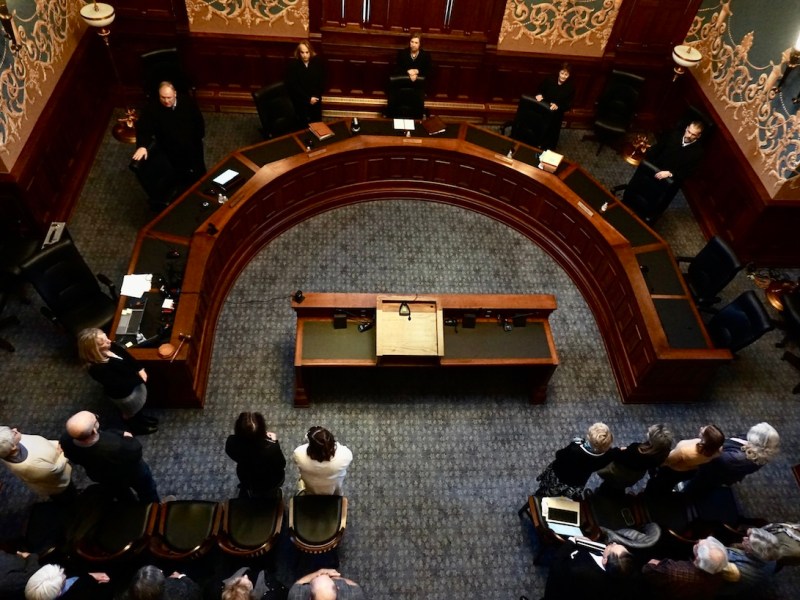

Parsons Behle & Latimer attorney Bill Schwartz represents Citizens For Responsible Use of State Lands, a group that filed an amicus brief in support of Teton County’s appeal against the state before the Wyoming Supreme Court. He recently joined attorneys representing the Casper Mountain Preservation Alliance in that group’s case against the State Board of Land Commissioners.
Regardless of how the courts rule on the various cases surrounding the state-versus-local control issues, the Legislature must ultimately weigh in, he told WyoFile.
“It’s a statewide issue that is probably a proper subject of legislation, and I’m surprised it hasn’t really boiled over before now,” Schwartz said. “I think some kind of legislation is required. It’s not right for the state land board to just totally disregard local planning efforts and local land-use plans and treat all state lands as being equal. What’s good on a piece of state land out in the middle of nowhere is not necessarily good for the Teton Village [state land] parcel next to the Tetons at the entrance of Grand Teton National Park, or in the middle of a residential communities [in Natrona County].”
With the Legislature scheduled to adjourn today, Schwartz will have to wait till next year’s session for lawmakers to consider such legislation.

The process to review & approve limited mining operations (LMOs) is not working for the people of Wyoming. When mistakes, poor judgement or influential wealth lead to bad decisions the State Land & Investment Board claims to have no power to correct errors. This is unacceptable.
Join us attending the SLIB meeting June 5th in Cheyenne to let them know! ! FIX THIS PROBLEM!
Kyle True is a hypocrite. After he leased the lands in and along Coates Road for gravel mining in early 2021 he then, later that year, leased the state lands adjacent to the True Compound on Garden Creek; not to gravel and help public schools, but to prevent you and me and any other commercial venture from gravel mining in his backyard. In fact the northern most state section today, adjacent to their lands, he retains the gravel lease on, connects with Wyoming Boulevard and is currently zoned Urban Agriculture UA, allowing gravel mining with a simple CUP Conditional Use Permit. If he wants to mine gravel and help the public schools why not get started in this state land? Because it is in his backyard!