

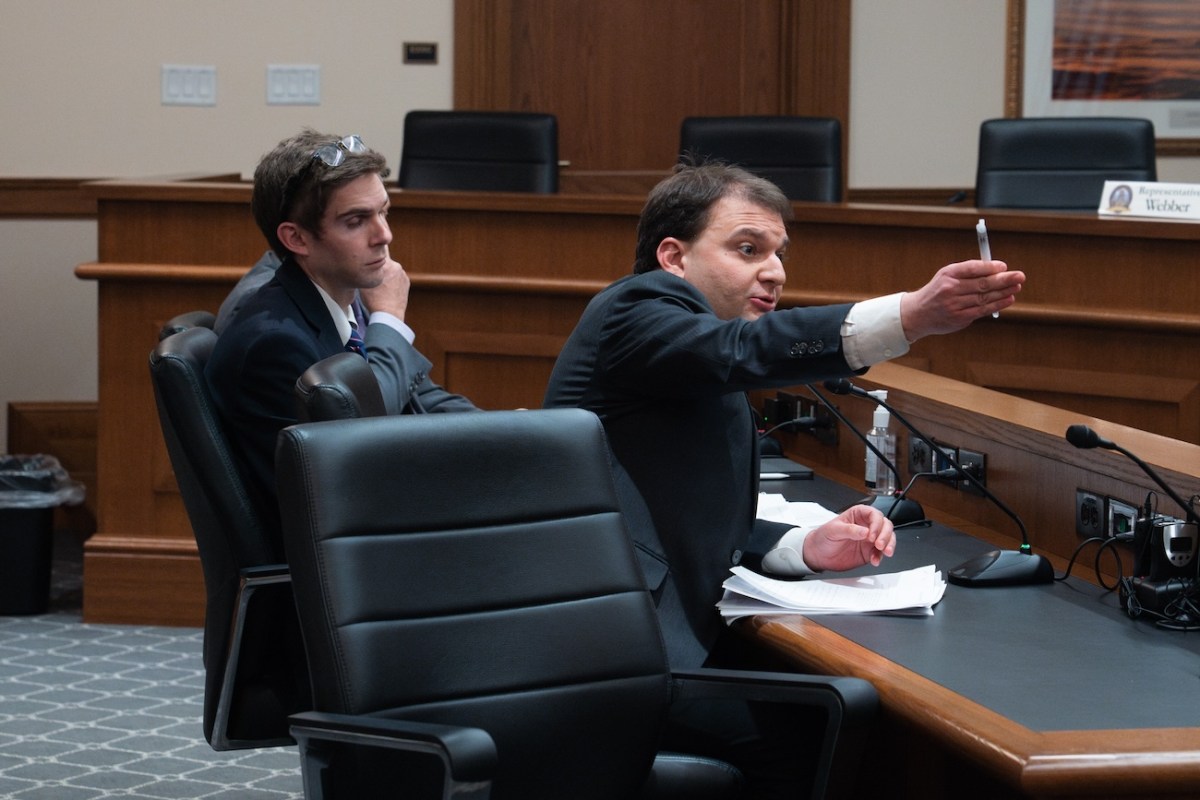
Attorneys for Secretary of State Chuck Gray asked a federal court Friday to dismiss a lawsuit against Wyoming’s new voter registration law, arguing in two filings that the complaint does not sufficiently demonstrate how the new requirements could harm potential voters.
Once the law goes into effect Tuesday, proof of state residency and U.S. citizenship will be required to register to vote in Wyoming. The law also requires someone registering to vote to attest that they’ve lived in the state for at least 30 days.
Equality State Policy Center, a voting-rights group made up of several nonprofits, filed a lawsuit in May after the Wyoming Legislature passed House Bill 156, “Proof of voter residency-registration qualifications” during the 2025 session.
The complaint alleges the new law is unconstitutionally vague as written and will impose an undue burden on the right to vote — particularly for women as well as Hispanic, young and low-income voters.
The harms described in the complaint, however, are speculative and lack the kind of specificity required to have standing in a federal court, Gray’s attorneys argued in Friday’s filings.
“Plaintiffs liberally assert these broad, sweeping claims, without bothering to submit supporting evidence,” attorneys with Dhillon Law Group argue.
“For example, they have not identified even one woman, one Hispanic citizen, one impoverished individual, one transgender citizen, or one person with epilepsy who cannot vote because Wyoming wishes to enforce the citizenship requirement embodied in both federal and state law. Nor can the plaintiff offer any method to reliably measure the likelihood or extent, if any, of such hypothetical difficulties in Wyoming.”
The law was a key priority for the Wyoming Freedom Caucus and Gray, whom the complaint names as a defendant in his official capacity alongside the state’s 23 county clerks.
“Wyomingites deserve fair, transparent elections and that’s why we are fighting tooth and nail to protect these election integrity measures,” Gray said in a Monday press release.
The case’s profile has risen considerably since it was first filed, attracting high-profile attorneys who have fought for and against President Trump on the national stage. Ahead of Gray’s filings on Friday, the Republican National Committee filed a motion to intervene in the case while a coalition of 25 states plus Guam filed a proposed amicus brief, urging the court to allow the law to go into effect.

Legal fight
Shortly after Equality State Policy Center filed its complaint, attorneys for the group sought a preliminary injunction, asking the court to prevent the law from going into effect while the case plays out.
Gray responded with two motions — one asking the court to allow the law to go into effect, another asking that the complaint be dismissed entirely.
In the first filing, attorneys for Gray argue that ESPC has not demonstrated that the law will impose a severe burden on the right to vote, and that Wyoming has a compelling interest in enforcing current federal and state laws that limit voting to U.S. citizens.
“Plaintiff’s request to preliminarily enjoin HB 156 — without evidence of actual harm, and well in advance of any election — is both premature and legally unfounded. Therefore, the motion [for a preliminary injunction] should be denied,” the filing states.
Attorneys for Gray fleshed out their argument further in a motion to dismiss, arguing the plaintiff does not have standing, or the right to bring the lawsuit, for three reasons.
The first centers on a 2024 U.S. Supreme Court decision.
ESPC argued in its complaint that the new law will impede its “core work of encouraging voters to register and participate in their democracy” and would require the group “to redirect significant resources to increase its voter registration education efforts.”
But when several anti-abortion groups challenged the Food and Drug Administration’s approval and subsequent actions regarding mifepristone — arguing it forced them to conduct their own studies of the drug — the high court ruled that did not give them standing.
“In short, increased educational efforts or advocacy efforts are not a concrete, particularized injury that establishes standing,” Gray’s filing argues.
Second, Gray’s attorneys say the plaintiffs failed to identify anyone who will be harmed by the law.


As part of its legal strategy, ESPC included several affidavits from individuals explaining potential harms of the new law, including the organization’s executive director, Jennifer DeSarro, as well as representatives from both a homeless shelter and a food pantry, both in Cheyenne.
“Despite Plaintiff’s claims of widespread harm, it has only identified one member organization that claims harm to its members,” Gray’s filings state, pointing to an affidavit from the Wyoming Coalition Against Domestic Violence and Sexual Assault. (Emphasis from the filing.)
“But this sole member has failed to meet the requirements” to have standing, the filing argues.
“Third, to the extent Plaintiff argues its members’ members will face injury, such injuries are speculative, at best, and, thus, cannot serve as a basis for Plaintiff’s standing.”
Equality State Policy Center now has until July 9 to file a response.

I have a better idea. Toss Chuck Gray instead.
The law Gray pushed was unnecessary and duplicative and I hope that the court strikes it down. Wyoming’s elections have a long history of being safe and secure. I truly wish the legislature would work on actual issues facing the state, such as what climate change impacts we can mitigate instead of trying to make nonsense problems to solve.
One problem is this:
In Albany County, a voter must have their name entered into an electronic data base prior to receiving a ballot. As a result, the lines at the polls are too long, and consequently people are discouraged from voting. When I voted on 11/05/2024, I spent 50 minutes in a line that extended 100 ft outdoors, and once reaching the front of the line I spent five minutes with the election judge who, via keyboard entry into a data base, was eventually successful at confirming my registration. The process used in the 2020 election was better. An election judge took my name, checked that my name was on a list of registered voters, and gave me a ballot. That took less than a minute.
We should have convenient and fast voting. So long as our elections remain free of corruption, I will hold convenient and fast to be the guiding principles.
The truth is we don’t need more voting laws, we have fair elections. These out- of- state goofballs have really mucked up my home state.