


For the third time, freshman lawmakers in the Wyoming House on Monday killed a bill that would have helped the state better evaluate child welfare and juvenile justice programs.
The Department of Family Services and longer-serving legislators want the agency to synthesize data from the multiple systems that serve the state’s families and children. Doing so would allow the agency to better support struggling families before they end up requiring court-ordered interventions, department officials say, but it requires a change to confidentiality statutes.
New House members, however, have stopped the measure over concerns about government overreach into people’s privacy.
The statute change would also let the agency examine how kids move through the criminal justice system — a question today that largely remains a black box for both outside researchers and government officials.
Wyoming incarcerates children at rates higher than most states in the nation — in 2021, it was the worst state on that metric.
That year, the Legislature’s Joint Judiciary Committee began examining the juvenile justice system, with lawmakers at the time noting it was costing taxpayers a lot of money to confine the state’s youth. That high cost is paired with poor outcomes for children, who, research has found, do not benefit from incarceration.
But lawmakers seeking to improve the system quickly ran into a wall.
Depending on where in the state they live, juveniles can see their cases adjudicated in circuit, municipal and district courts. Those different tracks, plus privacy statutes for minors, have made it impossible to follow cases and see how often children make it out of the system or end up incarcerated.
“It became very apparent to this committee and to all of us that work in this space that there’s really no way to know or understand how a juvenile progresses or where those opportunities for intervention may be,” DFS Director Korin Schmidt said Monday.
“It’s impossible for us to even talk about the ‘why,’” behind the high youth incarceration rates, Schmidt told lawmakers on the Joint Judiciary Committee, “because of the disconnects between the systems.”
For now, getting to the bottom of that “why?” will likely remain out of reach.
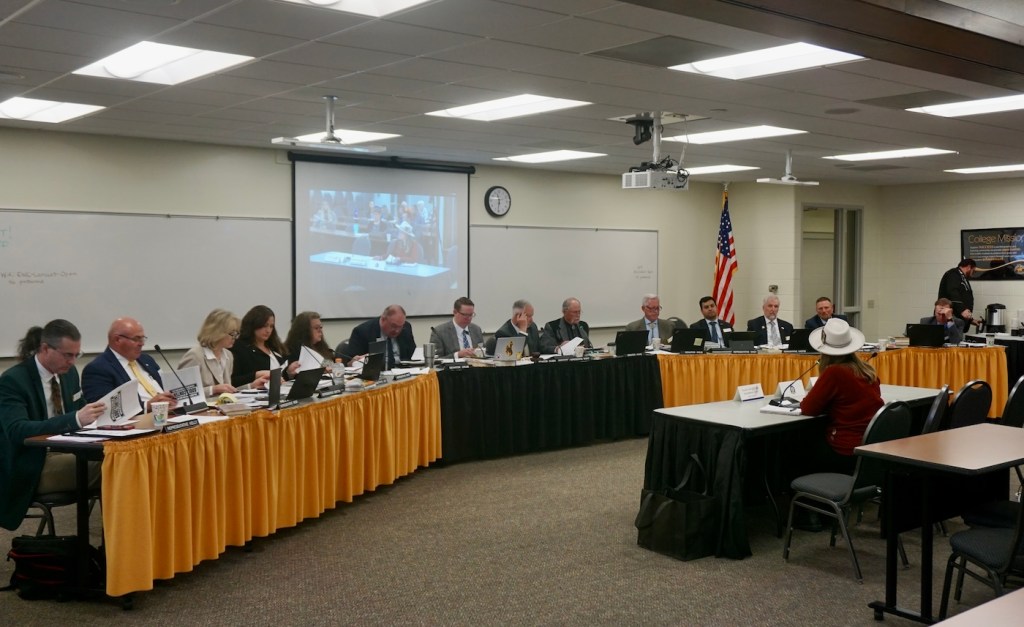
The House side of the committee voted 6-3 not to advance Schmidt’s bill on Monday. Though the four senators present all backed the measure, legislation must receive majority support from both the House and Senate sides of the committee to earn an endorsement ahead of the session.
“It came down in my opinion to a philosophical vote,” Sen. Larry Hicks, a longtime Republican senator from Baggs who votes deeply conservative, told WyoFile on Tuesday.
“I’ve been on both sides of that issue, so I understand where everybody is coming from,” Hicks said. “Historically, I was on the side that erred much more on people’s right to privacy than on government sharing data.” His stance changed with time spent in the legislature learning the criminal justice system, he said.
Schmidt was making her case to a new, and very different, judiciary committee than the one that worked on juvenile justice reform over several years. That committee in 2024 gave the department’s data bill its stamp of approval.
But when the Legislature largely turned over in the 2024 election cycle, the House side of that committee began this year staffed by freshman lawmakers, many of whom align with the conservative Wyoming Freedom Caucus. Those lawmakers rejected the DFS bill twice during the last session. The House Judiciary Committee rejected the measure at the session’s beginning. Senate Judiciary Committee Chairman Jared Olsen, a Cheyenne Republican, revived the bill and the senate passed it, but then the House Labor, Health and Social Services Committee again voted it down.
Schmidt and Rep. Lloyd Larsen, a longtime Republican representative from Lander who has advocated for the bill, told WyoFile that after three rejections by House committees, there is little appetite left for another run at it this coming session.


Instead, Larsen said, the new lawmakers may need to build their own understanding of the state’s juvenile justice systems in order to advance solutions. “For some of these new members this conversation gets stalled out by their lack of historic or institutional knowledge,” he said, “so we have to get back and repeat that work before we can get some of this stuff moved forward.”
One lawmaker who opposed the bill, Rep. Jayme Lien of Casper, seemed to suggest that repetitive step while explaining to the panel why she would vote against Monday’s bill.
“My recommendation would be that the Legislature take some time to really put together a good dive into the juvenile justice system and all of its programs together to be able to make one clear, concise bill that fixes a plethora of problems,” she told her colleagues.
Lien did not respond to a voicemail from WyoFile left Wednesday evening. Two other Republican representatives who voted “no,” Rep. Laurie Bratten of Sheridan and Rep. Joe Webb of Lyman, also did not respond to voicemails from WyoFile seeking comment on their votes.
“I think there are a lot of things that need to be looked at in this bill to secure data, to secure things that can help our youth and can help families,” Webb said before the vote. “That’s the reason that I will be a no on this is I think we need to look at those things before we impose a bill such as this one.”
Rep. Tom Kelly, also of Sheridan, told WyoFile the bill clashed with his concerns for the privacy of families and minors in the face of possible government intervention. Kelly was endorsed by the Wyoming Freedom Caucus but describes himself as a libertarian-leaning lawmaker.
“No matter how many times I’ve heard this bill explained,” Kelly said, “all I hear is ‘I’m here from the government and I’m here to help,’ and for someone from my line of thinking, that sends chills up our spines.”
He did not trust DFS to use the data to evaluate its own programs for effectiveness, he said, or to protect the data and people’s confidentiality from leaks or hacks.
“As someone who has studied political science for decades,” Kelly said, if DFS were to examine the effectiveness of its intervention, “I can already tell you the report will be ‘we’re doing a great job, we just need more money.’”
It boiled down to a check on power, he said. “She [Schmidt] wants the department to have more power and I don’t,” he said. “I understand she doesn’t want to wield it maliciously, she has good intentions. But my default mode is to not give government more power.”
Schmidt told the committee much of the data in question is on systems maintained by the tech giant Salesforce, which helps provide the latest protective systems. It is also maintained under security standards set by the Wyoming Department of Enterprise Technology Services, the statewide IT agency.
DFS officials were likely to seek outside help in evaluating data from the juvenile justice system, because it’s largely outside the department’s capabilities, she said in an interview with WyoFile.
And it’s not just the department that wants to analyze what’s working and what’s not for Wyoming youth. Independent academics and journalists who have raised questions about DFS and the state’s handling of juvenile justice also want to see the data restrictions loosened, so there’s more information with which to evaluate and critique the system.
Wyomingites can’t track whether prosecutors and judges in one county are incarcerating kids more than in another, nor determine how that works out for the youth involved. Wyoming law, meanwhile, leaves wide discretion to prosecutors to decide how to charge children accused of crimes in juvenile or adult courts, which can lead to very different outcomes.
“This is actually for the protection of kids,” Kayla Burd, a professor at the University of Wyoming, told WyoFile in an interview. She’s studied how children in the Wyoming justice system can receive disparate outcomes based on the community they’re in, or based on their race.
“If we can’t track [youth] outcomes we don’t know what is or what is not working for our communities,” Burd said. “Or maybe we don’t notice patterns of certain [officials] using their discretion in different ways than folks in other counties. I think that is a real problem.”
Burd later added that state officials focused on the cost of government should want to know if dollars are being spent most effectively.
“We have high rates of spending on out-of-home placements, and much less funding going towards community-based options, but without better data, we can’t demonstrate how kids are faring, or whether we are devoting dollars to the ‘right’ sources,” she wrote in an email.


We humans are not born inherently good or bad. We are taught. Our morals, values, beliefs are taught to us by our parents first, and life experiences. There is your answer to the juvenile incarceration rate. We can raise our kids or some weird influencer on tik tok, or street scum can. No study needed.
Anyone else notice how selective their fear of overreach into privacy is? Sure seems a bit hypocritical coming from the group that wants to dictate what you can do in your own bedroom.
I’m from the government and I’m here to put your child in jail. Yah, that’s also pretty libertarian lol. As is throwing money we don’t have at problems. Which is what the freedumb caucus does over and over. It’s hard to govern when you don’t even understand the basics of your job.
Well Wyoming does such a good job on their own. Haha. Here you have Wyoming politicians that don’t understand the system. Shouldn’t we replace these goofballs.
Surely there’s a way to anonymize data on minors going through the juvenile justice system. Can Salesforce send a representative to these committee meetings to explain how their data collection works? I’m sure it’s tiring for Dir. Schmidt to have to explain what data’s collected and how juveniles are tracked to new legislators. I do have sympathy for them as all of us are wary of our digital privacy these days. But I hope there’s a way to study this problem. What other states have brought down their juvenile incarceration rates, and what data did they use? It’s terrible that kids end up in jails when interventions early on might get them on the right path.