


An appeal before the Wyoming State Supreme Court asks a question at the heart of juvenile justice: whether a sentence of 42 to 75 years for a Casper teen who pleaded guilty to second-degree murder is cruel and unusual punishment.
The case touches on long-running issues of fair sentencing practices for youth, both in Wyoming and around the country. Since the Legislature acted on the subject in 2013, Wyoming has been among what today are 25 states that outlaw sentences of life without a chance at parole for children.
But in the case of Casper teenager Eavan Castaner, his attorneys maintain a Natrona County District Court judge handed him an unusually cruel sentence for a juvenile offender. The judge did so under a quirk in Wyoming statute that allows juveniles to receive a worse sentence for second-degree murder than for the more severe first-degree murder, they argued.
Castaner’s sentence goes against national recognition that the courts should handle juvenile offenders more gently than adults, they said.
“Despite the horrific nature of his crime, he was only 15 years old. He was a child,” Casper attorney Ian Sanderfer wrote in an amicus brief in the case, filed on behalf of the Juvenile Law Center, a national organization. “Because of his developmental immaturity, Mr. Castaner cannot be considered as culpable as an adult offender and cannot be treated as one under the Constitution.”
Attorneys for the state say Castaner and his attorney knew the statutory guidelines when the boy pleaded guilty to second-degree murder and made a bid for a lower sentence. His appeal comes because he didn’t like the results when a judge decided otherwise, Kristen Jones of the Wyoming Attorney General’s office argued Thursday.
Jones listed a series of difficult decisions a defendant must make as a criminal case proceeds. “Do I testify, do I not? Do I file the motion, do I not? Do I take the plea, do I not?” she said. Castaner had “roll[ed] the dice,” and pleaded guilty to second-degree murder, which has a minimum sentence of 20 years and a maximum of life behind bars.
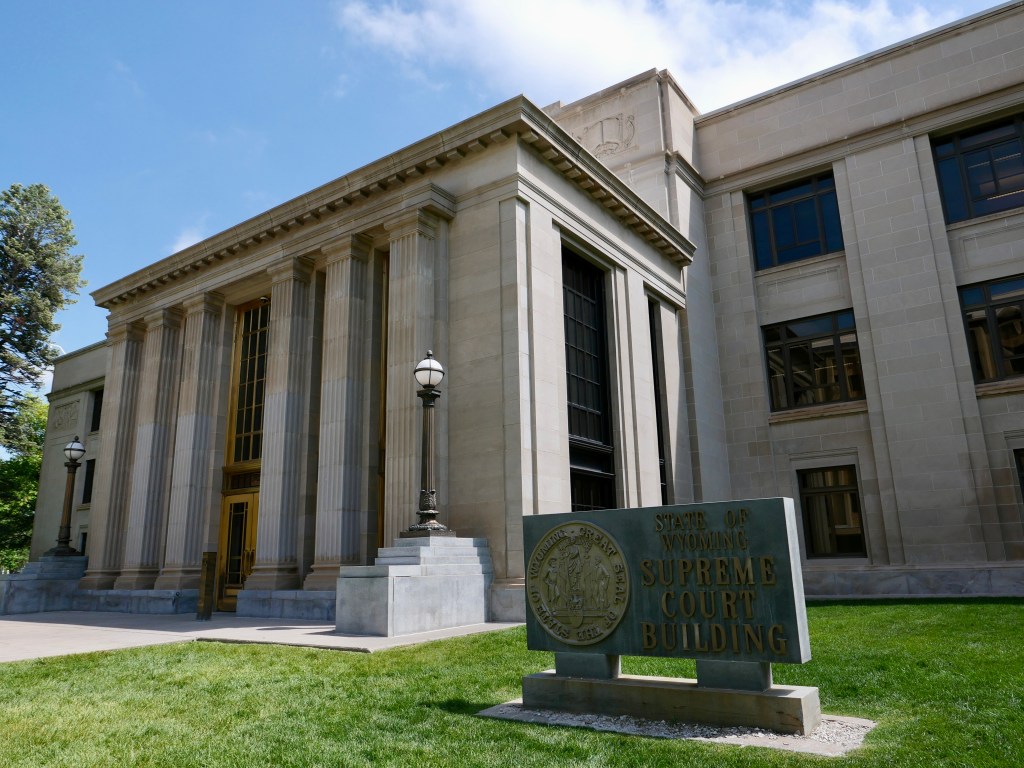
The Wyoming Supreme Court heard oral arguments on the case Thursday morning at the University of Wyoming Law School. The court occasionally hears cases there to give law students an opportunity to experience the process.
Castaner admitted earlier this year to shooting and killing his ex-girlfriend, Lene’a Brown, in May 2024. He was 15 at the time, and she was 17.
The killing was among several instances of youth violence that have rattled Casper in recent years. Castaner’s sentencing was followed this year by another teen offender pleading guilty to conspiracy to commit second-degree murder in the high-profile stabbing death of 14-year-old Bobby Maher. That teen has yet to be sentenced, but Natrona County District Attorney Dan Itzen has reportedly indicated he will seek a sentence with a minimum of 30 years — above the 25 years that Castaner’s attorneys say should be the maximum sentence without a chance of parole for juvenile homicides of any degree.
Horrifying crime
Castaner sent a series of texts leading up to the shooting, saying he wanted to kill someone to “release my anger,” according to court records. He had also texted his ex-girlfriend, Brown, that he wished her dead.
When Castaner met with a group, including his ex-girlfriend, in a park, he shot and killed her and fled the scene. Witnesses directed police to the home Castaner had run to, and he surrendered when they arrived. Castaner later confessed.
At the sentencing, the father of the slain girl, David Henrickson, told District Court Judge Dan Forgey in a statement that since his daughter’s death, “I scream inside all day long,” according to an article on the hearing published by Oil City News. Henrickson buried his daughter, who was Northern Arapaho, on the Wind River Indian Reservation last year, he told WyoFile in an April phone interview. The death and court proceedings drew attention from activists concerned about the epidemic of missing and murdered Indigenous women.
Brown was passionate about her relationships with friends and family and loved riding dirt bikes, Henrickson told WyoFile. At the time of her death, she had just started working at a Dairy Queen and was saving money to buy a car, he said.
At Castaner’s hearing, Itzen told the judge his aim in asking for a long sentence was to make the next potential killer take pause.
“Judge, make no mistake, this is not about rehabilitation, this is about punishment,” he said, according to appeal briefs filed with the state supreme court. “This is about deterrence.”
Conventional wisdom about juvenile justice holds that such offenders should be treated differently in part because they’re not yet capable of evaluating the consequences of their actions in the same way an adult does, Castaner’s attorneys say. In many cases, mental illness, addiction and other developmental disabilities can drive the crime, and Castaner’s attorney Ryan Semerad argued at the sentencing that those factors played a role in this case.
Those arguments echoed various opinions from the U.S. Supreme Court over the years. In 2010, the court ruled that children could not receive life without parole for non-homicide offenses. In 2012, the court issued a ruling requiring judges to consider “the mitigating aspects of youth,” before sentencing a child to life without parole in a homicide case, according to the Campaign for the Fair Sentencing of Youth.
Quirk in statute
A year after those cases, the Wyoming Legislature outlawed life sentences without parole for juvenile offenders of any crime. They also specifically changed statute to ensure a juvenile convicted of first-degree murder becomes eligible for parole after 25 years. But the Legislature did not amend the statute for second-degree murder at that time, and left the sentencing range there at 20 years to life.
Forgey’s sentence, Semerad argued Thursday, is unconstitutionally disproportionate to the crime he committed. If Castaner had pled guilty to the more serious crime of first-degree murder, under Wyoming statute for juveniles he would have received a sentence with a chance for parole at 25 years.
Though lawmakers did not specifically rewrite the language for second-degree murder, it stood to reason they intended the parole minimum for a worse crime to also apply to the lesser charge, he argued.
Under his current sentence, Castaner could be 59 years old before he gets his first chance at release. The state, however, has argued that if Castaner behaves well in prison and accumulates what’s called “good time” credits awarded by the Wyoming Department of Corrections, he’ll be eligible for parole in 28 years. But if Semerad wins the appeal, Castaner would receive a new sentencing hearing, where he can’t be sentenced to more than 25 years without an opportunity for parole.
With good time, Castaner could earn a parole hearing earlier, making the difference in his prison sentence potentially significant if he wins the appeal.
Jones, from the Wyoming Attorney General’s office, argued that Semerad is asking the court to issue a sweeping new minimum for juvenile offenders in any crimes, instead of allowing the Legislature to set statute. “That’s a very large piece of legislation for this court to sign,” she said.
The state supreme court now has 90 days, or longer, to issue a ruling in the case.


He ended the life of another human and there is worry about how long he will be in prison? Until her parents can hug her and hold her seems about right.
The lengthy sentence does not fit the crime and will do nothing to deter future juvenile crimes of a similar nature. Children that are capable of this type of crime need rehabilitation and an opportunity for forgiveness. Society will not benefit by locking a child up for 40+ years. No question that the family of the victim deserves justice. I don’t think justice should mean an otherwise excessively long behind bars death sentence. There are no good answers here unfortunately and to be fair to the victim’s family I can’t in good faith say that if this happened to my family I would be able to make the same argument for forgiveness and rehabilitation for the killer. I can only hope that I would find it in me to forgive because I think it is the only way to find peace.
Alright let’s get the truth out there. There are far to many non parents, parents by social media and free access to drugs. Our teen mental health crisis is fueled by all three. Our school systems have become social experiments and are an epic fail at discipline and stopping bullies. Too many split homes or no homes at all and no culpability for parents or lack there of. The reservations add to this because the culture there is even more dysfunctional. Rampant alcoholism at an early age, poor law enforcement, and schools governed by an archaic system out of the states purview. Perhaps the sentence is to harsh, but that is not the issue here at all. The issue is what we have let happen to our youth, well in some cases not let, but forced. I feel for that father, I would say I feel for the boys father, but it’s very likely that he doesn’t even know him. It’s time to end the social experiment and get back to raising families and toss the social media for children.