

TEN SLEEP—The Settlemire family’s 2025 Wyoming deer hunting season kicked off with quick success and venison headed for the freezer.
Two mule deer bucks were downed on opening morning. And Ashley Settlemire passed on a low-visibility shot that could have brought the count to three.
“Had him in the scope, but it was so foggy,” Settlemire said on Oct. 15 in the hours after her morning hunt wrapped up.
Eventually, the fog burned off. But a long-term gloom still hangs over mule deer that migrate into the Bighorn Mountains.
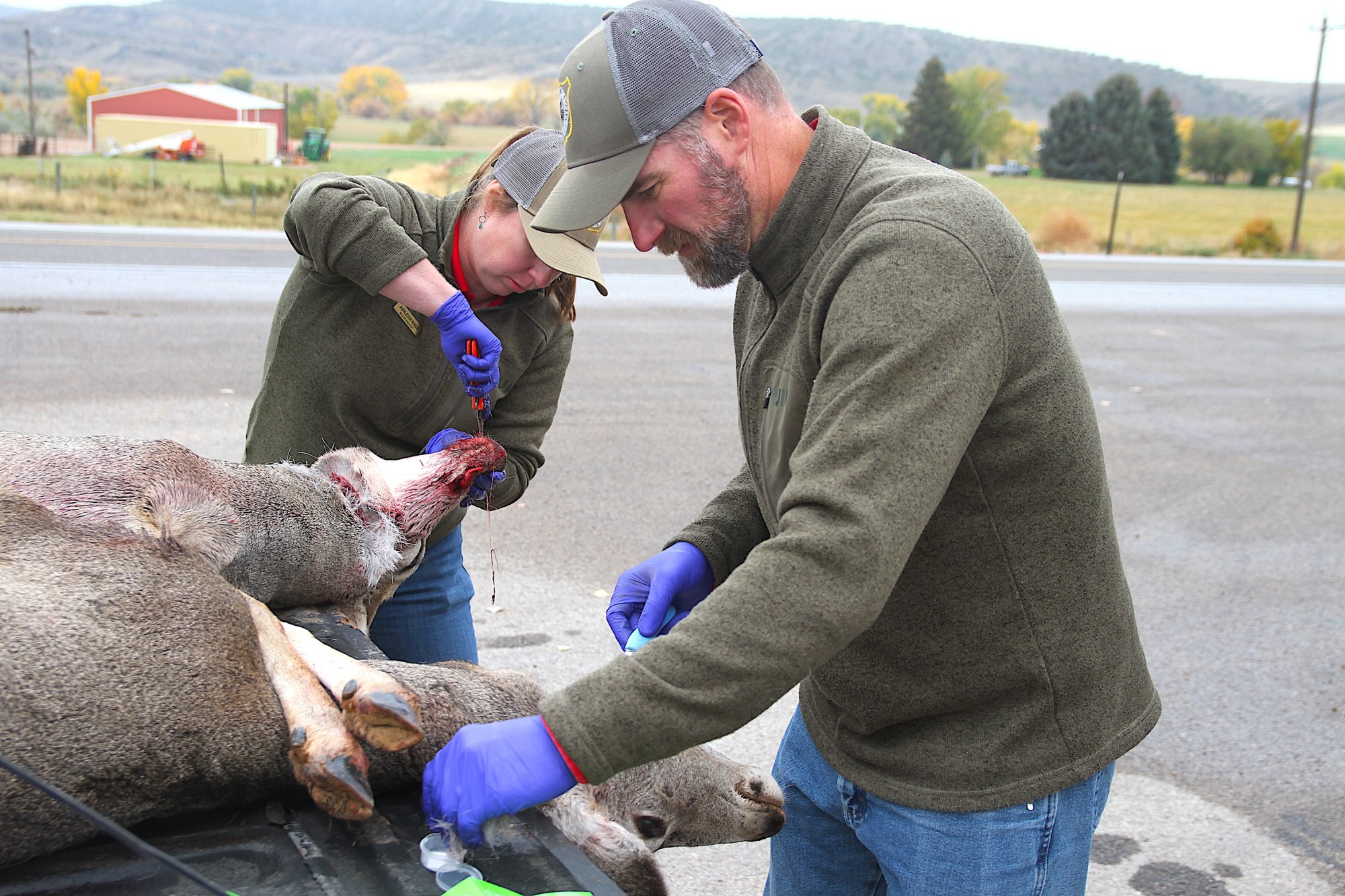
The source of that gloom — chronic wasting disease — was top of mind for two state biologists, Ashleigh Rhea and Corey Class, stationed just west of Ten Sleep at a Wyoming Game and Fish Department checkpoint.
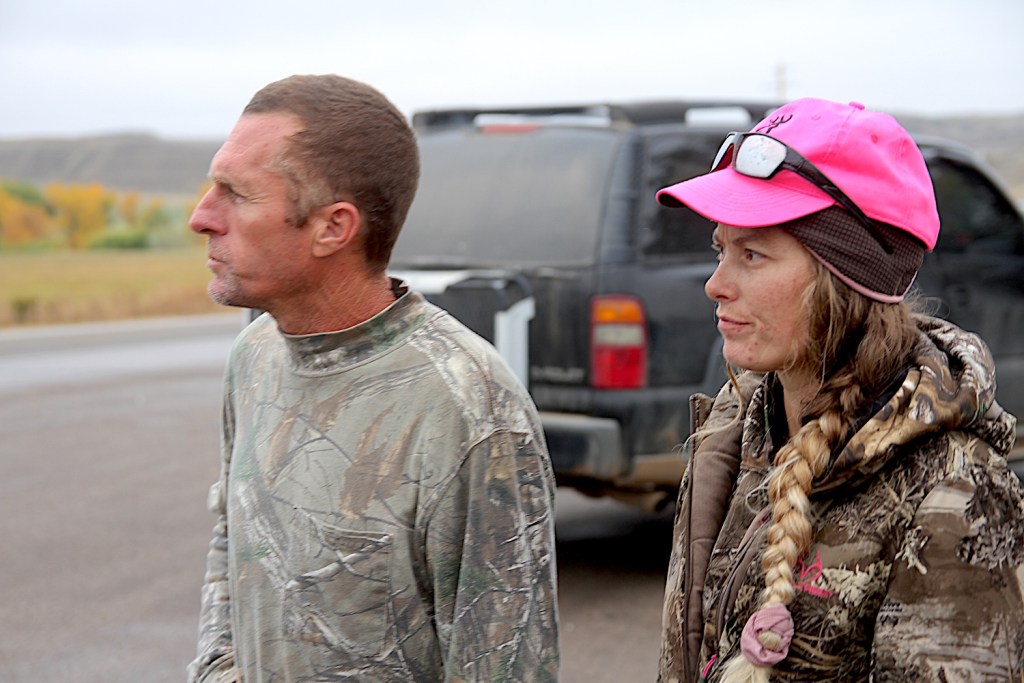
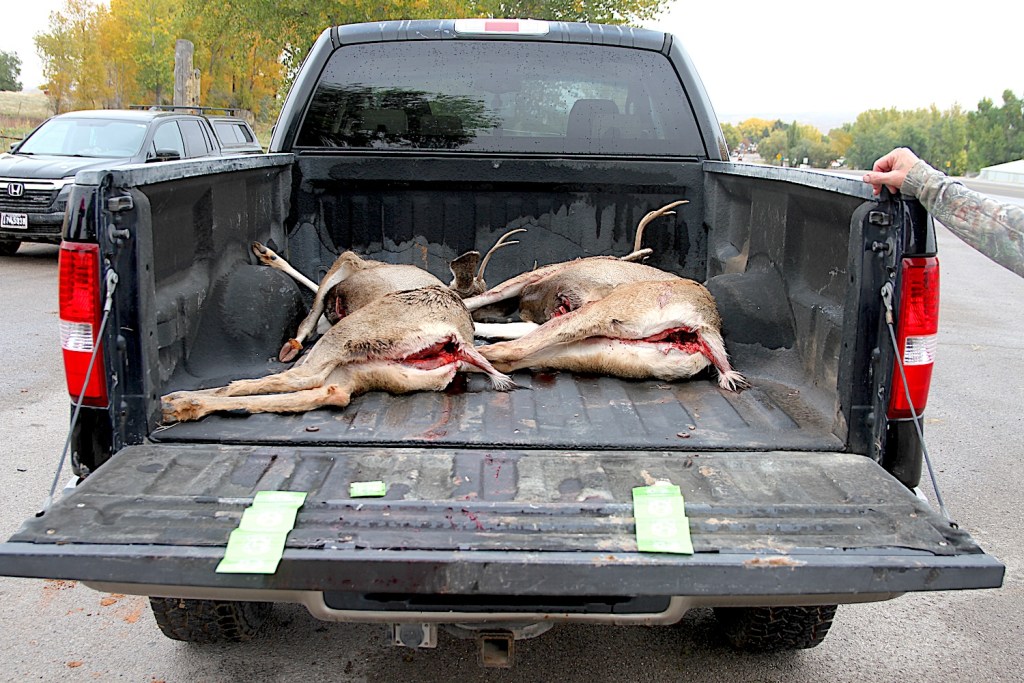
The Settlemires were the first successful hunters who stopped through on the morning of a busy rifle deer season opener that draws droves of hunters to the southwest slopes of the Bighorns.
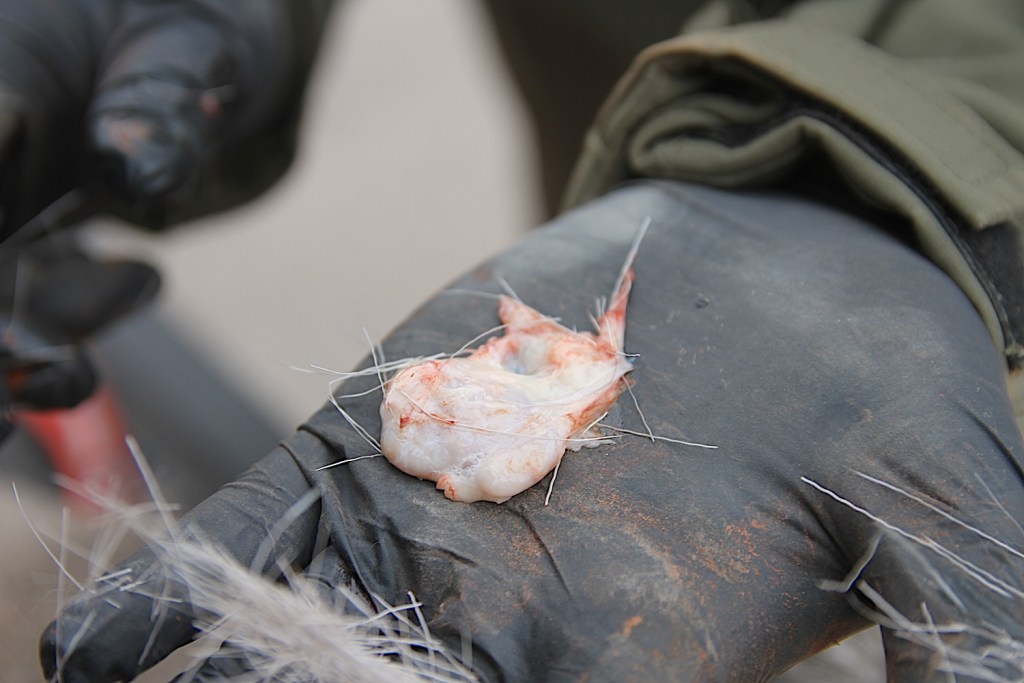
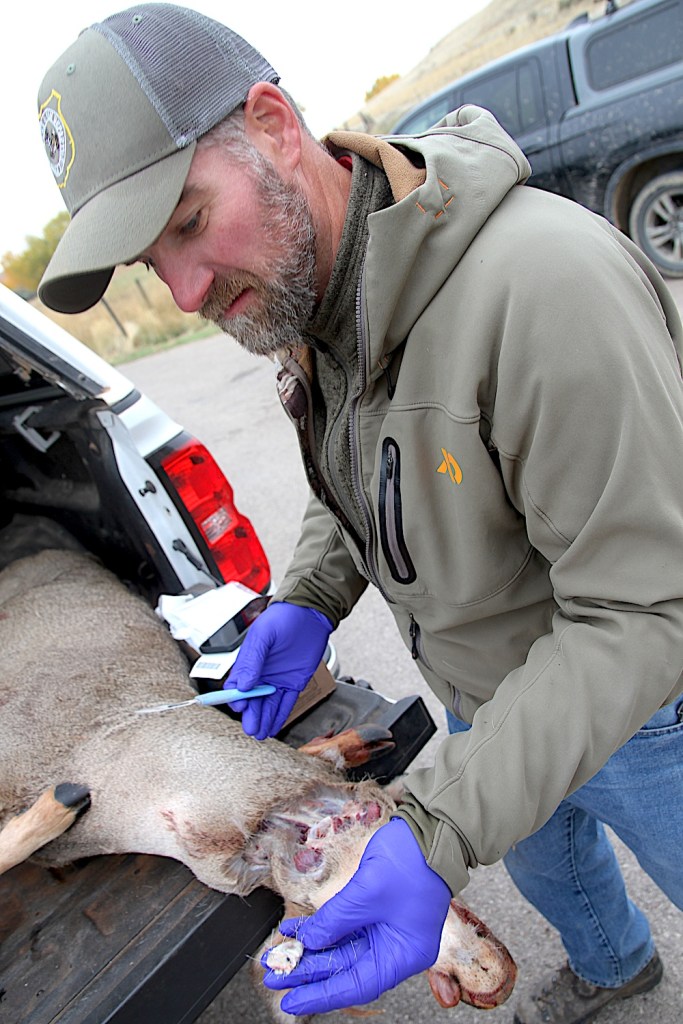
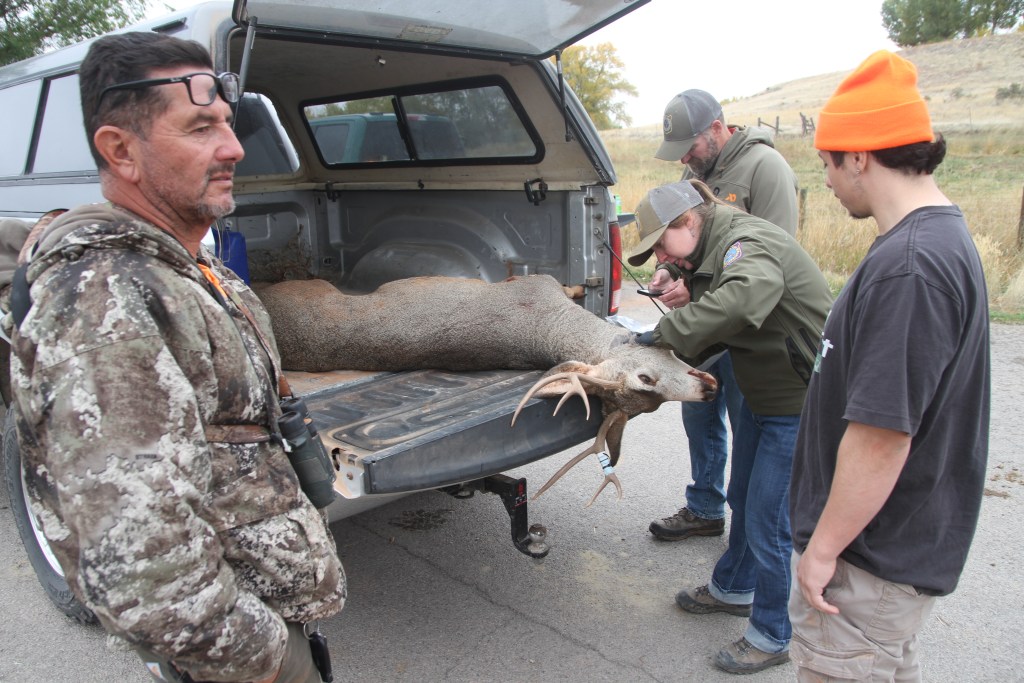
Rhea and Class were after basic information, like where the deer were killed and their estimated ages. It’s also now routine business to check and see whether the hunter-harvested deer carried CWD. Deftly slicing through hair, hide and flesh high under the necks of the Settlemire’s two deceased bucks, Class and Rhea had squishy grape-sized lymph nodes in hand. Those little chunks of tissue would later be tested for the infectious prions that spread CWD, an always-lethal disease that’s spreading into wild deer populations all around the world.
“Do we have more cases in the area this year?” Ashley Settlemire asked Rhea.
“We just kind of started our sampling,” the Thermopolis-based wildlife biologist responded, “but our buck average last year was 24%.”
This year, disease rates ticked up. Again. The nearly 20 happy hunters who stopped at the check station on the deer opener weren’t spared. More than a quarter of them would later learn they had a diseased deer on their hands.
Where the Settlemires hunted, and virtually everywhere in the Bighorn Basin, the hard-to-repress disease is on the upswing.
There are many reasons why mule deer here and elsewhere in Wyoming are struggling: drought, bad winters, other diseases, habitat loss from development and invasive species are high on the list. But there’s a case to be made that, when the conditions are right, incurable and always-fatal CWD can wreak as much long-term havoc as any other cause. Its potential for devastation has been on display for years, for those willing to look. They don’t have to look far. Immediately south of the Bighorn Basin, in Fremont County’s Project Deer Herd, the degenerative neurological disease has drastically reduced deer populations and hunting opportunities, and it threatens to keep the herd a shell of its old self indefinitely.
There are indications that the CWD surge underway in the Bighorn Basin is starting to move its mule deer population in a similar direction. Rates of the disease gained significant steam over the last decade. Deer populations in the basin’s most-infected herds are now sliding downward, and some are even outright plummeting. Yet, the local hunters and outfitters whose autumnal pastimes and bottom lines are most at risk aren’t yet too concerned about CWD.
“Around us, with most people, there isn’t much talk about it, honestly,” said Brent Sorenson, a longtime outfitter from the Greybull area. “There’s more concern about the lions killing the mule deer than CWD.”
Sorenson’s lack of alarm for CWD is understandable. Where he guides hunters in the Bighorns east of Shell, mule deer populations have so far held up OK. Numbers in the Paintrock and North Bighorn herds are still reasonably close to wildlife managers’ goals, and CWD prevalence rates in bucks have climbed, but not skyrocketed, and stayed under 20%.
That’s perhaps unlikely to last, if nearby herds are a harbinger. CWD infiltrates every population differently. Just to the west of where Sorenson lives and hunts, it’s a very different story.
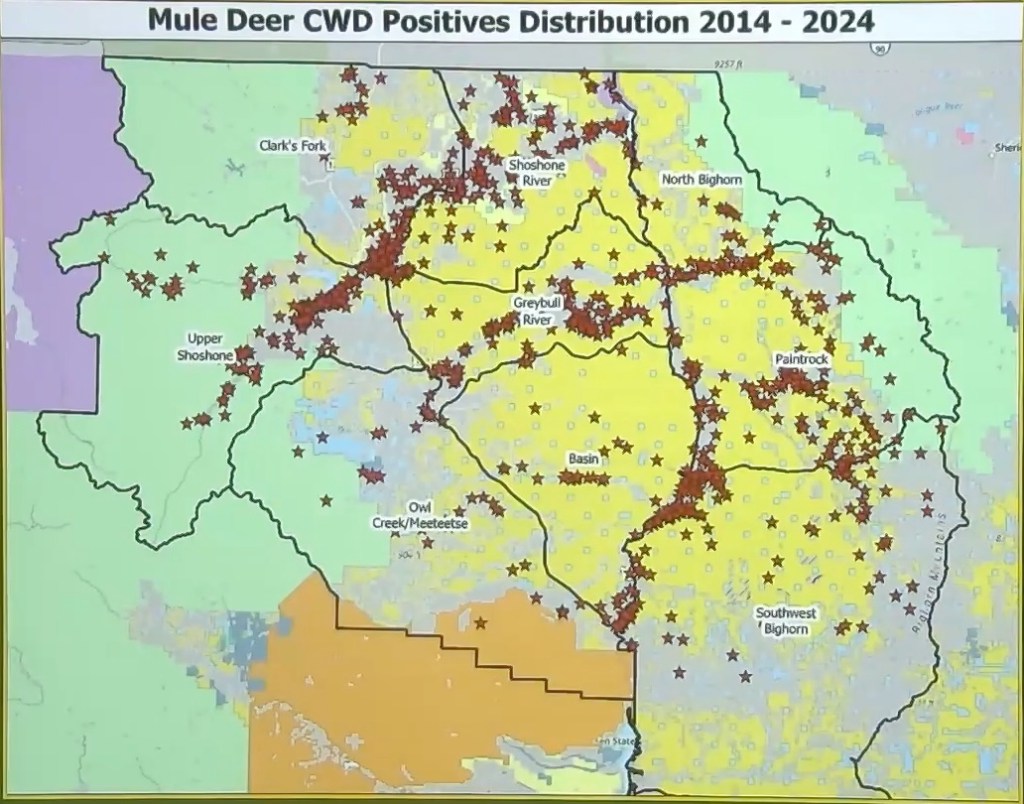
The basin’s three most lower-elevation mule deer populations — the Basin, Greybull River and Shoshone River herds — have been the hardest hit. A dozen years ago, the prevalence of the disease in these interior bucks was roughly 20%. Then it doubled. Then, in two of the herds, it even tripled, surpassing 60%, according to preliminary Game and Fish data.
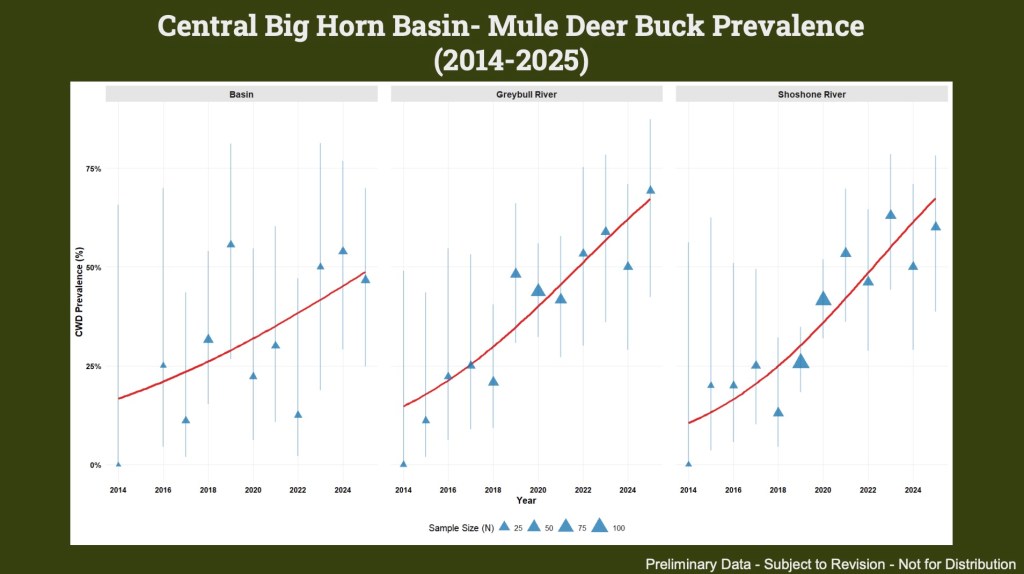
“There’s no denying that chronic wasting disease is likely playing an impact on those populations,” Game and Fish wildlife biologist Austin Wieseler told a Cody audience in February at the Draper Natural History Museum.
The herds are now in shambles, the most recent monitoring data shows. The Basin Herd was last estimated at roughly 825 deer, just 23% of its 3,600-deer goal. The Shoshone River Herd’s 1,400-animal estimate amounted to just 22% of its 5,000-deer objective. And the Greybull River Herd fared worst of all: Its 531-animal estimate in 2024 was just 13% of wildlife managers’ target of 4,000 mule deer.
Overviewing the local status of CWD in an hour-long presentation, Wieseler went over graphs showing the latest prevalence data for all nine mule deer herds in the Bighorn Basin, plus whitetail deer in the region. Disease rates in the basin vary widely, but a common thread is that the curves are all pointed up.
Mike Chamberlain, a University of Georgia researcher who studies CWD effects on whitetail deer populations, looked over the data from the Bighorn Basin. Although the disease is accelerating more quickly in some herds than others, the general trend playing out across the region of a slow buildup and then a spike is to be expected, he said.
‘Acceleration’ time
“The population kind of sits there with a low prevalence for years,” Chamberlain said. “Then, as the prion accumulates in the environment, you start getting an uptick.”
It looks like a handful of Bighorn Basin mule deer herds have reached an “acceleration” point, Chamberlain said. “Once it gets to that… point,” he added, “prevalence seems to increase pretty dramatically.”
It’s bad news for the tens of thousands of mule deer that dwell between the Absaroka Range and Bighorn Mountains.
“I would assume this population has to be in marked decline,” said Chamberlain, who’s been a guest on the popular MeatEater podcast to discuss the truth about CWD.
Chronic wasting disease affects the cervids — deer, elk, caribou and moose — and was first found in the wild nearly a half-century ago in northern Colorado. It’s rippled outward across the landscape ever since and now covers almost the entirety of Wyoming and portions of 36 states and five Canadian provinces. Spread by a misfolded protein known as a “prion,” it’s in the same disease family (the transmissible spongiform encephalopathies) as mad cow disease, scrapie in sheep and Creutzfeldt-Jakob disease in humans.
It’s an ugly, degenerative disease that causes brain lesions to form, rendering its hosts emaciated, listless and invariably dead within two years if something else doesn’t get them sooner.
Deer, elk and other cervids don’t have to get chronic wasting disease from each other. Transmission occurs via the environment itself. Once prions have bonded with soil, they can remain viable for years — even decades — and as a result, the landscape itself becomes a biohazard.
“Even if you move every deer off the landscape, there’s still a lot of infectivity that remains,” said Mike Miller, a retired Colorado Division of Wildlife veterinarian and longtime CWD researcher.
Its resilience and harrowing traits have led other wildlife disease experts to draw parallels to a disease better known to most humans.
“CWD has been compared to cancer,” said Hank Edwards, a retired Wyoming Game and Fish Department wildlife health laboratory supervisor. “Cancer just doesn’t go away, and this isn’t just going to go away, either. It’s going to steadily get worse.”
Surveillance for CWD was limited during the early stages of its arrival in the Bighorn Basin, but the best wildlife managers can tell it’s moved in from the south, Class said from the Ten Sleep check station. As it’s become progressively more prevalent in the population, the disease has manifested itself by reshaping herd dynamics.
Bye-bye big bucks
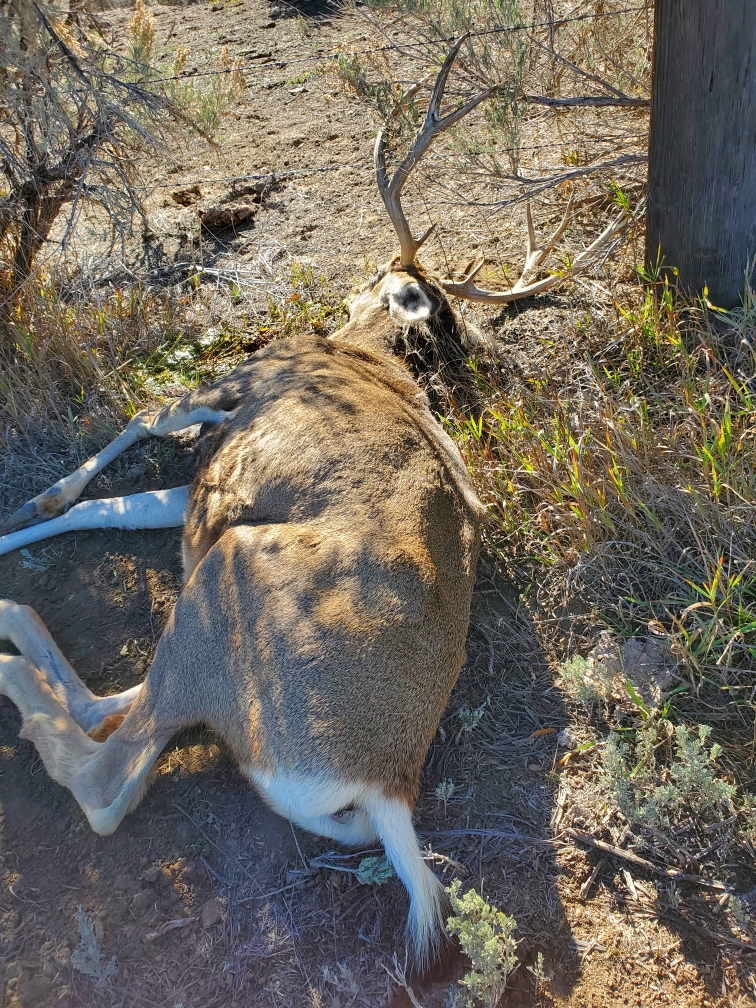
One apparent effect is that CWD is killing off older bucks before hunters can get to them.
“Our average age in the Upper Shoshone Herd is like 4 1/2,” Class said. “We’re worried. That keeps heading lower and lower.”
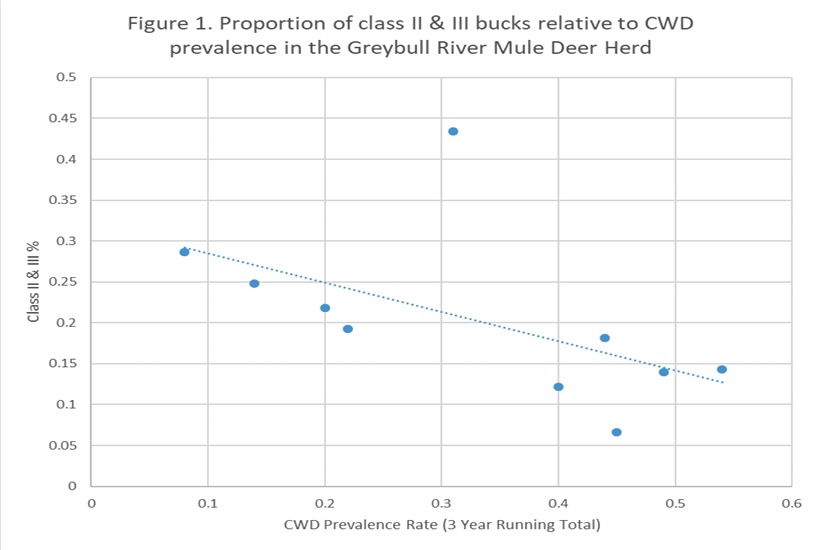
Class’ colleagues at Game and Fish’s Cody Region have even graphed the connection between increasing CWD prevalence in the hard-hit Greybull River Herd and the decline of mature “class II and III” bucks that have antlers wider than 20 inches. There’s a clear correlation. When disease rates were less than 10%, about 30% of bucks surveyed were larger-antlered animals. But in recent years, after CWD spiked to over 40%, consistently less than 15% of the bucks tallied during aerial surveys were mature animals with wide racks.
Chronic wasting disease’s drag on overall deer numbers is related to the sickness killing off females, the reproductive engine of any herd. Fortunately, buck prevalence rates are typically much higher — even double that of does.
But once overall CWD rates in a herd start to surpass 30% or so, it starts to whittle away at populations.
“They just don’t replace themselves,” said Trent Bollinger, a wildlife pathologist with the Canadian Wildlife Health Cooperative. “They’re dying of the disease.”
The University of Saskatchewan professor researched CWD as it surpassed that threshold in mule deer herds that roam the South Saskatchewan River watershed. They transformed.
“In the early 2000s, deer were quite abundant down there,” Bollinger said. “That is certainly not the case. Now, they’re quite rare.”
Not all of the Bighorn Basin’s mule deer herds are so infected that numbers are clearly in collapse because of CWD. And it’s tough to say that they inevitably will. The six peripheral, migratory herds have fared better, though prevalence rates in the large Southwest Bighorns and Upper Shoshone herds are starting to reach the acceleration point.
Biologists who know the herds best say that they’re seeing subtle effects. A handful of years ago, drought in the Bighorn Basin triggered a bad flare up of epizootic hemorrhagic disease — a virus spread by midges that gather at watering holes. It’s lethal; deer in the region got hit hard.
“Populations got knocked down and have not been able to bounce back, probably in large part because of CWD,” Class said. “All these herds would be doing that much better without it. It’s not helping any herds, that’s for darn sure.”
Wyoming, for years, was perceived as the do-nothing “control” that illustrated to other states what happens to ungulate herds if chronic wasting disease isn’t managed at all. Even in the super-infected, vastly diminished Project Herd, there was little public buy-in for management strategies that oftentimes call for killing more deer to reduce densities and CWD transmission.
Managers try to push back
Slowly, that’s changing.
“Anything that they can try that might have some benefit is better than doing nothing,” said Miller, the Colorado Division of Wildlife retiree.
Plans targeting CWD in Bighorn Basin are varied, just like the disease’s impacts.
“There’s not one cookbook management strategy,” Class said, “just because we see it act so differently across the landscape.”
Much of the effort so far has relied on identifying “hot spots” and knocking down deer numbers in those zones.
“At least in the Cody region, addressing these hot spots seems to be where public acceptance is the best,” Class said. “Addressing the places on the map that really jump out.”
Chronic wasting disease hot spots in the Bighorn Basin are clustered in riparian zones and adjacent agricultural areas, where prions have likely infiltrated the landscape.
This also tends to be where whitetail deer are found — another potential source of transmission to mule deer. Buck whitetails in the Bighorn Basin tested positive for CWD about 40% of the time in 2025 and whitetail doe prevalence rates hovered nearer 20%, according to preliminary Game and Fish data in Wieseler’s presentation.
One hope of killing high numbers of deer in the hotspots is that it will contain the contagion by limiting the number of migrating deer. Deer migrations aren’t necessarily bad, of course. Recent research even shows that migratory Wyoming mule deer are the most productive. But migrations can also be a mechanism to transport CWD.
“We’re trying to target animals that are potentially tracking the disease around to different places,” said Rhea, the Game and Fish biologist.
Just down the highway from where she spoke in hunt areas 41 and 164, mule deer hunters would be able to target a couple hundred hotspot-dwelling does and fawns relatively late into the fall. Bucks were fair game later into the season, too, so long as they were killed within a mile of irrigated land.
“That’s new,” Rhea said. “We’ll probably only have this season for like three years or so. We’ll drop it off, and see where our prevalence sits after that.”
Whether or not Game and Fish continues management intended to avert a CWD-driven population collapse will depend on public acceptance and appetite for addressing the disease.
Ignorance and indifference
For now, most Bighorn Basin hunters and outfitters are going about their falls without much regard for chronic wasting disease. Most successful hunters who stopped by the Ten Sleep check station knew little about it, though many were also curious to learn more.
The Settlemires — the deer-hunting family that downed the two bucks early on — had never had a deer test CWD-positive as of last fall. If they did, the meat would likely still be headed for the deep freeze, Mike Settlemire said.
“Probably just thoroughly cook it, I guess,” he said. “It’s normally processed by the time the results are in, anyway.”
Rhea clarified the public health officials’ guidance: “We don’t recommend that you eat it,” she said.
While chronic wasting disease has never been proven to spill over to humans, research suggests that there isn’t an absolute barrier and the risk isn’t zero. And prions cannot be cooked out of meat — that task requires expensive, high-heat incinerators.
California resident Oscar Gonzalez was among the Bighorn Basin deer hunters WyoFile encountered who wasn’t too concerned about being patient zero.
“I’d still eat it,” he said. “I’m pretty sure I’ve eaten some that have it, but didn’t really know about it.”
That’s a widespread attitude in areas where CWD has long been a part of the landscape.
“People have just gotten to the point that they are not getting their animals tested,” said Edwards, the retired Game and Fish health laboratory supervisor. “Ignorance is bliss. This is a disease that hasn’t been shown to go to humans. So why care?”
By the end of the day, Class and Rhea sliced their way through 16 mule deer and three whitetails in search of CWD-testable tissue. A quarter of the muleys sampled that day tested positive and so did one of the whitetails, the Wyoming Wildlife Health Lab would later learn.
There’s evidence that interest in CWD’s impact on northwest Wyoming mule deer populations is tepid at best.
Multiple past presidents of the Wyoming Outfitters and Guides Association who offer guided mule deer hunts in the Bighorn Basin declined interviews for this story. The Muley Fanatic Foundation didn’t return a phone call.
Last weekend, mule deer advocates from around the state gathered in Rock Springs for Mule Deer Days. While a session on backcountry hunting for big bucks filled up a conference room, just nine people sat in on a seminar about CWD and mule deer, according to an attendee.
Some outfitters who were willing to talk with WyoFile resisted Game and Fish’s efforts to manage the disease by hunting more heavily to reduce densities.
“I don’t think it’s the right thing to do,” said Cache Griffin of Shell Valley Outfitters. “It’s here, it’s been around forever, and you can’t really control it. If you kill them all by hunting, that isn’t going to fix the problem.”

Miller, the retired wildlife veterinarian, knows that the short-term costs of addressing the insidious disease that’s tightening its grip on Bighorn Basin might be “hard to bear.” He challenged today’s deer hunters to take the long view and think about the hunting heritage they’re leaving behind.
“The deer are going to be around and reasonably abundant in our lifetime,” Miller said. “But what’s going to be the case for the kids and the grandkids and the great-grandkids?


What happens if we kill all the deer and the disease is not eradicated? I know of a former CWD infected herd near Casper on a friend’s property. Several years ago, many of the deer harvested tested positive, yet none for the past 10 or so years. Could it be those deer have developed an immunity to CWD? Why do some get it, but others don’t? It seems counter-productive to kill off all the deer to save them. I contend that some deer have immunity to CWD. Why kill them all? Maybe we should let nature take her course on this one.
I notice Mike conveniently left predators off his list of various things that are affecting deer herds. Predators can be a huge factor, especially for herds trying to recover from a bad winter, etc. Those study herds fall into that category. While their numbers drop from disease, it’s exacerbated by predators.
Truly a sad sad disease for the animals and the hunters and these bogus ideas of thinning the deer herds doesn’t help eradicate the disease. This disease lives beyond the death of animals not carrying how it died, it continues to live and infect other the healthy animals. It would be smarter to stop introducing the super spreaders to other Counties and States in America and Yes the Wolves and Grizzlies are the super spreaders intentionally let loose on the public by eating and discharging after digestion back into environment. Hopefully these herds can develop some type of resistance towards CWD which is pretty much indestructible in their life as of now.
Along with disease that have ravaged the herds, severe overgrazing of public lands in the Bighorn Basin have helped decimate the wildlife, especially muleys, antelope and sage hens. While the WY G and F isn’t the land managers of BLM, BOR and State tracts, you’d think that they could at least advocate for public lands. In reality, WY G and F has been and still is in the pockets of the big ranchers who run their stock on the public land horizon. You can’t blame it all on CWD, you G and F bio’s. Grow a set, WY G and F and make some noise
If you want to experience the epitome’ of arrogance, try talking to any Cody region G & F biologists. They’ll dumb you down in a jiffy and have absolutely no time or use for your thoughts and suggestions. The deer and other wildlife herds are not in good hands with this current crop of G & F employees
I agree with Cache Griffin and as is stated most outfitters do. Does it make sense to try and exterminate a herd like the project herd when as is stated, does, are less likely to contact the disease. The article states that the prion gets into the environment for years or decades. So by killing all the deer, not just bucks, that helps the problem? I would like to ask two simple questions, Is this game management? Have the biologists heard of survival of the fittest? Personally I do not see exterminating a heard by killing them and answer for the future.
As a hunter who has been reading and learning about CWD for 20 years, I am dismayed by the number of hunters who still don’t understand even the most basic aspects of this disease, including that you can’t ‘cook it out.’ Thank you for the article and I hope you will continue to cover this subject.
As a hunter who has probably eaten it since the 60s I can say that it obviously doesn’t need to be cooked out.
Why does it seem that bad things like this go back to Government research facilities?
In 50 years CWD has spread from a Govt. Research facility in Colorado where it was first detected to 36 states and 5 provinces.
It was first detected at the Colorado research facility. That doesn’t prove that it originated there. Maybe, maybe not. There is a reasonable hypothesis, although not proven, that it came from domestic sheep. As far as many other wildlife diseases, many if not most are from the livestock industry.
Oh Gordon.
While sheep are generally considered resistant to natural infection of Chronic Wasting Disease (CWD), studies show they can be experimentally infected via direct, artificial inoculation. However, there is no evidence of natural transmission between wild deer and sheep.
Quoted from the NIH (National Institute of Health)
So they can be infected, right Chad
Great article. If you care to do so , read Pathological Protein and do a dive into prion science on your own. If you look into this with an open mind , I don’t think you will eat deer or elk again. I sure do not .
Ezra: Hunters usually have a pretty good idea if they killed an unhealthy animal. The State tests, the elk I have harvested in the past 8-10 years have all been tested. Results in 10 days to 2 weeks. Elk do not contract CWD at the same level deer do.
To date, there is no direct evidence or documented cases that Chronic Wasting Disease (CWD) has spread to humans, and studies suggest it is unlikely, according to National Institutes of Health
Not true Chad. I can’t tell you how many deer and elk I have diagnosed as positive for CWD that took the hunter entirely by surprise. “But, he was a big fat buck with nice antlers!” In the preclinical phase of disease, they can behave and look quite “healthy”. As to eating meat from a positive animal – biology is never black and white. When pushed to make a recommendation, I always opted to err on the side of caution and tell folks to get their animals tested and that I, personally, would not eat meat from positives cases. To each their own, but gambling with prion diseases wasn’t something I was enthusiastic about.
Even a cursory dive into food borne illness will show more sick and dead people every year from organic vegetables, fruits, processed lunch meat, and hot dogs containing salmonella, e coli and listeria than eating elk and deer, tested or not.
You are right Ezra.