
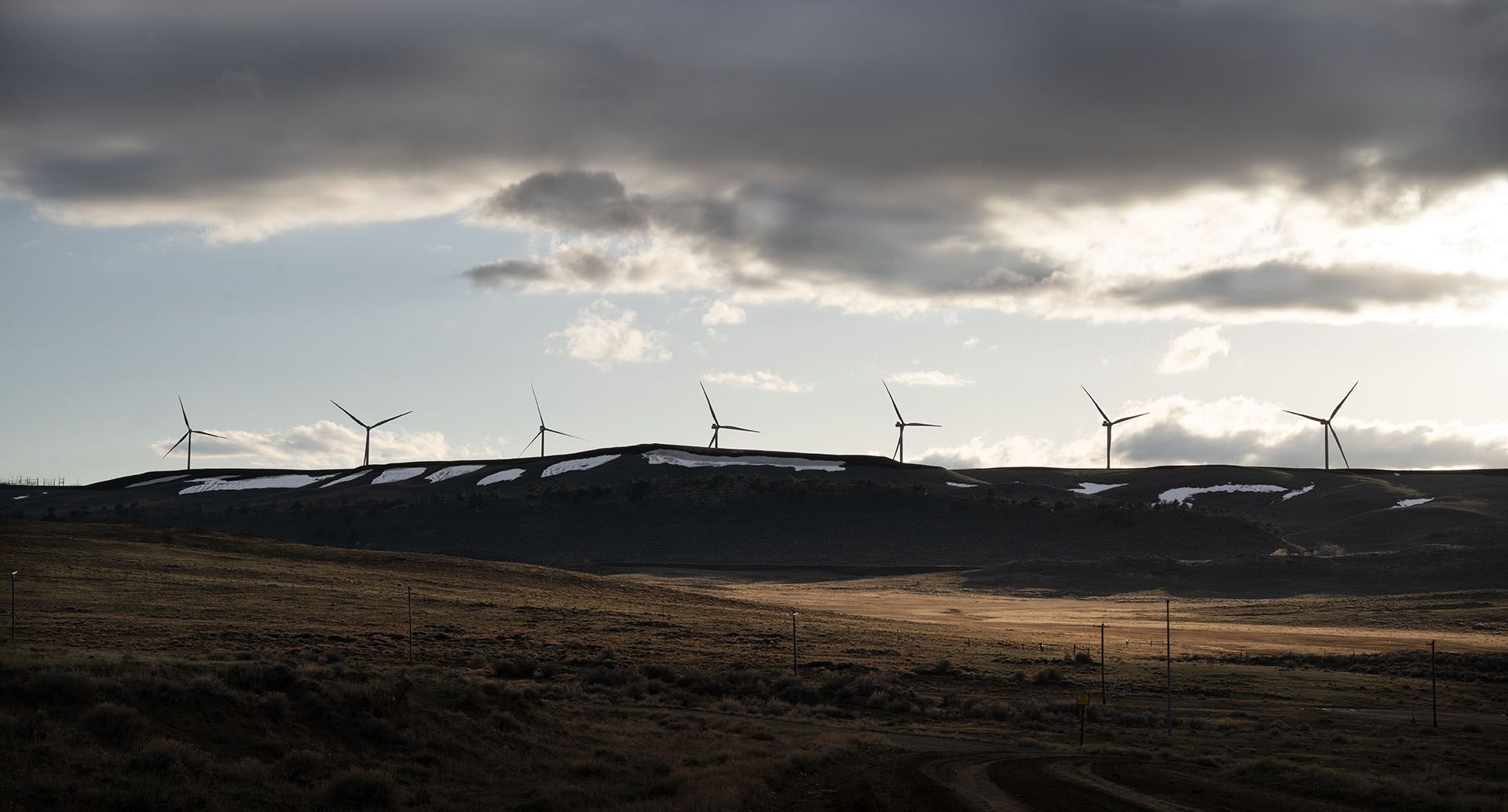

Entering election season, some Wyoming candidates are embracing President Donald Trump’s hard-line opposition to wind energy, which he has described as “a blight on our country,” while vowing his administration is “going to try and have no windmills built in the United States.”
Republican candidate for Wyoming’s lone U.S. House of Representatives seat and sitting Secretary of State, Chuck Gray, has declared “woke wind is wrong for Wyoming” and that wind turbines “have been terrorizing the landscape for too long.”
Reid Rasner, also vying for Wyoming’s U.S. House seat, has said, “I stand with President Trump, I oppose windmill expansion and I will fight to make America energy dominant again,” while chiding Gray for past votes in favor of wind energy as State Board of Land commissioner.
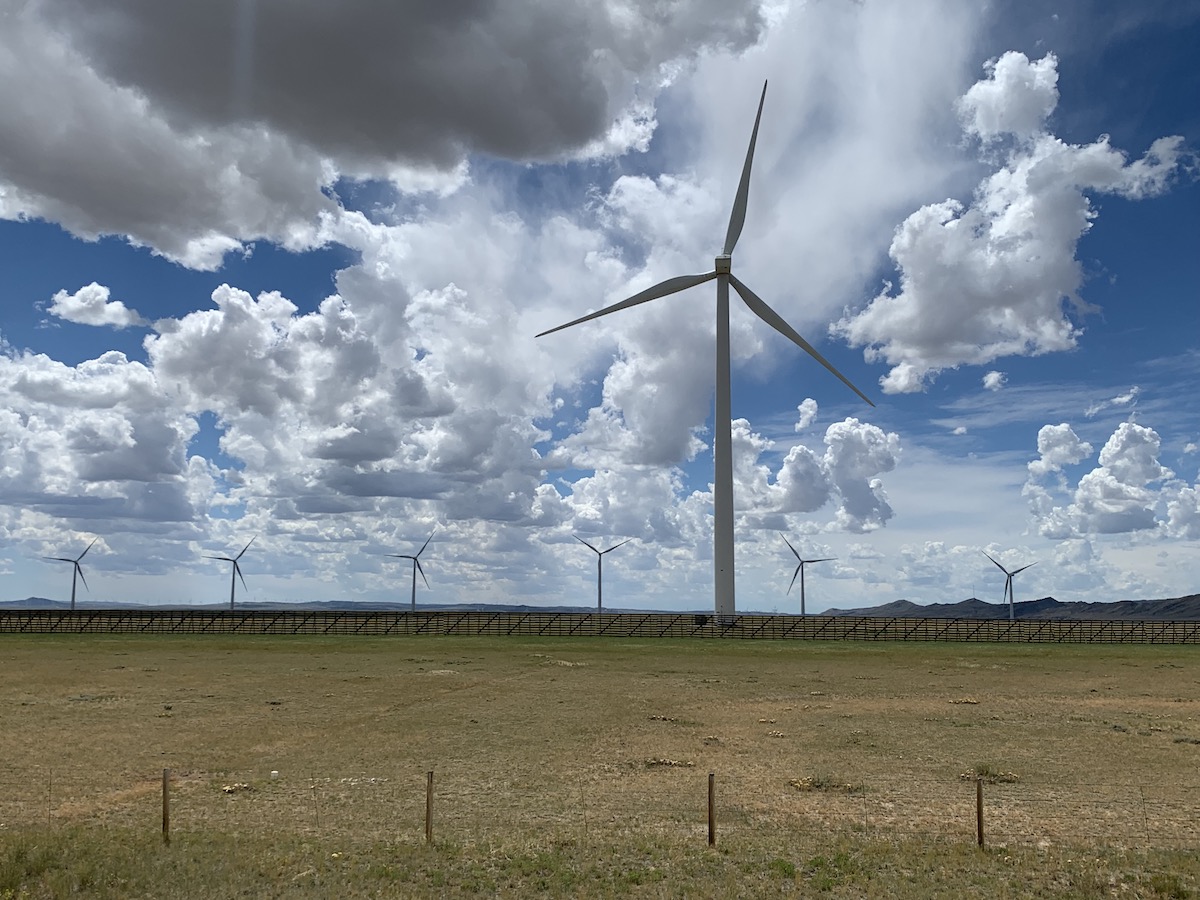
To date, there are about 1,500 wind turbines spinning in the state with a generating capacity of approximately 3,700 megawatts — that’s about 25% of Wyoming’s total electrical generation capacity, according to multiple sources compiled by WyoFile.
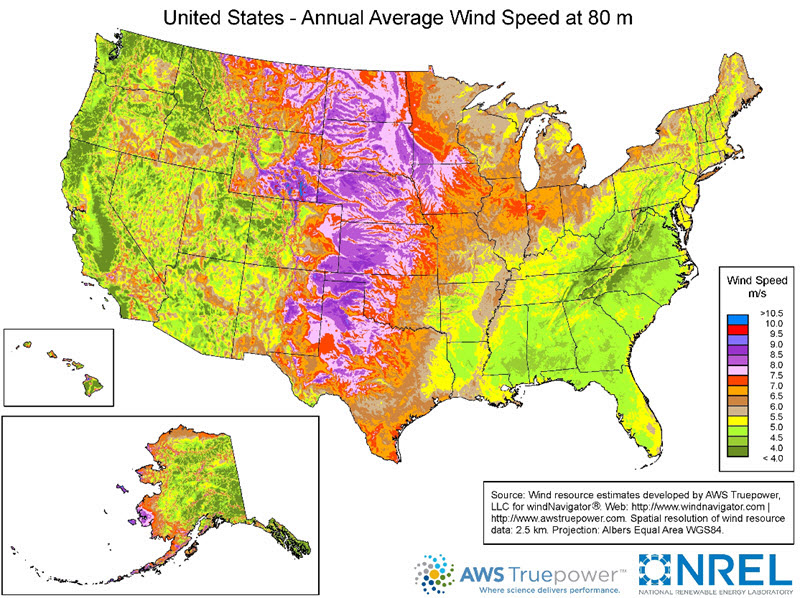
What’s yet to come depends on multiple factors, and tracking which projects are moving forward and which have stalled is challenging because there’s no single source or clearinghouse for up-to-date, Wyoming-specific information.
The Trump administration’s order to halt wind project permitting on federal lands has no bearing on development proposed for state and private lands. While there’s much debate at the state and local level about where to locate and, sometimes, whether to permit wind and other utility-scale renewable energy projects at all, it’s hard to size up exactly how much more wind development is on the horizon for Wyoming.
“We need to improve the process and transparency,” Cheyenne area resident Wendy Volk said.
Patchwork and moving targets
The Wyoming Industrial Siting Council holds a wealth of information, but only regarding qualifying projects: those exceeding $240 million in construction costs and with significant socioeconomic impacts. Landowners and county officials hear from many other developers about potential projects that haven’t yet entered the county, state or federal permitting process. Plus, many of the renewable energy and other industrial projects on the council’s docket continually change in size, scope and timing.
“You have an applicant for a permit and he’s telling the Industrial Siting Council, ‘We’re going to need to delay our project. We might resize our project.’ Or, what they’re not saying is they potentially may never build the project,” Volk told WyoFile.
The council has sent out at least eight public notices so far this year regarding amendments to various projects. The Settler Wind Project in Converse County, for example, was granted a request to change its construction start date from August 2025 to November 2027. The Dinosolar Solar Energy Project in Natrona County was granted a request to reduce the size of the project from 440 megawatts to 240 megawatts and to delay construction from April 2024 to March 2029.
One megawatt is enough electricity to power about 750 homes.
It’s not just the siting council that has incomplete and ever-changing information, Volk said. Residents are left to navigate fluctuating planning and permitting processes at the county, state and federal level. Some state-level officials have confided in her, Volk said, that the volume and ever-changing information is overwhelming and difficult to understand. Some have even suggested she generate a comprehensive map of existing and proposed renewable energy projects herself.
“Is that my job?” the real estate agent said.
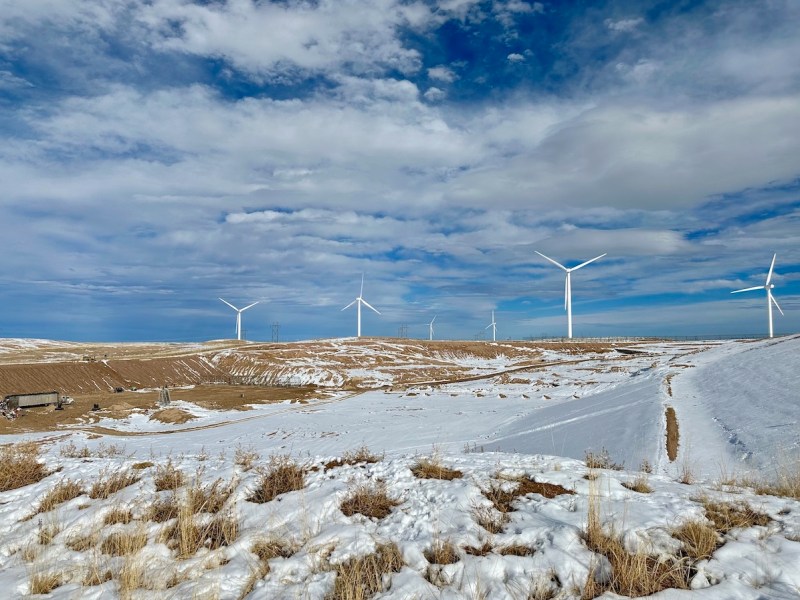
Volk recently helped launch a petition that, in part, asks Wyoming officials to pause renewable energy permitting to conduct a “cumulative, landscape-level impact analysis.”
“Wyoming residents expect transparency, accountability and an honest conversation,” Volk continued. “When projects stack up across a region, impacts multiply — even when each project claims compliance in isolation. My biggest concern is transparency. But let’s look at that cumulative impact. And how can you look at the cumulative impact of a 150-mile corridor if you don’t even have a map?”
Inherently arduous
The tangle of multiple authorities, moving targets and changing scope of projects — not to mention market realities like supply chain interruptions — is not a nefarious divide-and-conquer strategy, Power Company of Wyoming Communications Director Kara Choquette told WyoFile.
“There’s just a lot of permitting processes that are difficult to match up with the reality of what it’s like to develop a wind project,” Choquette said. “It’s really hard to predict. The timeframe on all of those permits have to be linked together.”
She pointed to a Wyoming wind energy permitting flow chart on page 84 of this document.
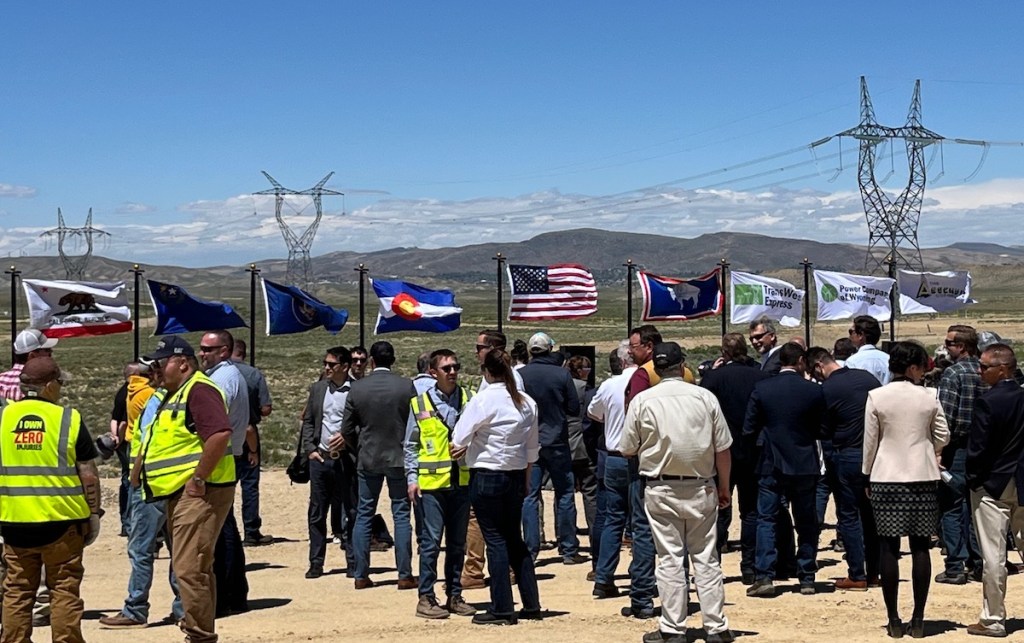
Choquette said she speaks from experience. The $3 billion, 732-mile-long TransWest Express transmission line to bring electricity from Power Company of Wyoming’s Chokecherry and Sierra Madre Wind Energy Project in Carbon County to the southwest took some 15 years to permit.
“It’s difficult to permit and develop a big energy project,” Choquette said.
Further muddying the picture of potential renewable energy development in Wyoming are legal entanglements.
Citing a court ruling, the Wyoming state lands board in February began the process of invalidating two wind leases it had approved last year — one related to the Pronghorn H2 Clean Energy Project in Converse County and one for the Sidewinder Clean Hydrogen Project in Niobrara County.
Before the vote, Wyoming State Auditor Kristi Racines said the board — made up of Wyoming’s top five elected officials — had sometimes whiffed on public notices and failed to give the public a proper platform to engage, referring to a December meeting that didn’t allow for a full discussion between the board and concerned residents.
“And so me, personally,” Racines said, “I am here today to tell you that I apologize. I apologize for the mess that this has become.”

Actually, the better solution to using wind and solar generation in Wyoming is to decouple from the regional and national grids altogether. Get the Wall Street corporations and especially the utility conglomerates out of the way. Cut off their money supply by encouraging each and every residence and business across Wyoming to consider adding solar panels and windplants all with battery storage to their property.
That is now easy to do technically , and considerably more economical than depending on the giant Soviet-style collective electrical grids. Give the people the right to choose their power sources by allowing 0-100% blending of on site power generation and storage with the quasi-governmental grids we are presently chained to. We have to break that chain.
The giant utility companies have plenty of new business to look forward to with AI and data centers popping up like mushrooms in all 50 states. There is no defensible reason to force the consumer and small business to pay for any of that surge. The homeowners and Mom & Pops stores must be allowed to generate their own electricity apart from the horrible financial constraints of Big Power. We do this by incentivizing the installation costs of small scale wind and solar, and allow the consumer to sell excess power back to the grid in real dollars. By going to national Smart Grids and local neighborhood sub-grids and site-specific cogeneration or standalone systems, we will come out way ahead on both electrons and economics.
Fossil fuels are on the way out. But we need to dispose of the fossil thinking that goes with it, for the greater good.
Wyoming needs to recalibrate . retool, rethink , Start by getting the greedy Republicans beholden to the corporate utility companies out of the way. Wake up, Chuck Gray.
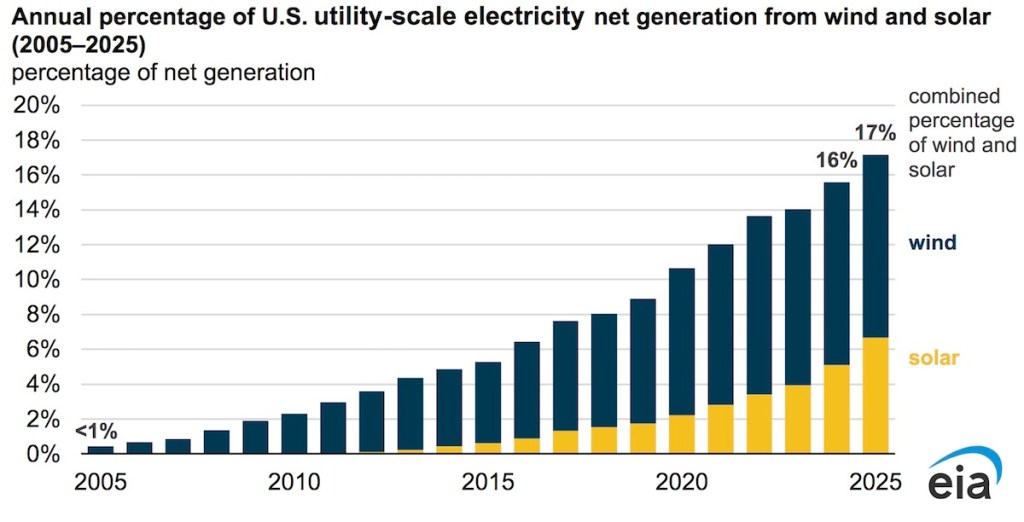
We now have the “Wyoming Fire Report” and are now facing a record drought in the Colorado River ecosystem. In spite of having a President and Congress that is fighting against renewable energy and that disputes that climate change, the above graph shows renewable energy (wind and solar) increased from 2% of total consumption in 2010 to 17% in 2025. Seems like we are only hindering or prolonging the transition.