


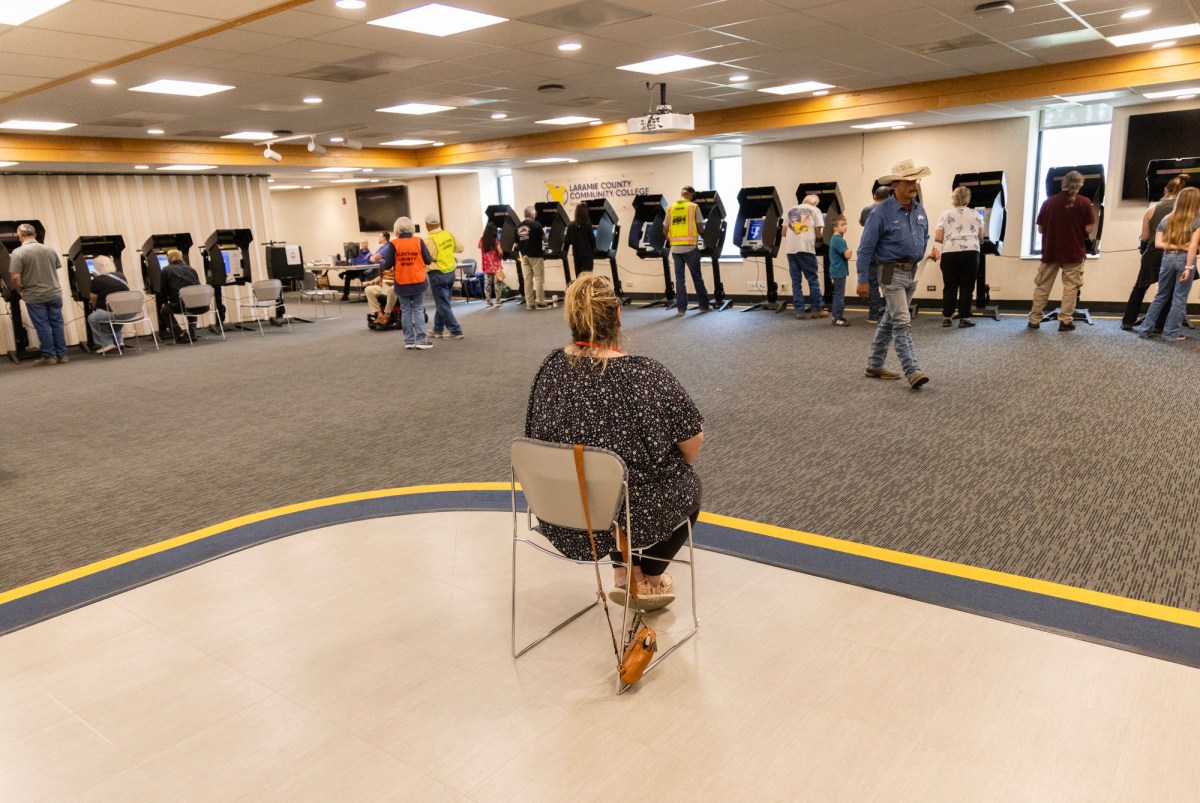
As the state canvassing board met Wednesday in Cheyenne to certify the results of Wyoming’s primary elections, Gov. Mark Gordon raised concerns about what he described as “aggressive” and “irregular” conduct by federal officials observing last week’s primary elections. The way the federal observers conducted themselves also prompted concern from Laramie County Clerk Debra Lee.
Two Department of Justice attorneys were dispatched to Laramie County as part of a “monitoring initiative,” according to a department press release published on Aug. 18, Wyoming’s primary election day.
“This monitoring initiative is aimed at promoting transparency and an open flow of communication between poll observers and election monitors,” the release stated.
Federal election observers aren’t new to Wyoming, or other states across the country. However, the Trump administration says it’s ramping up those efforts and planning to dispatch about 1,000 staff members across the country in November, when voters will decide who controls Congress. The monitoring follows the Justice Department’s efforts to obtain states’ voter data, which it successfully procured from Wyoming in 2025 with the assistance of Secretary of State Chuck Gray.
Last week, however, local and state officials were not made aware of federal observers, Gordon said at Wednesday’s meeting, pointing to the Wyoming Office of Homeland Security, the Wyoming Attorney General and the Laramie County Clerk’s Office as being out of the loop.
“To my knowledge, the U.S. Attorney was unaware of it, and it sounded like the behavior of the observers was a bit aggressive,” Gordon said at Wednesday’s meeting.
“It just was irregular, and I have asked the attorney general to start looking into, you know, kind of the nature of the visits and all that sort of stuff,” Gordon said.
Gray disputed the governor’s assertions, pointing to news reports which featured a statement from U.S. Attorney for Wyoming Darin Smith. Several hours after the Justice Department announced its plans to monitor elections in Laramie County, Smith’s office released a separate statement.
“Voters deserve absolute confidence that their ballots are secure and their voices are heard without interference,” Smith wrote. “We are working alongside local officials to ensure every lawful vote is protected.”
When Gordon asked if the federal government had notified the secretary of state’s office ahead of election day, Elections Division Director Paul Raines said, “our office had received an email, but that’s the extent of communications I’m aware of.”
Gray also pointed to state law, arguing that it “provides for observation of the election process.”
Gordon said he wasn’t “objecting to the observers,” but “their behavior seemed to exceed what the authority that Congress had given them was.” That behavior, he said, is why he’s asked the attorney general to “examine that.”
“I’m not saying anything went wrong or anything else, and I certainly think the conduct of this election was phenomenal,” Gordon said.
“I feel very strongly about federal government coming in and taking our guns,” he said. “I don’t like that. And I don’t like federal government coming in and taking our votes either.”
The chief election officer for Wyoming’s most populous county, Clerk Lee, also voiced concern about the DOJ’s presence in the Laramie County polling places she oversees.
“Two individuals, identifying themselves as DOJ election monitors, informed our poll worker that they were here to monitor Wyoming’s Primary Elections,” Lee said in a statement released Wednesday evening. “They did not offer their credentials until I requested they do so.”
Their presence also caught the longtime clerk off-guard. “Shortly after learning of their presence, I spoke with a DOJ official in Washington who informed me that the decision to deploy monitors to Wyoming was made on short notice, and an email had been sent to me, but it may have gone to the wrong address,” Lee wrote.
The monitors arrived at a busy time and asked questions, according to Lee, that appeared “outside the scope of federal voting rights laws. They included questions about the nature, length, and timing of poll worker training. Monitors requested training guides, asked how our new election equipment was acquired, and wanted to examine our tabulators.”
When she learned that the monitors also planned to interview voters “to assess compliance with federal civil rights and voting rights law,” she denied that request. “We do not allow interviews to be conducted in polling places,” Lee said.
“This was a poorly managed exercise and one that showed complete disregard for our state laws and administration of our elections,” her statement concluded.
The Department of Justice did not respond to WyoFile’s request for comment by publishing time.
Editor Tennessee Watson contributed reporting.
This is a breaking news story and may be updated.
Correction: This story has been updated to correct a typo in one of Gordon’s quotes. —Ed.
