

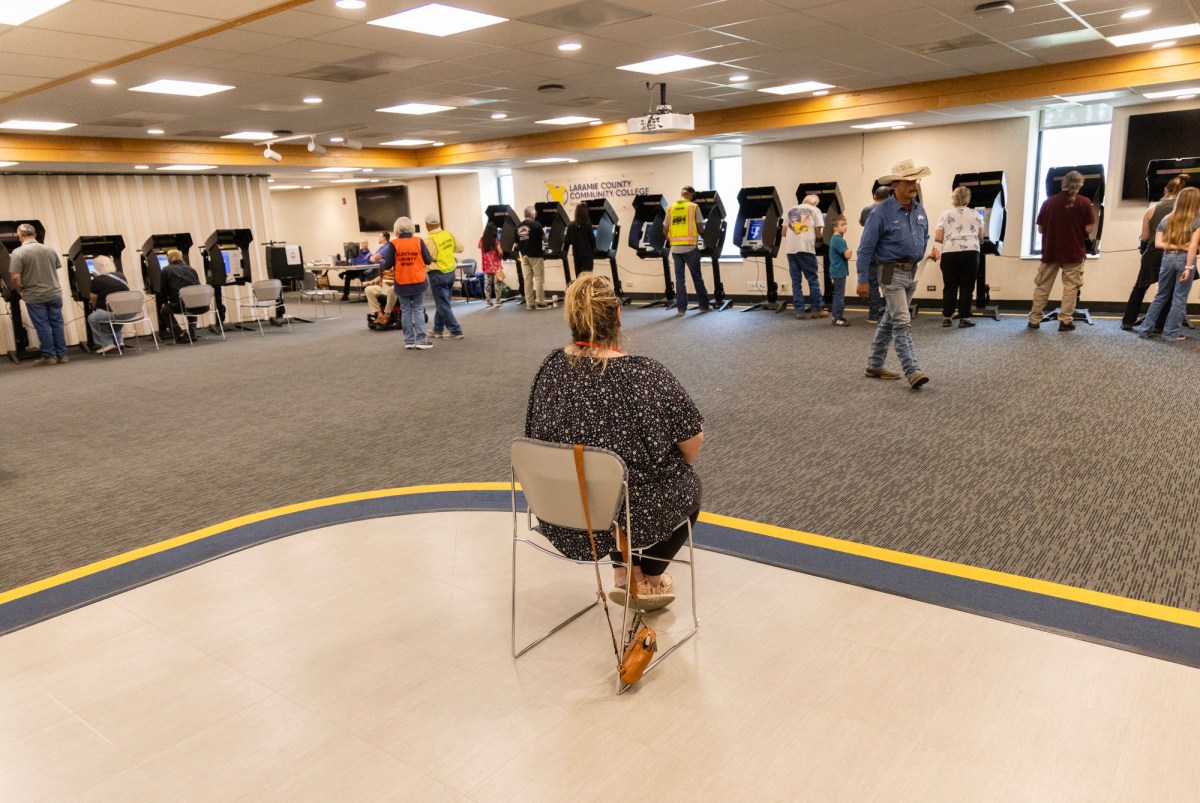
As the state canvassing board met Wednesday in Cheyenne to certify the results of Wyoming’s primary elections, Gov. Mark Gordon raised concerns about what he described as “aggressive” and “irregular” conduct by federal officials observing last week’s primary elections. The way the federal observers conducted themselves also prompted concern from Laramie County Clerk Debra Lee.
Two Department of Justice attorneys were dispatched to Laramie County as part of a “monitoring initiative,” according to a department press release published on Aug. 18, Wyoming’s primary election day.
“This monitoring initiative is aimed at promoting transparency and an open flow of communication between poll observers and election monitors,” the release stated.
Federal election observers aren’t new to Wyoming, or other states across the country. However, the Trump administration says it’s ramping up those efforts and planning to dispatch about 1,000 staff members across the country in November, when voters will decide who controls Congress. The monitoring follows the Justice Department’s efforts to obtain states’ voter data, which it successfully procured from Wyoming in 2025 with the assistance of Secretary of State Chuck Gray.
Last week, however, local and state officials were not made aware of federal observers, Gordon said at Wednesday’s meeting, pointing to the Wyoming Office of Homeland Security, the Wyoming Attorney General and the Laramie County Clerk’s Office as being out of the loop.
“To my knowledge, the U.S. Attorney was unaware of it, and it sounded like the behavior of the observers was a bit aggressive,” Gordon said at Wednesday’s meeting.
“It just was irregular, and I have asked the attorney general to start looking into, you know, kind of the nature of the visits and all that sort of stuff,” Gordon said.
Gray disputed the governor’s assertions, pointing to news reports which featured a statement from U.S. Attorney for Wyoming Darin Smith. Several hours after the Justice Department announced its plans to monitor elections in Laramie County, Smith’s office released a separate statement.
“Voters deserve absolute confidence that their ballots are secure and their voices are heard without interference,” Smith wrote. “We are working alongside local officials to ensure every lawful vote is protected.”
When Gordon asked if the federal government had notified the secretary of state’s office ahead of election day, Elections Division Director Paul Raines said, “our office had received an email, but that’s the extent of communications I’m aware of.”
Gray also pointed to state law, arguing that it “provides for observation of the election process.”
Gordon said he wasn’t “objecting to the observers,” but “their behavior seemed to exceed what the authority that Congress had given them was.” That behavior, he said, is why he’s asked the attorney general to “examine that.”
“I’m not saying anything went wrong or anything else, and I certainly think the conduct of this election was phenomenal,” Gordon said.
“I feel very strongly about federal government coming in and taking our guns,” he said. “I don’t like that. And I don’t like federal government coming in and taking our votes either.”
The chief election officer for Wyoming’s most populous county, Clerk Lee, also voiced concern about the DOJ’s presence in the Laramie County polling places she oversees.
“Two individuals, identifying themselves as DOJ election monitors, informed our poll worker that they were here to monitor Wyoming’s Primary Elections,” Lee said in a statement released Wednesday evening. “They did not offer their credentials until I requested they do so.”
Their presence also caught the longtime clerk off-guard. “Shortly after learning of their presence, I spoke with a DOJ official in Washington who informed me that the decision to deploy monitors to Wyoming was made on short notice, and an email had been sent to me, but it may have gone to the wrong address,” Lee wrote.
The monitors arrived at a busy time and asked questions, according to Lee, that appeared “outside the scope of federal voting rights laws. They included questions about the nature, length, and timing of poll worker training. Monitors requested training guides, asked how our new election equipment was acquired, and wanted to examine our tabulators.”
When she learned that the monitors also planned to interview voters “to assess compliance with federal civil rights and voting rights law,” she denied that request. “We do not allow interviews to be conducted in polling places,” Lee said.
“This was a poorly managed exercise and one that showed complete disregard for our state laws and administration of our elections,” her statement concluded.
The Department of Justice did not respond to WyoFile’s request for comment by publishing time.
Editor Tennessee Watson contributed reporting.
Correction: This story has been updated to correct a typo in one of Gordon’s quotes. —Ed.

The Democrats registered as republicans swept the elections. Gordon and his cronies are thrilled. They can keep milking the taxpayers for their carbon sequestration schemes and ‘hunger initiatives’. Hungry for taxpayer cash. How much State money when to the non profit run by his wife? Just curious? Now that would be an interesting article. Does Gordon have any financial ties to ‘environment businesses or green energy’? After these data centers and nuclear waste dumps destroy Wyoming, maybe we “the taxpayers” could pay him for a partial clean-up?
Rich Scheffler states in part: The Democrats registered as republicans swept the elections.
Prove it. What is your source of information for this statement?
Yay for Debra Lee!!!! You stood up for voters, for Wyoming’s elections, and refused to let the ‘monitors’ irritate or unnerve voters with their questions. May Governor Gordon and our Attorney General put a stop to this by November. Wyoming voters will not put up with Trump’s attempts to stop us.
Hopefully Wyoming will stand up to the MAGA cult reflected in this current administration and follow their hearts as to what is right for residents, not Republicans V. Democrats, but fellow Americans. The Feds need to stay out of the state’s elections! Go Wyoming!.
This is what Wyoming voted for. An uneducated population did this. trump’s cabinet, a cabal of millionaires and billionaires, told MAGA that giving the wealthy more tax breaks would trickle down to them, and they believed it. This same group of college-educated elites told MAGA that a college education would indoctrinate them, and they also believed that. This is a sad time in our nation’s history and a good argument to support free higher education.
trump and his gestapo. Lil chucky must be pleased. Can’t believe people voted for him.
If Wyoming state government was overstepped by DOJ, and it’s voters barely missed being interviewed by federal ‘monitors’, imagine what blue states could expect.
Doesn’t the fed know Chuck Gray has sent all of our personal voter data to the DOJ already?
Thankfully Gov. Gordon is not in the MAGA tank as far as I can tell but Harriet Hageman and Chuck Gray are. They believe in Trump with their whole hearts. They believe that the 2020 election was somehow stolen from Trump. Anyone who believes that rubbish is automatically off my list of people to vote for.
So is barrasso. He is a total magaloser.
This should be of no surprise to anyone. Just as Chuck Gray failed to notify voters or his County Clerks last August when DOJ demanded our private voter information, he failed to even give his colleagues in the Laramie County Clerk’s office a heads up that federal agents would be lurking around during our primary elections.
Nice “election integrity work” Chuck.
And we are about to reward this man with a seat in Congress???
And while it is nice to know the Governor is finally waking up to the reality that the Trump/Blanche DOJ is using increasingly aggressive and threatening tactics to influence the 2026 elections–even in the most Republican state in the nation–he still has not uttered a single word about the feds confiscating our confidential personal information from our sovereign voting rolls last year with the gleeful assistance of Gray–allegedly with the blessing of the Governor’s hand-picked Attorney General. At last count, 23 federal courts have now unaimously ruled that the feds request for that information was unlawful, yet our Governor, Supreme Court, and Legislative leaders stand by as if there is nothing to see.
Pretty shameful stuff folks.
Funny that they chose a reliably Democratic district to intimidate.
So Chuck Gray hates the feds sticking their noses into Wyoming’s doings until the feds are sent by his Big Boss in the White House. Then it’s all okay.
“Want our sensitive voter information? Sure, how fast do you need it. Wyoming voters won’t mind handing over their Social Security numbers to the data heads in D.C.”
The man can’t get close enough to DJT. He must miss the 19th century, when he could have shared a winter night with the president under a buffalo robe that would keep both of them warm.
“I feel very strongly about federal government coming in and taking our guns,” Governor Gordan said. “I don’t like that. And I don’t like federal government coming in and taking our votes either.”
Hooray for that Governor.
But where was he when Chuck Gray handed over our private voter information to the feds with the full knowledge of his hand-picked Attorney General–action which all 23 federal courts which have ruled on the issue have said was neither required nor authorized under federal law? Has he asked to see what the Attorney General actually told Gray? Has he asked to see what the reports the Attorney General says he solicited from other lawyers that supposedly found that Gray did not violate our election code? Why not??
Meanwhile George Powers carries on the fight to redress Gray’s disloyal and unlawful disclosure, doing the executive branch’s job for them. Pretty shameful stuf folks.
23 states have refused DOJ’s demand for voting records and won their cases, but our own then SOS without reservation turned over our assumed confidential records to DOJ. And he’s now a successful primary candidate for November. But if I’m correct, write-in votes are available to me in November?
You can also vote for Lisa Kinney, his on-the-ballot opponent in November. She has a far greater chance of beating him than any write-in candidate.
I will be doing that, as all others should.
Wow! This is something the majority Wyoming VOTED for – as a matter of highest percentage of all the states voting for the current administration, and the Governor and a County Clerk are surprised? What’s the expression George Bush fumbled regarding “fool me once, twice, three times” … how about, ” you can fool me ALL the time”, and I’ll STILL keep voting for you and your AUTOCRACY … whatever that means.”
A test run before November maybe?
What a philosophical conundrum: do republicans still hate federal overreach when it’s republican federal overreach?
Thank you for this article. I find this most upsetting and offensive. I have worked as an election judge in a small Wyoming town for about 20 years. This type of behavior will make it more difficult for county clerks to find poll workers.
Look, the felon in the White House couldn’t care less about anyone but himself. He will try anything to stop folks he doesn’t want voting from voting. It’s all about him. Somehow that California fellow keeps moving up, what a disgrace. I also sense a small movement of politicians moving away from Trump, very carefully. Maybe they learned something along the way- or more likely they don’t want to lose their position in government.
Vote blue.
Debra Lees opinion on this matter and her experience says it all. The monitors were out of line, requesting things Wyomings laws forbid. She will be sorely missed. No one has as much experience as Debra Lee. Many thanks!