

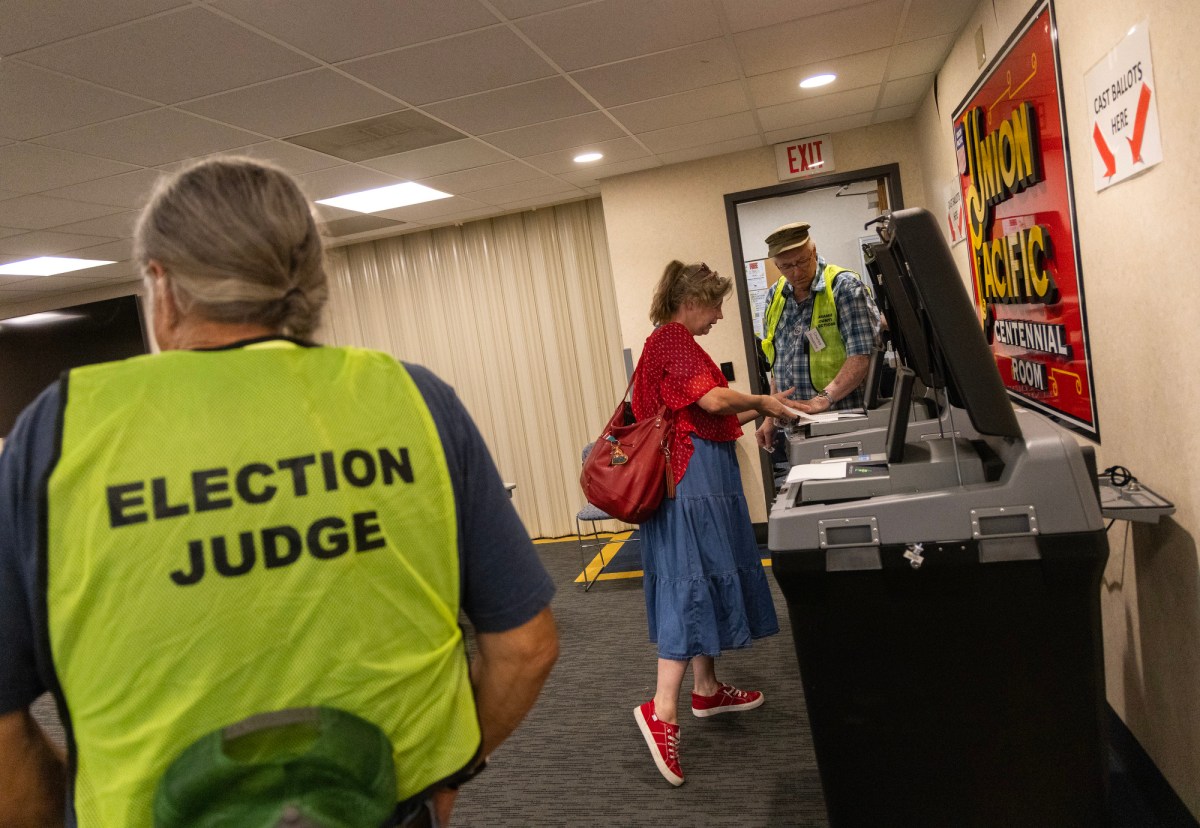
Laramie County Clerk Debra Lee confirmed Tuesday that the Department of Justice will send officials to Cheyenne next week to monitor Wyoming’s general election. In a press release, Lee said she expects the visit to go better than the last one, when Gov. Mark Gordon and other local officials were caught off guard by federal monitors’ “aggressive” behavior, raising concerns about interference.
In a Monday meeting, the DOJ confirmed its plans and also agreed to comply with a recent opinion by Wyoming Attorney General Keith Kautz, which concludes state law places limits on the federal monitors’ actions, according to the release.
“We are committed to following Wyoming law and protecting the rights of our citizens to vote privately, safely, securely, and without disruption or interference,” Lee said in the statement.
In August, local and state officials butted heads with the feds after two DOJ election monitors appeared at a Cheyenne polling place on primary election day, catching the governor and others off guard. Gordon later described the federal monitors’ conduct as “aggressive” and “irregular,” while Clerk Lee said it “was a poorly managed exercise and one that showed complete disregard for our state laws and administration of our elections.”
Email records indicate Secretary of State Chuck Gray was the only state official to be notified in advance that federal agents would monitor voting in Cheyenne, the Wyoming Tribune Eagle reported in September.
However, things are expected to go differently this time, Lee said.
“Unlike their visit during the Primary Election, however, monitors won’t be allowed inside polling places and must remain 100 yards from the polls, in accordance with state law and a recent Wyoming Attorney General’s opinion,” Lee said Tuesday.
In the opinion, requested by Lee’s office, Kautz writes that “in the absence of a court order, settlement agreement or consent decree, Wyoming County Clerks and their election judges not only have the authority to exclude the general public, including DOJ election monitors,… our law requires that they do so.”
In a virtual meeting Monday, the Justice Department told county officials “they had received the Attorney General’s opinion and would conduct observations and interviews only with voters who agree to be interviewed, outside the 100-yard restricted boundary around polling places, as required by state law,” according to the release.
Monitors will also identify themselves to voters, the release states, and wear official badges issued by the clerk’s office.
While federal election observers aren’t new to other states, it’s a unique experience for Wyoming, according to the release.
“Former senior staff of the Wyoming Secretary of State contacted by Lee said they had no recollection of DOJ monitors visiting Wyoming polls in at least 40 years, if ever,” the release states.
Meanwhile, the Trump administration has long said it plans to ramp up monitoring efforts across the country. Earlier this month, the DOJ confirmed to WyoFile that it would “have a presence in Wyoming in the general election” but did not provide further details.
DOJ spokesperson Kiersten Pels told States Newsroom on Monday that about 1,000 monitors will be involved nationally but that the department won’t disclose the full list of monitored locations until Election Day, when voters will decide who controls Congress.
President Donald Trump has repeatedly cast doubt on the integrity of the upcoming elections, saying Tuesday he would respect the outcome of the elections “if they’re honest.” He also told supporters to “cheat like hell, like they [the Democrats] do.”
The monitoring follows the Justice Department’s efforts to obtain states’ voter data, which it successfully procured from Wyoming in 2025 with the assistance of Secretary of State Gray.

