It was a week after Wyoming’s Aug. 18 primary election before voters — who were already betrayed last year when Secretary of State Chuck Gray handed over sensitive state voter data to President Donald Trump’s administration — learned of another outrageous injustice.
Opinion
Two U.S. Department of Justice attorneys were sent to Cheyenne to monitor the election, blindsiding officials like Gov. Mark Gordon and Laramie County Clerk Debra Lee, who are both Republicans.
Gordon doesn’t criticize the president much, and he said nothing about Gray’s myriad attempts to curry Trump’s favor. But learning that the feds actually sent officials to not just observe but actively monitor Wyoming’s safe and secure elections set the governor off.
Gordon called the attorneys’ Election Day interference “aggressive, irregular and disruptive” at the State Canvassing Board’s meeting to certify election results.
If Department of Justice attorneys blatantly march into the reddest, most pro-Trump state in the nation and demand to interview voters and inspect voting machines in violation of Wyoming’s state election laws, what do you think will happen in both red and blue states during the Nov. 3 midterm elections?
The U.S. Constitution guarantees states the authority to handle their own elections. Trump’s Justice Department routinely seems to ignore that sacred document, and the president’s rants have convinced me he has no idea what it says about governing.
The department was likely confident no one in Wyoming would complain, and didn’t anticipate the governor’s anger. While stopping short of an investigation, Gordon directed Wyoming Attorney General Keith Kautz to examine what happened.
This was Gordon’s most quoted pushback in state and national news coverage, and it’s well said: “I feel very strongly about federal government coming in and taking our guns. I don’t like that. And I don’t like federal government coming in and taking our votes either.”
At least part of the reason why Gordon and others publicly expressed their frustration is the fact that the DOJ didn’t clue them in beforehand about their monitoring activity. The list of those kept out of the loop included the governor’s office, Lee, Kautz and the Wyoming Department of Homeland Security.
(The DOJ did post a press release about election monitoring in Wyoming and Florida at about 7:20 a.m. on Election Day, though it’s unclear which agencies received that announcement. WyoFile did not receive that press release, but did receive a Wyoming-specific announcement from the DOJ just before 2 p.m.)
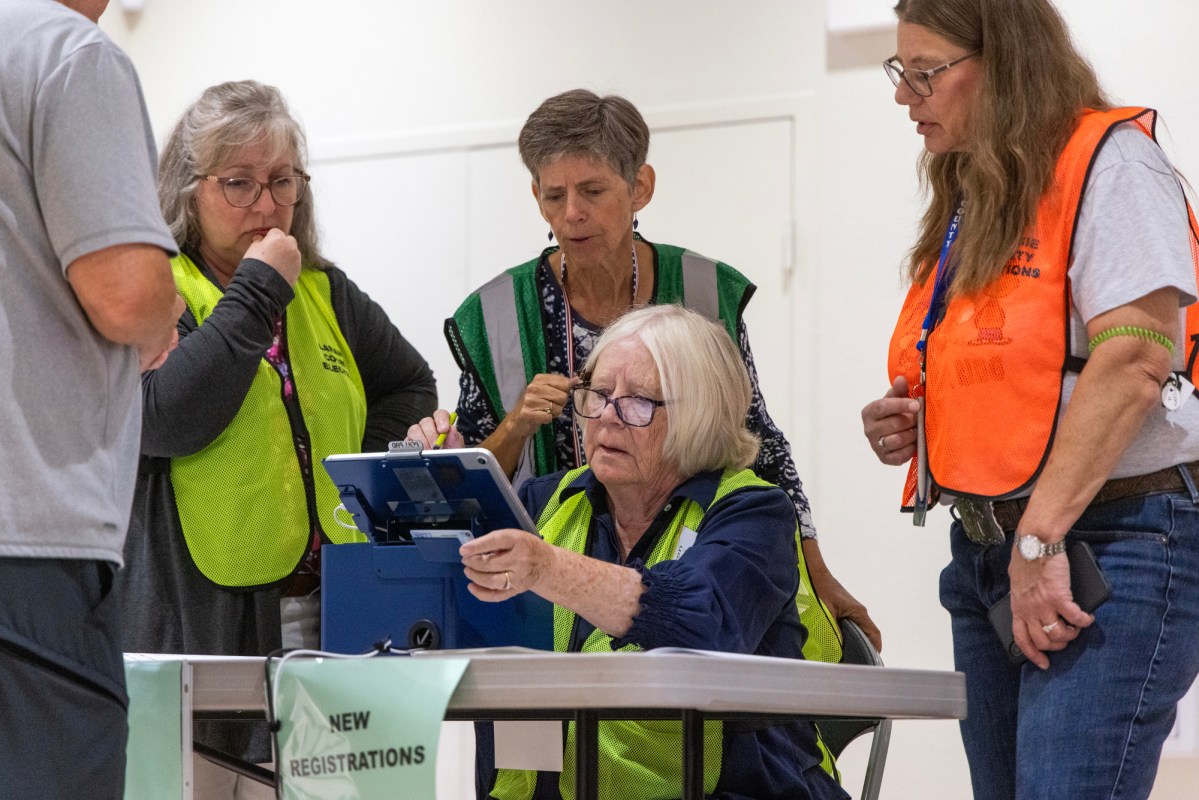
Lee earned the right to be the most disgusted when the pair of attorneys showed up when polls opened at 7 a.m. She’s also the official who voters should most appreciate for her quick response.
“They did not offer their credentials until I requested they do so,” Lee said in a statement last Wednesday. She called the department in Washington, D.C., to find out what was going on, and was told that the “monitoring initiative” was done on short notice. Supposedly she was sent an email about it but the feds admitted it may have been sent to the wrong address.
According to one Justice Department press release, the stated reason for sending the election monitors was to interview Wyoming voters to assess compliance with federal civil rights and voting rights laws.
But Lee turned the attorneys down flat. “We do not allow interviews to be conducted in polling places,” she said.
Lee, who has been Laramie County’s clerk since 2016, monitored international elections for many years, including in Afghanistan, Bosnia, East Timor, Kosovo, Lebanon, Nigeria and Sudan.
“I’ve been shot at, evacuated, and had the windows of my home blown out,” Lee told me for a column I wrote in 2020 about administering elections during the COVID-19 pandemic.
She also served in the Wyoming Secretary of State’s Election Division before she held her current position.
Lee knows what’s legal and what is not, and didn’t hesitate to put the federal attorneys in their place when they tried to assert their nonexistent authority to meddle in Wyoming’s election.
The type of questions the feds planned to ask, Lee noted, were “outside the scope of federal voting rights laws.” They included questions about the nature, length, and timing of poll worker training.
“Monitors requested training guides, asked how our new election equipment was acquired, and wanted to examine our tabulators,” the county clerk said. All of these inquiries were out of bounds.
”It could have been done in advance in a far less disruptive way,” Gordon pointed out.
That this could happen in a state that overwhelmingly voted for Trump all three times he’s appeared on presidential ballots, Gordon added, was “really shocking.”
Lee said Wyoming law does not specifically allow election observation, except by certified poll watchers, who are authorized to observe registration and turnout. Wyoming law has no provision for election monitoring.
“This was a poorly managed exercise, and one that showed complete disregard for our state laws and administration of our elections,” said Lee, who didn’t seek reelection this year.
It’s comforting to know she will still be on the job, protecting democracy from any planned shenanigans during the Nov. 3 general election.
One Justice Department’s news release said federal monitoring “is aimed at promoting transparency and an open flow of communication between poll observers and election monitors.”
That’s rich. It launched an open flow of BS that has nothing to do with transparency or communication, but carries the stench of chaos and disinformation that the Trump administration wants to see nationwide on general election day to protect GOP majorities in the House and Senate.
Gray, who has a history of picking public fights with Gordon, pushed back on the governor for saying state and local officials weren’t informed about the monitoring attempt until after it happened.
He said that the press release announcing the Wyoming monitoring initiative included a statement by Darin Smith, the state’s U.S. attorney.
It certainly did, but that release wasn’t sent until seven hours after the polls opened, and long after Lee shut down this sham of federal election monitoring.
Trump has announced plans to send up to 1,000 election monitors to polling places throughout the country.
Coupled with the president’s previous threats to also send military troops to election sites, some Democratic congressmen are calling such monitoring “a mechanism for intimidating voters and pressuring local election officials.”
Wyoming’s recent experience shows that even the most conservative states can be subjected to this kind of treatment. Fortunately, the election sent packing many in the far-right Freedom Caucus who have parroted Trump’s lies about the 2020 presidential election being stolen from him.
Gray, who based his 2022 campaign for his current office on false charges that Democrats rigged that election, won the Republican nomination for U.S. House in a nine-candidate race, but with only 25% of the total votes cast.
After enraging many Wyoming voters by turning their personal information over to Trump to show his loyalty, and participating in one of the most negative campaigns in the state’s history, is it possible that Gray doesn’t have his ticket to Washington locked up?
Gray must still face Democratic nominee Lisa Kinney, Libertarian Shawn Johnson and independent candidate Daniel Workman in November. If Gray keeps defending the federal government’s attempts to interfere in the state’s elections — a proposition few Wyomingites would agree with —a write-in campaign could also materialize.
Maybe an “Anybody but Chuck” strategy, which second-place GOP primary finisher Steve Friess tried but failed to launch, isn’t as far-fetched as it seemed on primary election day.
Even the Wyoming Republican Party’s platform states it “opposes any federal takeover or interference of federal, state, or local elections.” As his party’s nominee for U.S. House, perhaps Gray should rethink his position on federal election monitoring. After all, siding with the federal government in a dispute with the state isn’t usually a recipe for success for a Republican politician in Wyoming.