

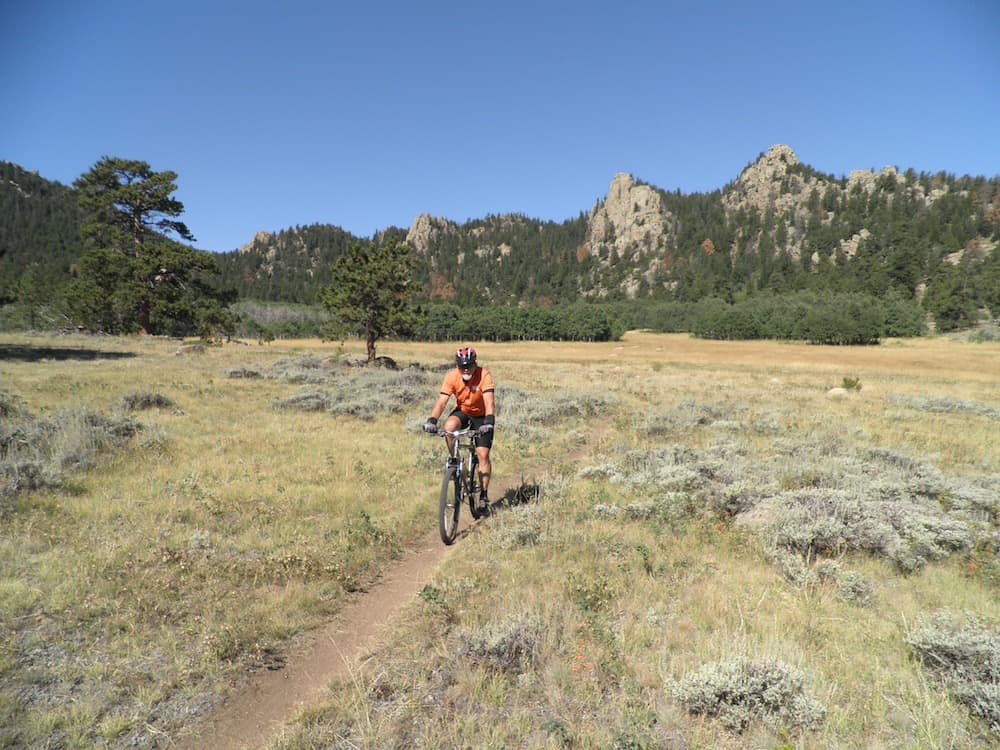
Someday, Jessica Flock would love to ride her bike the nine miles from Laramie to Pole Mountain’s Happy Jack area without having to use Interstate 80. The co-owner of Laramie’s Pedal House dreams of a pathway to a recreation area that’s known for its winter skiing and summer biking.
The Pole Mountain trails are mostly maintained by volunteers, like herself. The work is worth the effort, she said. She loves riding through the pine and aspen forests.
“It’s a superhighway, flowy and fast, hard-packed,” Flock said of the trails.
The area is popular with Nordic skiers, bikers, horseback riders and hikers from Laramie and Cheyenne. Yet as the Medicine Bow-Routt National Forest creates its travel management plan, these users have been ignored as the forest devotes its resources to motorized travel planning, said Tim Young, director of Wyoming Pathways. It’s not just that the agency isn’t planning a connecting pathway, they aren’t planning anything at all for non-motorized recreation, he said.
Don’t miss a WyoFile story — sign up for our free weekly newsletter.
On Aug. 12, Wyoming Pathways and the Ruckelshaus Institute are hosting a charrette, a gathering of stakeholders, to talk about the trails and non-motorized use on Pole Mountain. The meeting will cover summer and winter use.
Only the Forest Service can make management decisions, but Young hopes the charrette identifies needs and priorities and recommends a trail system to the agency. The Forest Service is mandated to specifically look at motorized travel. There is no similar requirement for non-motorized recreation, which isn’t considered during the travel management planning process, Young said.
“We’re in no-man’s land with the forest planning process and nowhere is it more true than in the forest travel management plans,” he said.

Recently on the Shoshone National Forest, planners said mountain biking would be studied in the travel management plan, but motorized travel was such a big and demanding issue it took all the resources and numerous years to produce an environmental impact study. The agency has limited resources and by the time it deals with motorized travel, there isn’t anything left for non-motorized, Young said.
Young knows the agency is strapped when it comes to time, money and resources. The charrette is meant to fill in the gap. Stakeholders will identify existing partnerships and find ways to enhance their impact and prioritize projects.
Young tried to gather up-to-date trail maps for Pole Mountain, but found the area is notorious for cow trails and people easily getting lost. The Ruckelshaus Institute, which is helping organize the charrette, also is building an online interactive map of the trails and proposals. The project fits into its mission, working with stakeholders to solve complex issues, said Steve Smutko with the University of Wyoming organization.
The Forest Service will attend the meeting.
“We’re always interested in hearing what people want and what people think when it comes to public lands,” said Aaron Voos, spokesman with the Medicine Bow National Forest.
However, the forest doesn’t have plans for new non-motorized trails and projects, and likely won’t add to the non-motorized system on Pole Mountain for at least five to 10 years, unless an outside group offered funding.
The forest is working on its required motorized travel plan. When it’s finished, it will take several years to implement changes or additions. To add new trails, the Forest Service must go through a prescribed planning process, including environmental assessments, and right now there are other priorities.
Priorities for trail maintenance could come from the charrette, but for any new trails, groups would also need to bring funding. The city of Steamboat Springs, Colorado, recently offered the Forest Service funding for new trails on the Routt National Forest. They hosted a trail stakeholder meeting to brainstorm ideas on how to use the money, after they had secured funding.
“We absolutely do have issues with capacity, with staffing and all of the resources we need to keep up with,” Voos said. “We’re struggling to keep up with what we currently have.”
The forest just reopened Pole Mountain’s Tie City Campground July 8 after it sat closed for more than a decade, Voos said. Its proximity to the trails is already making it a popular campground, but the amount of time it took to reopen is an example of the agency’s backlog of projects. The agency also needs to work on fuel reduction in the area.
“We’re struggling mightily with dead and falling trees from the beetle epidemic,” Voos said. “That’s going to be a huge part of what we do for the next five to 10 years.”
The trail stakeholder meeting will be held from 10 a.m. to 3 p.m. and 6 p.m. to 7:30 p.m. Aug. 12 at The Laramie Plains Civic Center in Laramie.

Here is how we, at the Pedal House feel about this event. “The local Laramie cycling community has been working with MBNA and the other user groups to try to improve the recreational opportunities for residents and visitors of Wyoming for quite some time. We knew when we started this that it was going to take time, with the USFS being underfunded and understaffed, so any forward motion helps strengthen our resolve. It is encouraging to have the concerned groups come together once again to discuss various options with the Forest Service. “
Pass Senator Barasso’s S.F. 1966 and clear dead trees with commercial logging, raise money for non motorized trails with commercial logging royalties, and stimulate a weakening Wyoming economy with logging and sawmill jobs. A win, win, win solution.