

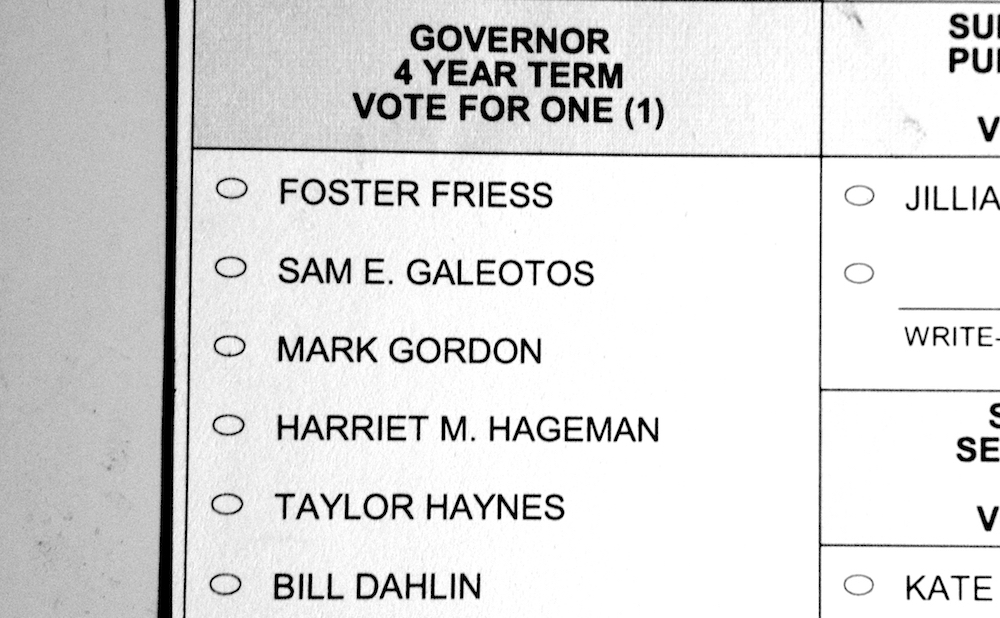
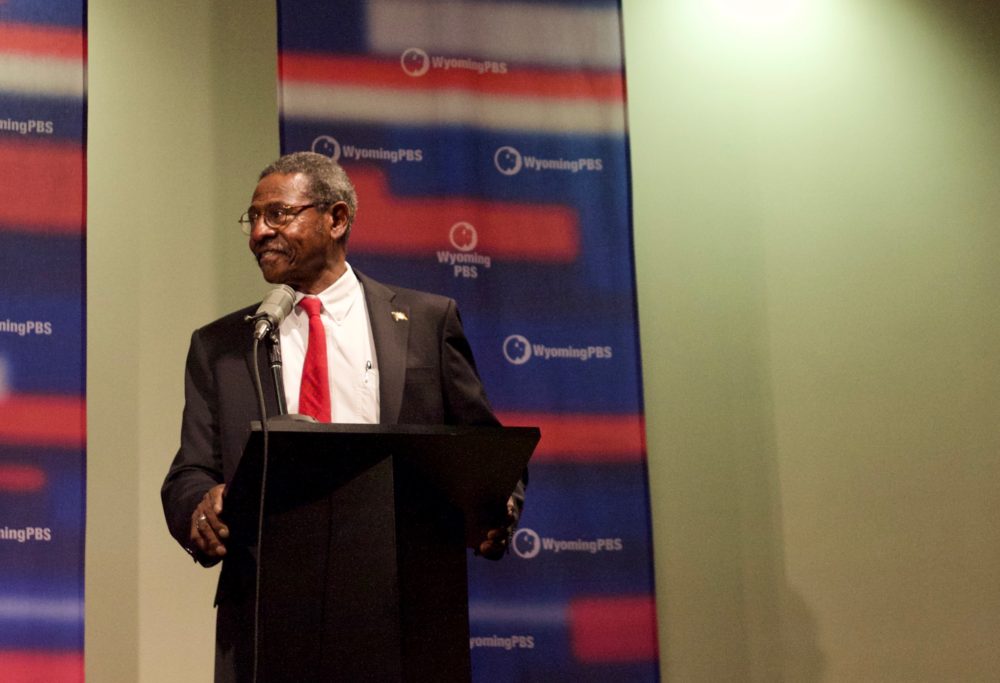
An attorney for Dr. Taylor Haynes argued Wednesday that the gubernatorial candidate is a legal Wyoming resident, that the State of Wyoming does not have the authority to remove him from the Republican primary race and that an elections clerk may have been biased against him.
Wyoming missed its chance to keep Haynes off the 2018 primary ballot when the Secretary of State’s office certified and published the ballots, attorney Michael Pearce wrote in his response to a complaint filed by the Wyoming Attorney General and the Secretary of State. He also wrote that removing Haynes from the race now could harm the integrity of the entire election by invalidating the votes cast for Haynes thus far.
In the same brief filed with Laramie County District Court, Pearce also made several claims regarding Haynes’ residency. Haynes is a valid Wyoming resident, the attorney wrote, because he has an extensive history in the state and maintained living quarters in Laramie business addresses. Haynes’ ranch has always been considered part of Wyoming, despite the house being geographically in Colorado, Pearce wrote.
Haynes never received the election clerk’s 2015 letter informing him his ranch address was legally part of Colorado and that he would be removed from the voter rolls, Pearce wrote.
The state contends that because Haynes twice swore on voter registration forms that he resided on his Wyoming-Colorado ranch from 2014 to 2015, and because the state considers that ranch to be a Colorado residence, the candidate does not meet Wyoming’s constitutional requ
irements. The Wyoming Constitution says a governor must have lived in Wyoming five years preceding election.
The physician had no reason to believe his ranch was not a valid Wyoming address when he completed those forms, Pearce said. Haynes paid utilities in and received emergency services from Albany County, Wyoming, Pearce wrote in the filings. There was no Colorado road access to the ranch, he said.
Pearce also argued that even if the ranch residence is in Colorado, Haynes’ long history in the state and the other residences he’s kept in various Wyoming cities make Haynes legal to serve as governor.
“A man who has every intention,” Pearce wrote, “in word and deed, of being a Wyomingite, even if a ranch crosses a border, should be considered a Wyomingite.”
The response was filed during a hearing Wednesday morning where Laramie County District Judge Thomas Campbell took arguments from both sides. Campbell will issue a ruling in coming days about the state’s authority to bring the lawsuit, according to a report in the Wyoming Tribune Eagle.
A previous order from the judge set aside a day and a half for a trial on the matter beginning Aug. 7, two weeks before the gubernatorial primary.
Addresses and discrimination
In the court documents, Haynes said he kept living quarters at two Laramie addresses used by his business over the years because his ranch was far from town and not accessible in bad weather. He had never applied for licenses, license plates or any other official forms in Colorado, he said, and he never sought residence in any other state.
Haynes has “continuously maintained living quarters at or near the business locations in Laramie, Wyoming since 2014,” he wrote in an affidavit. “My Albany County ranch is an hour’s drive from my office and sometimes not accessible in bad weather,” he wrote.
He maintained living quarters on the second floor of at a Grand Avenue address in Laramie previously reported on by WyoFile, he wrote. At the 702 S. 3rd Street address Haynes swore was his residence when he filed for his latest gubernatorial campaign, he kept an apartment in the rear of the building, he said.
“We preferred not to publish the ranch address as ranches are an attractive nuisance and this would decrease our privacy and security while increasing our liability,” Haynes said in the affidavit.
Haynes leased a different apartment in Laramie in July 2018, he said. Haynes said in a separate document that he leased a new apartment in Laramie in July, before the “news of [the] complaint” against him.
The complaint was filed with the Secretary of State on June 25, according to a statement released from that office on July 21. WyoFile reported Haynes was being investigated on July 5.
Pearce also suggested that because previous ranch residents say they voted in Albany County without issue, the elections clerk who removed Haynes from the roll when he registered with the ranch address could have been motivated by racial or political bias.
“No one else, to his knowledge, has been told they cannot vote, and he is a black conservative man; the County Clerk a white Democrat,” Pearce wrote. “While Dr. Haynes is slow to raise the issue of discrimination, it certainly appears the requirement has been selectively enforced and is not uniform.”
Later in his brief, Pearce said the clerk, Jackie Gonzales, was incorrect in her 2015 ruling that Haynes was not eligible to vote in Albany County . “While I am sure Ms. Gonzalez [sic] sought to be helpful, [the letter] was uninformed and misrepresented the situation.”
Never miss a story — subscribe
In the conclusion of his brief, Pearce reiterated his argument that it is too late for the state to remove Haynes from the ballot. The Secretary of State received the complaint on June 25, according to a press release that accompanied the Attorney General’s filing of the lawsuit last week. Early voting for the Aug. 21 primary began on July 6. The Secretary of State’s website gives a deadline of July 16 to allege “ballot error or omission.”
“Because the state failed to act prior to the printing of the ballots, it should not be able to remove a candidate from the ballot,” Pearce wrote.

I am very appalled that they would go out and say that this was a racial or political bias. Mr, Haynes and his lawyer don’t even have their information correct and our placing the blame on other people to try and get the attention focused else where. Ridiculous, and shows what kind of people they really are, attacking someone who has no relevance in this except doing their job.
If you live in a house in a state as your primary residence, you reside there. This is clear and that is what any constitutionalist would argue.
Judge Campbell ruled that Dr. Haynes is eligible to run for governor. Yet it looks like the attempt to fool Wyoming voters continues. Those who are complicit in the misrepresentation of facts need to show themselves as men, women, and organizations of integrity. Loudly and publicly apologize for making an issue out of nothing. It’s like the “Russia Collusion” narrative but Wyoming Deep-State style.
How convenient for Mr. Haynes to now raise the discrimination flag when most of what he advocates for is almost always in opposition to the betterment of the black community.
The relevant terminology at issue here are “resided” and “within the state” as laid out by the Wyoming Constitution’s qualifications to serve as governor. How exactly do we define these terms? Are they black and white? Or are they at the whim of other subjective interpretations?