


The discovery of chronic wasting disease in a member of the Jackson Elk Herd should trigger a review of the state’s population goal of 11,000 for the herd, according to a National Elk Refuge plan.
The Wyoming State Veterinary Laboratory confirmed the incurable fatal disease in a lymph node taken from an elk killed by a hunter in Grand Teton National Park. The hunter shot the elk Dec. 2 and technicians analyzed its required lymph node sample four times before confirming results Dec. 16.
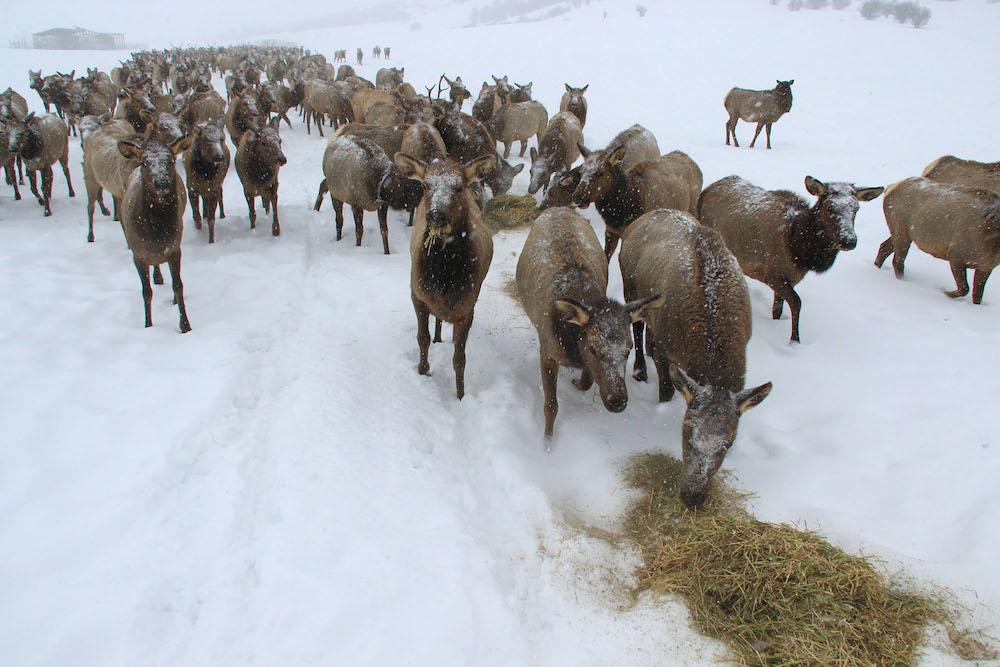
Discovery of the infected tissue marks the first time the disease has been found in an elk herd that uses one of 23 winter elk feedgrounds west of the Continental Divide — 22 state-run sites and the massive National Elk Refuge managed by the U.S. Fish and Wildlife Service. Although wildlife officials have detected the disease in deer in the area and in elk elsewhere in Wyoming, its appearance among feedground elk raises worries that the intractable malady, a cousin of Mad Cow Disease, could spread rapidly among animals concentrated on feed lines.
That’s one reason the federal Elk Refuge Disease Response Strategy calls for a request to review the population objective of the herd. Game and Fish Department estimates 80% of the elk in feedground-area herds winter on and feed at the feedgrounds.
Discovery of CWD in the Jackson Elk Herd “doesn’t mean we’ll unilaterally do anything,” said Frank Durbian, refuge manager. He is uncertain when his federal agency will raise the population issue with the state, he said, but hopes the topic will come up “in the next year if not sooner.”
Although the U.S. Fish and Wildlife Service operates the refuge, Wyoming Game and Fish sets herd size objectives.
The hunter killed the infected Grand Teton Elk near the town of Kelly as part of the park’s elk reduction program, park spokeswoman Denise Germann said. That’s within a mile or so of the National Elk Refuge, the largest feeding site for the Jackson Elk Herd.
The park reduction program seeks to balance different segments of the herd that winters on the refuge and on state feedgrounds in the Gros Ventre River valley.
The hunter, whom Game and Fish identified only as a Wyoming resident, killed the cow elk the day after Game and Fish held a webinar to launch an initiative to address the CWD feedground issue.
No surprise
Discovery of the positive CWD sample wasn’t a surprise, but was disappointing to many involved with Wyoming wildlife. Managers have said CWD arrival at feedgrounds is not a question of if, but when.
“When is now,” Mark Gocke, a Game and Fish Department spokesman, said Monday.
“It kind of underscores this public discussion we just initiated on elk feedgrounds,” he said. “It kind of elevates the importance for everybody to be engaged. We’re going to get the best ideas on the table.”
A lab technician in Laramie blurted out the bad news earlier this month in Laramie with an exclamation best not printed, said Hank Edwards, Game and Fish Wildlife Health Laboratory supervisor. It was Edwards’ job to call the hunter, which he said he did “as soon as we had our positive reactions in our lab.”
After the State Veterinary Laboratory confirmed the Game and Fish result with a different test, Edwards called the hunter back.
“I simply state ‘I’m sorry to report that your animal tested positive,’” Edwards said of the call he makes in such instances. He also sent a letter, which can indemnify a hunter who throws out infected wildlife from a charge of wasting game meat.
While there’s no firm science that shows CWD can be transmitted between species, there are suggestions it can jump from ungulates to primates. The CDC and Wyoming Game and Fish Department recommend against eating meat from an animal that tests positive for CWD.
Either the Grand Teton hunter or workers at a wild game processor had butchered the suspect elk by the time Edwards called the hunter with news about the infection, he said. Edwards does not know whether the hunter ate any of the infected animal.
“He took it very well,” Edwards said of the news. “Not everybody takes it well. He said, ‘Well I’m glad I removed her from the herd.’”
CWD is a disease of the central nervous system and the malady – caused by a malformed protein called a prion — is concentrated in the brain, spinal column and lymph nodes, experts say. Sick individuals become emaciated, lethargic and drool, shedding prions in the process.
There are few methods for neutralizing the malformed protein, including incinerating it at high temperature or dousing it with chemicals. Prions can exist in the environment for years without breaking down.
Wyoming Game and Fish Department provides information on how to handle wildlife carcasses on its website.
Refuge scaling down
The National Elk Refuge is in its second year of a step-down plan that seeks to gradually reduce the number of elk on the refuge to 5,000 animals. Wildlife managers counted 8,095 elk on feed on the refuge last winter. While the step-down plan calls for fewer elk on the refuge, it does not call for a smaller Jackson Elk Herd.
That overall number of animals in the Jackson Elk Herd would be the subject of talks the Fish and Wildlife Service would hope to initiate with the Game and Fish and others as outlined in the Elk Refuge’s CWD plan.

The feeding step-down began earlier this year when the refuge ceased feeding one week earlier than normal. This year it will cease feeding two weeks early. Next winter will delay the start of feeding by one week, Durbian said.
Feeding normally begins when the amount of accessible forage dwindles to an estimated 300 pounds an acre. Once it begins, elk are fed according to their numbers.
“There’s X number of pounds per elk as determined by the counts,” Durbian said of the alfalfa pellets that are spread out. “As we get more elk on the refuge, that’s adjusted to accommodate them.”
“We will feed the elk that show up here,” he said.
“Reducing both the number and concentration of wintering elk on refuge lands can help to reduce wildlife disease threats, lessen or prevent habitat degradation, and yield positive impacts for other native wildlife,” the Fish and Wildlife Service says on the Elk Refuge website. “Reduction in supplemental feeding will also encourage natural elk behavior.”
Support independent reporting — donate to WyoFile today
Meantime, Game and Fish has no plans to close any of its 22 western Wyoming feedgrounds in the near- or mid-term, Director Brian Nesvik told a legislative committee recently. Such a move would not come in the next 10 years, he said.
Game and Fish is encouraging interested persons to become involved in the feedground initiative and comment on the issue by Jan. 8. The agency said it expects to announce the format of a question-and-answer session — set for 4 p.m. Jan. 5 — in time for people to attend that session.


closing all those ridiculous feedgrounds would be an excellent start for Wyoming.
Perhaps the most insidious reality with CWD is that it moves so slowly it’s easy to ignore – right up until the point that it’s impossible to combat.