


Fresh grizzly bear bloodlines are expected to arrive in the Greater Yellowstone Ecosystem this summer, adding genetic diversity to a population of animals that’s been isolated for a century.
The infusion of genetics will come from the North Continental Divide Ecosystem, and it will roll down the highway in the form of a slumbering grizzly or two.
Why truck in grizzly bears to a population last estimated at nearly 1,000 animals?
Montana and Wyoming — which have hashed out an agreement — are translocating bears as part of the effort to convince the federal government that they’re responsible stewards of a large carnivore species, which the states contend no longer requires Endangered Species Act protections.
“We’re trying to demonstrate to everybody, the courts included, that connectivity isn’t an issue that should impede delisting,” said Ken McDonald, wildlife division chief for Montana Fish, Wildlife and Parks. “Until it’s happening regularly, naturally, we can cover this with human-assisted movements.”
The two grizzly bear populations aren’t far from each other — the leading edges are just 35 miles apart — but there’s never been a documented case of a Northern Continental Divide Ecosystem grizzly traveling to the Yellowstone Ecosystem and procreating. Grizzlies have gone the other direction, trekking north well into Montana, but that doesn’t accomplish the goal of creating gene flow into the isolated population.

Firm plans are in place to force the issue as soon as this summer. Montana Fish, Wildlife and Parks has staffed up, adding two employees who will be used during the summer and fall to assist with the grizzly translocation project, McDonald said. Those expert grizzly trappers will be targeting animals with specific attributes.
“Ideally, it’d be a bear that has no history of any conflict,” McDonald said. “And ideally, a younger aged female.”
Two conflict-free females
Wildlife officials intend to move the bears as soon as mid-June, but no later than mid-August. “We don’t want to move them too late, when they’re not ready to den,” McDonald said. “So it’s a pretty finite window.”
Other parameters of the genetic augmentation pilot project are described in an appendix of Montana’s draft grizzly bear management plan. That document estimates the frequency of translocating grizzlies at two to four animals every decade.
The grizzly-moving operation in the absence of a natural dispersal is also a commitment included in the tri-state memorandum of agreement that Wyoming, Montana and Idaho struck to guide management of the Greater Yellowstone Ecosystem’s grizzly bears.
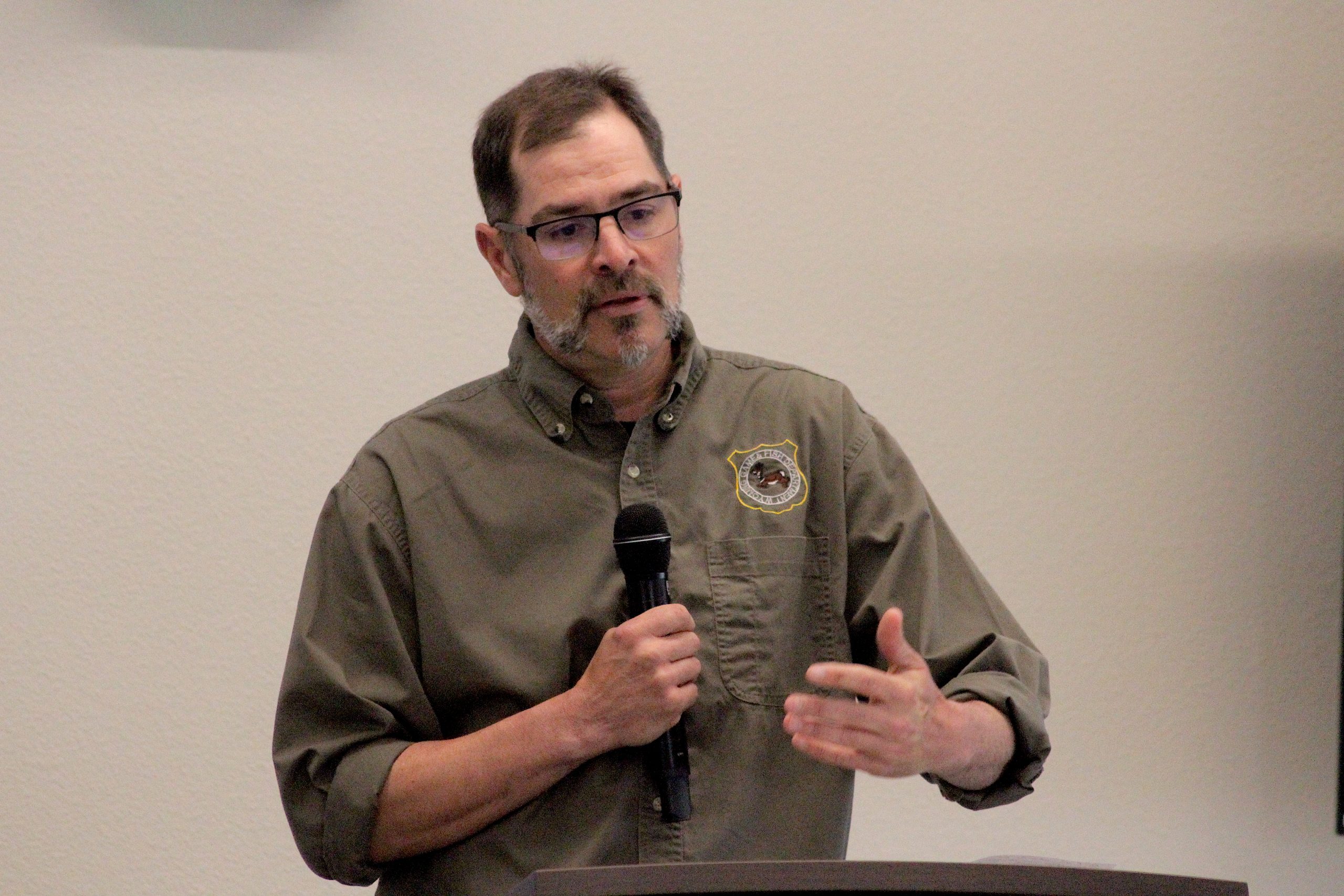
“In the tri-state MOA, we’re committed to translocating at least two grizzly bears from outside by 2025,” Wyoming Game and Fish Department large carnivore supervisor Dan Thompson told WyoFile.
Neither Thompson nor McDonald identified exactly where the Glacier-region grizzlies would be released, but there are some requirements and goals. It will need to be within the “demographic monitoring area,” which is a 19,278-square-mile zone in the Greater Yellowstone region’s core where bear numbers are estimated.
Ideally, McDonald said, the release site will be in a low-density grizzly bear habitat. Translocating the grizzly farther south — possibly into Wyoming — is another ideal, he said, because it’s farther geographically from where the bear will have been captured in Montana, and it’ll make the animal more likely to stay.
“We’ve been working with Wyoming on potential places,” McDonald told members of the Interagency Grizzly Bear Committee’s subcommittee for the Yellowstone Ecosystem, which met in Jackson in November.
Although state wildlife managers have committed to translocating grizzlies into the Greater Yellowstone Ecosystem, the current level of genetic diversity is not “in dire straits,” Interagency Grizzly Bear Study Team Leader Frank van Manen said.

“We have a little bit lower genetic diversity than other populations, but it’s not declining further,” he said. “It’s moderate genetic diversity, is how I would classify it.”
The genetic augmentation appendix of Montana’s draft grizzly bear management plan calls the ecosystem’s genetic isolation a “long-term conservation concern.”
“The rate of inbreeding has been very low (0.2% over 25 years),” the document states, “and no inbreeding effects have been detected.”
Genetic concerns?
Nevertheless, U.S. District Court Judge Dana Christensen sided with environmental groups in 2018 on the question of genetic diversity, ending a short stint where the Northern Rockies states had jurisdiction over their Ursus arctos horribilis populations.
Thompson pointed out that genetic diversity was an issue decades ago when the Yellowstone region population was much lower and “bottlenecked,” but nowadays, with many times more bears, it isn’t much of a concern, he said.
“We’ve demonstrated it is not an issue anymore,” Thompson said, “but [translocation] is another way to address the issues that some people have.”
Thompson made a “Star Wars” analogy out of environmental groups leveraging genetic diversity during the last round of litigation over grizzly delisting.
“It was the thermal exhaust port in the Death Star,” he said. “Opponents of delisting look for weaknesses and try to exploit them. We don’t feel that genetics are a weakness, but [translocation] is just another thing that we can do.”
“It was the thermal exhaust port in the Death Star. Opponents of delisting look for weaknesses and try to exploit them.”
Dan Thompson
There are indications that trucking animals into the Yellowstone region won’t placate groups opposed to the states having control over — and potentially hunting — their grizzly bear populations.
“My perspective would be that it undermines their claim of recovery, if they have to translocate bears,” said Matthew Bishop, a senior attorney with the Western Environmental Law Center who argued the last delisting litigation for WildEarth Guardians. “The goal should really be to get bears back in the Bitterroot [recovery area], and get some connectivity between subpopulations. Then maybe start thinking about delisting and recovery, but I don’t think we’re there yet.”

Retired U.S. Fish and Wildlife Service grizzly recovery coordinator Chris Servheen told WyoFile he conditionally supports the step that state managers plan to take in 2024.
“I’m okay with them doing it in the interim until the bears are naturally connected,” Servheen said, “but I do not want trucking bears to be the alternative to minimizing mortality in the intervening areas. The optimum is for the bears to naturally connect.”


Are they this desperate to hunt grizzly bears? Stupid. Its all about the money. How much mortality do they want. G & F kills on average 50 bears a year in Wyoming. It’s taken nearly 50 years to get 1000 grizzlies. Now they want to start killing them. NO.
BRUCE Rocheleau- the general public may want them, but it is the hunters and fishermen that are paying the bill. The ranchers and sportsmen are the ones taking the hit. Step up and fork over some money for your pet species.
There is something that not one person, not one person, has asked, why do they not naturally cohabitate? There is a reason they do not move into that thirty some odd mile, we’ll call dead zone! It is far beyond the thought process of these wildlife “experts”, and not one of the previous posters, thought deep enough to to question why! The wolf, and bear cry babies, who live in the cities, have no idea how destuctive these animals are! After living in Alaska for a few years, and living in northwest Wy., I have a better idea than most of what they are capable of! They will bite holes in bear spray cans and drink it, you try that! I think that if they had to contend with them, in their city limits they would have a whole different outlook! Now about adding more to the population, that will push bears farther out of their normal space, and place! We have had bears out to Basin WY., Burlington WY., they show up in Cody Wy., Powell Wy., a hundred miles out into the high desert! That is not their normal habitat! This is not the seventeen or eighteen hundreds! These are top line predators! Oh, and before you start your, building in thier habitat, It’s the friggin millionaires cashing out of their big city world who are buying the acreage, and buiding the mini mansions, ya know the big mouth liberals who ruin everything they touch!
Do you know why the bear habitats have not been connected over time? Have you ever been in that area that separates them? Stop calling people crybabies and do your research. IF you had been there, you would understand why the two habitats remain separated. The nature of that ground and its existing wildlife are highly discouraging for bear habitat. Yes, I have been there on horseback and even the horses are miserable in that country.
Trucking is a great idea, and all of the people managing this process are way more expert about these bears than you sound like you are. They actually study them, not observe them once in awhile from afar. Calm down and use reason and not aggressive language to deal with people that NEVER want any bear to die, even though all of them will do that eventually.
Next idea for those who hate the Endangered Species Act: Move grizzlies from Alaska to Yellowstone. Or even better, as Trump Admin. wanted, as long as there are a fair number of grizzlies anywhere on the Continent, there’s no need for them in the U.S. Thank God for the Endangered Species Act. Wildlife Management in these Western states is totally dominated by ranchers-hunters even though when surveys are conducted of the general population’s attitude, they support more grizzlies.
BRUCE Rocheleau- the general public may want them, but it is the hunters and fishermen that are paying the bill. The ranchers and sportsmen are the ones taking the hit. Step up and fork over some money for your pet species.
I applaud the concept but we all know that the federal government is not after anything “intellectual”, or “meaningful” but rather is after turning the entire country into nothing more than parks and “downtowns”, there will be only one way to “make it all better”
Here’s a declamation you can swear by as it applies to state and federal natural resources management: ” The appearance of management is the management of appearance. ” I actually first saw that on a Smokey the Bear spoof poster a few decades ago, but it rings true. This shallow grizzly shuffle ( only two bears ? ) is far less landscape ecology science and far more PR stuntwork.
While there is some actual wildlife conservation value to this scheme to translocate a few grizzlies up and down the Continental Divide in a single state, the major purpose is to provide the facade that firstly , Montana actually cares about wild grizzlies and will prove it with real field work. Secondly, it appears the managers are pawning off the notion this is actually part of a tripartite consensus between the three Griz states working cooperatively. Truth be told, Montana Wyoming and Idaho if left to their own devices and management would start killing grizzlies as official state wildlife policy on the ground. No camouflaging the appearance necessary. Admit it. That much the state game wranglers would agree on if the Federal fiddle players were no longer calling the tune or enforcing the ESA from top down.
Having said all that , translocating just two bears is statistically closer to zero. When climate change , human encroachment, development in or near the millions of acres of empty prime grizzly habitat in SIX ( or even eight) states that could support grizzlies , bear population density and reproductivity and other criteria are factored in, the US Fish & Wildlife Service should be translocating dozens and dozens of grizzly bears. This goes way beyond mere genetic diversity. The hard truth is given current conditions and human monkeywrenching in the Northen Rockies , the native Grizzly Bears cannot expand their range all by themselves in adequate numbers against the clock. Not even if given a century to do it. We humans drove the bears into the GYE and NCD zoo zones. We humans need to transport them back out as reparation for our shortsightedeness
I’m sure Wyoming would be more than willing to see their perceived ” surplus ” bears be taken away forthwith. Let’s start by ballparking 200 emigrated bears in the next decade. Do we know anyone who has a Sikorsky CH-50 class Stallion helicopter and crew that could provide same day capture and relocation grizzly service with a 750 mile radius , three or more bears per sortie ? Surely if they can move Giant Pandas from the bamboo jungles of south China to the National Zoo in Washington D.C-USA , we can move a sow and cubs from Wapiti Wyoming to the Selway-Bitterroot Wilderness of nearby Idaho or further afield to the San Juan Mountains of Colorado and beyond .
If Montana had any noble intentions, I would applaud this. The fact is that Montana wants to “manage” grizzlies the way they “manage” wolves. Montana, and Wyoming for that matter, just want to kill as many grizzly bears that they want, any way that they want, without having to deal with federal wildlife officials. Neither state cares about biology or species recovery.
I totally agree with you Shawn. I worked with Steve Nadeau and volunteered with the wolf reintroduction project in Winchester ID while attending LCSC. And the effort wasn’t to bring the wolves back as much as it was to keep the elk population strong and to re-establish the willows and aspens that lined the river banks that the elk were destroying because they weren’t being pushed out of the river bottoms.
We try to manage what we destroy. It’s like calling on the arsonists to put out the fire they started.
Our state legislature on the whole is of course no help! And those of us who truly embrace Montana values and our state’s constitutional rights are witnessing them erode away with the current policies and their disdain for the middle and lower class.
Red Lodge is home to quite a few grizzlies. We don’t just want them here amongst us, we welcome and love their presence as much if not more than our own. To fear such a magnificent creature is understandable. But what we too often do with that fear is deplorable!
This appears to be nothing but a cynical trophy-hunting, species-extinguishing scheme by state governments hell-bent on completing the last stages of Manifest Destiny. We all know their motives by now and should challenge every move.
Montana and Wyoming are trying to convince the federal government that they are “responsible stewards of large carnivore species,”?! You have got to be kidding me! Colorado has to import wolves to re-establish a population because wolves cannot naturally disperse there due to Wyoming’s “shoot on sight,” policy towards wolves (including allowing miscreants to lure wolves over the border and kill them–as reported here–which is what happened to Colorado’s first wolf family). Colorado had to get wolves from Oregon because both Wyoming and Montana declined to give any, this despite clear not wanting wolves in their states. They’d rather kill them than give the wolves to a state that wants them. Montana is determined to drive their wolf population down to the lowest number they can before triggering a relisting on the Feds part. They want no more then 450 wolves. My home state of Michigan has a stable population of 600 wolves in Michigan’s Upper Peninsula, which is much smaller than Montana, more heavily populated, and less ideal as habitat! Both Montana and Wyoming could support so many more wolves than they do, which would increase biodiversity, help keep the ungulate herds healthy and allow wolves to live in relative peace rather than as shattered families constantly running for their lives, as is the case in the NortRocky States for wolves now. “Responsible stewards!” Not even close!
Not sure it’s a Death Star issue – see Schafer (2022) “A greater yellowstone ecosystem grizzly bear case study: genetic
reassessment for managers”
The “Grizzly bear occupied range map” contained in this article clearly shows how far outside of the original designated habitat the great ears have spread – this is not the habitat which the recovery plans originally anticipated. Translocating is a great idea but it is meant to placate the grizzly advocates who have so far prevailed in federal court. The Federal court avenue is not working and has been widely abused; therefore, its time for congress to intervene and delist the great bears – circumventing the Federal courts and USFWS. When you look at the goals of the original recovery plans – the criteria to delist the great bears was met many years ago – we far exceed both the population goals and occupied habitat goals which the recovery plans identified. Congressional action is needed in order to put an end to this never ending saga.