


CHEYENNE—Election bills didn’t fare well this session.
As Wyoming elections have been flooded with anonymous campaign mailers and out-of-state influence, lawmakers and other officials have looked toward legislation to increase transparency and tighten Wyoming’s voter laws.
Last year, for example, the Legislature passed a bill closing a loophole that had allowed federal political action committees to skirt state campaign reporting requirements. And after several attempts, lawmakers also adopted a measure to ban crossover voting. That legislation will be in effect for the first time this election year.
Amid concerns about campaign money and election integrity, lawmakers brought nine election-related bills to the session this year. But none of those bills made it across the finish line.
Six of the election bills that died this year were sponsored by the Joint Corporations, Elections and Political Subdivisions Committee, which spent months before the session debating and crafting the legislation. Most of these measures died early in the session after failing to meet the two-thirds threshold required to be introduced during a budget session.
Dead committee bills
The dead committee bills aimed to address voter residency requirements, election worker intimidation, campaign finance reporting and the use of private funds to conduct elections.
One of the most consequential measures that the committee sponsored was a durational residency bill that would have required voters to attest that they have been a “bona fide” resident of Wyoming for at least 30 days before an election in which they vote.
Rep. Jared Olsen (R-Cheyenne), chairman of the House Corporations Committee, described the bill on the first day of the session as a “forward-looking attempt to make sure that our election code is as tight as it can be to prevent any mishaps or fraud.”
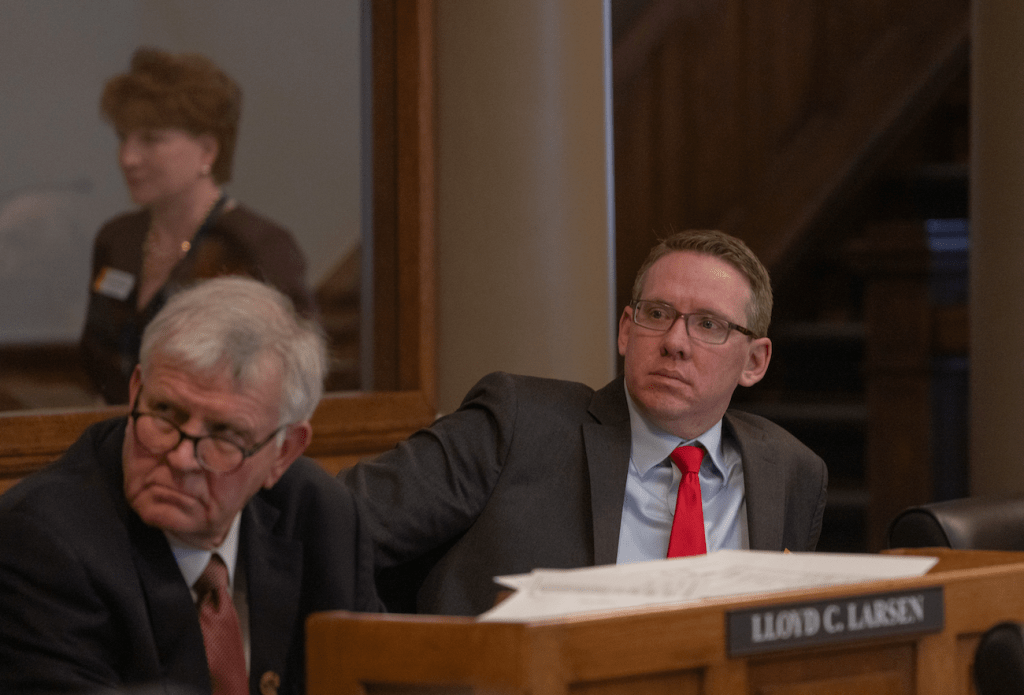
Lawmakers introduced the measure, and it passed the House Corporations Committee on an 8-1 vote. But the bill ultimately missed the deadline to be considered in the House Committee of the Whole — a body comprised of all House lawmakers.
Another committee-sponsored bill that would have barred the use of private funds to conduct elections, with an exception for special districts, likewise failed to make the deadline to be considered in the House Committee of the Whole.
The Corporations Committee also brought a bill that would have created a misdemeanor offense for election intimidation, which is currently only punishable by a felony. Lawmakers argued that adding a misdemeanor would give prosecutors another option when bringing charges for election intimidation that doesn’t involve physical violence. The panel also sponsored a measure clarifying residency requirements for state legislature candidates and another that would have required any group of two or more people to report campaign finances if they pool or jointly expend funds totaling more than $1,000 for campaign activity.
All of these measures failed introduction on the first day of the session.
In addition to these proposals, the Corporations Committee crafted a resolution asking the U.S. Congress to propose a constitutional amendment that would bar corporations and organizations from making campaign contributions unless they publicly disclose their members and donors — a request that stems from the 2010 Citizens United v. Federal Election Commission case, in which the U.S. Supreme Court ruled that Congress and states can’t bar independent corporate spending on political campaigns for public office. The resolution failed introduction.
Other legislation
Three election bills were also brought by individual lawmakers — one specifying that absentee ballots postmarked on or before election day and received after an election but before county canvassing boards convene would be counted; one that would have barred the distribution of unsolicited ballot forms; and another that would have changed the voting power of county political parties.
The latter bill would have brought a significant power shift for Wyoming political parties. Right now, each county has equal representation on a political party’s state central committee, even if one county has many more registered voters than another. The possibility for over- or under-representation is “not democratic,” said Sen. Cale Case (R-Lander), the bill’s sponsor. The legislation proposed weighting votes for each voting member based on the number of registered party voters in the county at the last congressional election. It failed introduction on an 8-23 vote.
In addition, lawmakers negotiating the state’s budget tossed a House budget amendment brought by Rep. Karlee Provenza (D-Laramie) that would have allocated $95,000 for county clerks to use on voter education — a topic that’s particularly relevant this year given the change around crossover voting that the Legislature adopted last session. This year’s election cycle will be the first where a new law barring crossover voting is in effect.

“I don’t really have faith that it’s a priority of some folks,” Provenza told reporters Thursday of public outreach about the crossover voting change.
“At the end of the day, I think it’s dishonest to make such a change in our statutes and then not tell people about it.”
For next session
Some of these election topics will likely come up in the legislative off-season or as individual bills next session.
Lawmakers, lobbyists and others have already requested election-related topics for interim study, though the list of topics that committees will take up before the next session isn’t finalized.
Topic requests include a study of campaign finances and campaign disclosures in Wyoming, voter education, open primaries, elections administration, regulating the use of “dark money,” election worker protections and online voter registration.

Another disappointment from the Wyoming legislative session. After the 2020 election cycle, I am still scratching my head about this one.
We in Wyoming are very conservative, patriotic folks, but not the elected politicians.
You’re right, this legislation session was a huge disappointment and probably a waste of time.
However, knowing that there are still gullible people who believe in the stolen election lies is a disappointment on a whole other level.